
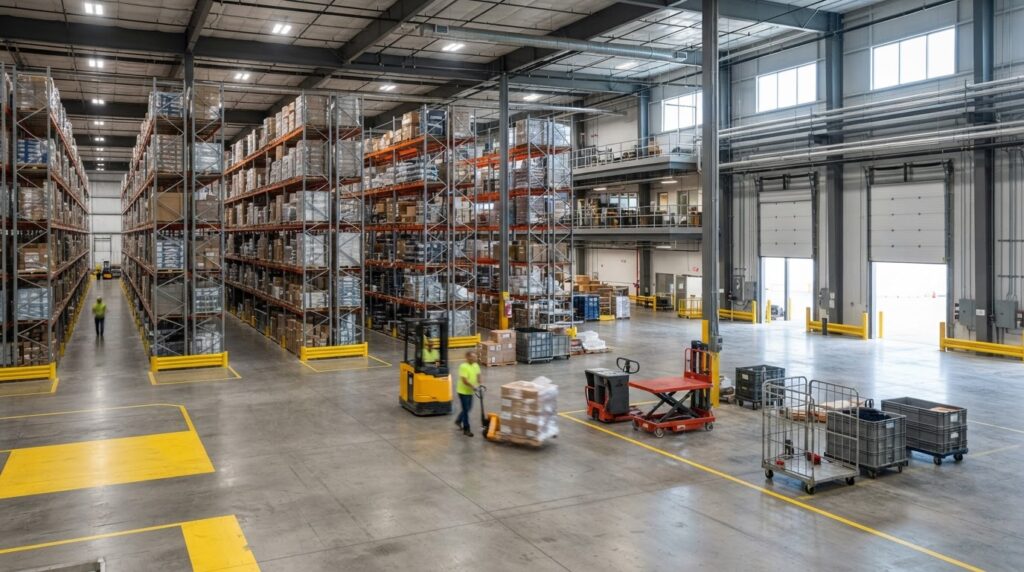
Material handling equipment keeps goods and components moving from receiving through storage, production, picking and shipping. The term covers far more than forklifts: pallet racking, carts, hoists, lift tables, workstations and loading dock systems all influence how smoothly an operation runs.
This comprehensive guide helps industrial buyers and facility managers understand equipment functions and plan a selection process around real-world work. For a starting overview of Fredon’s available solutions, explore material handling equipment for industrial operations.
What Counts as Material Handling Equipment?
Material handling equipment refers to devices and systems that move, store, protect, position or control materials during manufacturing, warehousing and distribution. A practical way to classify it is by function. Storage systems establish a place for inventory; transport systems move it; lifting and positioning equipment changes its location or orientation; and facility interfaces help manage transfer points.
Equipment often serves more than one purpose. A lift table can position a pallet for assembly and support a transfer to another surface. The right category is therefore determined by the task rather than by whether a machine is manual, hydraulic or automated. The types of material handling equipment guide compares the major groups in more detail.
Storage Equipment and Inventory Access
Industrial storage options include pallet racks, heavy-duty shelving, cabinets, parts bins and mezzanines. The best choice depends on unit-load dimensions, weight, SKU variety, frequency of access, handling method and space. For example, pallet racking supports palletized goods, while drawers or bins can be more appropriate for small, frequently retrieved components.
Plan storage around both capacity and retrieval. Increasing density without considering lift-truck clearances or picking travel may slow the operation. Review warehouse storage and pallet racking and shelving options in light of your actual inventory profile.
Transport Equipment and Material Flow
Transport equipment includes carts, pallet-moving devices, conveyors and powered industrial vehicles. Each has a different relationship to volume, route flexibility, load shape and operating conditions. A cart may be economical for short changing routes, while a conveyor can support repeatable movement between fixed points when upstream and downstream operations are balanced.
Before buying, map the full path a product takes. Count handling steps, transfers, travel distances and queues. An additional machine that moves material quickly into a congested area might not improve total throughput. Prioritize changes that remove unnecessary movement, rehandling or waiting.
Lifting, Positioning and Ergonomics
Hydraulic lift tables, pallet positioners, hoists and cranes support tasks where materials must be raised, lowered, presented or moved under controlled conditions. Workstations can bring tools and materials closer to the person doing the job. These systems are especially relevant when operators repeatedly bend, reach or handle loads at awkward heights.
Select lifting equipment by platform or hook requirements, maximum and off-center loading, travel height, control needs, duty cycle and environmental conditions. Manufacturer ratings, relevant safeguards, operator training and site-specific assessments matter more than generalized assumptions. See material positioning and cranes and hoists.
Loading Docks and Facility Interfaces
The warehouse dock is a transfer point where vehicles, people and goods interact. Dock levelers, restraints, seals and other equipment should fit trailer types, dock geometry and the facility’s procedures. A well-organized receiving area also needs sufficient staging and a planned route into storage, not simply a fast unload.
Workstations, mezzanines and facility layouts can likewise affect material movement. Treat them as part of one operating system. A dock upgrade can lose much of its potential value if receiving aisles remain blocked or storage is poorly located. Fredon’s loading dock equipment page explains the relevant categories.
How to Choose Material Handling Equipment
Start with the problem, the unit load and the environment. Document the maximum load and dimensions, how frequently it moves, access heights, aisle and doorway clearances, floor conditions, operating speed, power and maintenance resources. Include changes expected over the next several years.
A useful request for quotation states which process is inefficient and what improvement is required, then supplies drawings, photographs, load specifications and relevant restrictions. Ask vendors to describe operating assumptions, rated capacities, included services and incompatibilities. See the equipment selection guide for a deeper checklist.
Capacity, Safety and Reliability
Published equipment capacity must be applied in the configuration and conditions specified by its manufacturer. Off-center loads, damaged floors, elevated loads, attachments and repeated high-frequency cycles can change what is appropriate. Storage and lifting systems may need engineering, permits or professional installation depending on the application.
Train operators on the equipment and its limits, keep pedestrian routes and protective measures appropriate for the site, and establish inspections and maintenance. Also ask about replacement parts and support; a complex system that cannot be repaired promptly may introduce operational risk rather than resilience.
Purchase Cost, Ownership Cost and ROI
Compare alternatives over a useful evaluation period. Include acquisition, freight, installation, facilities work, training, energy, maintenance, downtime and eventual replacement. The lowest quoted price does not automatically result in the lowest operating cost.
Estimate productivity gains conservatively using measurable travel time, touches per unit, damage rates or other real data. The material handling equipment ROI guide and calculators can help structure a comparison.
Material Handling System Planning Checklist
Before ordering, establish a clear process map, baseline cycle times, maximum and typical loads, movement frequency, space restrictions and expected growth. Check how equipment will connect with storage, workstations, docks and control systems; specify who is responsible for installation, commissioning and operator training.
A pilot or measured test can be useful for higher-risk projects. Document acceptance criteria such as cycle time, proper transfer height, access clearance and operator visibility. Equipment selection should improve the overall flow rather than optimizing one isolated station.
Explore the Material Handling Topic Guides
Use this collection to move from equipment basics into practical buying decisions, system planning and operating improvements. Each guide addresses a specific material handling question.
Equipment Types & Applications
- Michigan material handling equipment supplier
- Material handling for distribution centers
- Storage and handling equipment
- Material transport equipment
- Bulk material handling equipment
- Manual vs. powered material handling equipment
- Heavy-load material handling equipment
- Small-parts material handling equipment
System Planning, Costs & Performance
- How to plan a material handling system
- Material handling equipment cost guide
- When to replace material handling equipment
- How to choose an equipment supplier
- How material handling equipment improves productivity
- How to improve material flow in a warehouse
Foundational Guides & Evaluation Tools
- Types of material handling equipment
- How to choose material handling equipment
- Material handling systems explained
- Material handling audit checklist
- How to calculate equipment ROI
- Equipment total cost of ownership
Next Steps
Fredon Handling helps industrial customers explore storage, lifting, positioning and facility equipment suited to real applications. Talk to an expert with your load details, photos and workflow requirements to discuss practical options.