
Fredon Handling provides material handling equipment and facility solutions for manufacturers, warehouses, distribution centers and other industrial operations.
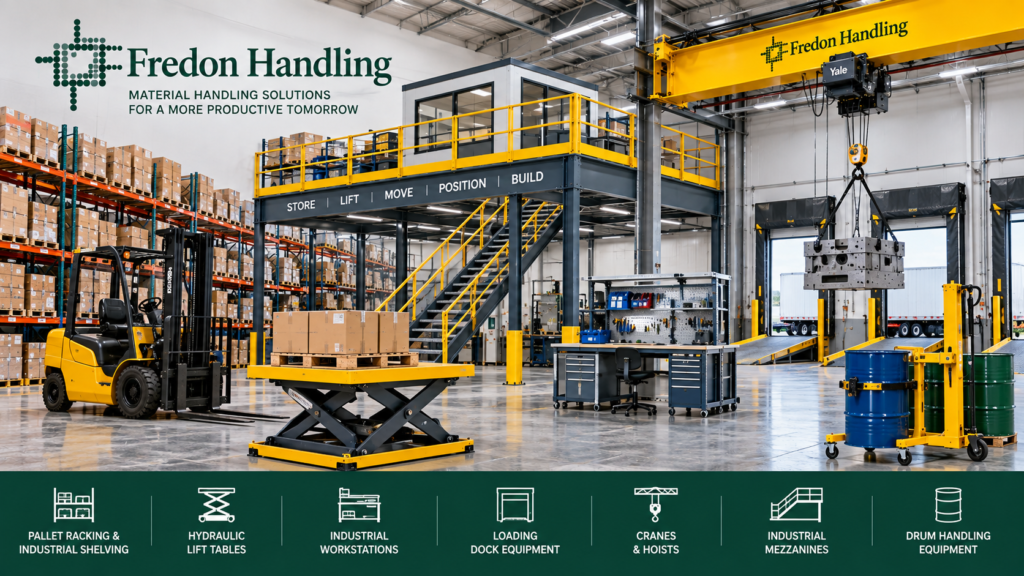
The right material handling equipment does more than move products from one location to another. It should support how materials are stored, lifted, positioned, transferred and used throughout the facility.
Fredon Handling helps customers evaluate equipment based on the actual application, including the material being handled, available space, workflow, employee interaction, production requirements and future operating needs.
Material Handling Equipment From Fredon Handling
Fredon Handling provides equipment for a wide range of storage, lifting, positioning and facility applications.
Our primary material handling equipment categories include:
- Pallet racking and industrial shelving
- Hydraulic lift tables
- Industrial workstations
- Loading dock equipment
- Cranes and hoists
- Industrial mezzanines
- Drum handling equipment
Each category addresses a different part of the material handling process, and many facilities use several types of equipment together.
Pallet Racking & Industrial Shelving
Storage systems help organize inventory while making better use of available floor and vertical space.
Fredon Handling provides pallet racking and industrial shelving solutions for warehouses, manufacturing facilities, parts departments and other industrial storage applications.
Storage options can help address:
- Palletized inventory
- Parts storage
- MRO inventory
- Small components
- Long or bulky materials
- High-density storage
- Hand-picked products
The right system depends on product size, load weight, inventory rotation, picking frequency, forklift access and available space.
Hydraulic Lift Tables & Material Positioning Equipment
Hydraulic lifts help raise, lower and position materials at useful working or transfer heights.
Applications may include:
- Assembly
- Pallet loading
- Pallet unloading
- Packaging
- Machine feeding
- Material transfer
- Production workstations
Material positioning equipment can be particularly valuable in repetitive applications where employees would otherwise need to bend, reach or manually reposition loads.
Industrial Workstations
Industrial workstations create organized work areas for assembly, production, packaging, inspection, maintenance and repair.
A well-designed workstation can help position:
- Tools
- Parts
- Materials
- Storage
- Work surfaces
- Accessories
Workstations should be selected around the task, employee interaction and surrounding material flow rather than simply choosing a standard bench.
Loading Dock Equipment
Loading docks connect transportation with the internal material handling operation.
Fredon Handling provides loading dock equipment including:
- Dock levelers
- Vehicle restraints
- Dock locks
- Dock seals
- Dock shelters
The appropriate equipment depends on dock height, trailer configurations, loading frequency, material handling equipment and the way products move into and out of the facility.
Industrial Cranes & Hoists
Cranes and hoists help lift, move and position heavy or awkward materials.
Fredon Handling offers overhead handling solutions including:
- Workstation bridge cranes
- Jib cranes
- Gantry cranes
- Monorail systems
- Industrial hoists
Overhead handling can be particularly useful where heavy components must move between machines, workstations or production processes.
Industrial Mezzanines
Industrial mezzanines can help facilities make better use of available vertical space.
Applications may include:
- Warehouse storage
- Parts storage
- Production areas
- Equipment platforms
- Work platforms
- Maintenance access
A mezzanine may provide additional usable space without immediately expanding the building footprint.
Drum Handling Equipment
Industrial drums often require specialized equipment because they may need to be transported, lifted, positioned, palletized, rotated or prepared for dispensing.
Fredon Handling provides drum handling solutions that may include:
- Drum trucks
- Drum dollies
- Drum palletizers
- Forklift drum attachments
- Drum rotators
- Drum rollers
- Below-the-hook drum handlers
The correct equipment depends on drum type, weight, dimensions and the movement required.
How to Choose Material Handling Equipment
Material handling equipment should be selected around the complete application.
Before choosing equipment, consider the following questions.
What Material Are You Handling?
Start with the product itself.
Consider:
- Weight
- Dimensions
- Shape
- Packaging
- Stability
- Quantity
- Handling sensitivity
A palletized load requires a different solution from a long steel tube, industrial drum or machine component.
Where Does the Material Begin and End?
Map the material’s movement through the facility.
For example:
Receiving → Storage → Production → Assembly → Packaging → Shipping
Understanding the complete path can help identify unnecessary movement and determine which equipment should be used at each stage.
How Often Is the Material Moved?
Equipment that performs an occasional task may have different requirements from equipment used repeatedly throughout every production shift.
Frequency can influence:
- Capacity
- Duty requirements
- Automation opportunities
- Equipment durability
- Ergonomic considerations
Who Interacts With the Material?
Consider how employees interact with the load.
Questions may include:
- Is the material manually lifted?
- Do employees repeatedly bend or reach?
- Is precise positioning required?
- Do operators work from pallets or containers?
- Does the equipment need to accommodate multiple employees?
Material handling equipment should support both the product and the people performing the work.
How Much Space Is Available?
Facility conditions can significantly affect equipment selection.
Evaluate:
- Floor space
- Clear height
- Aisle width
- Columns
- Machinery
- Doors
- Loading docks
- Traffic routes
- Existing storage systems
The best equipment is not useful if it does not fit the operating environment.
Material Handling Equipment for Manufacturing
Manufacturing facilities often need equipment to support materials throughout the production process.
This may include:
- Receiving raw materials
- Storing components
- Feeding production
- Positioning work
- Moving heavy components
- Supporting assembly
- Packaging finished products
- Shipping products
Several different material handling systems may work together.
For example, pallet racking may store reserve inventory, shelving may hold smaller parts, hydraulic lifts may position materials at workstations and overhead cranes may move heavier components.
Material Handling Equipment for Warehouses
Warehouse material handling typically focuses on receiving, storage, picking, staging and shipping.
Equipment may include:
- Pallet racking
- Industrial shelving
- Lift tables
- Loading dock equipment
- Workstations
- Mezzanines
The goal should be to create a smooth path for products through the building while making effective use of available storage space.
Material Handling and Facility Productivity
Material handling can have a major effect on overall facility productivity.
Poorly planned material movement can create:
- Excess travel
- Congestion
- Repeated handling
- Production delays
- Inefficient storage
- Unnecessary employee movement
- Bottlenecks
Improvement often begins by studying how materials actually move through the operation.
Sometimes the solution is new equipment.
In other cases, the better answer may involve changing the layout, storage method or sequence of operations.
Material Handling and Ergonomics
Material handling tasks often involve lifting, lowering, reaching, pushing, pulling or positioning products.
Equipment such as lift tables, pallet positioners, cranes and ergonomic workstations can help reduce unnecessary manual movement when properly selected for the application.
The complete task should be evaluated rather than focusing only on the weight of the material.
Important considerations include:
- Working height
- Reach distance
- Repetition
- Load orientation
- Movement distance
- Operator interaction
Improving Material Flow
A well-designed material handling system should help products move through the facility with as few unnecessary steps as practical.
Potential improvements can include:
- Relocating frequently used materials
- Improving storage layout
- Reducing travel distance
- Positioning materials closer to workstations
- Improving dock flow
- Using vertical space more effectively
- Reducing repeated handling
- Improving parts presentation
The goal is not simply to move material faster. It is to eliminate movement that does not add value.
Material Handling Equipment for Facility Expansion
Growing facilities often reach a point where floor space becomes limited.
Before relocating or expanding the building, it may be worth evaluating existing space more carefully.
Potential solutions may include:
- Higher-density pallet racking
- Industrial shelving
- Mezzanines
- Vertical storage
- Improved warehouse layout
- Better parts storage
- Reconfigured production areas
Using existing space more effectively can sometimes delay or reduce the need for building expansion.
New Material Handling Equipment vs. Existing Equipment
Not every material handling problem requires replacing equipment.
Sometimes existing equipment can continue to support the operation while other parts of the system are improved.
Before purchasing new equipment, ask:
- What problem are we trying to solve?
- Is existing equipment actually the bottleneck?
- Has the process changed?
- Has production volume increased?
- Has product size or weight changed?
- Is the current layout inefficient?
- Is equipment downtime becoming excessive?
Starting with the operating problem can help prevent unnecessary purchases.
Planning a Material Handling Equipment Project
Before requesting equipment recommendations, document the application as clearly as possible.
Useful information includes:
- Material type
- Maximum weight
- Dimensions
- Required movement
- Handling frequency
- Available space
- Facility dimensions
- Existing equipment
- Current workflow
- Problems with the existing process
- Future production requirements
Photos, drawings and measurements can also help clarify the application.
Material Handling Equipment Should Work as a System
Individual pieces of equipment rarely operate independently.
Consider a typical manufacturing process:
A forklift unloads material at the dock.
Pallet racking stores reserve inventory.
Shelving keeps smaller parts near production.
A hydraulic lift positions material beside an assembly workstation.
An overhead crane moves a heavy component into a machine.
A workstation supports final assembly or packaging.
Each piece of equipment serves a different purpose, but together they form the material handling system.
Planning these connections can help create a more efficient operation.
Frequently Asked Questions About Material Handling Equipment
What is material handling equipment?
Material handling equipment includes equipment used to move, store, lift, position and manage materials throughout warehouses, manufacturing plants and other industrial facilities.
What are examples of material handling equipment?
Examples include pallet racking, industrial shelving, hydraulic lift tables, workstations, loading dock equipment, cranes, hoists, mezzanines and drum handling equipment.
How do I choose the right material handling equipment?
Start with the material being handled, maximum weight, dimensions, required movement, handling frequency, employee interaction, available space and existing workflow.
What material handling equipment is used in manufacturing?
Manufacturing facilities may use racking, shelving, lift tables, workstations, cranes, hoists, drum handlers, carts and other equipment depending on the production process.
What equipment is used in warehouses?
Warehouse equipment can include pallet racking, shelving, loading dock equipment, lift tables, workstations, mezzanines and other systems used for storage and material movement.
Can material handling equipment improve productivity?
Properly selected equipment can help reduce unnecessary movement, improve material positioning, support better storage utilization and reduce bottlenecks within the operation.
Find the Right Material Handling Equipment for Your Operation
The best material handling solution begins with understanding the problem you need to solve.
Fredon Handling can help evaluate your materials, workflow, available space and operating requirements and identify equipment appropriate for your application.
Whether you need to store, lift, position, move or better organize materials, our team can help you evaluate the available options.