
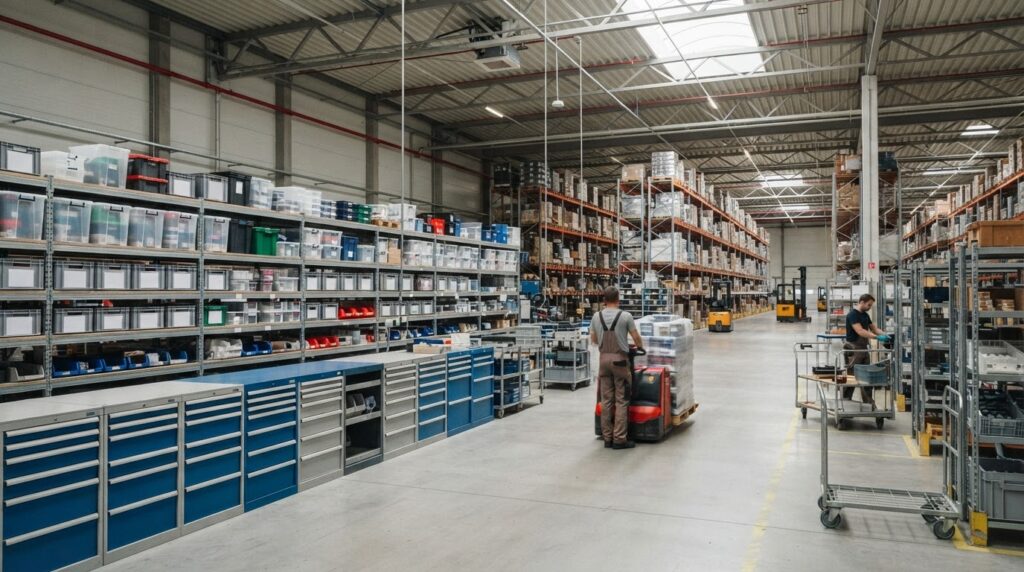
Storage equipment establishes where inventory belongs. Handling equipment determines how that inventory reaches the next work area. A facility can add significant rack capacity and still experience delays if retrieving items requires excessive travel, repeated lifting or unsuitable handling devices.
This selection guide connects storage density, access frequency and movement methods so that inventory can be both stored efficiently and retrieved when needed. Fredon’s warehouse storage solutions provide an overview of relevant equipment categories.
Classify Inventory Before Choosing a Storage System
Start with the size, gross weight, quantity, packaging, turnover, access frequency and identification needs of each product group. A heavy pallet that moves once a month should not automatically use the same storage arrangement as hand-picked repair parts needed every hour.
Group goods by handling unit and retrieval method: pallets, cartons, individual pieces, long items, bulky material and maintenance stock. Record typical and maximum loads. Evaluate not only how much material fits, but also how personnel and equipment access it.
Pallet Racking for Unit Loads
Pallet racks organize larger unit loads, often using powered lift trucks. Selective systems emphasize direct access to locations, while denser arrangements may trade accessibility for storage capacity. Each design must reflect load geometry, lift-truck characteristics, aisle requirements and expected inventory rotation.
Use documented capacity information and appropriate installation and inspection procedures. Confirm floor and building conditions for the intended rack system, and involve qualified specialists for design or structural questions. Fredon’s pallet racking and shelving page summarizes its storage solutions.
Shelving, Bins and Drawer Cabinets for Small Parts
Shelves and drawers are often better suited than pallet rack for items picked by hand. Modular storage can improve visibility and organization when the facility manages many small SKUs. Bin selection should account for component size, quantity, label visibility, replenishment and secure access where required.
A well-organized small-parts area makes locations predictable. Combine labels, defined replenishment rules and an appropriate layout with the physical storage. For detailed selection criteria, review the industrial shelving systems guide.
Point-of-Use Storage and Workstations
A workstation may need nearby shelves, drawers, parts bins or other storage so operators do not repeatedly walk across a plant. The best configuration depends on the assembly process, tool sizes, work heights and frequency of retrieval. Put the most frequently used items in locations that are practical to reach.
When planning workstations, check load ratings, electrical needs, maintenance access, seated or standing tasks, and room for material movement. Fredon offers industrial workstations for a range of applications.
Handling Equipment Connects the Storage Locations
Storage is only one part of the process. Carts, pallet-moving devices, lift tables and other material-positioning equipment connect stored inventory with production or shipping. If two locations have incompatible transfer heights or aisle clearances, extra handling may be required even when both locations are organized.
Map the full route from the pick face to the next workstation or dock. Account for floor transitions, turning radius, thresholds, transfer heights, load stability and the people who must operate the equipment.
Storage Density Versus Retrieval Speed
Maximizing cubic capacity everywhere can slow picking and replenishment. Instead, arrange inventory based on actual movement. Frequently picked items often benefit from locations that reduce travel; slower-moving reserve stock may be placed farther from the primary workflow. Allow room for restocking and safe travel.
Where floor space is limited, mezzanines or other vertical-space options might be worth examining, provided the building conditions, engineering, access and code requirements support the project. See industrial mezzanines.
Safety, Capacity and Equipment Condition
Every rack, shelf, drawer cabinet, cart and lift has application limits. Consider load distribution as well as total weight, protect equipment from foreseeable impacts and follow inspection and maintenance guidance. Damaged storage equipment or improvised handling arrangements can undermine a previously sound layout.
Review a storage system whenever product dimensions, load weights, material flow or industrial vehicles change. Do not assume an existing rack or lifting arrangement remains suitable for a new use without verification.
A Storage and Handling Equipment Worksheet
For each proposed area, document the number of SKUs, unit dimensions, maximum loads, retrieval frequency, method of access, available floor and vertical space, aisle restrictions and anticipated growth. Then compare options on usable capacity, access time, handling steps, operational flexibility and full installed cost.
Include workers who handle inventory daily in the planning discussion. Their knowledge can reveal repeated reaching, unnecessary transfers and location problems that are difficult to identify in a drawing alone.
For an overview of storage, transport, lifting and positioning options, read the complete guide to material handling equipment.
Next Steps
Review Fredon’s storage solutions, workstations and positioning equipment, or schedule a consultation about your inventory and material movement needs.