
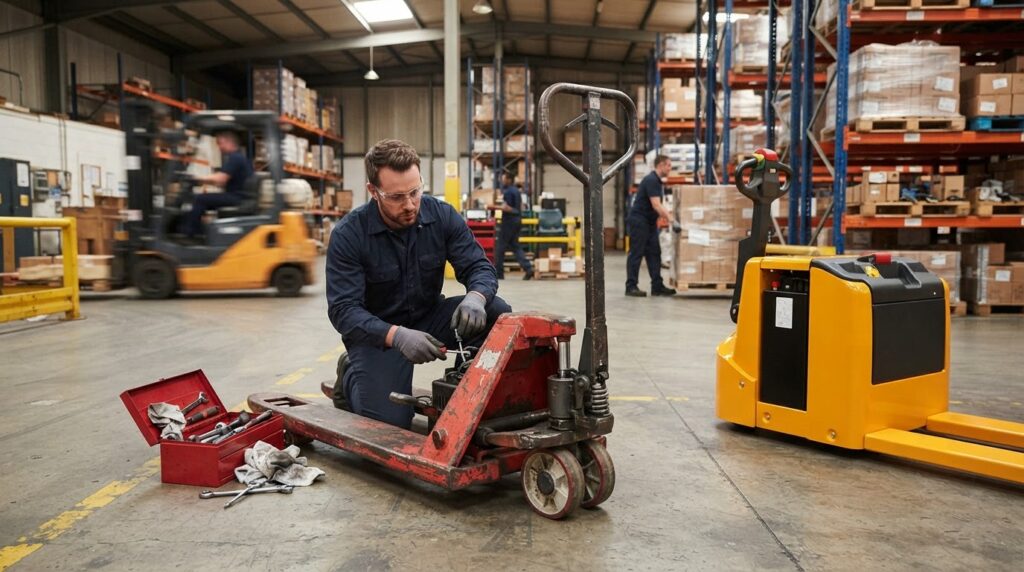
Material handling equipment can remain useful for years when it is suitable for the application and properly maintained. But age alone does not determine whether a cart, lift, rack, hoist or dock system should be replaced. Condition, operating limits, serviceability and changes in the work are more meaningful.
This guide helps facility managers decide when equipment should be inspected, repaired, upgraded or replaced. It does not authorize continued use of equipment with suspected unsafe defects; remove such equipment from service and follow qualified inspection and manufacturer guidance.
Safety or Structural Damage Comes First
Visible deformation, cracking, compromised safety devices, repeated uncontrolled movement, unusual instability or damage to load-bearing components may require immediate action. The appropriate response depends on the equipment and manufacturer instructions, but potential safety defects should not be treated as normal wear.
Isolate suspected unsafe equipment according to the facility’s procedures and obtain a qualified assessment. Do not rely on a general blog post to determine whether a damaged rack, lift or hoist remains safe to use.
Repeated Breakdowns and Unplanned Downtime
Frequent failures can disrupt production and increase maintenance labor, expedited freight and missed schedules. Track breakdown frequency, duration, root cause and repair cost instead of relying only on anecdotes. A series of small repairs can hide a growing reliability problem.
Ask whether the equipment fails due to ordinary service wear, inadequate maintenance, incorrect application or a change in load and duty. Replacing an item without correcting the cause may lead to the same problem again.
Maintenance and Replacement Parts Availability
Older equipment may remain economical if parts, service information and qualified maintenance are available. Conversely, discontinued components or long delays for critical parts can make future downtime harder to control.
Evaluate how quickly the equipment can be returned to service, which components are most likely to fail and whether a suitable repair plan exists. A replacement should have documented parts and maintenance requirements too.
Changed Loads, Products or Production Rates
A piece of equipment can be mechanically sound but no longer fit the work. Product dimensions may increase, packaging may change, or throughput may rise enough to exceed the practical duty of a handling system. A lift table designed for one task should not automatically be repurposed for a different load geometry.
Reassess rated capacity, center-of-gravity limits, cycle frequency, transfer height and environmental conditions before expanding use. Changes to storage systems can also affect rack configuration and lift-truck compatibility.
Ergonomic and Workflow Problems
Equipment that forces repeated manual repositioning, long travel or awkward work postures may deserve modification or replacement even if it still operates. A different workstation, lifting method or storage layout can sometimes remove unnecessary handling steps.
Compare the current workflow with realistic alternatives rather than assuming the newest machine is always better. Fredon’s material positioning and workstation solutions can support application reviews.
Repair, Retrofit or Replacement?
Repair makes sense when the equipment is suitable, defects can be corrected under manufacturer and professional guidance, and ongoing reliability is acceptable. Retrofitting may be an option when supported by qualified design and the resulting configuration remains compliant and appropriately documented.
Replacement may be warranted when repairs do not restore reliability, the application exceeds operating limits, required parts are unavailable or the cost of repeated downtime is high. Compare all realistic options and document the rationale.
Financial Comparison Using Whole-Life Cost
Estimate the cost of maintaining the current equipment over a defined period, including parts, labor, service interruptions, energy and risk of further downtime. Compare it with the total cost of an appropriate replacement, including installation, training and operational changes.
Avoid counting speculative benefits as guaranteed savings. Where possible, use recorded repair history and observed handling time. See total cost of ownership and equipment ROI for complementary analyses.
How to Plan an Orderly Replacement
Document the existing equipment’s make, model, configuration, rated limits, application, condition and maintenance history. Record any load or process changes and identify required downtime windows. Confirm the replacement fits the same space, interfaces and movement routes.
Plan removal, installation, commissioning, inspection and operator training before the cutover. For major systems, agree on acceptance criteria and what will happen if startup takes longer than expected.
Develop a Simple Replacement Review Calendar
Review equipment condition and operational suitability periodically, not just at failure. Use maintenance records, reported handling problems, throughput trends and changes in inventory or production. The frequency and inspections should follow manufacturer guidance and the site’s risk management approach.
A consistent review process helps distinguish isolated service issues from a real need to upgrade. It can also reduce last-minute purchases made under pressure.
For a wider look at storage, transport, lifting and positioning, see our complete guide to material handling equipment.
Next Steps
Explore replacement equipment options and talk with Fredon Handling about the current application, equipment condition and desired improvement.