
Material handling tasks often require employees to lift, lower, reach, bend, push, pull, turn and reposition products throughout the workday.
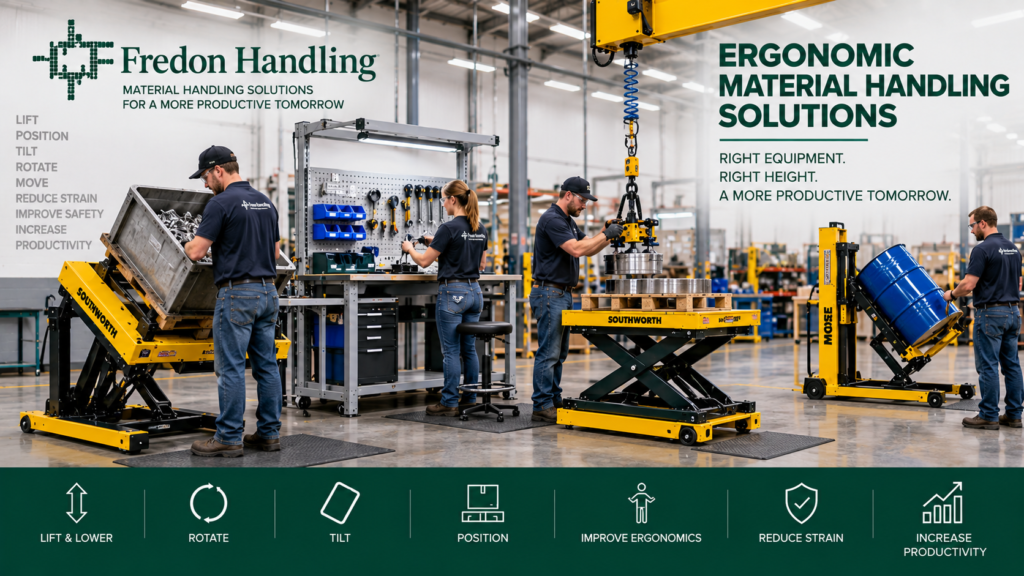
When materials are consistently stored or presented at awkward heights or orientations, these movements can become unnecessarily difficult and inefficient.
Fredon Handling provides ergonomic material handling solutions designed to improve how employees interact with materials during manufacturing, warehousing, assembly, packaging and other industrial operations.
Rather than focusing on one piece of equipment, Fredon helps evaluate the task, load, workstation and material flow to identify solutions that better position the work around the employee.
What Is Ergonomic Material Handling?
Ergonomic material handling focuses on arranging equipment, materials and work processes so employees can perform handling tasks with less unnecessary physical effort.
This may involve reducing:
- Excessive bending
- Long reaches
- Repetitive lifting
- Awkward load positioning
- Frequent twisting
- Manual repositioning
- Unnecessary walking
- Repeated pushing and pulling
The goal is not simply to make a task easier. A well-designed material handling process can also support productivity, consistency and smoother workflow.
Common Ergonomic Material Handling Problems
Industrial facilities may benefit from ergonomic improvements when employees regularly experience situations such as:
- Working from floor-level pallets
- Reaching into deep containers
- Handling products above shoulder height
- Lifting the same component repeatedly
- Manually rotating heavy parts
- Working at fixed benches that are too high or too low
- Carrying materials between nearby work areas
- Reaching across large work surfaces
- Moving awkward or irregular loads
- Repeatedly repositioning containers during production
These issues are often symptoms of a broader material positioning problem.
Hydraulic Lift Tables
Hydraulic lift tables can raise or lower materials to a more practical working height.
They may be used for:
- Assembly
- Pallet loading
- Pallet unloading
- Packaging
- Production
- Inspection
- Machine feeding
- Material transfer
Instead of employees continually bending toward a load as the working height changes, a lift table can help reposition the material.
Pallet Positioners
Pallet positioners can be particularly useful for repetitive palletizing and depalletizing.
As products are removed from a pallet, employees may otherwise need to bend progressively farther toward floor level.
A pallet positioner can help maintain the load at a more accessible working height.
Potential applications include:
- Order picking
- Packaging
- Assembly
- Production feeding
- Pallet loading
- Pallet unloading
Industrial Tilt Tables
Some containers are difficult to access because parts are located deep inside them.
Tilt tables can angle a container toward the employee, improving access to its contents.
They may be useful for:
- Parts bins
- Totes
- Containers
- Assembly components
- Production supplies
The appropriate tilt angle depends on the container, load and work process.
Industrial Turntables
Turntables allow employees to rotate a load rather than repeatedly walking around it or manually dragging it into a new position.
Applications may include:
- Assembly
- Packaging
- Inspection
- Welding
- Palletizing
- Production
Turntables can also be combined with lift tables where both height and orientation need to change.
Ergonomic Industrial Workstations
Workstation design has a major influence on how employees interact with tools, components and materials.
An ergonomic industrial workstation may consider:
- Work surface height
- Reach distance
- Tool location
- Parts presentation
- Storage
- Lighting
- Employee movement
- Material arrival
- Finished-product movement
The workstation should be designed around the task rather than requiring employees to adapt to a generic layout.
Adjustable-Height Workstations
Adjustable-height workstations can be useful when:
- Multiple employees use the same station
- Tasks vary throughout the day
- Product sizes change
- Both seated and standing work occurs
- Different work heights are required
The appropriate adjustment range depends on the operation.
Cranes & Hoists for Ergonomic Handling
Some materials are simply too heavy or awkward to reposition efficiently by hand.
Cranes and hoists can help support these loads while employees guide them into position.
Potential applications include:
- Machine loading
- Assembly
- Fabrication
- Maintenance
- Component installation
- Heavy parts handling
Workstation bridge cranes and jib cranes can be especially useful where heavy components are handled repeatedly within a defined work area.
Drum Handling Equipment
Drums are difficult to handle manually because of their size, shape and weight.
Specialized drum handling equipment can help employees:
- Move drums
- Lift drums
- Position drums
- Rotate drums
- Palletize drums
- Prepare drums for dispensing
Depending on the application, solutions may include drum trucks, dollies, palletizers, forklift attachments, rotators and below-the-hook handlers.
Reducing Repetitive Lifting
Repetitive lifting problems often begin with poor material presentation.
Before assuming employees simply need to lift differently, evaluate:
- Where the material is stored
- How high it is presented
- How far employees must reach
- How frequently lifting occurs
- Whether the load can be repositioned mechanically
- Whether containers can be changed
- Whether materials can be stored closer to the point of use
Sometimes the best ergonomic improvement is to reduce the need to lift altogether.
Improving Reach Distance
Frequently used materials should generally be positioned within practical reach of the employee.
Excessive reach can occur when:
- Work surfaces are too deep
- Containers are too large
- Parts are stored too far away
- Tools are poorly organized
- Materials are presented from the wrong direction
Workstation organization, shelving, bins and positioning equipment can all help improve access.
Ergonomic Pallet Handling
Pallet handling is a common source of repetitive bending and reaching.
As the pallet height changes, the employee’s working position changes with it.
Potential improvements may include:
- Pallet positioners
- Lift tables
- Turntables
- Better pallet placement
- Improved workstation layout
- Mechanical lifting equipment
The best solution depends on how material is added to or removed from the pallet.
Ergonomic Material Handling for Manufacturing
Manufacturing operations may involve repetitive handling at:
- Assembly stations
- Machine tools
- Welding cells
- Packaging areas
- Inspection stations
- Production lines
- Maintenance areas
Ergonomic improvements can help position materials closer to where the work occurs.
For example, a hydraulic lift may raise a container to working height while a workstation organizes tools and an overhead crane positions a heavier component.
Ergonomic Material Handling for Warehouses
Warehouse operations may involve repetitive:
- Picking
- Packing
- Palletizing
- Receiving
- Returns processing
- Replenishment
- Container handling
Improving the height and position of materials can help reduce unnecessary movement during high-frequency tasks.
Material Handling Ergonomics and Productivity
Ergonomic improvements and productivity often overlap.
When employees can access materials more easily, the operation may require fewer unnecessary movements.
Potential improvements include:
- Shorter reaches
- Less walking
- Reduced repositioning
- Better tool placement
- Improved material presentation
- Easier load orientation
The objective is to make the task more efficient without creating new handling problems elsewhere.
Start With the Task, Not the Equipment
A common mistake is choosing equipment before fully understanding the task.
Instead, begin by asking:
- What is the employee doing?
- What material is being handled?
- How much does it weigh?
- How large is it?
- Where does it begin?
- Where does it need to go?
- How often does the task occur?
- Which movements are repetitive?
- What equipment already surrounds the operation?
Once the task is understood, the appropriate equipment becomes easier to identify.
How to Evaluate an Ergonomic Material Handling Application
A useful evaluation may include several factors.
Load Weight
Determine both typical and maximum weights.
Load Dimensions
Large or awkward items may create handling challenges even when they are relatively lightweight.
Working Height
Identify the height where employees currently interact with the material and where the ideal working position would be.
Reach
Observe how far employees must reach for parts, tools and materials.
Frequency
A movement performed once per day is different from one performed hundreds of times.
Orientation
Consider whether the load needs to be rotated, tilted or otherwise repositioned.
Travel Distance
Evaluate how far employees carry, push or pull materials.
Workstation Layout
Look at how equipment, storage and tools are arranged around the employee.
Combining Ergonomic Material Handling Equipment
Many ergonomic improvements involve more than one type of equipment.
For example:
A pallet may arrive by forklift.
A lift table raises it to working height.
A turntable allows the employee to access all sides.
An industrial workstation keeps tools and components organized.
A jib crane assists with heavier parts.
Each device supports a different part of the same work process.
Information to Gather Before Contacting Fredon Handling
Helpful information includes:
- Load weight
- Load dimensions
- Handling frequency
- Current working height
- Desired working height
- Required movement
- Employee reach
- Available floor space
- Existing equipment
- Workstation dimensions
- Photos or video of the task
- Current handling problems
Understanding the actual task makes it easier to identify appropriate equipment.
Frequently Asked Questions About Ergonomic Material Handling
What is ergonomic material handling?
Ergonomic material handling involves organizing equipment, materials and work processes to reduce unnecessary physical effort while supporting efficient movement and positioning of materials.
What equipment can improve material handling ergonomics?
Depending on the application, equipment may include lift tables, pallet positioners, tilt tables, turntables, ergonomic workstations, cranes, hoists and specialized drum handling equipment.
How can pallet handling be made more ergonomic?
Pallet positioners, lift tables and turntables can help maintain products at a more practical working height and orientation during loading or unloading.
Can industrial workstations improve ergonomics?
Yes. Workstations can be configured around working height, reach, tools, parts storage and material flow to better support the task.
Can cranes and hoists help with ergonomics?
They can help reduce manual handling of heavy or awkward components by supporting the load during lifting and positioning.
Should ergonomic equipment be selected based only on load weight?
No. Weight is important, but reach, working height, frequency, orientation, travel distance and the surrounding process should also be evaluated.
Improve How Employees Interact With Materials
Effective ergonomic material handling starts with understanding the task.
Fredon Handling can help evaluate how materials are lifted, positioned, accessed and moved within your operation and identify equipment that better supports the work.
Whether the solution involves lift tables, workstations, overhead handling or specialized positioning equipment, the goal is to make the material fit the process rather than forcing employees to continually adapt to the material.