
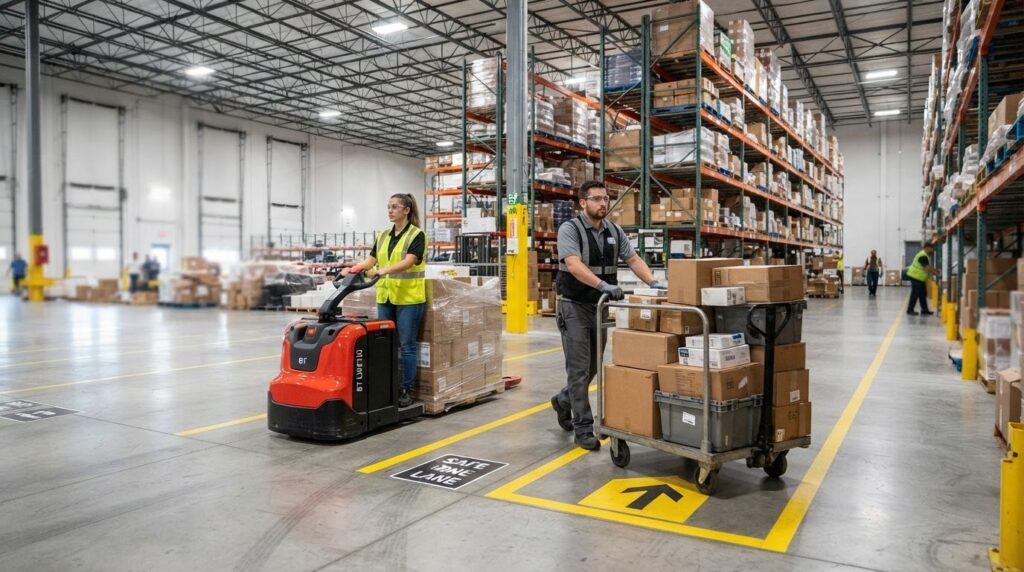
Choosing between manual and powered material handling equipment is fundamentally a question about the force, time, frequency and conditions required to move or position a load. Manual equipment can be economical and flexible. Powered devices may reduce repeated exertion or support larger volumes but introduce other operating requirements.
Power is not the same as automation: an electrically driven device may still require a human operator. This guide focuses on energy source and operating effort, whereas Fredon’s manual versus automated material handling article focuses on control and process automation.
What Is Manual Material Handling Equipment?
Manual equipment includes certain carts, hand trucks, pallet jacks and other devices operated using human force. These products can work for short travel, flexible routes, modest movement volumes and operations where powered infrastructure would be excessive.
A manual device is not automatically safe simply because it lacks a motor. The handling force depends on load, wheel condition, floor friction, inclines, starting and stopping, and how an operator grips and steers the device. Evaluate the actual task and work environment.
What Is Powered Material Handling Equipment?
Powered equipment uses an energy source to move, raise, position or transfer a load. Examples include powered pallet-moving devices, certain lift tables, conveyors and motorized handling systems. The source might be electric, hydraulic or another technology appropriate to the equipment.
Power can reduce physical effort or support repeated cycles, but requires attention to energy supply, charging, guards, controls, authorized operation and maintenance. Compare the exact manufacturer’s capabilities rather than inferring performance from the word ‘powered.’
Compare Load, Distance and Trip Frequency
The critical variables are the maximum and typical loads, movement distance, trips per shift, slopes, door thresholds and transfer heights. A light trolley used occasionally may not need powered movement. A long repetitive route can create a substantial cumulative physical demand even when each individual load is manageable.
Calculate the daily workload in practical terms: number of loads multiplied by the average distance and required handling steps. Observe peak shifts as well as normal days. The right equipment must handle foreseeable extremes without exceeding rated capacity.
Ergonomics and Operator Interaction
For manual transport, assess push-pull forces, grip locations, visibility, reach and body posture throughout the movement. For powered equipment, assess operator controls, emergency stops, travel speed, training and the way people enter or cross the equipment’s operating area.
Equipment should suit the intended task and users. It is possible for a powered device to introduce traffic conflicts that did not exist previously, just as an oversized manual cart may create visibility problems. Use a task-specific assessment instead of treating either category as inherently better.
Purchase Price and Ongoing Cost
Manual carts and other straightforward devices often have lower initial complexity, but still incur maintenance, wheels, replacement parts and labor. Powered equipment introduces purchase, energy, battery or power systems, service, inspection and sometimes facility changes. It may also reduce repeated movement time or fatigue-related constraints.
Calculate the full operational effect over a defined period rather than comparing sticker prices alone. Include realistic labor assumptions and expected equipment availability. Fredon’s total cost of ownership article provides a framework.
When Manual Equipment Is a Better Fit
Manual equipment may be effective for variable routes, low-frequency moves, short travel and smaller loads where documented handling forces are reasonable. It also can be a practical backup when a powered system is unavailable, assuming the task can still be performed safely.
Consider the ability to reconfigure a line and maintain equipment in-house. Simplicity is a meaningful benefit when a facility changes layouts frequently or does not have reliable access to power at every work area.
When Powered Equipment Is a Better Fit
Powered equipment deserves attention when loads are too demanding for manual movement, trips are frequent, travel distances are long or precise repeated positioning is required. The operator’s workload, site conditions and expected volume should justify the added equipment and support requirements.
Powered options are not a substitute for proper traffic design. Evaluate routes, visibility and safe interaction with pedestrians, and ensure maintenance and training are planned from the start.
A Decision Checklist for Facility Managers
Record load weight and center of gravity, dimensions, distance, slope, floor condition, travel frequency, needed lift or transfer height, space, power availability and staffing. Compare multiple options on safety, throughput, flexibility, cost, training and maintenance.
Where possible, test equipment with a representative load under the actual site conditions. A practical trial may reveal issues with caster selection, door clearance or transfer height that are not evident from a product specification.
For an overview of storage, transport, lifting and positioning options, read the complete guide to material handling equipment.
Next Steps
Explore material handling equipment and positioning solutions, or talk to Fredon Handling about the loads, routes and operating rate in your facility.