
Industrial cranes and hoists help manufacturers, warehouses and other facilities lift, move and position heavy or difficult loads within a defined work area.
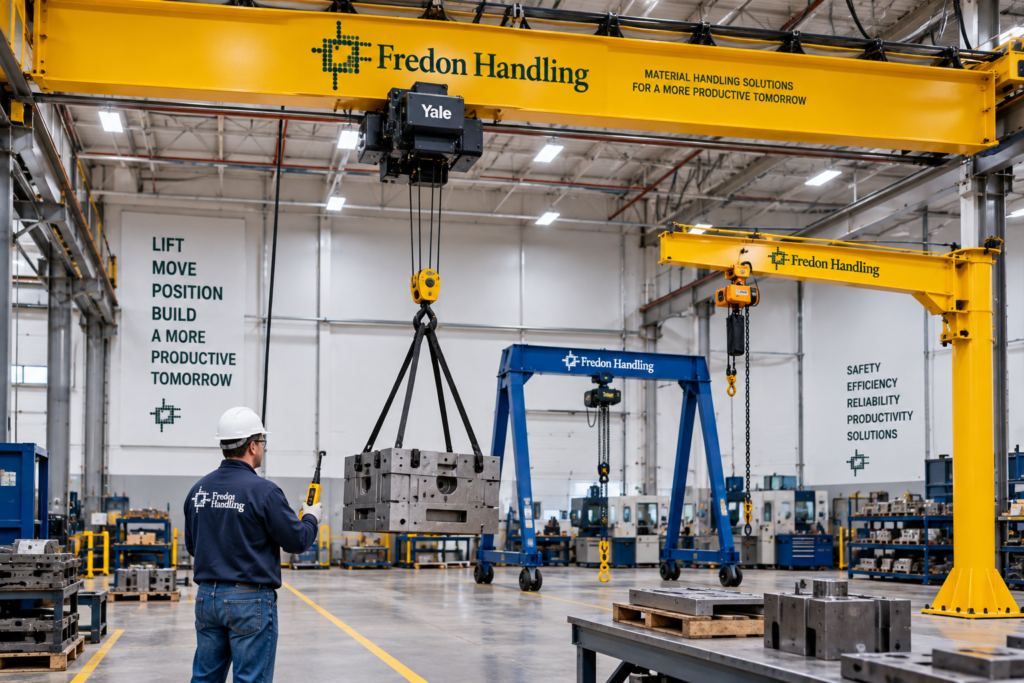
The right overhead handling system can reduce unnecessary manual handling, improve material positioning and help move components more efficiently between workstations, machines and production processes.
Fredon Handling provides industrial crane and hoist solutions including workstation bridge cranes, jib cranes, gantry cranes, monorail systems and application-specific overhead material handling equipment.
Rather than selecting equipment based only on lifting capacity, Fredon Handling can help evaluate the load, required movement, coverage area, lift height, operating frequency and facility conditions to determine an appropriate solution.
Industrial Overhead Material Handling
Overhead material handling allows loads to move above the floor rather than relying entirely on forklifts, carts or manual movement.
This can be particularly useful when:
- Loads are too heavy or awkward to handle manually
- Components must be positioned accurately
- Floor space is limited
- Materials repeatedly move between the same work areas
- Forklift access is difficult
- Heavy components must be loaded into machines
- Production processes require frequent lifting
The best system depends on where the load begins, where it needs to go and how precisely it must be positioned.
Workstation Bridge Cranes
Workstation bridge cranes provide overhead lifting coverage across a defined rectangular work area.
A bridge travels along parallel runways while a hoist moves across the bridge, allowing loads to be positioned throughout the crane’s coverage area.
Workstation bridge cranes can be useful for:
- Assembly areas
- Production cells
- Machine loading
- Component handling
- Manufacturing workstations
- Maintenance operations
- Repetitive lifting processes
They are especially useful when a load must move in more than one horizontal direction within the same work area.
Jib Cranes
Jib cranes provide localized lifting around a workstation, machine or production area.
A horizontal boom rotates around a support point, allowing the operator to move a suspended load through a defined radius.
Common jib crane applications include:
- Machine loading and unloading
- Assembly
- Maintenance
- Fabrication
- Component positioning
- Workstation lifting
- Production support
A jib crane may be appropriate when the lifting requirement is concentrated around one machine or relatively small work area.
Gantry Cranes
Gantry cranes use a freestanding supporting structure rather than relying entirely on the building for support.
They can provide overhead lifting in areas where a permanent runway system may not be appropriate.
Depending on the application, gantry cranes may be useful for:
- Maintenance
- Assembly
- Equipment handling
- Manufacturing
- Loading operations
- Temporary or changing work areas
The structure, capacity, span and movement requirements should all be evaluated before selecting a gantry crane.
Monorail Crane Systems
Monorail systems move suspended loads along a predetermined path.
Instead of providing coverage throughout an entire rectangular area, a monorail guides the load along a specific route.
This can be particularly effective when materials repeatedly travel between defined points such as:
- Production stations
- Assembly operations
- Paint or finishing processes
- Machines
- Inspection areas
- Loading positions
Monorail systems can help create predictable material movement where the required travel path is already known.
Industrial Hoists
The hoist is the lifting device that raises and lowers the load.
Depending on the application, different types of hoists may be used with bridge cranes, jib cranes, gantries, monorails or other lifting systems.
Selection factors can include:
- Load weight
- Required lift height
- Lifting speed
- Operating frequency
- Duty requirements
- Power availability
- Required positioning control
- Operating environment
The hoist and supporting crane system should be evaluated together.
Crane vs. Hoist: What’s the Difference?
A hoist primarily moves a load vertically by raising and lowering it.
A crane provides the structure and horizontal movement that allows the suspended load to travel through a larger working area.
In a typical bridge crane application, the hoist lifts the load while the bridge and trolley allow it to move horizontally.
Understanding the required directions of movement is an important first step when selecting overhead handling equipment.
How to Choose an Industrial Crane
Choosing a crane involves more than determining how much the load weighs.
Several application factors should be considered.
Maximum Load Weight
Determine the heaviest load the system will be expected to handle.
Do not base equipment selection only on typical or average loads.
Load Size and Shape
Large, long, irregular or unbalanced loads may create different handling requirements from compact loads of the same weight.
Required Lift Height
Determine how high the load must be raised and how much vertical clearance is available.
Coverage Area
Identify where the load needs to travel.
A localized lifting application may be suitable for a jib crane, while a larger rectangular area may benefit from a workstation bridge crane.
Travel Path
Determine whether the load needs to:
- Move vertically only
- Rotate around one location
- Travel along a fixed path
- Move throughout a rectangular area
The required movement often helps determine the appropriate crane type.
Operating Frequency
A crane used occasionally for maintenance presents different requirements from one performing repetitive production lifts throughout an entire shift.
Positioning Requirements
Some applications simply require moving a load from one location to another.
Others require precise positioning during assembly or machine loading.
Facility Conditions
Consider:
- Building structure
- Ceiling height
- Available headroom
- Columns
- Machinery
- Workstations
- Aisles
- Utilities
- Existing material handling equipment
The crane must fit both the load and the facility.
Freestanding vs. Building-Supported Crane Systems
Some crane systems can be supported by the building structure, while others use independent freestanding supports.
The appropriate configuration depends on facility conditions and the crane design.
A freestanding system may be useful when:
- The building structure is not suitable for crane loads
- Greater flexibility is required
- The crane needs to be independent of the building
- The application is being added to an existing facility
Building-supported systems may reduce the need for floor-mounted columns in appropriate applications.
Structural requirements should be evaluated by qualified professionals for the specific project.
Cranes for Machine Loading
Machine loading is an excellent example of an application where overhead material handling can provide significant value.
Heavy workpieces may need to be:
- Lifted from a pallet
- Rotated
- Positioned
- Lowered into a machine
- Removed after processing
A jib crane or workstation crane can help perform these movements without requiring a forklift to repeatedly enter the work area.
The correct equipment depends on component weight, machine location, required precision and available space.
Cranes for Assembly Operations
Assembly processes often involve components that are too heavy or awkward for employees to reposition efficiently by hand.
An overhead crane can help support the load while employees guide it into the required position.
Potential applications include:
- Large component assembly
- Fabrication
- Equipment manufacturing
- Automotive components
- Machinery assembly
- Maintenance and repair
The lifting system should be considered as part of the overall workstation design.
Overhead Handling and Ergonomics
Overhead lifting equipment can reduce the need for employees to manually lift or carry heavy components.
It may also help minimize repetitive handling when loads must frequently move between nearby positions.
However, simply installing a crane does not automatically create an ergonomic process.
The complete task should be evaluated, including:
- Load weight
- Load orientation
- Reach distance
- Frequency
- Employee movement
- Controls
- Required positioning
- Surrounding work area
Cranes, lift tables and industrial workstations can sometimes be used together to create a more effective material positioning system.
Below-the-Hook Lifting Equipment
The crane and hoist are only part of an overhead lifting system.
Many loads require a suitable device between the hoist and the material being handled.
Depending on the application, below-the-hook equipment may help lift, grip, support or position specialized loads.
The lifting device should be selected for the actual load geometry, weight and handling process.
Integrating Cranes With Other Material Handling Equipment
Overhead cranes often interact with other equipment throughout the facility.
These may include:
- Hydraulic lift tables
- Industrial workstations
- Pallet racking
- Forklifts
- Carts
- Machines
- Conveyors
- Drum handling equipment
For example, a forklift may deliver material to a production cell, while a workstation crane handles precise movement within the cell.
Looking at the complete process can help determine where overhead lifting provides the greatest benefit.
Crane Inspection and Maintenance
Industrial cranes and hoists require appropriate inspection and maintenance throughout their service life.
Inspection and maintenance requirements depend on the equipment, application, operating conditions and applicable requirements.
Facilities should follow current manufacturer instructions and applicable OSHA, ANSI, ASME and other relevant requirements for their specific equipment and operation.
Any damaged, unusual or improperly operating lifting equipment should be evaluated by appropriately qualified personnel before continued use.
Information to Gather Before Requesting a Crane Quote
Before contacting Fredon Handling, gather as much information as possible about the application.
Useful information includes:
- Maximum load weight
- Load dimensions
- Load shape
- Required lift height
- Required coverage area
- Required travel path
- Operating frequency
- Desired lifting speed
- Positioning requirements
- Building dimensions
- Ceiling height
- Available headroom
- Column locations
- Nearby machinery
- Existing equipment
Drawings, photographs and facility measurements can also help clarify the application.
Frequently Asked Questions About Industrial Cranes & Hoists
What is the difference between a crane and a hoist?
A hoist raises and lowers a load. A crane provides the structure and horizontal movement that allows the suspended load to travel through a larger area.
What type of crane is best for a workstation?
The appropriate system depends on the required coverage area and movement. Jib cranes can provide localized coverage around a machine or workstation, while workstation bridge cranes can cover a larger rectangular area.
When should a gantry crane be considered?
A gantry crane may be useful where a freestanding overhead lifting system is preferred or where the building is not being used to support the crane structure.
What is a monorail crane system?
A monorail guides a suspended load along a predefined path and can be useful when materials repeatedly move between specific locations.
How do I determine crane capacity?
Start with the maximum expected load, but also consider below-the-hook equipment and all other components involved in the lifting application. Equipment selection should be based on the complete application and appropriate engineering requirements.
Can cranes improve ergonomics?
Overhead lifting equipment can reduce manual lifting and help position heavy or awkward components. The entire work process should be evaluated when addressing ergonomic concerns.
Find the Right Crane & Hoist System
The right industrial crane is determined by more than capacity.
Load size, movement, coverage area, lift height, operating frequency, building conditions and the surrounding production process all matter.
Fredon Handling can help evaluate your overhead material handling application and identify a crane and hoist configuration suited to your facility.
Tell us what you need to lift, how much it weighs, where it needs to move and how the equipment will be used.