
A well-designed industrial workstation puts tools, components and materials where employees need them while supporting an organized, efficient workflow.
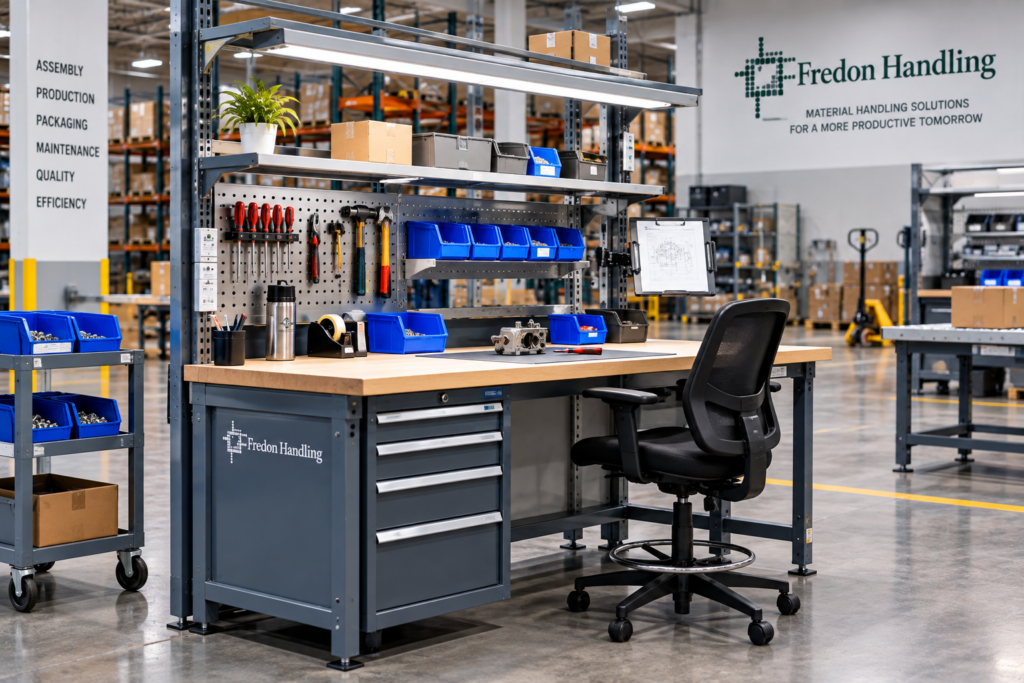
Fredon Handling provides industrial workstations for manufacturing, assembly, packaging, maintenance, inspection and other demanding industrial applications.
Rather than forcing employees to adapt to a generic workbench, the right workstation can be configured around the task, available space, tools, parts and material flow.
Industrial Workstations Designed Around the Task
Every work area is different.
An effective industrial workstation should support the specific operation being performed, whether employees are assembling components, inspecting products, packaging orders, repairing equipment or preparing parts for production.
Industrial workstations can support applications such as:
- Assembly
- Manufacturing
- Packaging
- Inspection
- Maintenance
- Repair
- Quality control
- Parts preparation
- Production support
- Tool organization
The best configuration depends on the task, equipment, materials and workflow.
Modular Industrial Workstations
Modular industrial workstations provide flexibility because individual components can be arranged around the application.
Depending on the system and requirements, a workstation may include:
- Work surfaces
- Shelving
- Drawers
- Tool storage
- Parts bins
- Overhead components
- Lighting
- Accessory rails
- Mobile bases
- Stationary frames
This approach allows the workstation to support the process rather than requiring employees to work around a fixed arrangement.
Ergonomic Industrial Workstations
Workstation ergonomics should be considered whenever employees repeatedly perform the same motions or spend extended periods at a production station.
An ergonomic workstation design considers:
- Working height
- Reach distance
- Tool placement
- Parts presentation
- Storage location
- Repetitive movements
- Task sequence
- Material arrival
- Finished-product movement
The goal is to make required tools and materials easier to access while reducing unnecessary reaching, bending and repositioning.
Adjustable-Height Workstations
Some industrial tasks benefit from an adjustable working height.
Employees may vary in height, or the same workstation may support several different processes throughout the day.
Adjustability can also be useful when products vary in size or when a workstation must accommodate both seated and standing tasks.
The appropriate height range should be based on the actual work being performed.
Assembly Workstations
Assembly workstations should organize parts, tools and materials around the sequence of the assembly process.
A good assembly workstation can help improve:
- Parts accessibility
- Tool organization
- Work consistency
- Material flow
- Changeovers
- Space utilization
Frequently used items should generally be positioned where they are easy to reach, while less frequently used supplies can be stored farther from the primary work area.
Packaging Workstations
Packaging operations often require cartons, labels, tape, tools, documentation and finished products to come together in one area.
A properly configured packaging workstation can help keep these materials organized and reduce unnecessary movement during the packing process.
Workstation design should consider both incoming products and how finished packages leave the work area.
Maintenance and Repair Workstations
Maintenance departments often need durable work surfaces and organized storage for tools, components and replacement parts.
An industrial workstation can create a dedicated area for:
- Equipment repair
- Preventive maintenance
- Component rebuilding
- Tool storage
- Parts preparation
- Inspection
Integrating storage directly into the workstation can help keep frequently used tools and parts available near the point of use.
Mobile Industrial Workstations
Mobile workstations can be useful when the work needs to move rather than remain at one fixed location.
Applications may include:
- Maintenance operations
- Flexible production areas
- Tool transport
- Inspection
- Repair work
- Temporary assembly stations
A mobile workstation can allow tools and components to move with the employee instead of requiring repeated trips back to a fixed bench.
Stationary Industrial Workstations
Stationary workstations provide a dedicated location for processes that consistently occur in the same area.
They are commonly used for:
- Assembly
- Packaging
- Testing
- Inspection
- Production
- Repair
Stationary systems can often support more permanent accessories and storage configurations.
Workstations and Material Handling
Industrial workstations often perform best when planned together with surrounding material-handling equipment.
Depending on the application, a workstation may interact with:
- Hydraulic lift tables
- Pallet positioners
- Industrial shelving
- Parts storage
- Cranes and hoists
- Conveyors
- Carts
- Pallet racking
For example, a hydraulic lift table can position a pallet next to an assembly workstation while shelving keeps smaller components within easy reach.
The complete workflow should be considered instead of treating each piece of equipment separately.
How to Choose an Industrial Workstation
Several factors should be evaluated before choosing a workstation.
Task
Start by defining exactly what employees will do at the station.
Assembly, packaging, maintenance and inspection can require very different layouts.
Work Surface
Consider the required work surface size, durability and working height.
The product or equipment being handled should fit comfortably within the work area.
Tools and Components
Identify the tools, parts and supplies used most frequently.
These items should be positioned so they can be accessed efficiently.
Storage
Determine whether the workstation needs drawers, shelving, bins, cabinets or other storage.
Mobility
Decide whether the workstation should remain in one location or move throughout the facility.
Material Flow
Understand how materials enter the workstation and where they go when the work is complete.
This can have a major effect on workstation orientation and surrounding equipment.
Available Space
Measure the area carefully and account for:
- Aisles
- Equipment
- Employee movement
- Material staging
- Doors
- Columns
- Nearby machines
Industrial Workstations for Manufacturing
Manufacturing facilities may use industrial workstations throughout the production process.
Potential applications include:
- Subassembly
- Final assembly
- Inspection
- Testing
- Production support
- Packaging
- Maintenance
- Quality control
Workstations should be configured around the process rather than selected only by size.
Industrial Workstations for Warehouses
Warehouse operations may use workstations for:
- Packing
- Shipping
- Receiving
- Returns
- Labeling
- Inventory inspection
- Parts handling
- Order preparation
The workstation should support the movement of products into and out of the area while keeping supplies organized.
Information to Gather Before Requesting a Quote
Before contacting Fredon Handling, gather:
- Available dimensions
- Work surface requirements
- Type of task
- Products being handled
- Tools used
- Storage requirements
- Desired working height
- Need for mobility
- Number of employees
- Surrounding equipment
- Material flow
- Any special accessories required
Photos or sketches of the existing work area can also help clarify the application.
Frequently Asked Questions About Industrial Workstations
What is an industrial workstation?
An industrial workstation is a work surface and supporting system designed for manufacturing, assembly, packaging, maintenance, inspection or other industrial tasks.
What is the difference between an industrial workstation and a regular workbench?
Industrial workstations are typically designed for more demanding environments and can often be configured with storage, shelving, accessories, mobility and other components tailored to the work process.
What makes a workstation ergonomic?
An ergonomic workstation is designed around the employee and task, with attention to working height, reach distance, tool placement, parts presentation and repetitive movements.
Can industrial workstations be customized?
Many workstation systems are modular and can be configured with different work surfaces, storage components, shelving and accessories.
Should a workstation be mobile or stationary?
That depends on the workflow. Stationary workstations are appropriate for fixed processes, while mobile configurations can be useful where tools or work surfaces need to move between locations.
Build a Workstation Around Your Operation
The best industrial workstation is not simply a bench. It is a work area designed around the process, employee, tools and materials.
Fredon Handling can help evaluate your application and identify a workstation configuration that supports your production and material-handling requirements.
Tell us what work is being performed, what tools and materials are involved and how much space is available.