
Industrial drums can be difficult to move, lift, position, rotate and dispense safely without the right equipment.
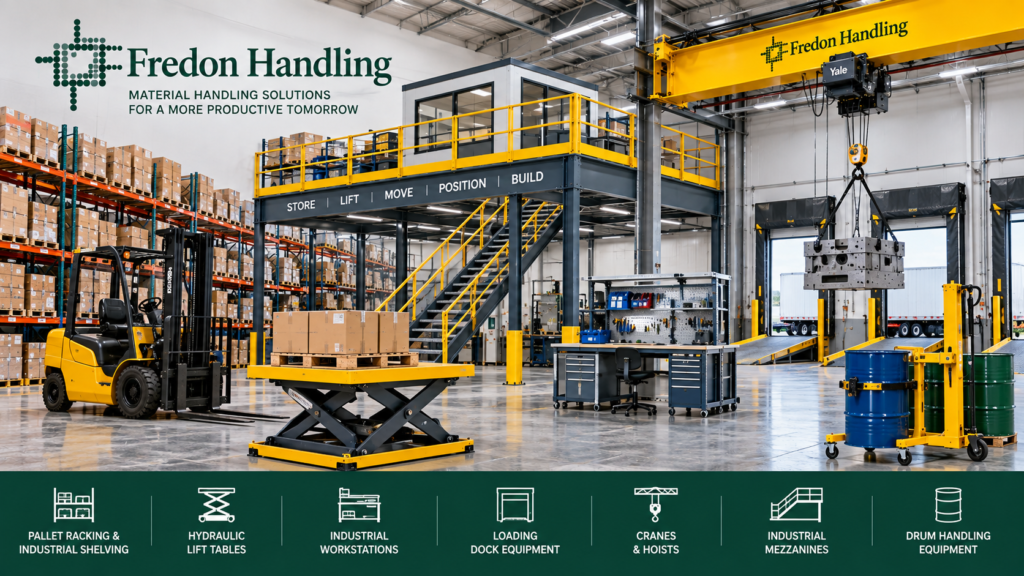
Fredon Handling provides drum handling equipment for manufacturing plants, warehouses, processing facilities and other industrial operations that work with steel, plastic or fiber drums.
Depending on the application, drum handling equipment can help transport drums, lift them from pallets, move them with a forklift or crane, rotate them for mixing, or position them for dispensing.
The right solution depends on the drum, its weight, how it needs to move and the equipment already available in the facility.
Drum Handling Equipment for Industrial Applications
Drum handling requirements vary significantly from one operation to another.
A drum may simply need to move across a facility, or it may need to be:
- Lifted
- Transported
- Rotated
- Tilted
- Palletized
- Depalletized
- Positioned
- Mixed
- Dispensed
- Suspended from a crane or hoist
Fredon Handling can help evaluate the application and identify drum handling equipment suited to the required movement.
Drum Trucks
Drum trucks are designed to help move drums manually over relatively short distances.
They can be useful in warehouses, maintenance departments, production areas and other facilities where drums need to be moved from one location to another.
When selecting a drum truck, consider:
- Drum diameter
- Drum height
- Full drum weight
- Drum construction
- Floor conditions
- Travel distance
- Frequency of use
The equipment should be appropriate for the specific drum and operating environment.
Drum Dollies
Drum dollies allow drums to remain mobile while supported on a wheeled base.
They can be useful where drums need to move between work areas or remain movable during storage or dispensing.
Potential applications include:
- Production areas
- Maintenance departments
- Chemical handling
- Lubricant storage
- Parts washing
- Dispensing stations
The appropriate dolly depends on drum size, weight and floor conditions.
Drum Palletizers
Drum palletizers help raise and position drums when transferring them to or from pallets.
This can reduce the amount of manual handling required during palletizing and depalletizing.
They may be particularly useful where drums arrive on pallets but must be moved individually throughout the facility.
When evaluating a drum palletizer, consider:
- Drum type
- Drum weight
- Pallet dimensions
- Required lift height
- Handling frequency
- Available floor space
Forklift Drum Attachments
Forklift drum attachments allow suitable lift trucks to perform specialized drum handling tasks.
Depending on the attachment, a forklift may be used to:
- Lift drums
- Move drums
- Transport multiple drums
- Position drums
- Load or unload drums
Forklift attachments can be useful when a facility already relies heavily on lift trucks and wants to use existing equipment for drum handling.
The attachment must be appropriate for the forklift, drum and application.
Drum Lifters
Drum lifters help raise drums from the floor, pallet or another position.
Different lifting methods may be used depending on the drum design and the equipment available.
Applications can include:
- Loading drums
- Unloading drums
- Moving drums between pallets
- Positioning drums
- Supporting production processes
The lifting method should be matched to the drum’s size, construction and weight.
Below-the-Hook Drum Handlers
Below-the-hook drum handling equipment can be used with compatible cranes and hoists.
This can be useful in facilities where overhead lifting equipment already serves the work area.
Potential applications include:
- Lifting drums from pallets
- Positioning drums over processing equipment
- Moving drums between production areas
- Handling drums in areas where forklift access is limited
The lifting device should be appropriate for both the drum and the overhead lifting system.
Drum Rotators
Drum rotators allow drums to be turned or rotated as part of a handling or production process.
Depending on the application, rotation may be required for:
- Positioning
- Emptying
- Pouring
- Mixing
- Processing
- Orientation changes
A drum rotator may be integrated with other material handling equipment such as forklifts, cranes or mobile drum handlers.
Drum Rollers
Drum rollers are commonly used to rotate sealed drums for mixing or blending their contents.
They may be useful in applications where materials need to be mixed without transferring the contents to another container.
When choosing a drum roller, consider:
- Drum dimensions
- Drum weight
- Drum material
- Rotation requirements
- Operating time
- Production environment
Drum Pouring and Dispensing
Some drum handling applications require the drum to be tilted or positioned for controlled dispensing.
The correct equipment depends on:
- Drum weight
- Drum type
- Dispensing height
- Required tilt angle
- Frequency of use
- Container receiving the material
The entire process should be considered, including how the drum reaches the dispensing area and how it is removed when empty.
Handling 55-Gallon Drums
The 55-gallon drum is common in manufacturing and industrial environments, but its size and weight can make manual handling difficult.
A full drum may be too heavy and awkward to move safely without mechanical assistance.
Possible handling solutions include:
- Drum trucks
- Drum dollies
- Forklift attachments
- Drum palletizers
- Drum lifters
- Drum rotators
- Below-the-hook handlers
The appropriate equipment depends on how the drum needs to move and how often the task occurs.
Steel, Plastic and Fiber Drums
Different drum materials can affect equipment selection.
Steel Drums
Steel drums are common in industrial environments and may be compatible with a wide range of drum handling equipment.
Plastic Drums
Plastic drums can have different wall strength, shape and gripping requirements than steel drums.
Fiber Drums
Fiber drums may require equipment that supports the container without damaging it.
The drum construction should always be considered when selecting handling equipment.
Full vs. Empty Drum Handling
A full drum presents a very different handling challenge from an empty drum.
Important differences can include:
- Weight
- Stability
- Center of gravity
- Handling method
- Required equipment
- Operator effort
Equipment should be selected for the heaviest and most demanding condition it will encounter.
Drum Handling and Ergonomics
Drums can be awkward because they are large, cylindrical and difficult to grip.
Manual handling can involve:
- Pushing
- Pulling
- Tilting
- Rolling
- Lifting
- Repositioning
Mechanical drum handling equipment can help reduce unnecessary manual effort by allowing the equipment to support or control the load.
The complete task should be evaluated, including:
- Drum weight
- Frequency
- Travel distance
- Required lifting
- Operator interaction
- Floor conditions
- Workstation height
Drum Handling in Manufacturing
Manufacturing facilities may use drums for:
- Raw materials
- Lubricants
- Chemicals
- Process materials
- Waste collection
- Coatings
- Adhesives
- Cleaning materials
Drum handling equipment can help move these containers between receiving, storage, production and dispensing areas.
Drum Handling in Warehouses
Warehouses may need to receive, store, pick and ship drums.
Potential equipment can include:
- Drum dollies
- Forklift attachments
- Drum trucks
- Palletizers
- Storage equipment
The storage and handling method should account for drum weight, inventory volume and movement frequency.
Integrating Drum Handling Equipment With Other Systems
Drum handling equipment often works with other material handling systems.
These may include:
- Forklifts
- Cranes and hoists
- Hydraulic lift tables
- Pallet racking
- Industrial shelving
- Workstations
For example, a forklift may deliver a pallet of drums to a production area, while a drum palletizer removes individual drums and a rotator positions them for dispensing.
Looking at the entire workflow can help identify the most practical combination of equipment.
How to Choose Drum Handling Equipment
Before selecting drum handling equipment, answer several basic questions.
What Type of Drum Are You Handling?
Identify:
- Steel
- Plastic
- Fiber
- Other container type
What Does the Drum Weigh?
Consider both full and empty drum weight.
What Are the Drum Dimensions?
Record the diameter and height of the drum.
What Movement Is Required?
Determine whether the drum must be:
- Moved horizontally
- Lifted
- Rotated
- Tilted
- Palletized
- Dispensed
- Suspended
How Often Is the Task Performed?
A drum moved once per week presents different requirements from a drum handling process repeated throughout every shift.
What Equipment Is Already Available?
Existing equipment may influence the solution.
For example:
- Forklifts
- Cranes
- Hoists
- Pallet jacks
- Lift tables
Using compatible existing equipment may simplify the application.
Information to Gather Before Requesting a Quote
Before contacting Fredon Handling, gather:
- Drum type
- Drum material
- Drum diameter
- Drum height
- Full weight
- Empty weight
- Required movement
- Handling frequency
- Available forklift or crane equipment
- Floor conditions
- Available space
- Required lifting height
- Dispensing requirements
- Photos of the application
This information can help narrow the equipment options quickly.
Frequently Asked Questions About Drum Handling Equipment
What equipment is used to move 55-gallon drums?
Common options include drum trucks, dollies, forklift attachments, drum palletizers and mobile drum handling equipment.
How do you lift a heavy drum?
Mechanical equipment such as drum lifters, forklift attachments, palletizers or below-the-hook drum handlers can be used depending on the application.
What is a drum palletizer?
A drum palletizer helps lift and position drums when moving them onto or off pallets.
What is a drum rotator used for?
A drum rotator turns or tilts a drum for positioning, pouring, mixing or other process requirements.
Can a forklift move drums?
Yes, when equipped with a compatible drum handling attachment appropriate for the forklift and drum.
Can cranes and hoists be used for drum handling?
Yes. Below-the-hook drum handling equipment can allow suitable cranes and hoists to lift and position drums.
Find the Right Drum Handling Equipment
The best drum handling solution depends on the container, load, movement and process.
Fredon Handling can help evaluate your application and identify equipment for lifting, moving, positioning, rotating or dispensing industrial drums.
Tell us what type of drum you are handling, how much it weighs and what movement you need to accomplish.