
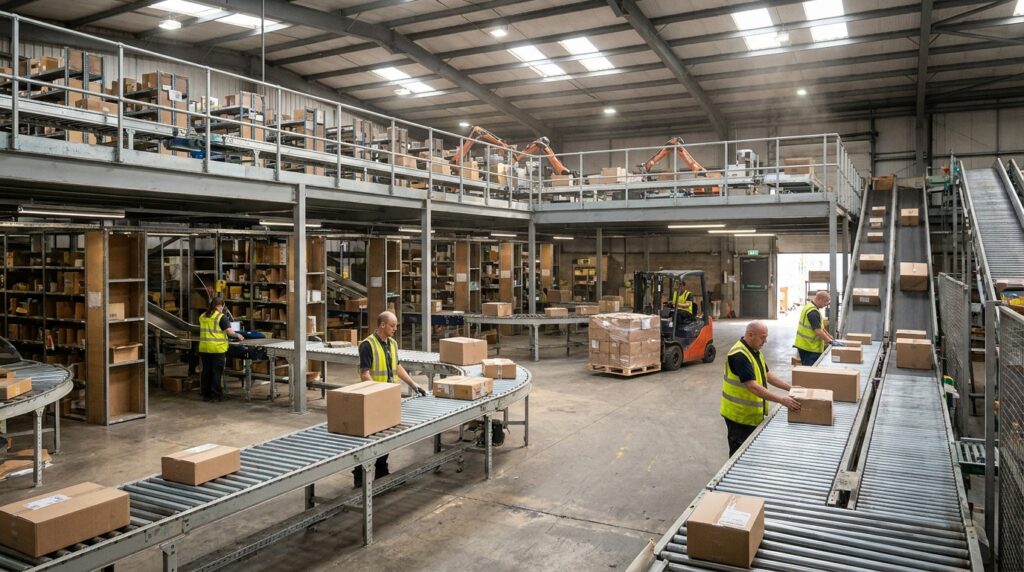
Material handling systems form the backbone of every efficient warehouse, manufacturing plant, distribution center and industrial facility. Whether you are moving raw materials from a loading dock to a production line, picking orders for shipment, or storing finished goods on pallet racking, the way you handle materials directly affects throughput, labor costs, workplace safety and customer satisfaction. Understanding how these systems work—and how to choose the right combination of equipment, layout and processes—is essential for any operations professional looking to streamline workflow and gain a competitive edge.
This guide breaks down the core components of material handling systems, explains the most common categories of equipment, highlights practical applications, and offers selection guidance so you can make informed decisions for your facility.
What Material Handling Systems Are and Why They Matter
A material handling system is any combination of equipment, technology, processes and personnel used to move, store, protect and control materials throughout a facility. The scope ranges from a single hand truck used to shuttle boxes across a shop floor to a fully automated distribution center with conveyors, automated storage and retrieval systems, sortation lines and robotic palletizers.
The Material Handling Institute (MHI) estimates that material handling accounts for 20–25 percent of total manufacturing costs. Poorly designed handling processes inflate that number through wasted motion, damaged goods, safety incidents and bottlenecks. Conversely, well-designed systems deliver measurable benefits:
- Reduced labor costs – Mechanized and automated equipment lets fewer operators move more material in less time.
- Improved throughput – Continuous flow and optimized storage reduce cycle times from receiving to shipping.
- Enhanced safety – Ergonomic workstations, hydraulic lifts and cranes remove repetitive lifting tasks that lead to musculoskeletal injuries.
- Better space utilization – Vertical storage solutions such as pallet racking and mezzanines maximize cubic footage without expanding the building footprint.
- Lower product damage – Proper handling and storage equipment protect goods from impact, moisture and contamination.
- Greater inventory accuracy – Organized storage combined with warehouse management software makes it easier to locate and track products.
For industrial buyers, facility managers and warehouse managers, the goal is not simply to purchase equipment but to create an integrated material handling system that matches the specific flow of goods through their operations.
For a deeper understanding of the practical applications of material handling systems, you can explore the article on various projects undertaken by Fredon Handling, which showcases innovative solutions and implementations in the field. This resource provides valuable insights into how these systems are utilized in real-world scenarios. You can read more about it here: Fredon Handling Projects.
Core Categories of Material Handling Equipment
Material handling equipment is typically grouped into four broad categories. Understanding each category helps you identify gaps in your current workflow and select solutions that work together efficiently.
Transport Equipment
Transport equipment moves materials from one location to another within a facility or between facilities. Examples include:
- Forklifts and pallet jacks – The workhorses of most warehouses, available in electric, propane and diesel configurations for indoor and outdoor use.
- Conveyors – Belt, roller, chain and overhead conveyors create continuous material flow for high-volume operations. They are especially valuable on production lines and in order-fulfillment centers.
- Automated guided vehicles (AGVs) and autonomous mobile robots (AMRs) – These self-navigating vehicles transport pallets, totes or carts along programmed or dynamic paths, reducing reliance on manual forklift traffic.
- Industrial carts and tugger trains – Often used in lean manufacturing environments for point-of-use delivery.
The right transport equipment depends on load weight, travel distance, frequency of moves and floor conditions. A short, infrequent move may only need a hand pallet jack, while a long, repetitive route may justify a conveyor line or an AGV fleet.
Storage and Retrieval Equipment
Storage equipment keeps materials organized and accessible until they are needed. Key solutions include:
- Selective pallet racking – The most common rack type, offering direct access to every pallet position. Ideal for facilities with a large number of SKUs and moderate throughput.
- Drive-in and drive-through racking – High-density systems where forklifts enter the rack structure. Best for bulk storage of few SKUs.
- Push-back and pallet flow racking – Dynamic systems that use gravity or carts to move pallets to the pick face, combining density with selectivity.
- Cantilever racking – Designed for long, bulky items such as lumber, pipe, bar stock and furniture.
- Shelving and bin systems – Used for smaller parts and components in manufacturing, maintenance and order-picking areas.
- Mezzanines – Freestanding elevated platforms that double usable floor space for storage, workstations or offices without costly building expansion.
- Automated storage and retrieval systems (AS/RS) – Crane-based or shuttle-based systems that store and retrieve loads automatically, maximizing vertical space and throughput in high-volume environments.
Fredon Handling offers a wide range of pallet racking configurations and mezzanine solutions designed to fit the unique dimensions and throughput demands of each client’s facility.
Positioning and Lifting Equipment
Positioning equipment raises, lowers, tilts or rotates materials to place them precisely where they need to be. This category is critical for ergonomics and process efficiency:
- Hydraulic lift tables and scissor lifts – Raise heavy loads to comfortable working height, eliminating bending and manual lifting. Common in assembly, packaging and palletizing applications.
- Overhead cranes and bridge cranes – Handle heavy or oversized loads that exceed forklift capacity. Widely used in manufacturing, fabrication and heavy industry.
- Jib cranes and hoists – Serve individual workstations or specific areas of a production line, providing targeted lifting capability without tying up an overhead crane.
- Dock levelers and loading dock equipment – Bridge the gap between the warehouse floor and trailer bed, enabling safe and efficient loading and unloading. Mechanical, hydraulic and air-powered models are available.
- Tilters, turntables and upenders – Reposition loads for wrapping, labeling, assembly or inspection without manual handling.
Fredon Handling supplies hydraulic lifts, cranes, hoists and loading dock equipment engineered for demanding industrial environments, helping operations teams reduce injury risk while speeding up material flow.
Identification and Control Systems
This category includes the technology layer that tracks, identifies and directs materials through the system:
- Barcode scanners and RFID readers – Capture data at receiving, putaway, picking and shipping to maintain inventory accuracy.
- Warehouse management systems (WMS) – Software that orchestrates storage locations, pick paths, replenishment and labor allocation.
- Warehouse execution systems (WES) and warehouse control systems (WCS) – Manage automated equipment such as conveyors, sortation systems and AS/RS in real time.
- Industrial scales, dimensioners and vision systems – Verify weight and dimensions for quality control, shipping compliance and slotting optimization.
While Fredon Handling focuses primarily on physical equipment, our team understands how hardware and technology must work together and can coordinate with controls and software integrators to deliver a cohesive system.
How to Design an Effective Material Handling System
Purchasing individual pieces of equipment without a system-level design often leads to islands of automation, mismatched capacities and persistent bottlenecks. A structured design approach prevents these problems.
Analyze Current Material Flow
Begin by mapping every material movement in your facility—from inbound receiving to outbound shipping. Document distances, frequencies, load types, weights and current handling methods. Look for:
- Excessive travel distances or backtracking
- Manual handling of heavy or repetitive loads
- Congestion points where multiple flows converge
- Underutilized vertical space
- High damage or error rates at specific process steps
This analysis provides the data foundation for justified equipment investments.
Define Throughput and Growth Requirements
Size the system not only for today’s volume but also for projected growth over the next five to ten years. Key metrics include:
- Pallets received and shipped per shift
- Order lines picked per hour
- Peak-to-average volume ratio (seasonal surges)
- SKU count and velocity distribution (fast, medium, slow movers)
A system designed too tightly for current volumes will bottleneck quickly as the business grows. Modular solutions such as bolted pallet racking and freestanding mezzanines offer the flexibility to expand without major reconstruction.
Select Equipment That Works Together
Choose transport, storage, positioning and control equipment as complementary parts of a single workflow—not as standalone purchases. For example:
- A new mezzanine gains full value only when paired with a conveyor or vertical reciprocating conveyor to move product between levels.
- High-density racking saves space but requires narrower aisles, which may demand reach trucks or turret trucks instead of standard counterbalance forklifts.
- A hydraulic lift table at a packing station reduces cycle time only if the upstream pick process delivers product at a matching rate.
Fredon Handling’s team evaluates the full workflow context before recommending equipment so that every component contributes to system-wide efficiency.
Plan for Safety and Ergonomics
Every design decision should incorporate safety. Key considerations include:
- Adequate aisle widths for equipment and pedestrian traffic
- Rack protection such as column guards, end-of-aisle barriers and rack netting
- Proper loading dock restraints and dock locks to prevent trailer creep
- Ergonomic workstation heights, anti-fatigue matting and adjustable lift equipment
- Clear sightlines and traffic management at intersections
- Compliance with OSHA, ANSI/MH and local building codes
Investing in safety-focused material handling equipment—such as ergonomic workstations, hydraulic lift tables and guardrail-equipped mezzanines—reduces workers’ compensation costs, improves retention and avoids costly regulatory penalties.
Real-World Applications Across Industries
Material handling systems are not one-size-fits-all. The optimal configuration depends heavily on the industry, product characteristics and operational model.
Manufacturing and Assembly
Manufacturers need to deliver raw materials, components and subassemblies to the production line at precisely the right time. Solutions often include overhead cranes for heavy fabrications, jib cranes and hoists at individual workstations, ergonomic assembly benches with integrated hydraulic lifts, and lean material delivery carts. Selective and cantilever pallet racking typically store raw materials and work-in-process inventory near production areas.
Warehousing and Distribution
Distribution operations prioritize speed, accuracy and density. High-volume facilities may combine deep-lane pallet racking for bulk reserve storage with carton-flow racking in pick modules. Conveyor and sortation systems connect zones, and dock levelers and loading dock equipment ensure fast trailer turnaround. Mezzanines are frequently used to create additional pick levels or value-added service areas above the ground floor.
Food, Beverage and Cold Storage
Temperature-controlled environments demand equipment rated for cold and damp conditions. Drive-in racking maximizes expensive cold-storage space. Stainless steel conveyors, galvanized rack components and sealed hydraulic lifts resist corrosion. FIFO flow-through racking helps manage product rotation and shelf-life compliance.
Heavy Industry and Fabrication
Steel service centers, machine shops and heavy equipment manufacturers handle loads that can reach tens of thousands of pounds. Overhead bridge cranes, gantry cranes and heavy-duty cantilever racking are essential. Loading dock equipment must accommodate flatbed trailers and oversized loads, and lift tables may need capacities of 10,000 pounds or more.
For those interested in delving deeper into the intricacies of material handling systems, a related article can provide valuable insights into various products and solutions available in the market. You can explore a comprehensive range of options by visiting this link, which showcases innovative equipment designed to enhance efficiency and streamline operations in material handling.
Common Pitfalls to Avoid When Upgrading Your System
Even well-intentioned material handling projects can go wrong. Watch for these frequent mistakes:
- Buying equipment before defining the problem. A new conveyor system does not help if the real bottleneck is an inefficient pick methodology. Always diagnose before prescribing.
- Ignoring vertical space. Floor space is expensive. Pallet racking, mezzanines and overhead cranes exploit the cube of the building, not just the footprint.
- Underestimating installation and integration costs. Structural engineering for mezzanines, electrical work for powered conveyors, concrete reinforcement for heavy cranes—these ancillary costs must be budgeted upfront.
- Neglecting maintenance. Every piece of material handling equipment requires routine inspection and maintenance. Cranes and hoists require annual and periodic inspections per OSHA and ASME standards. Racking should be inspected regularly for damage. Hydraulic systems need fluid checks and seal replacement.
- Failing to train operators. The best equipment in the world underperforms when operators do not know how to use it correctly or safely. Budget for thorough training with every equipment rollout.
- Overlooking future flexibility. Bolted racking systems can be reconfigured more easily than welded systems. Modular mezzanines can be expanded or relocated. Choosing flexible solutions protects your investment against changing business needs.
Selecting the Right Material Handling Partner
Choosing a supplier is as important as choosing the equipment itself. Look for a partner that offers:
- Broad product expertise – A single-source partner that understands pallet racking, hydraulic lifts, workstations, loading dock equipment, cranes, hoists, mezzanines and other material handling equipment can identify synergies that a narrow specialist might miss.
- Application engineering – The ability to assess your workflow, recommend solutions, produce CAD layouts and specify equipment that meets load, throughput and code requirements.
- Quality products from reputable manufacturers – Equipment that meets or exceeds ANSI, OSHA, ASME and RMI standards.
- Installation and project management – Professional installation ensures structural integrity, safety compliance and minimal disruption to ongoing operations.
- After-sale support – Ongoing service, inspections, spare parts and modification capabilities keep your system running at peak performance.
Fredon Handling checks every one of these boxes. With decades of experience serving industrial buyers, manufacturers and facility managers across a range of industries, Fredon provides the consultative approach needed to design, supply and install material handling systems that deliver real operational gains.
Take the Next Step Toward a More Efficient Operation
A well-designed material handling system does more than move product—it reduces costs, protects your workforce, maximizes your facility’s capacity and positions your operation for growth. Whether you need to upgrade a single loading dock, redesign your pallet racking layout, add a mezzanine for additional storage, install cranes and hoists in a fabrication bay, or outfit ergonomic workstations with hydraulic lifts, the right starting point is a conversation with someone who understands the full picture.
Talk to a Fredon Handling material handling expert today. Our team will evaluate your current workflow, identify improvement opportunities and recommend practical, cost-effective solutions tailored to your operation. Contact us to schedule a consultation and start streamlining your facility’s material flow.