
Hydraulic lift tables help manufacturers, warehouses and industrial facilities raise, lower and position materials at a practical working or transfer height.
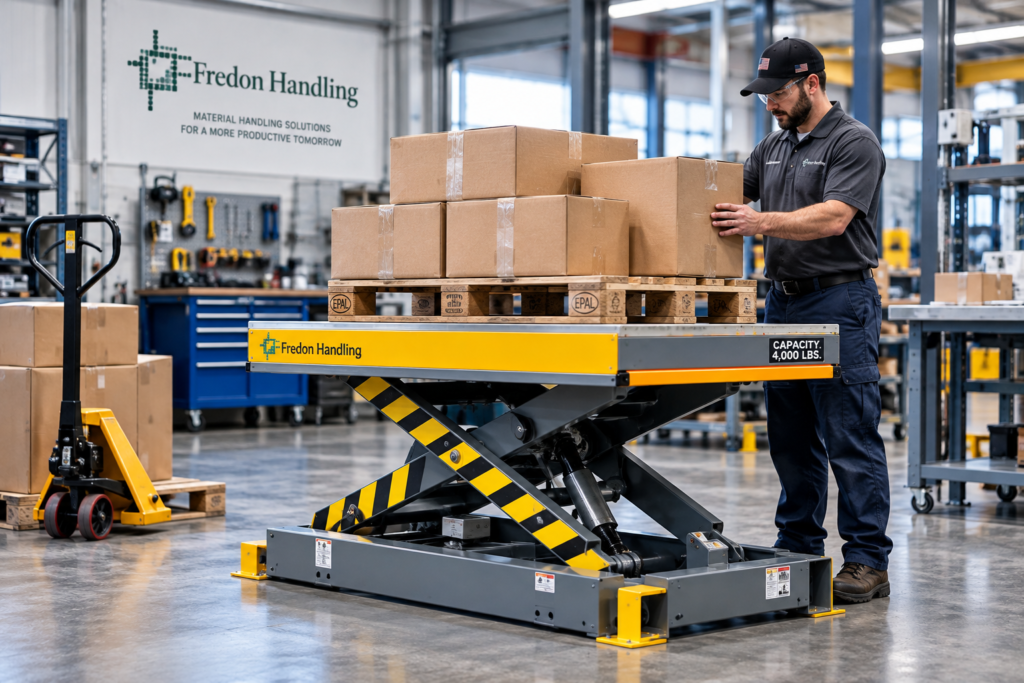
Rather than requiring employees to repeatedly bend, reach, lift or reposition heavy loads, the right material positioning equipment can bring the load closer to where the work actually takes place.
Fredon Handling can help evaluate your application and identify hydraulic lifting and positioning equipment based on load weight, dimensions, required height, operating frequency, workflow and facility conditions.
Industrial Hydraulic Lift Tables
Hydraulic lift tables use a lifting mechanism to raise and lower a platform carrying materials, pallets, containers, components or equipment.
They are commonly used anywhere material needs to be positioned vertically during production or handling.
Applications can include:
- Assembly
- Manufacturing
- Pallet loading and unloading
- Packaging
- Material transfer
- Machine loading
- Inspection
- Maintenance
- Production workstations
- Parts handling
The goal is not simply to lift a load. It is to position that load where employees or equipment need it.
Scissor Lift Tables
Scissor lift tables provide vertical movement using a scissor-style lifting mechanism beneath the platform.
They can be useful for applications where materials must move between different working heights or where operators repeatedly access products from pallets, containers or bins.
The appropriate lift table depends on factors such as capacity, platform size, travel distance, lowered height and duty cycle.
Pallet Positioning Equipment
Pallet positioners help maintain products at a more useful working height as items are added to or removed from a pallet.
This can be particularly valuable in repetitive palletizing and depalletizing applications.
Instead of forcing an employee to continually reach toward the floor as a pallet empties, positioning equipment can help keep the working level closer to the operator.
Industrial Tilt Tables
Some loads are easier to access when they are both raised and tilted toward the operator.
Industrial tilt tables can help reposition containers, bins and other loads so components are easier to reach during assembly, picking or production processes.
The correct configuration depends on the load, container geometry and how employees interact with the material.
Industrial Turntables
Turntables allow a load to rotate so employees can access different sides without repeatedly walking around the material or manually repositioning it.
Turntables may be used independently or incorporated into other material positioning systems.
For some applications, combining vertical lifting and rotation can create a more efficient working position.
Hydraulic Lifts and Ergonomics
Material positioning plays an important role in industrial ergonomics.
Tasks that repeatedly require workers to bend, reach, stretch or manually reposition heavy materials can create unnecessary physical demands.
Properly selected lifting and positioning equipment can help bring work closer to the employee rather than requiring the employee to continually move around the work.
The complete application should be evaluated, including:
- Working height
- Operator reach
- Load orientation
- Repetition
- Load weight
- Task duration
- Material movement before and after the workstation
Hydraulic lift tables are often most effective when considered together with the workstation, storage system and overall material flow.
How to Choose a Hydraulic Lift Table
Choosing the right hydraulic lift requires more than matching the equipment to a maximum weight.
Several factors should be evaluated.
Load Weight
Determine the maximum expected weight of the load.
The equipment should be selected for the actual operating conditions rather than only the average load.
Load Dimensions
Consider the length, width, shape and center of gravity of the material being positioned.
Platform dimensions should support the load appropriately for the application.
Required Lift Height
Identify both the lowest required position and the highest working or transfer position.
This determines the amount of vertical travel required.
Lowered Height
In some applications, the minimum lowered height is just as important as maximum elevation.
For example, pallet handling equipment may need to interface with pallet jacks, forklifts or other equipment.
Operating Frequency
Consider how often the equipment will cycle.
A lift used several times per day presents different operating requirements from equipment that cycles repeatedly throughout an entire shift.
Loading Method
Determine how the material will reach the lift.
Possible methods include:
- Manual loading
- Forklift
- Pallet jack
- Conveyor
- Crane or hoist
- Other production equipment
Operator Interaction
Consider what employees do after the material reaches the lift.
Are they assembling components, removing products from a pallet, loading a machine, packaging items or performing inspection?
Understanding the task helps determine how the load should be positioned.
Facility Conditions
The surrounding environment may affect equipment selection.
Consider:
- Available floor space
- Traffic patterns
- Nearby machinery
- Columns and obstructions
- Utilities
- Washdown or environmental conditions
- Material flow
- Future changes to the operation
Hydraulic Lift Tables for Manufacturing
Manufacturing facilities often use hydraulic lifting equipment to position components and materials during production.
Potential applications include:
- Assembly lines
- Machine loading
- Component positioning
- Work cells
- Packaging operations
- Palletizing
- Parts handling
- Production support
Material positioning equipment can be especially valuable where the same handling task occurs repeatedly throughout a shift.
Hydraulic Lift Tables for Warehouses
Warehouse applications may involve positioning pallets or containers for picking, packing, loading or replenishment.
A lift table or pallet positioner can help place products at a more practical working height while employees add or remove items.
The appropriate equipment depends on the load, picking process, pallet type and surrounding handling equipment.
Hydraulic Lift Table vs. Manual Handling
Manual handling may be appropriate for small, lightweight or infrequently moved materials.
As loads become heavier, larger or more repetitive, mechanical positioning equipment may provide a more practical solution.
Questions to consider include:
- How often is the task performed?
- How much does the material weigh?
- How far must employees bend or reach?
- Does the working height change during the process?
- Are employees manually repositioning the same load repeatedly?
- Is material handling slowing the production process?
The answers can help determine whether a hydraulic lift or another positioning solution should be evaluated.
Integrating Lift Tables With Other Material Handling Equipment
Hydraulic lifts rarely operate in isolation.
Depending on the application, they may interact with:
- Industrial workstations
- Pallet racking
- Conveyors
- Forklifts
- Pallet jacks
- Cranes and hoists
- Packaging equipment
- Assembly equipment
Considering these connections during equipment selection can help create a smoother material flow through the facility.
Information to Gather Before Requesting a Quote
Providing detailed application information helps identify suitable equipment more efficiently.
Before contacting Fredon Handling, gather:
- Maximum load weight
- Load dimensions
- Load type
- Required maximum height
- Required minimum height
- Desired platform dimensions
- Operating frequency
- Loading and unloading method
- Available floor space
- How employees interact with the material
- Existing equipment
- Any unusual operating conditions
Photos, drawings and measurements can also be useful when discussing the application.
Frequently Asked Questions About Hydraulic Lift Tables
What is a hydraulic lift table used for?
A hydraulic lift table raises, lowers or positions materials so they can be handled, transferred or worked on at a useful height. Applications include assembly, pallet handling, packaging, production and material transfer.
How do I choose the right hydraulic lift table?
Start with the maximum load weight, load dimensions, required lift height, lowered height, platform size, operating frequency and how the material will be loaded and unloaded.
What is the difference between a lift table and a pallet positioner?
A lift table primarily provides controlled vertical movement. A pallet positioner is specifically intended to help maintain palletized material at a practical working position as products are added or removed.
Can hydraulic lift tables improve ergonomics?
They can help reduce unnecessary bending, reaching and manual repositioning by bringing materials closer to the desired working height. The complete task and workstation should be evaluated when addressing ergonomic concerns.
Can lift tables be used with forklifts or pallet jacks?
Some configurations are designed to interface with forklifts, pallet jacks or other material-handling equipment. The loading method should be identified before selecting equipment.
Find the Right Hydraulic Lift for Your Application
The best hydraulic lift table is the one that fits the load, process, operator and facility.
Fredon Handling can help evaluate your material positioning requirements and identify equipment appropriate for your application.
Tell us what you are lifting, how much it weighs, where it needs to move and how your employees interact with the load.