
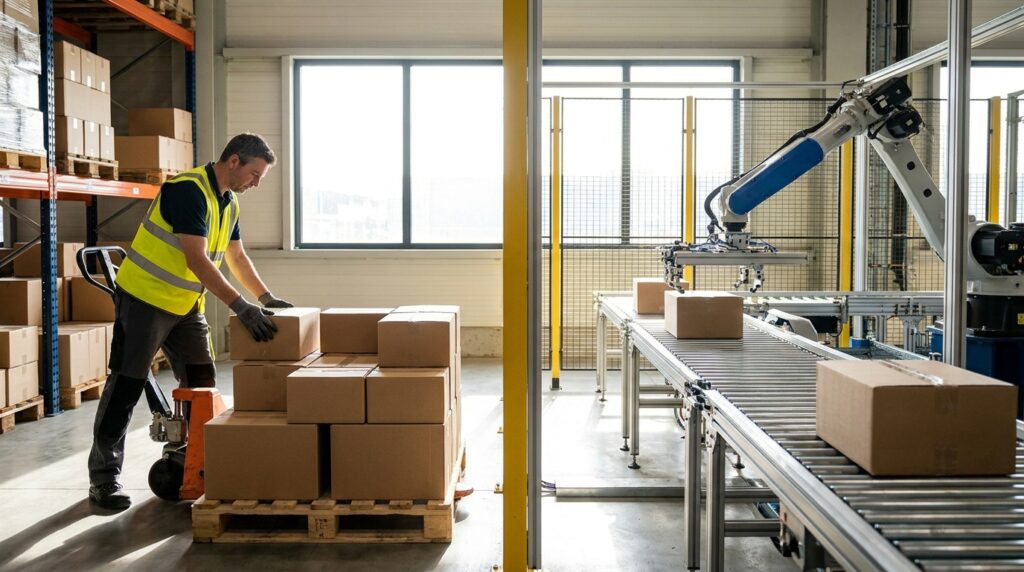
When facility managers and operations leaders evaluate their material handling strategies, the choice between manual vs. automated material handling represents one of the most consequential decisions affecting productivity, safety, and long-term operational costs. Both approaches offer distinct advantages depending on your facility’s throughput requirements, workforce availability, budget constraints, and growth projections.
This comprehensive guide examines the fundamental differences between manual and automated material handling systems, helping you determine which approach—or which hybrid combination—best serves your specific operational needs. Whether you’re managing a small warehouse, a large-scale manufacturing plant, or a distribution center handling thousands of SKUs daily, understanding these options enables smarter capital investments and more efficient workflows.
Understanding Manual Material Handling Systems
Manual material handling refers to any activity where workers physically move, lift, carry, push, or position materials without powered mechanical assistance. This encompasses everything from hand-carrying boxes to using non-powered equipment like hand trucks, pallet jacks, and basic carts.
Common Manual Handling Equipment and Methods
Facilities relying on manual material handling typically employ various equipment types to assist workers:
Non-powered transport equipment includes hand trucks, manual pallet jacks, platform carts, and dollies. These tools reduce physical strain compared to carrying items directly while maintaining complete operator control over movement and positioning.
Basic storage systems such as static shelving, gravity flow racks, and bin storage support manual picking operations. Workers retrieve items by walking to locations and selecting products by hand.
Manual lifting aids like lift tables, tilters, and positioners help workers handle heavy or awkward items more safely without full automation. These semi-mechanical devices reduce injury risk while keeping humans in direct control.
Advantages of Manual Handling Operations
Manual material handling remains prevalent across many industries for valid reasons:
Lower initial capital investment makes manual systems accessible to smaller operations or those with limited budgets. Basic equipment costs significantly less than automated alternatives.
Operational flexibility allows workers to adapt instantly to changing requirements, unusual product dimensions, or unexpected situations. Human judgment handles exceptions that might challenge automated systems.
Simpler implementation requires minimal technical expertise for deployment. Training new employees on manual equipment typically takes days rather than weeks.
Easier scalability for small operations permits facilities to add equipment and workers incrementally without major system overhauls.
Limitations and Challenges
Despite these benefits, manual material handling presents significant challenges that grow more pronounced as operations scale:
Physical strain and injury risk remain primary concerns. Repetitive lifting, bending, and carrying contribute to musculoskeletal disorders, which represent a substantial portion of workplace injuries in material handling environments.
Throughput constraints limit how quickly manual operations can process materials. Human fatigue, break requirements, and physical limitations create natural speed ceilings.
Inconsistent performance results from varying worker skill levels, fatigue throughout shifts, and human error. Quality and speed fluctuate in ways that automated systems avoid.
Rising labor costs make manual operations increasingly expensive over time, particularly in regions facing workforce shortages or wage pressures.
In exploring the differences between manual and automated material handling systems, it’s insightful to consider the case studies presented in the article on various projects undertaken by Fredon Handling. These projects highlight the practical applications and benefits of both approaches in real-world scenarios.
Exploring Automated Material Handling Solutions
Automated material handling systems use machinery, robotics, software, and controls to move, store, retrieve, and track materials with minimal human intervention. These systems range from simple conveyor installations to sophisticated robotic picking cells and fully integrated warehouse management platforms.
Types of Automation Technologies
Modern automated material handling encompasses diverse technologies suited to different applications:
Conveyor systems move products along fixed paths using belts, rollers, chains, or powered mechanisms. These fundamental automation components efficiently transport items between workstations, departments, or building areas.
Automated storage and retrieval systems (AS/RS) use computer-controlled equipment to automatically place and retrieve items from designated storage locations. Configurations include unit-load systems for pallets and mini-load systems for smaller items.
Automated guided vehicles (AGVs) and autonomous mobile robots (AMRs) transport materials throughout facilities without fixed infrastructure. AGVs follow predetermined paths while AMRs use advanced sensors and software to navigate dynamically.
Robotic picking and palletizing systems handle repetitive tasks like case picking, layer building, and pallet stacking. Modern systems incorporate vision technology and artificial intelligence for improved accuracy.
Sortation systems automatically route items to designated destinations based on size, weight, barcode data, or other criteria. High-speed sortation handles thousands of items hourly with precise accuracy.
Benefits of Automation Investment
Organizations implementing automated material handling typically experience multiple operational improvements:
Increased throughput and consistency enables facilities to process higher volumes with predictable performance. Automated systems maintain steady speeds throughout extended operations.
Reduced labor requirements lower ongoing operational expenses and decrease dependency on workforce availability. This proves particularly valuable given current labor market challenges.
Improved accuracy reduces picking errors, shipping mistakes, and inventory discrepancies. Many automated systems achieve accuracy rates exceeding 99.9 percent.
Enhanced safety removes workers from hazardous tasks, repetitive strain activities, and heavy lifting operations. This reduces injury rates and associated costs.
Better space utilization results from high-density storage configurations that automated systems can efficiently access. Narrow-aisle AS/RS installations maximize cubic storage within existing footprints.
Real-time visibility through integrated warehouse management systems provides accurate inventory data, performance metrics, and operational insights.
Considerations Before Automating
Despite compelling advantages, automation requires careful evaluation:
Substantial capital investment demands significant upfront funding. ROI analysis must account for all costs including equipment, installation, integration, training, and ongoing maintenance.
Implementation complexity requires careful planning, system integration expertise, and potential operational disruption during installation and commissioning.
Technical maintenance requirements necessitate specialized skills for ongoing support, troubleshooting, and repairs. Facilities must develop internal capabilities or establish reliable service partnerships.
Reduced flexibility in some configurations makes adapting to major product changes or operational shifts more challenging than manual alternatives.
Comparing Manual vs. Automated Material Handling Across Key Factors
Making informed decisions about manual vs. automated material handling requires systematic comparison across factors most relevant to your operation.
Cost Analysis: Initial Investment Versus Total Cost of Ownership
Manual systems require lower startup costs but accumulate higher ongoing expenses through labor, injury-related costs, and lower productivity. Automated systems demand substantial capital investment but typically deliver lower cost-per-unit-handled over time.
A proper comparison examines total cost of ownership over five to ten years, including:
- Equipment purchase or lease costs
- Installation and integration expenses
- Training and ramp-up costs
- Labor expenses including wages, benefits, and turnover costs
- Maintenance and repair requirements
- Energy consumption
- Insurance and workers’ compensation costs
- Productivity and throughput value
Many operations find that automation becomes cost-competitive when throughput exceeds certain thresholds or when labor availability creates operational constraints.
Throughput and Productivity Comparison
Automated systems generally deliver higher sustained throughput than manual alternatives. Consider these typical comparisons:
Order picking: Manual picker productivity often ranges from 60-120 lines per hour depending on layout and product characteristics. Goods-to-person automation can achieve 300-600 lines per hour or more.
Pallet handling: Manual forklift operations handle perhaps 20-30 pallets hourly per operator. Automated pallet handling systems can process significantly higher volumes continuously.
Sortation: Manual sorting operations are limited by human speed and accuracy. Automated sortation systems process thousands of items hourly with near-perfect accuracy.
Safety and Ergonomic Considerations
Workplace safety regulations from OSHA and other agencies establish requirements for both manual and automated environments. However, the nature of risks differs significantly.
Manual handling exposes workers to lifting injuries, repetitive strain disorders, and fatigue-related accidents. Proper training, ergonomic equipment, and job rotation help mitigate these risks but cannot eliminate them.
Automated systems present different hazards including pinch points, equipment collisions, and electrical dangers. Modern systems incorporate extensive safeguarding, but proper training, maintenance, and operating procedures remain essential.
When evaluating safety implications, always verify current OSHA, ANSI, and applicable industry standards for your specific equipment and applications. Requirements evolve and vary by jurisdiction.
Flexibility and Adaptability Assessment
Manual handling offers inherent adaptability—workers can immediately respond to new requirements, handle unusual items, or accommodate process changes.
Automated systems vary in flexibility. Traditional automation with fixed paths and programming may require significant reconfiguration for major changes. Modern AMRs and software-driven systems offer improved adaptability but still require planning for modifications.
Evaluate how frequently your operation changes and the nature of those changes when comparing flexibility requirements.
Determining the Right Approach for Your Facility
Selecting between manual vs. automated material handling depends on your specific operational context. Consider these evaluation criteria:
Assessment Checklist for Your Operation
Throughput requirements: What volumes must you handle currently and projected over the next five to ten years?
Labor situation: What is your current labor availability, turnover rate, and wage trend in your region?
Product characteristics: Do your products suit automated handling regarding size, weight, fragility, and consistency?
Facility constraints: Does your building accommodate automation infrastructure including ceiling heights, floor conditions, and electrical capacity?
Capital availability: Can you fund automation investment, and what payback period is acceptable?
Growth projections: How do you expect your business to change, and how might that affect handling requirements?
Process stability: How frequently do your products, packaging, or processes change?
When Manual Handling Makes Sense
Consider manual approaches when:
- Throughput volumes remain relatively low
- Product mix changes frequently
- Items require human judgment for handling
- Capital constraints prevent automation investment
- Operations are temporary or exploratory
- Flexibility requirements exceed consistency needs
When Automation Delivers Greatest Value
Prioritize automation when:
- Throughput demands exceed manual capacity
- Labor availability limits growth
- Tasks involve repetitive, predictable movements
- Accuracy requirements are extremely high
- Operations run extended hours or multiple shifts
- Worker safety concerns relate to heavy lifting or hazardous conditions
- Product consistency supports standardized handling
Hybrid Solutions: Combining Approaches Strategically
Many successful operations implement hybrid strategies, applying automation where it delivers clearest benefits while retaining manual flexibility elsewhere.
Common hybrid configurations include:
Automated transport with manual processing: Conveyors move materials between manual workstations where workers perform value-added tasks.
Automated storage with manual picking: AS/RS systems manage storage and retrieval while workers handle final order assembly.
Robotic heavy handling with manual finishing: Robots manage palletizing or case handling while workers handle exceptions and quality checks.
In the ongoing debate between manual and automated material handling systems, understanding the advantages and disadvantages of each approach is crucial for businesses looking to optimize their operations. A related article that delves deeper into this topic can be found at Fredon Handling, where you can explore insights on how to choose the right system for your specific needs. By examining factors such as efficiency, cost, and flexibility, companies can make informed decisions that enhance their productivity and streamline their processes.
Taking the Next Step Toward Optimized Material Handling
The decision between manual vs. automated material handling significantly impacts operational efficiency, safety, costs, and competitive positioning. Neither approach suits all situations—success comes from matching solutions to specific requirements.
Begin with honest assessment of current operations, future requirements, and organizational capabilities. Gather accurate data on costs, throughput, error rates, and safety incidents to support informed comparisons.
Consult with material handling specialists who can evaluate your specific situation and recommend appropriate solutions. Experienced partners like Fredon Handling bring expertise across both manual equipment and automation technologies, helping you identify the right approach—whether simple, sophisticated, or strategically combined—for your operational goals.
In the ongoing debate of Manual vs. Automated Material Handling, understanding the fundamentals of material handling systems is crucial for making informed decisions. A related article that delves deeper into this topic can be found at this link, where various material handling methods are explored, providing insights that can help businesses optimize their operations. By examining the advantages and disadvantages of each approach, companies can better assess which system aligns with their specific needs and goals.
Frequently Asked Questions About Manual and Automated Material Handling
What is the typical payback period for material handling automation?
Payback periods vary widely based on application, labor costs, and utilization but often range from two to five years for well-matched implementations. Detailed ROI analysis considering all factors provides accurate projections for specific situations.
Can small facilities benefit from automation?
Yes. While comprehensive automation typically suits larger operations, smaller facilities often benefit from targeted automation such as conveyors, lift assists, or single robotic cells addressing specific bottlenecks.
How does automation affect existing workers?
Automation typically changes roles rather than eliminating jobs entirely. Workers often transition to operating, monitoring, maintaining, or exception-handling positions that leverage human judgment alongside automated capabilities.
What maintenance do automated systems require?
Automated systems require regular preventive maintenance including inspections, lubrication, component replacement, and software updates. Maintenance requirements and costs should factor into total cost of ownership calculations.
How long does automation implementation take?
Implementation timelines range from weeks for simple conveyor installations to many months for complex integrated systems. Proper planning, facility preparation, and thorough testing ensure successful commissioning.