
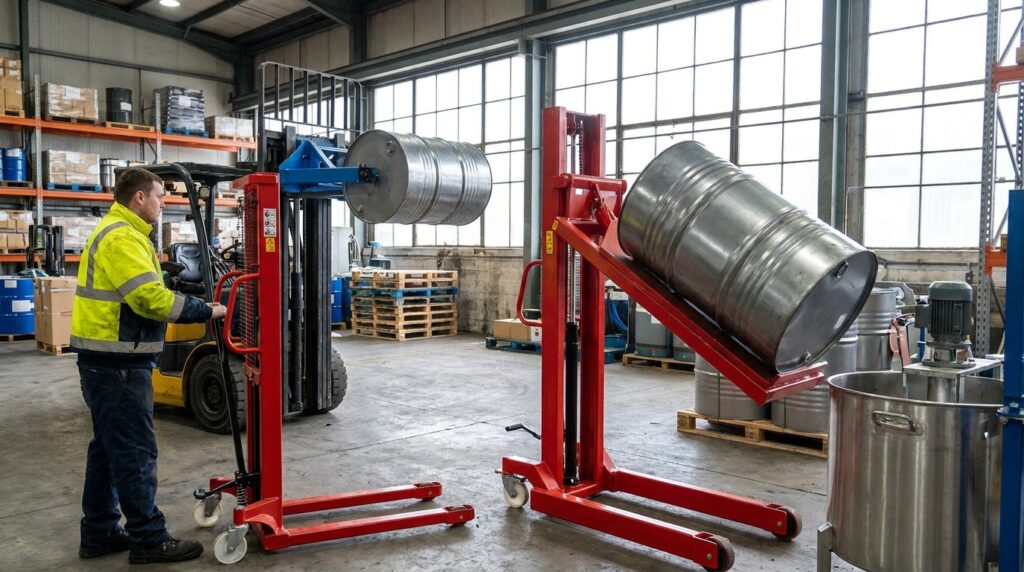
Drum Tilters vs. Drum Rotators: Understanding the Differences
In the demanding environment of warehouses, manufacturing plants, and industrial facilities, the efficient and safe handling of drums is paramount. Drums, whether they contain liquids, powders, or semi-solids, represent significant weight and potential hazards. Incorrect handling can lead to spills, injuries, and costly downtime. Among the various tools designed to manage drums, drum tilters and drum rotators stand out for their specific functionalities. While both address the challenge of drum manipulation, they serve distinct purposes. Understanding these differences is crucial for warehouse managers, plant engineers, safety managers, and industrial equipment buyers to make informed decisions that optimize operations, enhance safety, and improve productivity. This article delves into the core distinctions between drum tilters and drum rotators, exploring their mechanics, applications, benefits, and selection factors.
The Essential Functions of Drum Handling Equipment
Before dissecting the differences between tilters and rotators, it’s important to establish the fundamental goals of any drum handling equipment. At its core, effective drum handling aims to:
- Reduce Manual Labor: Lifting, tilting, and pouring from heavy drums manually is a significant ergonomic strain. Equipment takes over these physically demanding tasks.
- Enhance Safety: Proper equipment minimizes the risk of spills, splashes, back injuries, and other accidents associated with manual handling.
- Improve Efficiency: Streamlined processes for moving, positioning, and emptying drums lead to faster throughput and reduced operational bottlenecks.
- Increase Accuracy: Precise control over drum movement and dispensing ensures that materials are transferred accurately, reducing waste.
- Accommodate Various Drum Types: Different drum materials (steel, plastic), sizes (55-gallon, 30-gallon), and contents require specialized handling solutions.
Fredon Handling offers a comprehensive range of drum handling equipment designed to meet these diverse needs. You can explore our full selection at https://fredonhandling.com/drum-handling-equipment/.
For those interested in exploring the nuances of material handling equipment, a related article that delves deeper into the various types of drum handling solutions can be found at Fredon Handling. This resource provides valuable insights into the advantages and applications of different drum handling devices, helping readers make informed decisions based on their specific needs.
Drum Tilters: Precision Pouring and Controlled Dispensing
A drum tilter is a piece of equipment designed to lift and then tilt a drum to a specific angle, typically for the purpose of controlled dispensing or pouring of its contents. The primary function is to allow for gravity-assisted flow of liquids or free-flowing solids from the drum without requiring manual lifting or tipping.
How Drum Tilters Work
Drum tilters generally operate using a mechanism that secures the drum and then rotates it around a pivot point. This pivot point is strategically located to allow the drum to be tilted forward. The tilting action can be manual (via a hand wheel or crank), hydraulic (powered by a pump), or electric.
- Mechanism: Most tilters feature a robust clamp or cradle that firmly grips the drum. Once secured, a lifting mechanism (e.g., a hydraulic cylinder or a chain hoist) raises the drum. A separate mechanism, often a gear and worm drive or a hydraulic motor, then rotates the drum to the desired tilt angle.
- Drum Material and Size: Drum tilters are engineered to accommodate standard drum sizes, most commonly 55-gallon steel drums, but many models can be adapted for smaller drums (e.g., 30-gallon) or plastic drums with appropriate adapters. The weight capacity is a critical specification, ensuring the tilter can safely handle the full drum.
- Capacity and Weight: The capacity of a drum tilter is directly related to the drum size and the weight of its contents. Manufacturers specify the maximum drum weight and dimensions the equipment can safely handle. For example, a typical 55-gallon drum can weigh upwards of 500-600 lbs when full.
- Equipment Compatibility: Drum tilters are designed to work with various industrial settings. They can be standalone units, integrated into production lines, or mounted on forklifts for mobile operation.
Key Applications of Drum Tilters
The controlled pouring capability of drum tilters makes them invaluable in a variety of applications:
- Dispensing Liquids: This is the most common application. Operators can accurately pour liquids like oils, chemicals, paints, solvents, or food ingredients into smaller containers, mixing vats, or processing equipment. The precise tilt angle minimizes splashing and waste.
- Draining Drums: Tilters can be used to efficiently drain residual liquids from drums after emptying, ensuring maximum product recovery and preparing the drum for cleaning or disposal.
- Mixing and Blending: In some cases, drums can be tilted to facilitate in-drum mixing of contents, especially for powders or viscous liquids that require agitation.
- Waste Management: For hazardous waste drums, tilters allow for safe and controlled transfer of waste into disposal containers.
Benefits of Using Drum Tilters
- Ergonomic Improvement: Significantly reduces the physical strain on workers compared to manual tipping.
- Spill Prevention: The controlled tilting mechanism minimizes the risk of accidental spills, protecting personnel and the environment.
- Accurate Dispensing: Allows for precise pouring, reducing product loss and ensuring accurate batching.
- Versatility: Many models can handle different drum types and sizes, offering flexibility in operations.
- Improved Workflow: Faster and safer dispensing contributes to smoother production cycles.
Practical Example
Consider a chemical manufacturing plant that needs to transfer precisely measured amounts of a liquid catalyst from 55-gallon drums into smaller mixing tanks. Using a manual method would involve two workers struggling to tip a heavy drum, leading to potential spills and inaccurate measurements. With a hydraulic drum tilter, one operator can safely secure the drum, lift it to the required height, and then precisely control the tilt angle to pour the exact amount of catalyst needed into the tank, all while maintaining a safe distance.
Drum Rotators: Full Drum Inversion for Complete Emptying
A drum rotator, also known as a drum inverter or drum dumper, is designed for a more complete and often more vigorous manipulation of a drum. Its primary function is to invert the drum completely or to a significant degree, allowing for the emptying of its contents, particularly powders, granules, or viscous materials that may not pour easily.
How Drum Rotators Work
Drum rotators typically secure the drum within a cage or frame and then rotate it around its central axis. This rotation can be powered by manual effort, hydraulics, or electricity. The key difference from a tilter is the focus on full inversion rather than controlled pouring from an angled position.
- Mechanism: Drum rotators often feature a robust, open cage that encloses the drum. This cage is then rotated. Some designs lift the drum first before rotating, while others rotate it while it’s at a certain height. The rotation can be achieved through hand cranks, chain mechanisms, or hydraulic/electric motors. The primary goal is to achieve a 360-degree rotation or close to it.
- Drum Material and Size: Similar to tilters, rotators are designed for standard drum sizes. The cage construction is usually robust enough to handle steel drums. Adaptations may be available for plastic drums. The weight capacity is crucial.
- Capacity and Weight: The capacity is defined by the drum dimensions the cage can accommodate and the maximum weight it can safely rotate. These are typically designed for heavier loads than some basic tilters, especially when dealing with dense materials.
- Equipment Compatibility: Drum rotators are often used in conjunction with forklifts for mobility or as stationary units integrated into processing or packaging lines. Some are designed for overhead crane attachment.
Key Applications of Drum Rotators
The complete inversion capability of drum rotators makes them ideal for:
- Emptying Powders and Granules: This is where rotators truly shine. Materials like resins, powders, fertilizers, or food ingredients that are prone to sticking or compacting can be thoroughly emptied from the drum.
- Dispensing Viscous Materials: Thick pastes, adhesives, or sludges that would not flow from a tilted drum can be effectively dispensed using a rotator.
- Complete Product Recovery: Ensures that virtually all the product is removed from the drum, minimizing waste and maximizing value.
- Material Transfer to Hoppers or Process Equipment: Rotators are often used to empty drums directly into processing machinery, mixers, or hoppers.
- Bulk Material Handling: In industries dealing with bulk powders, rotators are a standard tool for efficient drum emptying.
Benefits of Using Drum Rotators
- Complete Emptying: Maximizes product recovery and minimizes material waste.
- Handles Difficult Materials: Effective for powders, granules, and viscous substances that are hard to pour.
- Reduces Manual Effort: Eliminates the need for manual labor to shake or pound drums to release contents.
- High Throughput: Facilitates rapid emptying of drums, improving operational speed.
- Versatility for Powder Handling: A preferred solution for many powder-based industries.
Practical Example
Imagine a food processing facility that uses drums filled with granulated sugar. Simply tilting the drum would leave a significant amount of sugar clinging to the sides and bottom. A drum rotator, however, can completely invert the drum, shaking out all the sugar into a processing hopper. This ensures full product utilization, reduces the need for manual cleaning of residual product, and speeds up the ingredient feeding process.
Drum Tilters vs. Drum Rotators: A Direct Comparison
The fundamental distinction lies in the degree and purpose of drum manipulation.
| Feature | Drum Tilter | Drum Rotator |
| : | :- | :- |
| Primary Action | Tilts drum to a specific angle. | Inverts drum completely or to a high degree. |
| Main Purpose | Controlled pouring/dispensing of liquids/free-flowing solids. | Complete emptying of powders, granules, viscous materials. |
| Mechanism | Pivots drum around an axis to create an opening. | Rotates drum around its central axis within a cage. |
| Material Handling | Best for liquids, free-flowing powders, small solids. | Best for powders, granules, viscous pastes, sticky materials. |
| Degree of Emptying | Partial to significant emptying, depending on tilt angle. | Aims for near-complete emptying. |
| Complexity | Generally simpler mechanism. | Often more robust and complex mechanism. |
| Speed | Moderate speed for controlled pouring. | Can be very fast for complete dumping. |
| Ergonomics | Excellent for reducing lifting and pouring strain. | Excellent for eliminating manual drum manipulation. |
| Safety Focus | Spill prevention during controlled dispensing. | Containing dust/material during vigorous inversion. |
When to Choose a Drum Tilter
- You primarily handle liquids or free-flowing powders that can be poured.
- Your operation requires precise dispensing into smaller containers or process equipment.
- Minimizing splashing during transfer is a priority.
- You need to drain residual liquids efficiently.
- Budget might be a consideration, as basic tilters can be more cost-effective.
Fredon Handling offers a range of drum tilters, including manual, hydraulic, and electric models, designed for various applications. Explore options like our Manual Drum Tilters or Hydraulic Drum Lifters & Tilters.
When to Choose a Drum Rotator
- You need to empty powders, granules, or viscous materials that stick to drum walls.
- Complete product recovery is essential to minimize waste.
- You need to transfer bulk materials directly into hoppers or processing machinery.
- Your operation demands rapid and thorough drum emptying.
- Dust containment during inversion is a significant concern (many rotators have features to mitigate this).
For operations requiring complete drum inversion and emptying, Fredon Handling provides robust solutions. Consider our Drum Rotators designed for maximum product recovery.
In exploring the distinctions between drum tilters and drum rotators, it can be beneficial to refer to a related article that delves deeper into the various handling solutions available for industrial applications. This resource provides valuable insights into the different types of equipment used for managing heavy drums and containers. For a comprehensive overview, you can check out the article on industrial handling solutions, which complements the discussion on drum tilter and rotator functionalities.
Factors to Consider When Selecting Drum Handling Equipment
Choosing between a drum tilter and a drum rotator, or even a specific model within those categories, involves several critical considerations:
1. Drum Characteristics
- Material: Steel drums (common for hazardous materials, flammable liquids) versus plastic drums (common for food-grade, non-hazardous chemicals). Ensure the clamp or cage is compatible with your drum material to prevent damage.
- Size and Dimensions: Standard sizes like 55-gallon (approx. 22.5 inches diameter, 35 inches height) are common. However, you might handle 30-gallon, 16-gallon, or even smaller drums. The equipment must be able to securely grip or enclose the drum.
- Weight: This is paramount. Calculate the maximum potential weight of your full drums (drum tare weight + product weight). The equipment’s rated capacity must exceed this to ensure safe operation.
- Contents: As discussed, liquids, powders, granules, or viscous materials will dictate whether tilting or rotating is more appropriate. Consider potential for dust generation with powders.
2. Application Requirements
- Frequency of Use: Will the equipment be used daily, intermittently, or occasionally? High-frequency use may justify a more automated or powered solution.
- Throughput Needs: How quickly do drums need to be emptied or dispensed? This will influence the choice between manual, semi-automatic, and fully automatic options.
- Dispensing Accuracy: For precise liquid dispensing, a tilter with fine angle control is crucial. For bulk powder emptying, a rotator’s thoroughness is key.
- Environment: Is the environment corrosive, explosive (ATEX rated equipment might be necessary), or does it require specific hygiene standards (e.g., food industry)?
- Integration: Does the equipment need to integrate with existing forklifts, conveyors, or processing machinery?
3. Power Source and Operation
- Manual: Relies on physical strength, often with a hand wheel or crank. Best for lighter drums, less frequent use, or when power is unavailable.
- Hydraulic: Offers significant lifting and tilting power, ideal for heavier drums and smoother operation. Requires a hydraulic power unit.
- Electric: Provides automated operation and precise control, often with push-button activation. Suitable for high-frequency use and integration into automated systems.
4. Safety Features
- Secure Clamping/Caging: Ensures the drum cannot slip during operation.
- Locking Mechanisms: Prevents accidental tilting or rotation.
- Emergency Stops: Essential for powered equipment.
- Operator Guarding: Protects the operator from moving parts.
- Material Containment: Especially important for rotators handling dusty materials.
- Stability: The equipment must be stable, especially when handling full, heavy drums.
5. Drum Material and Drum Capacity Specifications
When evaluating equipment, always pay close attention to the manufacturer’s specifications regarding drum material compatibility (e.g., “fits all 30-55 gallon steel drums”), maximum drum weight capacity, and the dimensions of drums the equipment can accommodate. Fredon Handling provides detailed specifications for each product to help you make an informed choice.
In exploring the distinctions between drum tilters and drum rotators, it’s also beneficial to consider how these systems fit into the broader context of material handling. For a deeper understanding of how various material handling systems can streamline your workflow efficiently, you can read this informative article on the subject. This knowledge can help you make more informed decisions about the equipment that best suits your operational needs. You can find the article here: material handling systems explained.
Maintenance and Safety Considerations for Drum Handling Equipment
Investing in quality drum handling equipment is only the first step. Proper maintenance and adherence to safety protocols are crucial for longevity, operational efficiency, and, most importantly, the well-being of your workforce.
Routine Maintenance for Drum Tilters and Rotators
- Regular Inspections: Periodically check for worn parts, loose bolts, leaks (in hydraulic systems), and any signs of damage.
- Lubrication: Ensure all moving parts, such as pivot points, gears, and chains, are properly lubricated according to the manufacturer’s recommendations. This prevents wear and ensures smooth operation.
- Hydraulic System Checks: For hydraulic equipment, monitor hydraulic fluid levels and condition. Check for leaks and ensure the system operates at the correct pressure.
- Battery Maintenance: If electric-powered, ensure batteries are charged and maintained according to the manufacturer’s guidelines.
- Cleaning: Keep the equipment clean to prevent build-up of dust or material that could interfere with mechanisms or pose a slip hazard.
Safety Best Practices
- Operator Training: Ensure all personnel operating drum handling equipment are thoroughly trained on its safe operation, including pre-operation checks, proper loading and unloading procedures, and emergency protocols.
- Read the Manual: Always refer to the equipment’s operation and maintenance manual for specific instructions and safety warnings.
- Weight Limits: Never exceed the rated weight capacity of the equipment.
- Clear Work Area: Ensure the area around the equipment is clear of obstructions, personnel, and unnecessary materials before operation.
- Secure Drum Engagement: Always ensure the drum is fully and securely clamped or contained before lifting or operating the mechanism.
- Controlled Movements: Operate the equipment smoothly and avoid sudden starts or stops, especially when drums are elevated or tilted.
- Personal Protective Equipment (PPE): Operators should always wear appropriate PPE, including safety glasses, gloves, and safety shoes. For dusty operations, respiratory protection may be required.
- Regular Safety Audits: Conduct periodic safety audits to ensure compliance with safety procedures and identify any potential hazards.
Fredon Handling: Your Partner in Drum Handling Solutions
Navigating the complexities of industrial equipment selection can be challenging. At Fredon Handling, we understand the critical role that efficient and safe drum handling plays in your operations. Whether you require the precise dispensing capabilities of a drum tilter or the complete emptying power of a drum rotator, we offer a comprehensive range of solutions designed to meet the demands of modern industrial environments. Our commitment to quality, durability, and safety ensures that you receive equipment that not only performs exceptionally but also protects your most valuable assets – your people.
We encourage you to explore our extensive catalog of drum handling equipment at https://fredonhandling.com/drum-handling-equipment/. Each product page provides detailed specifications, application guidance, and safety information to assist you in your selection process.
Frequently Asked Questions About Drum Tilters and Rotators
Q1: Can a drum tilter be used to empty powders?
A1: Drum tilters are best suited for liquids or free-flowing solids. While some powders might pour out when tilted, they are generally not as effective as drum rotators for completely emptying powders, especially if they are fine or prone to sticking. Drum rotators offer superior performance for powder emptying due to their ability to invert the drum.
Q2: What is the difference in the amount of product that can be retrieved from a drum using a tilter versus a rotator?
A2: A drum rotator will generally allow for a much higher percentage of product retrieval, often approaching 100%, especially with powders and viscous materials. A drum tilter’s efficiency in product retrieval is limited by the angle of tilt and the flow characteristics of the material.
Q3: Are there drum handling devices that can both tilt and rotate?
A3: While specialized equipment might exist for combined functions, typically drum tilters and drum rotators are distinct tools designed for specific primary actions. Some advanced drum dumpers might offer multi-axis movement, but they are generally more complex and costly. For most applications, choosing between a dedicated tilter or rotator based on the primary need is the most practical approach.
Q4: How do I determine the correct weight capacity needed for my drum handling equipment?
A4: To determine the correct weight capacity, you need to know the maximum weight of your full drums. This includes the weight of the drum itself (tare weight) plus the weight of the product it contains. Always choose equipment with a rated capacity that significantly exceeds the maximum drum weight you will be handling to ensure a safety margin.
Q5: What safety features should I look for in drum handling equipment?
A5: Key safety features include secure drum clamping or caging mechanisms to prevent slippage, robust locking systems to maintain position, clearly visible operational controls, emergency stop buttons on powered units, and ergonomic designs that minimize operator strain. For powdered materials, features that help contain dust during operation are also vital.
Conclusion
The choice between a drum tilter and a drum rotator hinges on the specific materials you handle and the desired outcome. Drum tilters excel in controlled pouring and dispensing of liquids and free-flowing substances, offering precision and spill prevention. Drum rotators are the workhorses for complete emptying of powders, granules, and viscous materials, maximizing product recovery and reducing waste. By carefully considering your drum characteristics, application requirements, and safety needs, you can select the right equipment from Fredon Handling to optimize your operations, enhance safety, and boost productivity.
Ready to enhance your drum handling efficiency and safety? Contact Fredon Handling today for expert advice and a personalized consultation. Our team is ready to help you find the perfect drum tilter or drum rotator solution for your specific needs.