
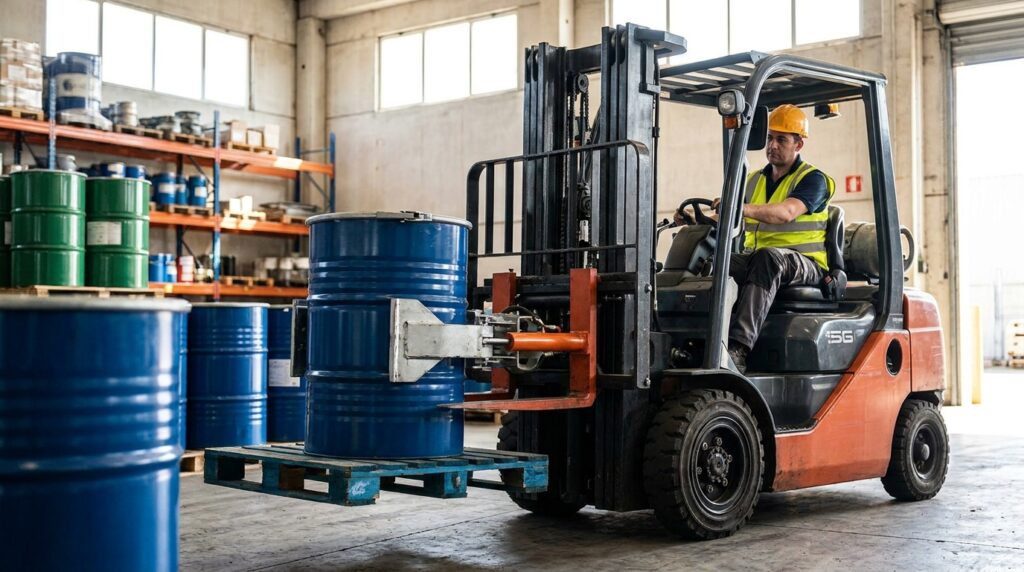
SEO Title: Safely Transport Drums with Forklifts: A Comprehensive Guide for Warehouses
Meta Description: Master safe forklift drum transportation with our expert guide. Explore equipment, best practices, safety protocols, and maintenance for warehouse managers, engineers, and buyers.
Understanding the Foundation: Forklift Drum Transport Fundamentals
The safe and efficient movement of drums within a warehouse or industrial facility is a critical operational necessity. Drums, whether they contain raw materials, finished products, or hazardous substances, present unique handling challenges. Relying solely on manual labor or inappropriate equipment can lead to costly accidents, product damage, and severe injuries. Forklifts, when equipped with the right attachments and operated with proper technique, offer a powerful solution for drum transportation. This comprehensive guide delves into the intricacies of safely transport drums using a forklift, equipping warehouse managers, plant engineers, safety managers, and industrial equipment buyers with the knowledge to optimize their operations and minimize risks. We will explore the types of drums you’ll encounter, the essential forklift attachments designed for drum handling, crucial safety protocols, and practical considerations for selecting the right equipment.
The Diverse World of Drums: Materials, Sizes, and Capacities
Before discussing safely transport drums using a forklift, it’s essential to understand the various types of drums that commonly circulate through industrial environments. The material, size, and weight of a drum directly influence the handling methods and the type of forklift attachment required. Understanding these characteristics is the first step in ensuring safe and effective transport.
Common Drum Materials and Their Implications
Drums are typically constructed from one of three primary materials: steel, plastic (polyethylene), or fiber. Each material has distinct properties that affect its handling requirements.
Steel Drums
Steel drums are robust and offer excellent protection for contents, especially hazardous materials. They are commonly used for flammable liquids, chemicals, and sensitive products requiring a high degree of containment. Their rigidity means they can withstand significant external forces. However, steel drums can be heavy when empty, and their smooth surfaces can sometimes present a grip challenge for certain attachments. Their weight can also be a factor in the overall load capacity of the forklift and attachment.
Plastic Drums
Polyethylene drums, often referred to as poly drums, are lightweight, corrosion-resistant, and do not rust. They are frequently used for a wide range of chemicals, food products, and water. Their flexibility can be an advantage for some applications, but it also means they are more susceptible to deformation under pressure. This is particularly important when selecting a drum handling attachment, as excessive clamping force could damage a plastic drum. Drum capacities for plastic drums vary widely, from small 5-gallon pails to larger 55-gallon drums.
Fiber Drums
Fiber drums, also known as composite drums, are made from compressed paperboard or cardboard. They are lightweight, environmentally friendly, and cost-effective. While suitable for many dry goods, powders, and some semi-liquids, they generally offer less structural integrity and protection compared to steel or plastic drums. They are not typically suitable for hazardous materials that require stringent containment. Their lighter weight is a consideration for forklift capacity, but their susceptibility to moisture and crushing requires careful handling to prevent damage.
Drum Sizes and Standard Capacities
The most common drum size encountered in industrial settings is the 55-gallon (approximately 208-liter) drum. However, drums come in a variety of sizes, from small 5-gallon pails (19-liter) to larger 110-gallon intermediate bulk containers (IBCs) which, while not always referred to as “drums,” often require similar handling principles.
- 5-Gallon Pails: These smaller containers are often handled in multiples. Specialized attachments can grip and lift several pails at once, or individual pails can be stacked on a pallet and handled with standard forks. Their lighter weight makes them easier to manage, but their smaller footprint can make them less stable when stacked.
- 30-Gallon Drums: A mid-range option, these drums are also common for various industrial products. They offer a balance between volume and manageability.
- 55-Gallon Drums: This is the workhorse of drum handling. They are frequently transported individually or in pairs. Their significant weight (often exceeding 400 lbs when full) necessitates robust lifting equipment and careful operation.
- 110-Gallon Drums/IBCs: While larger than standard drums, these often require specialized handling equipment that shares principles with drum manipulation, focusing on secure gripping and stable transport.
The actual weight of a drum will depend on its contents. A full 55-gallon drum of water weighs approximately 460 pounds (208 kg), while a drum of dense chemicals or powders can weigh considerably more. Always consult the drum’s labeling for precise weight information.
Drum Weight and Capacity Considerations
The safely transport drums using a forklift heavily depends on understanding the drum’s weight and the forklift’s capacity.
- Full Drum Weight: This is the most critical factor. Always know the maximum potential weight of the drums you will be handling. This information is usually available from the drum manufacturer or product supplier.
- Forklift Capacity: Your forklift has a rated capacity that is reduced by the weight of the attachment and the load’s horizontal center of gravity. Exceeding this capacity is extremely dangerous.
- Attachment Capacity: Each drum handling attachment will also have its own weight and load capacity rating, which must be adhered to.
Equipment Compatibility: Matching the Drum to the Tool
Not all forklift drum attachments are created equal, and compatibility is paramount.
- Clamp Attachments: These are designed to grip the rim of a drum. They are versatile but require a consistent rim profile. Steel drums typically have a more pronounced and consistent rim than plastic drums, making them ideal for clamp attachments.
- Drum Forks: These specialized forks slide under the drum, providing support. They are suitable for most drum types and are particularly useful when drums are palletized.
- Drum Rotators/Tippers: These attachments allow for the controlled pouring of drum contents. They require a secure grip and often incorporate a mechanism to tilt the drum. They are best suited for drums with robust construction.
When selecting an attachment, confirm its compatibility with the specific types, sizes, and materials of drums you handle regularly. Ensure the attachment’s gripping mechanism will not damage the drum or its contents.
For those interested in learning more about safe material handling practices, a related article can be found on the Fredon Handling website. This resource provides valuable insights into various aspects of equipment safety and operational efficiency, which can complement the guidelines on how to safely transport drums using a forklift. To explore this further, you can visit the article here: Fredon Handling.
Essential Forklift Attachments for Drum Handling
To safely transport drums using a forklift, specialized attachments are indispensable. These tools are engineered to provide secure gripping, stable support, and efficient manipulation of drums, mitigating the risks associated with manual handling or inadequate equipment.
Drum Clamps: The Versatile Grippers
Drum clamps are among the most common and versatile forklift attachments for drum handling. They operate by gripping the chime or rim of a drum to lift and move it.
Single Drum Clamps
These clamps are designed to handle one drum at a time. They are ideal for navigating tight spaces and for situations where individual drum placement is critical.
- Operation: The clamp arms extend to encompass the drum and then tighten, creating a secure grip on the top and bottom rims.
- Drum Material Suitability: Best suited for steel drums due to their rigid rims. While they can be used with plastic drums, care must be taken to avoid excessive clamping force, which could deform or crack the drum.
- Capacity: Varies by model, but typically designed for standard 55-gallon drums. Lighter duty versions may handle smaller drums or pails.
- Advantages: Excellent for quick pick-ups and drop-offs, good maneuverability.
- Disadvantages: Can require precise alignment to engage the rim effectively, not ideal for damaged drums with compromised rims.
Double Drum Clamps
These attachments allow operators to handle two drums simultaneously, significantly increasing efficiency.
- Operation: Similar to single clamps, but with two sets of gripping arms, allowing them to secure two drums side-by-side.
- Drum Material Suitability: Again, primarily designed for steel drums. Using with plastic drums requires careful pressure management.
- Capacity: Designed to lift two standard drums. The forklift’s capacity must be sufficient to handle the combined weight of two drums and the attachment.
- Advantages: Doubles throughput, reduces forklift traffic, and saves time.
- Disadvantages: Requires more space to maneuver, a greater burden on forklift capacity, and potential for drum damage if not aligned properly.
Drum Clamp with Pallet Manipulator
Some advanced drum clamps integrate a pallet gripping function. This allows for the handling of drums that are either on pallets or can be placed onto a pallet by the clamp itself.
- Operation: Combines the drum gripping mechanism with forks or clamps designed to engage with a pallet.
- Drum Material Suitability: Dependent on the drum clamp portion; generally best for steel drums.
- Capacity: Varies based on the combined capabilities.
- Advantages: Offers flexibility in handling drums with or without pallets, streamlines workflow.
- Disadvantages: More complex, heavier attachment, requires more operator skill.
Drum Forks: Secure Underneath Support
Drum forks provide a stable and secure method of carrying drums by sliding beneath them.
- Operation: These specialized forks are designed to fit snugly under the circumference of a drum, providing balanced support. They are often adjustable to accommodate different drum diameters.
- Drum Material Suitability: Excellent for all drum types (steel, plastic, fiber) as they distribute weight evenly and do not rely on the rim for grip. This makes them particularly good for handling drums that might be slightly damaged or have less defined rims.
- Capacity: Dependent on the forklift and the fork strength. Standard 55-gallon drums can be handled effectively.
- Advantages: Gentle on drums, highly stable, suitable for various drum types and conditions, good for transporting drums on pallets.
- Disadvantages: Requires a forklift with sufficient fork length and capacity, might not be as agile in very confined spaces as a clamp.
Drum Rotators and Tippers: Controlled Pouring
For operations that require the dispensing of drum contents, drum rotators and tippers are essential. These attachments securely hold a drum and allow for its controlled rotation and tilting.
- Operation: The attachment clamps the drum and then utilizes hydraulic or manual mechanisms to rotate the drum around its horizontal axis, enabling precise pouring of liquids or powders.
- Drum Material Suitability: Best suited for robust drums, particularly steel drums, that can withstand the forces involved in rotation. Plastic drums may be used with caution, ensuring the clamp mechanism does not induce undue stress.
- Capacity: Designed to handle standard drum sizes and weights, with specific models rated for particular loads.
- Advantages: Enables safe and controlled dispensing of contents, reduces manual labor and risk of spills, improves accuracy.
- Disadvantages: More complex and expensive attachments, require specialized training for operation, not suitable for all drum types or contents.
Drum Grabs and Lifters: Simple Vertical Movement
Drum grabs and lifters are designed for simpler, vertical lifting and moving of drums. They often use a locking mechanism that engages with the drum’s rim or body.
- Operation: These devices typically consist of a frame with a gripping mechanism that secures the drum. They are then attached to the forklift’s carriage or forks.
- Drum Material Suitability: Varies by design. Some are similar to clamps and work best with steel drums, while others are more general-purpose.
- Capacity: Generally designed for single drum lifting.
- Advantages: Relatively simple and cost-effective for basic drum lifting.
- Disadvantages: Limited in their manipulation capabilities compared to clamps or rotators, can be less stable for long-distance transport.
When choosing an attachment, always consult the manufacturer’s specifications regarding drum compatibility, weight capacity, and any limitations. Fredon Handling offers a comprehensive range of drum handling solutions, including various types of drum clamps, forks, and specialized attachments. Visit https://fredonhandling.com/drum-handling-equipment/ to explore their offerings and find the ideal solution for your specific needs.
Implementing Safe Forklift Drum Transport Procedures
The most critical aspect of moving drums with a forklift is adherence to stringent safety protocols. These procedures are designed to prevent accidents, protect personnel, and preserve the integrity of the drums and their contents. Establishing and consistently enforcing these guidelines is paramount for any operation involving safely transport drums using a forklift.
Pre-Operation Checks: Ensuring Readiness
Before any drum transport operation begins, a thorough pre-operation check is essential. This applies to both the forklift and the drum handling attachment.
Forklift Inspection
- Tires: Check for wear, damage, and proper inflation.
- Hydraulics: Inspect for leaks in hoses, cylinders, and pumps. Ensure proper fluid levels.
- Brakes: Test the effectiveness of service and parking brakes.
- Lights and Horn: Verify all lights (headlights, taillights, strobes) and the horn are functioning correctly.
- Mast and Forks: Check for any damage or wear on the mast channels and forks.
- Operator Controls: Ensure all controls are responsive and functioning as intended.
- Fluid Levels: Check engine oil, coolant, and hydraulic fluid levels.
Attachment Inspection
- Gripping Mechanism: Inspect the clamp jaws, forks, or other gripping elements for wear, cracks, or damage. Ensure they move freely and engage securely.
- Hydraulic Connections: Check for leaks at hose connections and cylinder seals.
- Mounting Hardware: Verify that all bolts and pins securing the attachment to the forklift are present and secure.
- Safety Latches/Locks: Ensure any safety mechanisms are functioning correctly.
- Weight Capacity Labels: Confirm that the attachment’s weight capacity is clearly visible.
Loading and Lifting Techniques
The manner in which drums are engaged and lifted is crucial for stability and safety.
- Approach: Approach the drum squarely and at a slow, controlled speed. Ensure the forklift is stable on the floor.
- Engagement (Clamps):
- For single drum clamps, align the clamp arms with the drum’s chime.
- Slowly close the clamps, ensuring even pressure on both sides. Avoid over-tightening, especially with plastic drums.
- Listen for secure engagement. If unsure, disengage and re-approach.
- Engagement (Forks):
- Slide the drum forks completely under the drum, ensuring the drum is centered and balanced on the forks.
- Lift the forks slightly to ensure the drum is securely supported.
- Lifting:
- Once the drum is securely engaged, tilt the mast back slightly to stabilize the load against the carriage.
- Lift the drum just enough to clear the ground or any obstructions. Avoid lifting higher than necessary.
- Load Stability: Ensure the drum is stable and centered on the attachment. Any wobbling or shifting indicates an insecure grip or an unbalanced load.
Traveling with Drums
Movement of the forklift with a drum load requires a different approach than traveling with a standard pallet.
- Speed: Travel at a slow, safe speed, especially when turning or on inclines.
- Visibility: Maintain clear visibility. If the drum obstructs your view, travel in reverse or use a spotter. Drum clamps can significantly reduce forward visibility.
- Mast Position: Keep the mast tilted slightly back to keep the load stable against the carriage. Avoid tilting the mast forward while carrying a drum.
- Pathways: Stick to designated travel aisles. Ensure pathways are clear of obstructions, spills, or debris.
- Turns: Take turns slowly and wide to avoid tipping.
- Incline/Decline: When traveling on an incline or decline, always travel with the load facing downhill. If carrying a drum, this means traveling in reverse when going downhill, or forward when going uphill if visibility allows.
- Stopping: Stop smoothly and gradually. Avoid sudden braking.
Unloading and Placement
The process of placing a drum at its destination is as important as the lifting and transport.
- Approach: Approach the drop-off location squarely and at a slow speed.
- Positioning: Position the forklift precisely where the drum needs to be placed.
- Lowering: Lower the drum slowly and steadily.
- Disengagement (Clamps): Once the drum is fully resting, slowly open the clamps, ensuring the drum remains stable.
- Disengagement (Forks): Gently slide the drum forks out from under the drum. Ensure the drum is fully supported by its resting surface before retracting the forks.
- Clearance: Ensure sufficient clearance before retracting the forklift.
Personal Protective Equipment (PPE)
Appropriate PPE is non-negotiable for anyone operating a forklift or working in proximity to drum handling operations.
- Safety Shoes: Steel-toed boots are essential to protect feet from falling objects.
- Safety Glasses/Goggles: Protect eyes from splashes or airborne debris.
- Gloves: Chemical-resistant gloves should be worn if handling drums with potentially hazardous contents. Heavy-duty gloves provide grip and protection.
- High-Visibility Clothing: Especially important in busy warehouse environments to ensure operators and pedestrians are easily seen.
- Hard Hat: May be required in areas with overhead hazards.
Emergency Procedures
Having clear emergency procedures in place is vital for responding to incidents effectively.
- Spill Response: Know the location of spill kits and be trained in their use. Understand the procedures for containing and cleaning up spills based on the drum’s contents.
- Accident Reporting: Establish a clear protocol for reporting all accidents, near misses, and equipment malfunctions.
- Fire Safety: Be aware of fire extinguisher locations and evacuation routes. Understand the fire hazards associated with the materials being stored and transported.
Selecting the Right Forklift and Drum Handling Equipment
Choosing the correct forklift and drum handling attachment is a strategic decision that directly impacts operational efficiency, safety, and cost-effectiveness. This involves a careful assessment of your specific needs and the available equipment. Safely transport drums using a forklift begins with the right tools for the job.
Assessing Your Operational Needs
Before investing in any equipment, conduct a thorough needs assessment.
Drum Characteristics:
- Types of Drums: What materials (steel, plastic, fiber) do you handle most frequently?
- Sizes and Capacities: What are the typical drum sizes (5-gallon, 55-gallon, IBCs) and their maximum filled weights?
- Contents: Are you handling hazardous materials? Corrosive substances? Food-grade products? This will influence material compatibility and containment requirements.
Warehouse Environment:
- Aisle Widths: How narrow are your aisles? This will dictate the maneuverability required and the type of forklift (e.g., narrow-aisle, reach truck).
- Floor Conditions: Are your floors smooth and level, or are there rough patches or inclines?
- Ceiling Heights: What are the maximum stacking heights required?
- Lighting: Is adequate lighting provided for safe operation?
- Ventilation: Is proper ventilation in place, especially when handling volatile materials?
Workflow and Throughput:
- Volume of Drums: How many drums do you typically move per shift or per day?
- Frequency of Movement: How often are drums being moved?
- Specific Tasks: Do you only need to transport drums, or do you also need to stack them, rotate them for dispensing, or handle them on pallets?
Forklift Types and Drum Handling Compatibility
The type of forklift you use plays a significant role in its ability to safely transport drums using a forklift.
- Counterbalance Forklifts: Versatile and common, they are suitable for most drum handling tasks, especially when paired with drum clamps or forks. Their stability allows for lifting drums to moderate heights.
- Reach Trucks: Ideal for narrow aisles and high-rack storage. They can be equipped with specialized attachments to handle drums, but maneuverability with a drum load might be more challenging compared to a counterbalance forklift.
- Order Pickers: Primarily used for selecting individual items, but some can be adapted for drum handling with appropriate attachments, particularly for lower-level operations.
- Pallet Jacks (with drum attachments): While not a forklift, some powered pallet jacks can be fitted with basic drum lifting accessories for short-distance, ground-level movements.
Key Selection Factors for Drum Handling Attachments
When selecting a drum handling attachment, consider these critical factors:
- Capacity: Ensure the attachment’s weight and drum capacity exceed your maximum load requirements, with a safety margin.
- Drum Compatibility: Verify that the attachment is designed for the types and sizes of drums you handle. Consider rim condition for clamps and overall drum integrity for forks.
- Ease of Use: The attachment should be intuitive to operate, minimizing training time and reducing the risk of operator error.
- Durability and Construction: Invest in high-quality, robust attachments built to withstand the rigors of an industrial environment. Look for reputable manufacturers with good warranties.
- Maintenance Requirements: Consider the ease of maintenance and the availability of spare parts.
- Visibility: How does the attachment affect the operator’s visibility? Drum clamps, in particular, can significantly obscure forward vision.
- Versatility: If your needs vary, consider attachments that can handle multiple drum types or perform multiple functions.
- Cost vs. Value: While initial cost is a factor, prioritize value, which includes durability, efficiency, and safety features. A cheaper attachment that fails prematurely or causes accidents will be more expensive in the long run.
Fredon Handling’s Drum Handling Solutions
Fredon Handling offers a comprehensive suite of drum handling equipment designed to optimize your operations. Their range includes:
- Drum Clamps: Available in single and double configurations, designed for secure gripping of steel and plastic drums.
- Drum Forks: Providing stable and gentle support for various drum types, suitable for palletized and unpalletized drums.
- Drum Grabbers: Offering efficient vertical lifting solutions for standard drums.
- Specialized Attachments: For unique drum types or handling requirements.
Explore their offerings at https://fredonhandling.com/drum-handling-equipment/ to discover solutions that can enhance the safety and efficiency of your drum transportation processes.
When considering the safe transport of heavy items like drums using a forklift, it’s essential to understand the best practices involved in material handling. For further insights on this topic, you might find the article on material handling particularly helpful, as it covers various techniques and safety measures that can enhance your operational efficiency and safety standards.
Maintenance and Longevity for Drum Handling Equipment
The longevity and reliable performance of your forklift drum handling equipment hinge on a proactive and thorough maintenance program. Neglecting maintenance can lead to equipment failure, costly downtime, and, most importantly, safety hazards. Implementing regular checks and adhering to manufacturer recommendations are crucial for safely transport drums using a forklift over the long term.
Daily Inspections: The First Line of Defense
Similar to pre-operation checks, daily visual inspections are essential. Operators should be trained to identify and report any anomalies immediately.
- Lubrication Points: Check for adequate lubrication on moving parts, such as pivot points and sliders.
- Hydraulic Hoses: Inspect for cuts, abrasions, kinks, or leaks. Even minor leaks can indicate a developing problem.
- Structural Integrity: Look for any signs of cracks, bending, or distortion in the frame, arms, or clamps.
- Grip Surfaces: Ensure gripping surfaces on clamps or forks are free from excessive wear or damage that could compromise grip.
- Actuation: Test the movement of clamps, forks, or other operational components to ensure they move freely and without binding.
Scheduled Preventative Maintenance
Beyond daily checks, a scheduled preventative maintenance program is vital. This should be based on manufacturer recommendations, operating hours, and usage intensity.
Key Maintenance Tasks:
- Hydraulic System: Regular inspection of hydraulic fluid levels and condition. Filter changes at recommended intervals prevent contamination. Check hydraulic pressure and ensure relief valves are functioning correctly.
- Mechanical Components: Periodic tightening of bolts, pins, and connections. Replacement of worn bushings or bearings.
- Wear Parts: Drum handling attachments often have specific wear parts, such as rubber grips on clamps or wear plates on forks. These should be inspected and replaced as needed.
- Cleaning: Keeping attachments clean, especially after handling drums containing sticky or corrosive materials, prevents build-up that can impede function and lead to corrosion.
- Lubrication Schedule: Adhere to a strict lubrication schedule for all moving parts.
Troubleshooting Common Issues
Understanding and addressing common problems promptly can prevent minor issues from escalating.
- Slipping Grip (Clamps):
- Cause: Worn grip pads, damaged chime on the drum, insufficient clamping pressure.
- Solution: Replace grip pads, ensure drum chime is intact, check hydraulic pressure for adequate clamping force.
- Binding Movement:
- Cause: Lack of lubrication, debris in mechanism, bent components.
- Solution: Lubricate all moving parts, clean thoroughly, inspect for and straighten bent components.
- Hydraulic Leaks:
- Cause: Damaged seals, worn hoses, loose connections.
- Solution: Replace damaged seals and hoses, tighten connections. For recurring leaks, consult a hydraulic specialist.
- Inconsistent Drum Engagement:
- Cause: Misalignment, worn attachment components, drum inconsistencies.
- Solution: Ensure proper alignment during engagement, inspect and repair/replace worn parts on the attachment, and if possible, use drums with consistent dimensions.
Record Keeping
Maintaining detailed maintenance records is crucial for tracking equipment history, scheduling future maintenance, and identifying recurring issues. These records should include:
- Date of maintenance
- Type of maintenance performed (inspection, repair, part replacement)
- Technician’s name
- Any issues identified and resolutions
By investing in a robust maintenance program, you ensure your drum handling equipment remains in optimal condition, contributing to safer operations, reduced downtime, and a longer service life. Fredon Handling not only provides high-quality equipment but also supports its customers with advice on best practices for maintenance and longevity.
Frequently Asked Questions About Forklift Drum Transport
Q1: Can I use standard forklift forks to transport drums?
While it might seem possible to balance a drum on standard forks, it is highly unsafe and not recommended. Drums can easily roll off, leading to spills, damage, and injuries. Specialized drum handling attachments like drum forks or clamps are designed to securely grip or support drums, ensuring stability during transport.
Q2: What is the safest way to lift a plastic drum with a forklift clamp?
Plastic drums are more susceptible to damage from excessive force than steel drums. When using a drum clamp for a plastic drum, ensure the clamp’s pressure is adjustable and set it to the minimum required to securely hold the drum without deforming or cracking it. It’s often best to use attachments specifically designed for plastic drums or to opt for drum forks, which provide support rather than clamping force. Always consult the attachment manufacturer’s guidelines for plastic drum handling.
Q3: How do I know if my forklift is powerful enough to handle drums with an attachment?
The forklift’s rated capacity is crucial. This capacity is reduced by the weight of the drum handling attachment and the horizontal distance of the load’s center of gravity from the forklift’s mast. Always consult the forklift’s data plate and the attachment’s specifications. A general rule is to ensure the combined weight of the drum(s) and the attachment is well within the forklift’s reduced capacity for the intended load center.
Q4: What kind of training is required for operating a forklift with drum handling attachments?
Operators must be certified forklift operators and receive specific training on the safe operation of the drum handling attachment they will be using. This training should cover pre-operation checks, proper engagement and disengagement techniques for different drum types, safe travel procedures with drum loads, and emergency response protocols.
Q5: How often should drum handling attachments be inspected and maintained?
Drum handling attachments should be visually inspected daily by the operator before use. A more comprehensive inspection and preventative maintenance schedule, typically on a weekly or monthly basis depending on usage, should be implemented. This schedule should be guided by the manufacturer’s recommendations and should include checks for hydraulic systems, mechanical components, wear parts, and overall structural integrity.
Conclusion: Prioritizing Safety and Efficiency in Drum Handling
The safe and efficient transportation of drums is a cornerstone of successful warehouse and industrial operations. By understanding the diverse nature of drums, leveraging the appropriate forklift attachments, implementing rigorous safety procedures, and maintaining equipment diligently, you can significantly reduce the risks associated with drum handling. Investing in the right equipment from reputable suppliers like Fredon Handling is not just about acquiring tools; it’s about ensuring the well-being of your personnel, protecting your valuable inventory, and optimizing your workflow.
To ensure you have the most effective and safest solutions for your specific drum handling needs, we encourage you to consult with our experts.
Ready to enhance your drum handling safety and efficiency? Contact Fredon Handling today for a personalized consultation and to explore our comprehensive range of forklift drum handling equipment.