
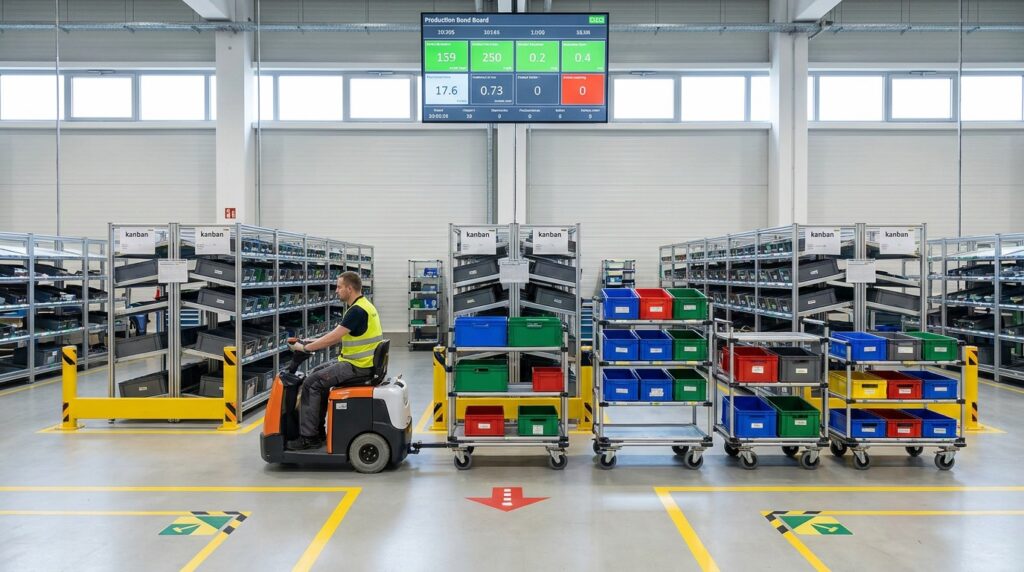
Lean material handling represents a systematic approach to moving, storing, and controlling products throughout industrial facilities while eliminating waste and maximizing value. For warehouse managers, manufacturing directors, and facility decision-makers, implementing lean material handling principles can dramatically reduce operational costs, improve worker safety, and accelerate throughput without requiring massive capital investments.
This comprehensive guide explores how lean principles apply specifically to material handling operations, providing actionable strategies that industrial facilities can implement to achieve measurable improvements in efficiency and productivity.
Understanding Lean Material Handling Fundamentals
Lean material handling adapts the core principles of lean manufacturing to the specific challenges of moving materials, components, and finished products through industrial environments. The methodology focuses on identifying and eliminating activities that consume resources without adding value to the customer.
At its core, lean material handling recognizes that every time a product is moved, stored, or handled, there’s potential for waste. The goal isn’t necessarily to eliminate all material movement—which would be impossible in most operations—but rather to ensure that every handling activity serves a clear purpose and occurs in the most efficient manner possible.
The Eight Wastes Applied to Material Handling
Traditional lean methodology identifies seven wastes, with many practitioners now including an eighth. In material handling contexts, these wastes manifest in specific ways:
Transportation waste occurs when materials travel farther than necessary between processes. This might include routing products through unnecessary staging areas, positioning workstations in suboptimal configurations, or using inefficient pick paths in warehouses.
Inventory waste involves maintaining more stock than required to meet customer demand. Excess inventory ties up capital, consumes floor space, increases handling requirements, and creates opportunities for damage or obsolescence.
Motion waste refers to unnecessary physical movements by workers. Reaching, bending, twisting, and walking all consume time and energy while potentially creating ergonomic hazards.
Waiting waste happens when materials, equipment, or workers sit idle. Forklifts waiting for loading docks, workers waiting for replenishment, or products waiting for processing all represent lost productivity.
Overprocessing waste includes any handling activity beyond what customers require. Double-handling products, excessive packaging, or unnecessary quality inspections add cost without adding value.
Overproduction waste creates downstream material handling burdens by generating more products than immediate demand requires, forcing additional storage and handling activities.
Defects waste multiplies handling requirements when damaged or incorrect items must be returned, reworked, or replaced.
Skills waste occurs when experienced material handling professionals aren’t empowered to identify improvements or when their expertise goes unutilized.
Lean material handling is a crucial aspect of optimizing warehouse operations, and understanding the right equipment can significantly enhance efficiency. For a deeper insight into the various types of material handling equipment that can streamline processes, you can refer to this informative article: Top Material Handling Equipment for Efficient Warehouse Operations. This resource provides valuable information on selecting the best tools to support lean practices in your facility.
Designing Facility Layouts for Lean Material Flow
Effective lean material handling begins with thoughtful facility design. How equipment, storage systems, and workstations are positioned fundamentally determines how efficiently materials can flow through operations.
Principles of Flow-Optimized Layout Design
The ideal lean facility arranges processes to minimize material travel distances while maintaining logical workflow sequences. Materials should move in predominantly one direction, avoiding backtracking and cross-traffic that create congestion and safety hazards.
When evaluating or redesigning facility layouts, consider these factors:
- Process sequence alignment positions workstations in the order materials naturally flow through production or fulfillment operations
- Point-of-use storage places frequently needed items within arm’s reach of where they’re consumed
- Flexible configurations allow layout adjustments as product mixes and volumes change
- Clear traffic patterns separate pedestrian walkways from equipment travel paths
- Visual management zones use floor markings, signage, and color coding to communicate locations and traffic rules
Facilities considering layout modifications should work with material handling specialists who can analyze current flow patterns and model proposed changes. Companies like Fredon Handling can provide expertise in configuring storage systems, conveyors, and equipment to support lean objectives.
Cellular Manufacturing and Material Handling
Manufacturing cells group equipment and workstations needed to complete a product family into compact arrangements. This approach dramatically reduces material travel while improving communication between workers and accelerating quality feedback.
For material handling, cellular layouts create opportunities to implement right-sized equipment. Rather than relying on large forklifts to transport materials across sprawling facilities, cells might use small tuggers, gravity conveyors, or even simple roller carts to move products short distances between operations.
Implementing Kanban and Pull Systems for Material Replenishment
Pull-based replenishment represents one of the most powerful lean material handling strategies. Instead of pushing materials into operations based on forecasts or schedules, pull systems allow downstream processes to signal when they need replenishment.
How Kanban Controls Material Flow
Kanban, meaning “signboard” in Japanese, uses visual signals to authorize material movement. The classic two-bin kanban system works simply: when one bin empties, it becomes a signal to replenish while the second bin provides working inventory.
Modern kanban implementations might use:
- Physical cards that travel with containers and return to trigger replenishment
- Electronic sensors that detect when inventory reaches reorder points
- Barcode or RFID scanning that updates inventory levels and generates replenishment requests
- Visual indicators like colored flags, lights, or floor markings
Regardless of the specific mechanism, effective kanban systems share common characteristics. They limit work-in-process inventory to predetermined levels, create clear visual communication about material status, and establish standardized container quantities that simplify handling.
Supermarket Systems for Line-Side Delivery
Supermarket-style storage areas serve as intermediate buffers that support pull-based replenishment. Named for their resemblance to grocery store aisles, these systems position materials in flow racks or shelving where workers can easily select what they need.
Line-side supermarkets typically contain only enough inventory to cover expected consumption during the replenishment cycle, plus a modest safety stock. Materials in supermarkets are organized by part number with clear visual labels, making item identification and selection efficient.
A dedicated material handler, sometimes called a water spider or runner, regularly circuits through the facility replenishing supermarkets from bulk storage. This approach centralizes material handling expertise, allowing production workers to focus on value-adding activities.
Selecting Right-Sized Material Handling Equipment
Lean material handling often requires rethinking equipment choices. The largest, fastest, or most automated solution isn’t always the best fit for lean operations.
Matching Equipment Capacity to Actual Requirements
Traditional material handling approaches sometimes emphasize equipment utilization, encouraging facilities to invest in high-capacity equipment and then find ways to keep it busy. Lean thinking reverses this logic, starting with actual material flow requirements and selecting equipment that matches those needs without excess capacity.
Right-sizing might mean replacing large forklifts with smaller units for short-distance transport, substituting powered equipment with gravity conveyors where elevation differences permit, or using simple carts instead of motorized vehicles for lightweight loads.
Consider these equipment selection criteria through a lean lens:
- Flexibility over specialization, enabling equipment to serve multiple purposes
- Simplicity over complexity, reducing maintenance requirements and training needs
- Appropriate capacity rather than maximum capacity, matching equipment to actual load requirements
- Ergonomic design that minimizes worker fatigue and injury risk
- Visual compatibility with standardized containers and kanban systems
Automation Decisions in Lean Environments
Automation can support lean material handling but requires careful evaluation. The lean perspective questions whether automation truly eliminates waste or merely moves it, potentially reducing flexibility or creating new dependencies.
Before automating, lean practitioners typically try to simplify processes manually. Once operations are stable and streamlined, selective automation of repetitive, ergonomically challenging, or error-prone tasks may provide lasting benefits.
Effective automation in lean environments tends to be modular and scalable, allowing incremental implementation and adjustment. Working with equipment specialists who understand both automation technologies and lean principles helps ensure appropriate solutions. Fredon Handling’s team can help evaluate options ranging from simple gravity systems to sophisticated automated storage and retrieval.
Lean Material Handling focuses on optimizing the flow of materials to reduce waste and improve efficiency in various industries. For those interested in exploring this topic further, a related article can be found at Fredon Handling’s Education Center, which offers valuable insights and strategies for implementing lean principles in material handling processes. This resource provides practical tips that can help organizations streamline their operations and enhance productivity.
Creating Standard Work for Material Handling Operations
Standardized processes form the foundation for sustained lean material handling improvements. Without documented, agreed-upon procedures, variations creep in, best practices get lost, and improvement becomes difficult to sustain.
Developing Material Handling Standard Work Documents
Standard work documents for material handling typically include:
- Task sequences that specify the order of activities for common material handling operations
- Time standards that establish expected durations for tasks, enabling capacity planning and identifying abnormal conditions
- Quality checkpoints that define inspection or verification requirements at key handoff points
- Safety requirements that document required personal protective equipment and safe work practices
- Visual aids including photos, diagrams, or videos that clarify proper techniques
Standard work development should involve the people actually performing material handling activities. Their practical experience reveals nuances that outside observers might miss, and their involvement builds ownership of the resulting standards.
Continuous Improvement Through Kaizen Events
Kaizen, meaning “change for better,” describes both a philosophy of continuous improvement and specific structured improvement events. Material handling kaizen events typically gather cross-functional teams to intensively analyze and improve specific operations over several days.
Effective material handling kaizen events might focus on:
- Reducing travel distances for high-volume products
- Eliminating ergonomic hazards in repetitive handling tasks
- Improving visual management and organization using 5S principles
- Streamlining receiving or shipping dock operations
- Implementing or refining kanban systems
Organizations new to kaizen often benefit from external facilitation to learn effective techniques. Over time, internal teams can lead events independently, building organizational capability for ongoing improvement.
Measuring Lean Material Handling Performance
Meaningful metrics enable lean material handling teams to identify problems, track improvement progress, and demonstrate value to organizational leadership.
Key Performance Indicators for Material Handling Operations
Select metrics that directly connect to lean objectives of eliminating waste and improving flow. Common lean material handling metrics include:
- Travel distance per unit measures total material movement divided by output volume
- Inventory turns indicate how quickly materials move through the facility
- Dock-to-dock time tracks total time from material receipt to shipment
- Space utilization assesses how effectively floor space supports productive activities
- Equipment utilization monitors actual use versus available capacity
- Damage rates reveal handling quality issues
- Safety incidents track injuries and near-misses related to material handling
Display metrics visually where material handling teams can see and discuss them regularly. This transparency supports rapid response to problems and keeps improvement priorities visible.
Auditing and Sustaining Improvements
Regular audits help sustain lean material handling gains. Audit checklists should verify that standard work is being followed, visual management systems are maintained, and key metrics remain on target.
When audits reveal deviations from standards, treat them as opportunities for improvement rather than failures requiring punishment. Understanding why variations occur often reveals systemic issues that, once addressed, prevent recurrence.
Frequently Asked Questions About Lean Material Handling
What’s the difference between lean material handling and traditional approaches?
Traditional material handling often optimizes individual activities like equipment utilization or warehouse density. Lean material handling optimizes entire material flows, focusing on eliminating waste and reducing total lead time even if individual elements appear less efficient in isolation.
How long does lean material handling implementation take?
Initial improvements often appear within weeks through quick-win projects addressing obvious waste. Building mature lean material handling systems with integrated kanban, standardized processes, and sustained improvement cultures typically requires ongoing effort over months to years.
Does lean material handling require expensive technology investments?
Many lean improvements require minimal capital investment, instead leveraging better organization, standardized processes, and visual management. Technology investments should follow simplification efforts and target specific, validated needs.
How does lean material handling affect worker safety?
Properly implemented lean material handling typically improves safety by reducing travel distances, eliminating awkward ergonomic positions, and creating more organized work environments. Organizations should verify that any changes comply with current OSHA regulations and applicable ANSI standards.
Facilities seeking to implement lean material handling practices benefit from partnering with experienced material handling specialists. Fredon Handling offers consultation, equipment solutions, and implementation support to help industrial operations achieve their lean objectives while maintaining safe, compliant workplaces.