
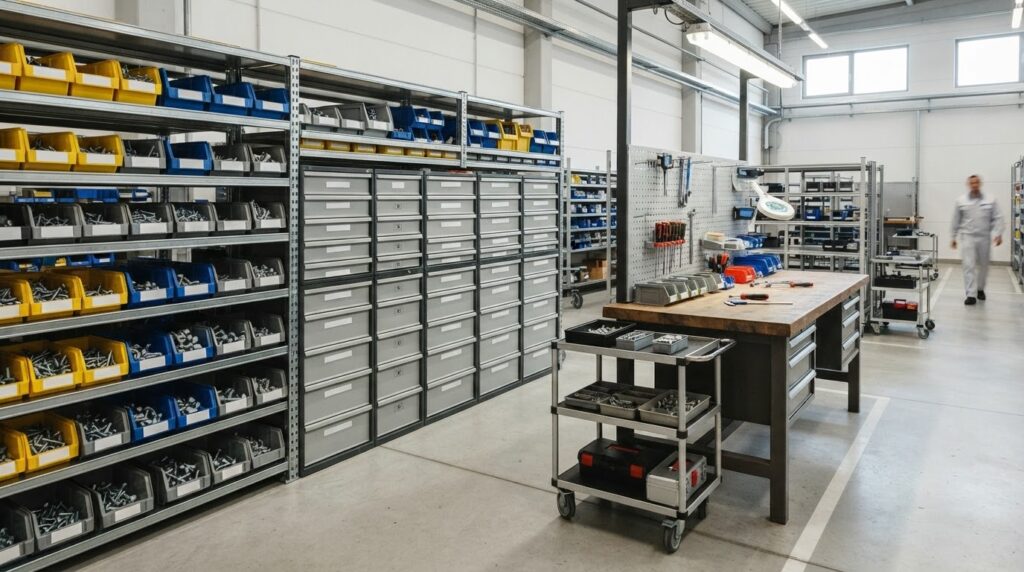
Small parts create material handling problems that differ from the challenges of moving pallets. The loads may be light, but the number of components, pick frequency, identification requirements and repeated trips can make the process labor-intensive.
An effective small-parts setup connects storage, order picking, replenishment and point-of-use delivery. This guide concentrates on how parts move and are presented—not merely how much inventory fits on a shelf. For detailed storage configurations, see Fredon’s small-parts storage guide.
Small Parts Handling Starts With the Work Sequence
A maintenance department may retrieve a few replacement components unpredictably, while an assembly cell needs the same fasteners and fittings on a predictable schedule. Those workflows should not use the same storage and delivery rules by default. Record how parts arrive, where they are stored, how they are picked and how they reach the user.
Count touches and travel steps, including returns of unused items. Often the biggest opportunity is reducing repeated searching, walking and repacking rather than purchasing a faster transport device.
Bins, Shelving and Modular Drawers
Industrial bins can group compatible parts and make contents visible, while shelves support varied cartons or containers. Modular drawers offer high-density organized storage and may help keep small items protected. The ideal size, divider layout and access method depend on the SKU dimensions and pick frequency.
Avoid mixing different components in unlabeled containers. Select the arrangement based on retrieval accuracy, operator reach and replenishment. Fredon’s industrial workstation and warehouse storage options can support different stages of the workflow.
Point-of-Use Storage for Assembly
Parts used repeatedly at a station should be positioned in a logical, reachable sequence when the process allows. A cart, small rack or workstation storage module can reduce trips back to a distant storeroom. However, duplicating too much stock at each station can create inventory control problems.
Separate the quantity needed for near-term production from central reserve stock. Define how and when small bins are replenished, who owns that task and how component identification is maintained.
Moving Small Parts Between Areas
Carts, shelves on wheels, totes or other compatible transport devices can move small-parts kits between storage, assembly and maintenance. Consider the weight of the loaded container as well as the parts inside, and protect delicate or easily mixed items during transit.
The best method may use a kit assembled for each job rather than many individual pick trips. Test cart height, number of containers, turning space, floor transitions and the receiving work area before standardizing a route.
Picking Accuracy and Identification
Small-parts operations depend on consistent bin location, clear labeling, accurate counts and a simple way to report shortages. A well-designed handling workflow should make it difficult to accidentally select similar components and easy to replenish without interrupting active work.
Label and location conventions matter as much as the physical equipment. If stock frequently appears to be missing but is later found, investigate part identification and storage rules before adding more space.
Ergonomics and Repetitive Handling
Even small items can create repetitive reach and bending demands when retrieved hundreds of times. Put frequently used components within practical reach and consider workstation height, visibility, tray presentation and the way operators transfer materials between containers.
Avoid organizing solely by alphabetical SKU or physical size if the result creates unnecessary repeated movement. Where justified, evaluate material positioning options that help keep items at a useful working level.
Scaling a Small-Parts System
New SKUs, packaging changes and higher pick volumes can quickly overwhelm a fixed set of bins. Plan reserve capacity for expansion while preserving a consistent location system. Revisit the layout when travel time, stockouts or errors rise.
Use observed picking activity to identify which components deserve prime locations. A deliberate reassessment is often more effective than adding cabinets wherever floor space happens to be available.
Small-Parts Equipment Selection Checklist
Record the size and quantity of SKUs, maximum loaded bin weights, pick frequency, retrieval accuracy, storage dimensions, transport route, destination workstations and expansion needs. Identify whether you need secure storage, mobile picking, point-of-use access or a combination.
Compare options based on accessibility, identification, handling steps, maintainability and cost. Storage density is useful only when the resulting items can be retrieved effectively.
For a wider look at storage, transport, lifting and positioning, see our complete guide to material handling equipment.
Next Steps
Explore Fredon’s warehouse storage solutions and industrial workstations, or talk to an expert about parts storage, picking and replenishment.