
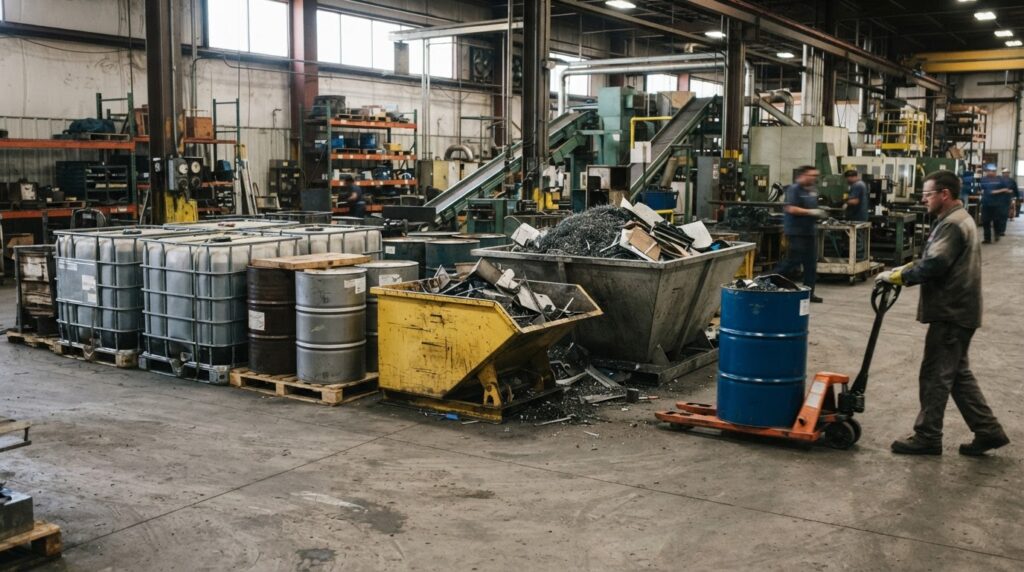
Bulk material handling describes the movement, storage, discharge and control of quantities of loose or contained materials rather than individually handled finished products. Industrial applications may include scrap, granules, powders, components collected in bins, liquids in drums and other production materials.
Equipment selection starts with the material’s physical and environmental characteristics. A hopper that works for dry metal parts may not suit a fine powder or a liquid; a drum that can be transported safely may still need specialized equipment to dispense its contents.
What Counts as Bulk Material Handling Equipment?
Common equipment includes bins, containers, hoppers, drum-handling devices, material transfer equipment and purpose-designed dispensing or conveying systems. The exact set varies by product state, required containment, transfer method and production environment.
Fredon Handling offers industrial drum handling equipment as part of its broader material handling portfolio. For systems such as process conveyors or specialized bulk-flow machinery, confirm supplier scope and technical suitability before assuming compatibility.
Material Properties Come Before the Equipment
Record whether the material is solid, granular, dusty, abrasive, sticky, fragile, hazardous or liquid. Include particle size, bulk density or filled-container weight, moisture sensitivity, temperature and potential for segregation or bridging. Different properties can radically change how well a device loads, stores or releases its contents.
Safety data and handling instructions matter especially for chemicals and combustible dusts. The general equipment guidance here is not a substitute for a material-specific risk assessment or qualified process design. Obtain manufacturer and site safety input for special materials.
Hoppers and Bins for Loose Materials
Industrial bins and hoppers can collect, contain or transfer loose materials such as production scrap. Some designs permit controlled dumping while others function as static storage or process feed containers. Capacity should be checked for both the container and its handling attachment; bulk volume alone does not establish loaded weight.
Consider opening size, discharge direction, center of gravity, vehicle compatibility, housekeeping and how the container will be secured or emptied. The equipment must fit the method used to lift and release it, not merely the amount of material.
Drums and Liquid or Powder Containers
Drum handling often requires moving, lifting, tilting, rotating or dispensing a closed container. A basic drum truck may transport a compatible drum, while a rotator or tilter addresses a different process. Equipment selection depends on drum size, shape, contents, closure, weight and the desired action.
For example, transporting a 55-gallon drum across a floor is not the same task as pouring its contents into a smaller vessel. See the industrial drum rotators guide and Fredon’s drum handling category for distinct applications.
Moving Material Between Stations
Transport may involve wheeled containers, forklifts and suitable attachments, cranes and hoists, or stationary equipment designed for the material. Fixed conveyor or process-feed systems may be appropriate for predictable flows, while mobile containers offer flexibility for intermittent or changing production.
Map the complete route including loading, travel, discharge, return and cleaning. The receiving process may determine the right equipment more than the travel distance does. A mismatch at the receiving station can require additional transfers and create dust, spills or downtime.
Containment, Housekeeping and Operator Exposure
Bulk processes can create exposure to dust, spills, sharp scrap or unstable loads. Plan appropriate containment, spill-control methods and operator access based on the material and applicable regulations. Evaluate whether a closed transfer, guard, barrier or engineering control is necessary for the application.
Never use general-purpose handling equipment for hazardous or unusual materials without confirming suitability. Pay particular attention to manufacturer restrictions, safe load limits, process temperature and compatibility with the material.
Capacity, Discharge and Duty Cycle
Specify required volume, loaded weight, discharge rate and frequency of operation. Account for accumulated material or uneven filling, not just nominal container capacity. If equipment tilts or rotates a load, assess changing center of gravity, stability, clearance and the intended direction of movement.
Also plan cleaning, inspections and maintenance. An equipment design that is difficult to empty completely or clean between batches may introduce contamination or productivity problems even when its basic capacity is sufficient.
A Practical Bulk Handling Equipment Brief
Provide a material description, applicable safety information, required volume and mass, container details, pickup and discharge height, travel route, number of cycles, operator interaction and environmental constraints. Include photos of the current process and identify the specific handling difficulty being addressed.
Request a documented statement of operating limits and compatibility for the particular application. Where the material creates additional risks, arrange qualified engineering or safety review before committing to the equipment.
For an overview of storage, transport, lifting and positioning options, read the complete guide to material handling equipment.
Next Steps
For industrial drum movement and positioning, explore Fredon’s drum handling equipment or discuss your application, including the material, container and transfer conditions.