
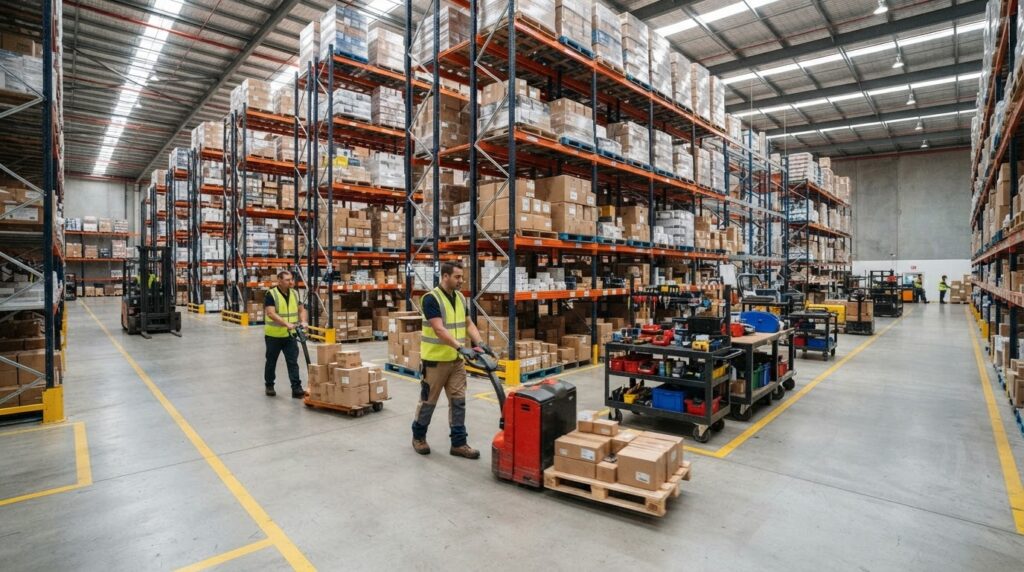
Material transport equipment moves components, finished goods and inventory between process steps. A transport device may travel a few feet from an assembly bench or carry pallets across a warehouse. In either case, the goal is to move the load reliably with as little unnecessary handling as practical.
The right choice depends on load shape, weight, route, trip frequency, ground conditions, transfer heights and the people who share the space. This guide compares major transport approaches and explains how to decide which is most suitable.
What Material Transport Equipment Includes
Transport equipment includes manually pushed carts, platform trucks, pallet jacks, powered pallet movers, industrial vehicles, conveyors and specialized carriers. It is one part of the wider material handling equipment family, alongside storage, lifting, positioning and loading solutions.
The distinction is operational rather than purely mechanical. If a load stays at one station and must be raised to a comfortable height, a positioning device may be more important than a transporter. If it repeatedly crosses the facility, route suitability matters.
Industrial Carts and Platform Trucks
Industrial carts can be effective for components, totes, tools and mixed loads where routes change frequently. They are comparatively simple to rearrange, can support batch movement and do not require fixed conveyor infrastructure. However, wheels, handles, brakes, deck height and load stability must suit the application.
Evaluate the force required to start and stop the cart under real conditions, including ramps and thresholds. An apparently small load may be difficult to move if wheel selection or floor conditions are poor. Provide safe loading methods and avoid blocking the operator’s visibility.
Pallet Transport Equipment
Pallet jacks and similar devices support palletized unit loads, but the pallet, floor, lift height and route determine suitability. Powered alternatives may be considered for frequent or longer-distance movement. Compare the actual rated capacity and load-center requirements rather than assuming all devices with similar appearance perform alike.
Measure aisle widths, door openings, turning space and the interface with racking or dock equipment. A load may fit on a pallet but still fail to pass safely through a constrained doorway or transfer area.
Conveyors and Fixed Transport Paths
Conveyor systems can move repeated product types along fixed routes, but they require consistent transfer conditions and sufficient upstream and downstream capacity. Roller, belt and other conveyor formats handle different load characteristics. Consider package presentation, tracking, noise, guarding, maintenance and how personnel will cross or access the line.
Before installing a fixed system, confirm expected throughput and seasonal variability. A route that often changes due to new production cells or layouts may favor flexible equipment instead of permanent conveyor infrastructure.
Manual Versus Powered Transport
Manual movement can be suitable for short distances and manageable loads; powered equipment can reduce sustained pushing or pulling effort and may help with greater movement volumes. Power is not the same as automation: a powered cart may still be driven by an operator, while an automated system follows programmed controls.
Weigh purchase and energy costs against operator workload, volume, training, charging or fueling requirements and maintainability. The manual versus automated handling guide explores a related, but different, decision.
Route Design and Traffic Management
Map every repeated route and note queues, crossing points, floor grades, threshold changes, blind corners and pedestrians. Transportation equipment should fit an overall traffic plan; putting a faster machine into an aisle conflict can make the operation less safe and less predictable.
Separate vehicle and pedestrian movement where feasible, maintain visibility and train authorized operators. Confirm braking, stability and load restraint features for the actual environment rather than relying on a general product category.
Transfer Height and Handling Steps
A cart’s deck height, pallet truck’s lift range or conveyor elevation affects how goods transfer to the next station. If the receiver must unpack, lift or reorient every item because of a height mismatch, the organization may lose much of the benefit from faster travel.
Use a workflow sketch that includes the origin and destination, not merely the movement distance. Fredon’s material positioning and hydraulic lift table categories address associated transfer-height problems.
A Transport Equipment Buying Checklist
Document maximum load and dimensions, route length, trips per shift, floor condition, changes in elevation, aisle clearance, transfer heights, loading method and expected growth. Ask what power, inspection, training and maintenance each option needs.
Compare alternatives using total installed cost, minutes per movement, safety requirements, handling steps and flexibility. Equipment that is easy to maintain and matches the real route often provides more value than a nominally faster machine.
For an overview of storage, transport, lifting and positioning options, read the complete guide to material handling equipment.
Next Steps
Review Fredon’s material handling equipment and discuss your transport application with drawings, load details and route measurements.