
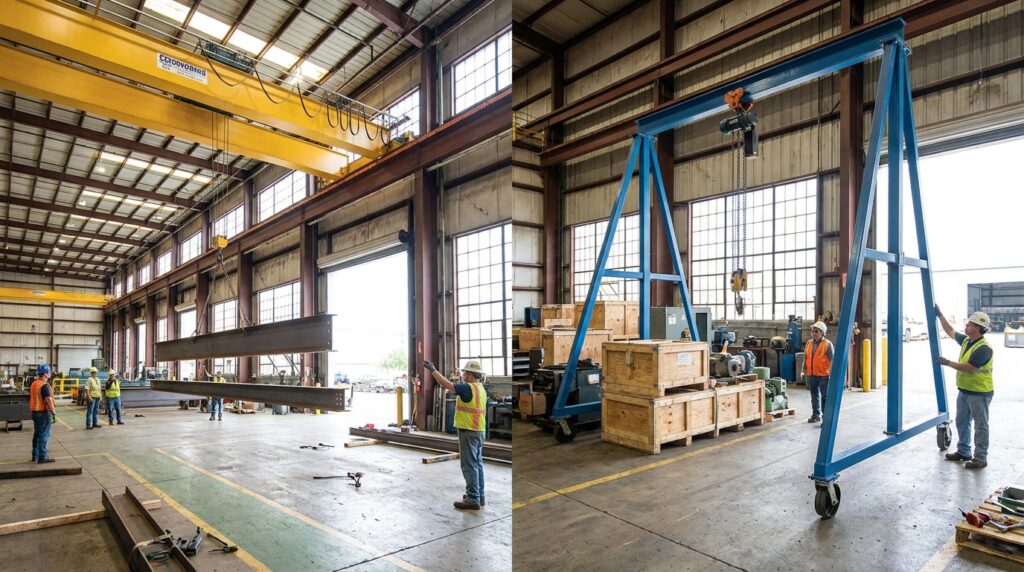
Bridge Crane vs. Gantry Crane: Key Differences and Applications
Understanding Overhead Lifting: Bridge Cranes and Gantry Cranes Explained
In the demanding world of manufacturing, warehousing, and heavy industry, efficient and safe material handling is paramount. The choice of lifting equipment can significantly impact productivity, operational costs, and workplace safety. Two of the most common and versatile overhead lifting solutions are bridge cranes and gantry cranes. While both systems are designed to move heavy loads with precision, their design, installation, and application differ significantly. This comprehensive guide will explore the fundamental differences between bridge cranes and gantry cranes, helping manufacturing managers, warehouse operators, engineers, maintenance teams, and industrial equipment buyers make informed decisions for their specific needs.
Defining the Terms: What Exactly Are Bridge and Gantry Cranes?
Before delving into the distinctions, it’s crucial to establish clear definitions.
Bridge Crane Fundamentals
A bridge crane, often referred to as an overhead crane, consists of a horizontal bridge beam that spans the width of a workspace. This bridge beam moves along elevated runways, typically supported by building columns. A trolley travels along the bridge beam, carrying the hoist and its load. The entire bridge assembly can move horizontally along the runways, while the trolley with the hoist moves across the bridge. This dual-axis movement provides comprehensive coverage within its designated work area.
Gantry Crane Essentials
A gantry crane, in contrast, is a self-supporting structure. Its bridge beam is elevated by legs that move on wheels or rails at ground level. This fundamental difference means gantry cranes do not rely on building infrastructure for support. They are essentially mobile or semi-mobile lifting solutions. The hoist and trolley also move along the bridge beam, allowing for precise load positioning.
When exploring the differences between bridge cranes and gantry cranes, it’s essential to consider their specific applications and advantages in various material handling scenarios. For a deeper understanding of how these systems can streamline your workflow and enhance efficiency, you can refer to a related article that discusses various material handling systems in detail. This article provides valuable insights into optimizing your operations and can be found at Material Handling Systems Explained: Streamlining Your Workflow Efficiently.
Structural Differences: Design and Support Systems
The most significant divergence between bridge and gantry cranes lies in their structural design and how they are supported. This impacts their installation, portability, and suitability for different environments.
The Building-Dependent Bridge Crane
Bridge cranes are intrinsically linked to the existing structure of a building.
Runway Support
The runways for a bridge crane are typically mounted on top of or attached to the building’s columns. This requires the building to be engineered to bear the substantial loads imposed by the crane’s operation, including the weight of the crane itself, the hoist, the load, and the dynamic forces generated during movement. For facilities without the necessary structural integrity, retrofitting can be a significant and costly undertaking.
Span and Height Considerations
The span of a bridge crane is limited by the distance between the supporting columns of the building. While larger spans are achievable with reinforced structures, they represent a considerable investment. Similarly, the lifting height is determined by the clearance within the building.
The Self-Supporting Gantry Crane
Gantry cranes offer a distinct advantage in their independent structural design.
Leg and Wheel/Rail Systems
The legs of a gantry crane provide its support, allowing it to straddle the work area. These legs are often equipped with wheels for mobility on a prepared floor surface or run on dedicated rails installed at ground level. This eliminates the need for specialized building modifications to support the crane’s primary structure.
Mobility and Portability
The wheeled or rail-mounted nature of gantry cranes makes many of them inherently mobile. This allows for repositioning the crane to different areas of a facility or even moving it outdoors, offering flexibility that bridge cranes cannot match. Semi-gantry cranes, which have one end supported by legs and the other by a runway attached to a building, offer a hybrid solution.
Operational Advantages and Limitations
Beyond structural differences, the way these cranes operate presents distinct advantages and limitations that influence their ideal applications.
Comprehensive Coverage of Bridge Cranes
The fixed nature of bridge cranes provides excellent coverage within a defined bay or shop.
Full Bay Utilization
Once installed, a bridge crane can access virtually every point within its span and length of travel. This makes them ideal for production lines, assembly areas, and workshops where consistent and repetitive material movement is required. The smooth, controlled movement across the entire work envelope ensures efficient material flow.
Higher Lifting Speeds and Capacities
Generally, bridge cranes are designed for higher duty cycles and can accommodate heavier lifting capacities due to their robust, often custom-engineered support structures. They can also be equipped with sophisticated control systems for precise, high-speed movements.
The Flexible Gantry Crane
Gantry cranes excel in situations requiring adaptability and independent operation.
Outdoor and Temporary Installations
Their self-supporting nature makes gantry cranes perfectly suited for outdoor use, such as in shipyards, construction sites, or lumber yards, where building structures are absent. They are also an excellent solution for temporary lifting needs or in facilities where permanent overhead infrastructure is not feasible or desired.
Ease of Relocation
The mobility of wheeled gantry cranes allows them to be easily moved from one location to another, making them ideal for facilities with evolving layouts or where lifting needs change frequently. This reduces the downtime and cost associated with reconfiguring fixed lifting systems.
Potential Obstructions
The legs of a gantry crane can sometimes obstruct the movement of other equipment or personnel within the workspace, a consideration that needs careful planning.
Application Scenarios: Where Each Crane Shines
The inherent characteristics of bridge and gantry cranes dictate their most effective applications.
Bridge Crane Applications: The Industrial Workhorse
Bridge cranes are the backbone of many manufacturing and heavy industrial operations.
Manufacturing and Assembly Lines
In factories, bridge cranes are indispensable for moving raw materials to workstations, transporting sub-assemblies between stages, and placing finished products onto trucks or into storage. Their ability to precisely position heavy components is critical for complex assembly processes.
Fabrication Shops
Metal fabrication shops frequently utilize bridge cranes to move large steel plates, beams, and other materials during cutting, welding, and assembly.
Warehousing and Distribution Centers
For high-volume storage and retrieval operations, particularly with heavy or bulky items, bridge cranes offer efficient material flow.
Repair and Maintenance Bays
Large machinery repair facilities rely on bridge cranes to lift and maneuver heavy equipment components for servicing and repair.
Gantry Crane Applications: Versatility in Action
Gantry cranes offer a broad spectrum of applications where flexibility and independence are key.
Shipyards and Ports
Gantry cranes are iconic in shipyards for their massive lifting capacities, used to assemble ship sections and load/unload cargo. Port cranes are a type of large gantry crane designed for container handling.
Construction Sites
Temporary or portable gantry cranes are invaluable for lifting heavy structural components, precast concrete elements, and other materials on construction sites.
Outdoor Storage Yards
Facilities storing large pipes, precast concrete, lumber, or steel often employ gantry cranes for efficient stacking and retrieval.
Automotive Manufacturing
In certain automotive assembly or component handling areas, gantry cranes can provide flexible lifting solutions.
Laboratories and Clean Rooms
Smaller, specialized gantry cranes can be used in controlled environments where building modifications are undesirable.
When exploring the differences between bridge cranes and gantry cranes, it’s also beneficial to consider their specific applications in various industries. For a more in-depth understanding of how these cranes operate and their respective advantages, you can refer to a related article that discusses the nuances of crane selection and usage. This resource can provide valuable insights for anyone looking to optimize their material handling processes. To learn more, visit this article.
Key Selection Criteria: Choosing the Right Crane
Selecting between a bridge crane and a gantry crane, or even a specific type within each category, requires careful consideration of several factors.
Load Capacity and Lifting Height
- Load Capacity: This is the most critical factor. Both crane types are available in a wide range of capacities, from a few hundred pounds to several hundred tons. The required capacity will dictate the structural requirements and, consequently, the cost.
- Lifting Height: Determine the maximum height the load needs to be lifted. This influences the trolley height, bridge height, and overall crane dimensions.
Workspace and Facility Layout
- Span and Reach: For bridge cranes, the span is the width of the workspace they need to cover. For gantry cranes, consider the overall dimensions they will occupy and the area they need to traverse.
- Existing Infrastructure: Assess the building’s structural capacity if considering a bridge crane. If it’s insufficient or unavailable, a gantry crane becomes a more viable option.
- Mobility Needs: If the lifting operation needs to move to different areas, a mobile gantry crane is the clear choice.
Duty Cycle and Frequency of Use
- Duty Cycle: This refers to how often and how intensely the crane will be used. Heavy-duty applications with frequent operation may necessitate more robust construction and higher-rated components.
- Frequency: For occasional use, a lighter-duty or portable option might suffice.
Environment and Power Availability
- Indoor vs. Outdoor: Gantry cranes are generally more suitable for outdoor applications. Bridge cranes are typically installed indoors.
- Power Supply: Ensure a reliable power source is available for the crane’s operation.
Budget and Installation Costs
- Initial Purchase Price: Gantry cranes, especially portable ones, can sometimes have a lower initial purchase price than a comparable capacity bridge crane system, particularly when building modifications for a bridge crane are extensive.
- Installation Costs: Factor in the cost of installation. Bridge cranes often require professional installation tied to building structural work, which can be substantial. Gantry cranes, particularly portable ones, may have simpler installation requirements.
- Long-Term Operating Costs: Consider energy consumption, maintenance, and potential repair costs.
When exploring the differences between bridge cranes and gantry cranes, it’s also beneficial to understand the broader context of material handling equipment. For a comprehensive overview of essential tools that enhance efficiency in various applications, you can refer to this informative article on types of material handling equipment. This resource provides valuable insights that can help you make informed decisions about the right equipment for your specific needs. You can read more about it here.
Safety Considerations and Regulatory Compliance
Safety is paramount in all material handling operations. Both bridge and gantry cranes must be operated and maintained in accordance with relevant safety standards.
OSHA and ASME Standards
In the United States, the Occupational Safety and Health Administration (OSHA) and the American Society of Mechanical Engineers (ASME) provide guidelines and standards for overhead cranes.
- OSHA 29 CFR 1910.179: This standard covers general industry overhead and gantry cranes, detailing requirements for design, construction, installation, inspection, maintenance, and operation.
- ASME B30.17: This standard specifically addresses overhead and gantry cranes.
Key safety aspects include:
- Proper Load Weight Verification: Never exceed the rated load capacity of the crane.
- Qualified Operators: Only trained and authorized personnel should operate the crane.
- Pre-Operational Inspections: Daily checks for worn components, proper lubrication, and operational functionality are crucial.
- Safe Rigging Practices: Using appropriate slings, shackles, and lifting accessories is essential.
- Clear Communication: Using established hand signals or radio communication between the operator and ground personnel.
- Exclusion Zones: Maintaining a safe distance from the moving load and crane.
- Emergency Stop Procedures: Familiarity with emergency stop buttons and procedures.
Specific Safety Features
- Limit Switches: Prevent the hoist from traveling beyond its upper or lower limits.
- Overload Protection: Devices that prevent the crane from lifting loads exceeding its rated capacity.
- Brakes: Robust braking systems for the hoist and bridge/trolley movements.
- Warning Signals: Horns or lights to alert personnel of crane movement.
Maintenance and Longevity: Keeping Your Crane Operational
Regular and proper maintenance is essential for ensuring the safety, reliability, and longevity of both bridge and gantry cranes.
Preventive Maintenance Programs
A well-structured preventive maintenance (PM) program is crucial. This typically includes:
- Daily Checks: Performed by the operator, focusing on visual inspections of ropes, hooks, brakes, and controls.
- Weekly/Monthly Inspections: More detailed checks by maintenance personnel, including lubrication points, electrical connections, and mechanism testing.
- Annual Inspections: Thorough inspections by qualified personnel, often including load testing and detailed component analysis, as recommended by OSHA and ASME standards.
Key Maintenance Areas
- Hoisting Mechanism: Regular inspection and lubrication of the hoist motor, gearbox, wire rope, and hook.
- Braking Systems: Checking brake linings, springs, and adjustments for effective stopping power.
- Electrical Systems: Inspecting wiring, contactors, limit switches, and control panels for wear and damage.
- Structural Components: Examining the bridge, trolley, legs, and runways for any signs of fatigue, corrosion, or deformation.
- Wheels and Rails (Gantry Cranes): Ensuring smooth operation, checking for wear, and maintaining proper lubrication.
Comparing Capacities and Specifications: A Practical Overview
The following table provides a generalized comparison of typical capacities and considerations for bridge and gantry cranes. It’s important to note that specific models and custom designs can vary significantly.
| Feature | Bridge Crane | Gantry Crane |
| : | : | : |
| Support Structure | Relies on building columns and runways. | Self-supporting legs, moves on wheels or rails. |
| Installation | Can be complex, requiring building modifications. | Generally simpler, especially for portable units. |
| Mobility | Fixed within its runway system. | Can be mobile (wheeled) or semi-mobile. |
| Typical Span | Up to 150+ feet (building dependent). | Up to 100+ feet (often less than bridge cranes). |
| Lifting Height | Limited by building clearance. | Can be designed for very high lifts, especially port gantry cranes. |
| Typical Capacity | 1 Ton to 500+ Tons. | 1 Ton to 1000+ Tons (especially port gantry cranes). |
| Duty Cycle | Excellent for high-duty cycle, continuous use. | Varies widely, from light-duty to heavy-duty. |
| Environment | Primarily indoor applications. | Suitable for indoor and outdoor applications. |
| Flexibility | High coverage within a fixed area. | High flexibility due to mobility and self-support. |
| Cost Considerations| Can be higher initially if building modifications are extensive. | Can be lower initially for portable units; overall cost depends on size and features. |
| Common Applications| Manufacturing, assembly lines, fabrication shops. | Shipyards, ports, construction, outdoor storage yards. |
Frequently Asked Questions About Bridge vs. Gantry Cranes
1. Which type of crane is better for a new warehouse?
For a new warehouse where building structure is being designed, a bridge crane is often the preferred choice if the primary lifting needs are confined to specific bays and continuous, heavy-duty operation is expected. However, if flexibility in layout or outdoor access is a requirement, a gantry crane system might be more suitable. The decision depends heavily on the specific operational workflow and future expansion plans.
2. Can a gantry crane be used indoors?
Yes, absolutely. Many gantry cranes, especially smaller, portable, or semi-gantry models, are perfectly suited for indoor use in workshops, assembly areas, or manufacturing facilities where building modifications for a bridge crane are not feasible or cost-effective.
3. What is the maximum weight a gantry crane can lift?
Gantry crane capacities vary enormously. While smaller portable gantry cranes might lift a few tons, massive container gantry cranes used in ports can lift over 1,000 tons. It is crucial to define your lifting requirements accurately to select the appropriate gantry crane.
4. Are bridge cranes more expensive than gantry cranes?
Not necessarily. The initial cost comparison is complex. A simple, small portable gantry crane is likely less expensive than even a moderate-capacity bridge crane. However, a large, heavy-duty gantry crane designed for specific industrial use could be as expensive or more expensive than a comparable bridge crane system, especially when factoring in the cost of runway installation for the bridge crane. The cost of building modifications for a bridge crane is often a significant factor in this comparison.
5. What is a semi-gantry crane?
A semi-gantry crane is a hybrid design. It has one end of the bridge supported by a leg that moves on wheels or rails at ground level, while the other end of the bridge is supported by a runway attached to a building column or wall. This offers a balance between the self-supporting nature of a gantry and the workspace coverage of a bridge crane.
6. What are the safety compliance requirements for operating these cranes?
In the US, compliance with OSHA 29 CFR 1910.179 and ASME B30.17 standards is mandatory. This includes ensuring qualified operators, regular inspections, proper maintenance, and adherence to safe operating procedures to prevent accidents and ensure a safe working environment.
Conclusion: Partnering with Fredon Handling for Your Overhead Lifting Solutions
Choosing between a bridge crane and a gantry crane is a strategic decision that hinges on a thorough understanding of your operational needs, facility constraints, and safety requirements. Both systems offer powerful material handling capabilities, but their distinct designs lend themselves to different environments and applications.
Fredon Handling is your trusted partner in navigating these complex choices. With our extensive expertise in material handling equipment, we offer a comprehensive range of both bridge cranes and gantry cranes, along with custom solutions tailored to your unique challenges. Our team of experienced professionals is dedicated to helping you select the most efficient, safe, and cost-effective lifting solution for your business.
Don’t let material handling inefficiencies slow you down. Contact Fredon Handling today to discuss your specific requirements. Our experts will work with you to assess your needs, provide detailed specifications, and recommend the optimal bridge or gantry crane solution that will enhance your productivity and safety for years to come.
Explore our comprehensive range of overhead cranes and lifting solutions at fredonhandling.com.