
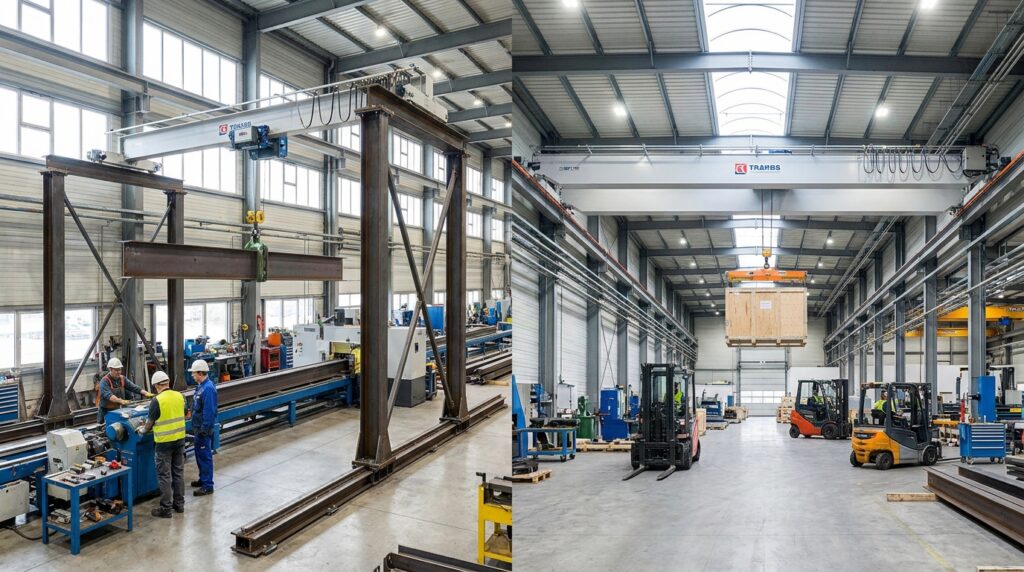
SEO Title: Freestanding vs. Ceiling-Mounted Bridge Cranes: A Comprehensive Guide for Industrial Managers
Meta Description: Choosing between freestanding and ceiling-mounted bridge cranes? This guide from Fredon Handling details the pros, cons, selection criteria, applications, safety, and maintenance for manufacturing and warehouse professionals.
Suggested URL Slug: freestanding-vs-ceiling-mounted-bridge-cranes
Understanding Your Industrial Lifting Needs: The Bridge Crane Decision
Selecting the right overhead material handling system is paramount for optimizing productivity, ensuring worker safety, and maximizing operational efficiency in any industrial setting. Among the most versatile and widely adopted solutions are bridge cranes, particularly the choice between freestanding and ceiling-mounted configurations. This decision hinges on a thorough understanding of your facility’s infrastructure, production workflow, and long-term strategic goals. At Fredon Handling, we understand that this choice can significantly impact your operations, which is why we offer comprehensive guidance to help you make the most informed decision. This article will delve deep into the advantages and disadvantages of both freestanding and ceiling-mounted bridge cranes, providing you with the critical information needed to align your lifting strategy with your facility’s capabilities and requirements.
When considering the advantages and disadvantages of freestanding versus ceiling-mounted bridge cranes, it’s essential to explore various factors that can influence your decision. For a deeper understanding of how these systems can impact your operations, you might find it helpful to read a related article that discusses the different types of material handling equipment and their applications. You can access this insightful resource by following this link: Material Handling Equipment Insights.
Freestanding Bridge Cranes: Versatility and Independence
Freestanding bridge cranes, also known as self-supported or self-standing cranes, are a popular choice for facilities where existing building structures may not be suitable for supporting overhead crane loads, or where flexibility in layout is a primary concern. These systems are engineered with their own integral support structure, typically comprising robust columns and runways, which bear the entire weight of the crane and its load. This self-contained design offers significant advantages, particularly in environments that might not have the load-bearing capacity in their ceilings or walls, or in leased spaces where permanent structural modifications are not feasible.
The Advantages of Freestanding Crane Systems
The primary benefit of a freestanding bridge crane lies in its installation flexibility. Because it doesn’t rely on the building’s superstructure, it can be erected almost anywhere within your facility, offering unmatched adaptability to different plant layouts and operational zones. This independence from building supports also means a faster and often less disruptive installation process. There’s no need for extensive structural surveys or modifications to your existing building, which can save considerable time and expense.
Furthermore, freestanding cranes provide excellent scalability and reconfigurability. As your operational needs evolve or your facility layout changes, a freestanding system can often be relocated or expanded with relative ease. This is particularly valuable for businesses undergoing growth or frequent process reconfigurations. Their self-contained nature also means they do not impose any additional load on the building’s structure, a crucial consideration for older buildings or those not originally designed for heavy overhead loads. This eliminates potential structural integrity concerns and associated compliance issues.
The Drawbacks of Freestanding Crane Systems
Despite their numerous advantages, freestanding bridge cranes do have certain limitations. The most significant is the floor space requirement. The columns and runways of a freestanding system occupy valuable floor area, which can reduce available working space for other equipment or material storage. This is a critical factor in facilities where space is at a premium.
The initial capital investment for a freestanding system can also be higher compared to a ceiling-mounted counterpart, primarily due to the cost of the integrated structural components. While installation might be less disruptive to the building, the crane’s structure itself is a substantial piece of equipment requiring a solid, level foundation for stable operation. This might necessitate foundation preparation, adding to the overall project cost and complexity. Finally, while their independent nature is an advantage, it also means they cannot take advantage of existing building height as effectively as a ceiling-mounted crane, potentially limiting the maximum hook height achievable without raising the entire structure.
Ideal Applications for Freestanding Bridge Cranes
Freestanding bridge cranes are exceptionally well-suited for a variety of industrial applications. They are a prime choice for new construction where the crane structure can be designed in tandem with the building, or for facilities with limited or inadequate ceiling support. Manufacturing assembly lines, repair bays, and material staging areas often benefit from the localized lifting capabilities of freestanding cranes, especially when different workstations require independent overhead lifting.
They are also ideal for leasehold improvements where permanent structural alterations are prohibited. Warehouses and distribution centers that handle palletized goods or heavy individual items can utilize freestanding cranes for efficient loading, unloading, and internal movement. Furthermore, facilities that anticipate future expansion or layout changes will find the inherent adaptability of freestanding systems to be a significant long-term asset. For specialized operations requiring a dedicated lifting solution within a larger facility, such as a specific machine tool cell or a welding station, a freestanding crane provides a self-sufficient and precise solution.
Ceiling-Mounted Bridge Cranes: Leveraging Existing Infrastructure
Ceiling-mounted bridge cranes, often referred to as top-running or under-hung cranes, are integrated directly into the building’s existing structural framework. This type of crane utilizes the building’s ceiling beams, roof trusses, or specialized overhead runways to support the crane’s bridge and travel. This integration offers a distinct set of advantages, particularly for facilities with robust overhead structures designed to accommodate such loads, or those looking to maximize usable floor space.
The Advantages of Ceiling-Mounted Crane Systems
The most compelling benefit of a ceiling-mounted bridge crane is its efficient use of space. By utilizing the building’s overhead structure, these cranes do not occupy any valuable floor space, leaving the entire ground level clear for operations, storage, or vehicle traffic. This can significantly increase the usable area within a facility. They also typically offer a higher hook height relative to the building’s floor compared to freestanding systems, as the crane’s structure is elevated.
Another significant advantage is the potentially lower initial cost. When a building’s structure is already capable of supporting crane loads, the expense of fabricating and installing a separate freestanding support structure is eliminated. This can make ceiling-mounted cranes a more cost-effective solution, provided the building’s integrity is confirmed. The installation process, while requiring careful integration with the building’s structure, can often be less complex than erecting an entirely new freestanding frame, particularly in existing facilities with suitable overhead infrastructure.
The Drawbacks of Ceiling-Mounted Crane Systems
The primary limitation of ceiling-mounted cranes is their dependence on building structure. The existing ceiling, roof trusses, or support columns must be capable of withstanding the significant dynamic and static loads imposed by the crane and its intended payloads. This necessitates a thorough structural analysis and potentially costly building modifications to ensure safety and compliance, which can be a significant hurdle in older or non-industrially designed buildings.
The flexibility and reconfigurability of ceiling-mounted systems are also more limited. Relocating or modifying a ceiling-mounted crane often requires substantial work on the building’s structure, making them less adaptable to frequent layout changes or future expansions compared to freestanding designs. Installation can be more disruptive to ongoing operations, as it often involves working overhead and potentially impacting the building’s integrity during the process. Furthermore, if the building’s structure is not adequately designed for crane loads, ongoing maintenance and inspections of the building’s support points become critical to ensure continued safety.
Ideal Applications for Ceiling-Mounted Bridge Cranes
Ceiling-mounted bridge cranes are ideal for facilities where ample overhead structural capacity exists. Manufacturing plants with robust steel framing, warehouses with reinforced concrete ceilings or substantial truss systems, and distribution centers are prime candidates. They are particularly beneficial in environments where maximizing floor space is a priority, such as assembly lines where clear working areas are essential, or in facilities with high-volume material flow requiring unobstructed pathways.
These cranes are also well-suited for long-term, fixed installations where the operational layout is unlikely to change significantly. Industries such as automotive manufacturing, aerospace, heavy machinery fabrication, and large-scale logistics operations often rely on the dependable and space-saving capabilities of ceiling-mounted bridge cranes. They are excellent for covering large floor areas with a single crane system or multiple interconnected cranes, providing comprehensive lifting coverage over entire factory floors or expansive warehouse sections.
Key Selection Criteria: Making the Right Choice for Your Operation
The decision between a freestanding and a ceiling-mounted bridge crane is not one to be taken lightly. It requires a meticulous evaluation of several critical factors that directly impact your facility’s operational efficiency, safety, and budget. At Fredon Handling, we guide our clients through this process by focusing on a holistic understanding of their unique requirements.
Assessing Your Facility’s Infrastructure
The most fundamental criterion is the capability of your existing building structure. For ceiling-mounted cranes, a detailed structural engineering assessment is non-negotiable. This assessment will determine the load-bearing capacity of your roof trusses, columns, and beams to ensure they can safely support the static and dynamic loads of the crane, the trolley, the hoist, and the maximum intended payload. Any deficiencies identified will necessitate costly reinforcements or may render a ceiling-mounted system impractical or unsafe.
If your building’s structure is inadequate or if you operate in a leased space where modifications are restricted, a freestanding system becomes the logical and often the only viable option. Freestanding cranes eliminate the burden of structural reinforcement, relying instead on their own robust support columns and a solid foundation. This allows for significant flexibility in placement and installation without compromising the building’s integrity.
Evaluating Your Operational Workflow and Space Requirements
Consider the layout of your facility and the flow of materials. If maximizing floor space is a critical objective, a ceiling-mounted crane offers unparalleled advantages by keeping the ground level completely clear. This is especially important in high-traffic areas, assembly lines, or where the movement of other equipment, such as forklifts, is constant.
Conversely, if your facility has ample floor space, or if the layout is dynamic and subject to frequent changes, a freestanding crane offers greater adaptability. Its independent structure allows for placement in areas that might not be directly under suitable overhead support, or it can be relocated more easily if operational zones shift. Think about the typical paths materials take and whether they would be impeded by the support columns of a freestanding crane.
Understanding Load Capacity and Lifting Requirements
Your maximum anticipated load weight is a primary determinant for both types of cranes. Both freestanding and ceiling-mounted systems can be engineered to handle a wide range of capacities, from a few tons to hundreds of tons. However, the structural implications of lifting extremely heavy loads can differ. For exceptionally heavy lifts, the foundation requirements for a freestanding crane become more significant, and the structural analysis for a ceiling-mounted system becomes even more critical.
Consider the frequency and nature of your lifts. Will you be performing frequent, heavy lifts, or a mix of lighter and heavier tasks? The duty cycle of the crane, dictated by the application (e.g., ASME classes), will influence the choice of components and the overall design. For applications requiring precise positioning of heavy loads, the stability and robust construction of both types can be engineered to meet specific needs.
Budgetary Considerations and Installation Timelines
Initial capital expenditure is a significant factor. While ceiling-mounted cranes can sometimes have a lower upfront cost if the building structure is already suitable, the potential need for structural upgrades can quickly escalate expenses. Freestanding cranes, while having a higher inherent cost due to their self-supporting structure, often come with more predictable installation costs and timelines, as they are less dependent on the existing building.
Installation time and disruption are also key. Freestanding cranes can often be installed more rapidly and with less impact on ongoing operations, as they don’t require integration with the building’s structural elements. Ceiling-mounted cranes may require more complex installation procedures, potentially necessitating downtime or phased installations to minimize disruption. Always factor in the long-term maintenance costs and potential repair expenses for both options, considering the complexity of each system and its interaction with the facility.
When considering the best options for your material handling needs, it’s essential to weigh the advantages and disadvantages of different crane types, such as freestanding and ceiling-mounted bridge cranes. For a deeper understanding of how these systems fit into the broader context of material handling, you may find it helpful to explore a related article that discusses the fundamentals of this field. You can read more about it in this informative piece on material handling, which provides valuable insights into optimizing your operations.
Safety and Maintenance: Ensuring Reliable Operation
Regardless of whether you choose a freestanding or a ceiling-mounted bridge crane, ensuring robust safety protocols and a diligent maintenance schedule is paramount. Both systems, when properly engineered, installed, and maintained, offer reliable and safe material handling solutions. However, the specific considerations for each type can vary.
Safety Considerations for Both Crane Types
Compliance with OSHA and ASME Standards is a fundamental requirement for all overhead cranes. OSHA’s regulations (e.g., 29 CFR 1910 Subpart N, Material Handling and Storage) and ASME’s B30 standards provide comprehensive guidelines for the design, installation, inspection, maintenance, and operation of cranes. Fredon Handling engineers all our systems to meet or exceed these critical safety benchmarks.
Operator training is crucial for both freestanding and ceiling-mounted cranes. Operators must be proficient in load handling, proper signaling, understanding crane limitations, and emergency procedures. Regular pre-operational inspections by the operator are essential to identify any visible issues before use. These inspections should cover the crane structure, hoist, trolley, end stops, and power supply.
Clearance and workspace safety are also vital. For freestanding cranes, ensure that personnel and equipment do not operate within the footprint of the crane’s support structure when it is in motion. For ceiling-mounted cranes, maintaining adequate clearance between the crane and any obstructions, as well as ensuring proper guarding of moving parts, is essential. Proper load balancing and secure rigging practices are critical regardless of the crane type to prevent accidental drops or imbalances.
Maintenance Guidance for Freestanding Cranes
Freestanding cranes, due to their self-contained nature, often present simpler maintenance procedures regarding the crane’s structure. However, regular inspections of the support columns and the foundation are essential to detect any signs of shifting, cracking, or wear. Ensure the anchor bolts securing the columns to the foundation are secure and free from corrosion.
Lubrication of all moving parts, including the bridge and trolley wheels, travel mechanisms, and hoist components, is critical for smooth operation and preventing premature wear. Regular checks of the electrical components, including the control panels, limit switches, and power feeds, are necessary to prevent electrical faults. The hoist and lifting gear require specialized maintenance in accordance with manufacturer recommendations and ASME B30 standards, including regular inspections of wire ropes or chains for wear, damage, or deformation.
Maintenance Guidance for Ceiling-Mounted Cranes
For ceiling-mounted cranes, maintenance extends beyond the crane itself to include its integration points with the building structure. Regular inspections of the crane’s runway beams and their supports are paramount. This includes checking for any signs of fatigue, deformation, or loosening of connections to the building’s structure. Lubrication of runway wheels and tracks ensures smooth travel and minimizes wear on both the crane and the building’s infrastructure.
Periodic alignment checks of the runway and bridge can prevent excessive wear and stress on the system. As with freestanding cranes, rigorous inspection and maintenance of the hoist, trolley, and electrical systems are critical. Pay close attention to the condition of the runway end stops and their attachment points to the building, as these are crucial for preventing overtravel and potential structural damage. Annual load testing and thorough inspections by a qualified professional, as recommended by ASME B30.17 (Industrial Top Running Bridge and Gantry Type, Underhung Hoist, Trolley Cranes), are often mandated to ensure continued operational safety and compliance.
Comparing Capacities and Applications: Choosing the Right Fit
The choice between a freestanding and a ceiling-mounted bridge crane often comes down to a detailed evaluation of their respective capacities and how they align with specific industrial applications. While both systems can be engineered for a wide spectrum of load capacities, the fundamental differences in their support structures influence their optimal use cases.
Understanding Capacity Ranges and Limitations
Both freestanding and ceiling-mounted bridge cranes can be designed to handle loads ranging from a few tons to well over 100 tons. The actual capacity is determined by the engineering design of the crane and its supporting structure, as well as the selected hoist and trolley.
For freestanding cranes, the limiting factor for capacity is often the load the foundation can bear and the strength of the support columns and runways. Extremely heavy loads may require substantial concrete foundations and larger, more robust column designs. This can increase the footprint and cost of the system.
For ceiling-mounted cranes, the load capacity is directly tied to the load-bearing capacity of the building’s structure. If a building’s roof structure or columns are rated for, say, 20 tons, then a crane with a capacity exceeding this may not be feasible without significant and potentially prohibitive structural upgrades. Conversely, if the building is robustly engineered, ceiling-mounted cranes can often support very high capacities efficiently.
Matching Crane Types to Specific Industrial Applications
Manufacturing Facilities:
- Ceiling-mounted: Ideal for assembly lines where clear floor space is crucial, allowing for efficient movement of large components and unobstructed access for workers. They can cover vast manufacturing floors with a single, continuous lifting solution.
- Freestanding: Suitable for specific workstations or machine cells where localized lifting is needed, or in older facilities with insufficient overhead support. They can also be used to create dedicated lifting zones within a larger manufacturing space.
Warehouses and Distribution Centers:
- Ceiling-mounted: Excellent for high-bay warehouses where maximizing vertical storage and clear aisle space is paramount. They facilitate efficient loading and unloading of trucks and rapid internal movement of goods.
- Freestanding: Useful for staging areas, receiving docks, or in facilities where the existing roof structure is not suitable for crane loads. They can also be employed to create flexible, mobile lifting solutions within a warehouse.
Heavy Industry (e.g., Steel Mills, Shipyards, Foundries):
- Ceiling-mounted: Often used for massive production areas, such as ladle cranes or heavy fabrication bays, where the building structure is specifically designed to support extreme loads.
- Freestanding: Can be employed for specialized repair shops, maintenance areas, or in locations where a dedicated, heavy-duty lifting solution is required and the existing structure is insufficient. For instance, large outdoor gantry cranes, a type of freestanding structure, are common in shipyards.
Automotive Manufacturing:
- Ceiling-mounted: Dominant in assembly plants for lifting and positioning vehicle bodies, engines, and other large components. The need for precise movement and clear access to the assembly line makes them indispensable.
- Freestanding: Might be used in specific areas like engine testing bays or for maintenance of heavy manufacturing equipment where a self-sufficient lifting solution is beneficial.
Aerospace and Heavy Equipment Manufacturing:
- Ceiling-mounted: Critical for lifting and maneuvering large aircraft sections, heavy machinery, or complex assemblies. The requirement for high precision and the ability to cover extensive work areas make these cranes essential.
- Freestanding: Useful for specialized repair or fabrication areas, or in facilities that may not have the uniform structural capacity required for a full ceiling-mounted system.
Ultimately, the selection hinges on a thorough site survey and a deep understanding of the operational demands. Fredon Handling specializes in assessing these needs and recommending the most efficient, safe, and cost-effective overhead lifting solution, whether it’s a precision-engineered freestanding system or a seamlessly integrated ceiling-mounted crane.
Frequently Asked Questions (FAQs)
Q1: How do I determine if my building’s ceiling can support a ceiling-mounted bridge crane?
A detailed structural analysis conducted by a qualified structural engineer is essential. This assessment will evaluate the load-bearing capacity of your existing roof structure, columns, and beams to determine if they can safely handle the static and dynamic loads of the crane, hoist, and intended payloads. Fredon Handling can assist in coordinating this assessment.
Q2: What is the typical lifespan of a bridge crane, and does it differ between freestanding and ceiling-mounted systems?
The lifespan of a bridge crane is highly dependent on its construction quality, the duty cycle it operates under (ASME class), and the rigor of its maintenance program. Both freestanding and ceiling-mounted cranes, when properly maintained, can last 20-30 years or even longer. Regular inspections, lubrication, and timely replacement of worn parts are crucial for longevity, regardless of the mounting type.
Q3: Can a freestanding bridge crane be moved to a different location within my facility?
Yes, freestanding bridge cranes are designed for relocation. While it requires careful disassembly, transport, and reassembly, and potentially new foundation work at the new site, they offer a degree of portability not found in ceiling-mounted systems. This makes them ideal for facilities with evolving layouts or for businesses that may relocate in the future.
Q4: Are there any specific foundation requirements for freestanding bridge cranes?
Absolutely. Freestanding bridge cranes require a solid, level foundation, typically concrete, capable of supporting the significant vertical and lateral loads imposed by the crane and its payloads. The exact specifications for the foundation will be determined by the crane’s capacity, column spacing, and soil conditions at the installation site, and will be detailed in the engineering design.
Partner with Fredon Handling for Your Overhead Lifting Solutions
Choosing between freestanding and ceiling-mounted bridge cranes is a critical decision that impacts the efficiency, safety, and profitability of your industrial operations. At Fredon Handling, we are dedicated to providing expert guidance and tailored solutions to meet your unique material handling challenges. Our team of experienced engineers and specialists will work closely with you to assess your facility, understand your operational needs, and recommend the optimal overhead crane system. Whether you require the independent flexibility of a freestanding crane or the space-saving efficiency of a ceiling-mounted system, Fredon Handling has the expertise and product range to deliver a reliable, safe, and productive solution.
Don’t leave your material handling to chance. Contact Fredon Handling today to schedule a consultation and discover how our comprehensive overhead crane solutions can elevate your operations.