
Jib Crane Buying Guide: Types, Capacities & Applications
Understanding Jib Cranes: The Backbone of Material Handling
Jib cranes are indispensable in modern manufacturing and warehousing environments, offering targeted lifting and positioning solutions for repetitive tasks. Unlike overhead cranes that cover large areas, jib cranes provide focused, localized material handling, significantly improving efficiency and reducing manual strain in specific workstations. Their versatility makes them a crucial investment for businesses seeking to optimize their operational flow and enhance workplace safety. This guide aims to provide manufacturing managers, warehouse operators, engineers, maintenance teams, and industrial equipment buyers with a comprehensive understanding of jib cranes, from their fundamental types and capabilities to practical considerations for selection, application, and long-term care.
At Fredon Handling, we understand that selecting the right material handling equipment is paramount to operational success. Jib cranes, in their various forms, represent a strategic investment that, when chosen correctly, can yield substantial returns in productivity and safety. This guide will equip you with the knowledge to make an informed decision, ensuring your chosen jib crane perfectly aligns with your specific operational needs.
When considering the purchase of a jib crane, it’s essential to understand not only the various types and capacities but also the broader context of material handling equipment. For a comprehensive overview of essential tools that enhance efficiency in material handling, you can refer to this informative article on types of material handling equipment. It provides valuable insights that complement the information found in the Jib Crane Buying Guide: Types, Capacities & Applications. To explore this further, visit this article.
## Types of Jib Cranes: Matching Your Needs to the Right Design
The world of jib cranes is diverse, with several distinct types designed to address different workspace configurations and lifting requirements. Understanding these distinctions is the first step in selecting the optimal solution for your facility. Each type offers unique advantages in terms of reach, rotation, and installation complexity.
### Fixed and Articulated Jib Cranes
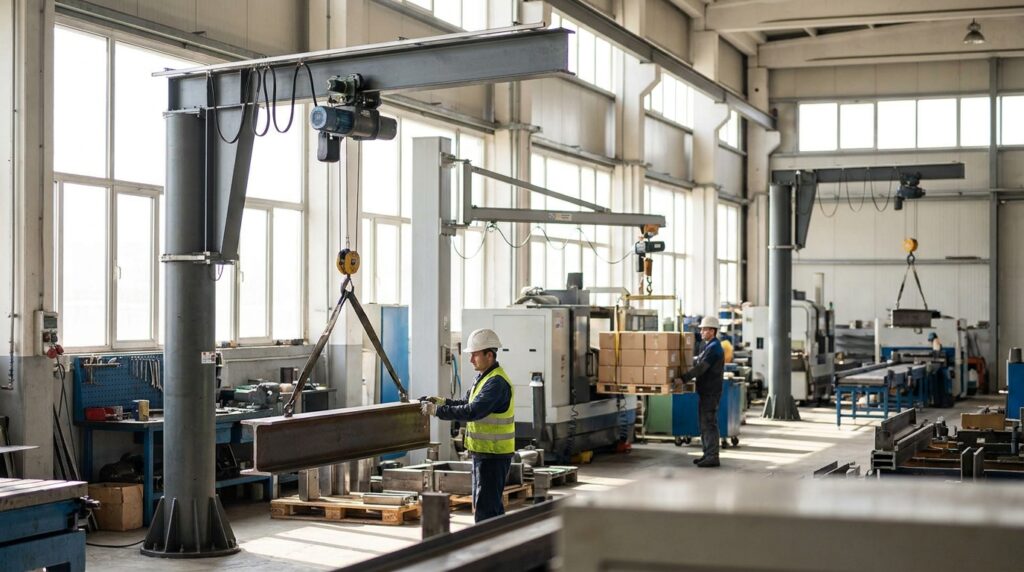
Fixed jib cranes are the most common and straightforward type. They feature a rotating horizontal boom (jib) that is either wall-mounted or mounted on a floor-standing pillar. The boom can rotate 270 or 360 degrees, allowing it to service a circular area. Fixed jibs are ideal for applications where a consistent and predictable lifting path is required.
Articulated jib cranes, often referred to as “knuckle” jibs, offer greater flexibility. They feature two or more boom sections connected by joints, allowing for more complex movement and the ability to reach around obstacles. This design is particularly useful in confined spaces or areas where the crane needs to navigate around machinery or other fixed structures. The additional articulation provides a wider operational envelope, making them suitable for intricate assembly or maintenance tasks.
### Mast-Type Jib Cranes
Mast-type jib cranes utilize a vertical mast or column as their primary support structure. The rotating boom is attached to this mast, offering excellent stability and allowing for a full 360-degree rotation. These are typically floor-mounted and are a popular choice for applications requiring complete coverage within a specific radius, such as loading docks or machine tool servicing. Their robust construction makes them suitable for heavier lifting duties within their designed capacity.
### Wall-Mounted Jib Cranes
As the name suggests, wall-mounted jib cranes are secured directly to a building’s structural wall or a reinforced steel support column. This design is space-saving, as it doesn’t require a dedicated floor footprint, making it an excellent option for facilities with limited floor space. The boom typically rotates up to 200 degrees. Careful consideration of the wall’s structural integrity is crucial during installation to ensure safe and stable operation.
### Portable Jib Cranes
For maximum flexibility, portable jib cranes are designed to be moved around a facility. They are often mounted on a mobile base or can be easily disassembled and reassembled. This allows them to be deployed where and when needed, making them ideal for temporary or changing work areas. While offering unparalleled adaptability, their lifting capacities are generally lower than fixed or mast-type jibs.
## Jib Crane Capacities and Reach: Determining Your Lifting Requirements
Selecting a jib crane necessitates a thorough understanding of your lifting requirements. This involves assessing the weight of the loads you typically handle and the spatial coverage needed for your operations. Exceeding a crane’s rated capacity is a serious safety hazard, and under-specifying its reach can lead to inefficiencies.
### Load Capacity Considerations
Jib crane capacities range widely, from a few hundred pounds to several tons. When determining the required capacity, consider not only the weight of the object being lifted but also the weight of any lifting accessories such as slings, hooks, or spreader bars. It’s always advisable to select a crane with a capacity that exceeds your maximum anticipated load by a comfortable margin to ensure safe operation and longevity. Fredon Handling offers a wide array of jib cranes with varying capacities to meet diverse industrial needs, from light-duty assembly to heavy manufacturing.
### Understanding Reach and Rotation
The reach of a jib crane refers to the horizontal distance the boom extends from the mast or mounting point. This is a critical factor in determining how much floor space your crane can effectively service. Similarly, the degree of rotation (e.g., 200, 270, or 360 degrees) dictates the coverage area.
- Short Reach, Full Rotation: Ideal for servicing a single machine or workstation with precise positioning needs.
- Long Reach, Partial Rotation: Useful for covering a longer linear area, such as a conveyor belt or a series of workstations.
- Articulated Reach: Offers the ability to navigate around obstacles, extending the effective reach in complex environments.
When evaluating reach, consider not only the horizontal extension but also the vertical lift height required. This will determine the appropriate hoist selection to complement the jib crane.
## Applications of Jib Cranes in Industry: Enhancing Efficiency and Safety
Jib cranes are highly versatile and find applications across a broad spectrum of industries, revolutionizing material handling at the workstation level. Their ability to precisely lift, move, and position loads significantly enhances productivity and operator safety.
### Manufacturing and Assembly Lines
On assembly lines, jib cranes are invaluable for lifting and positioning components, sub-assemblies, and finished products. They reduce the physical strain on workers, allowing for more precise placement of parts, leading to higher quality and faster production cycles. For instance, a car manufacturer might use a jib crane to place heavy engine blocks onto chassis, or an electronics assembly plant could utilize smaller jibs for positioning delicate circuit boards.
### Warehousing and Logistics
In warehouses, jib cranes can be deployed for loading and unloading trucks, moving pallets, or servicing specific picking stations. They are particularly useful in areas where overhead cranes are not practical or cost-effective. A typical application might involve a jib crane at a shipping dock to quickly transfer goods from a staging area to a truck.
### Machine Tending and Maintenance
Jib cranes are excellent for machine tending operations, allowing operators to easily load and unload raw materials or finished parts into machining centers, presses, or other production equipment. They also play a vital role in maintenance, enabling the safe removal and installation of heavy machine components. Imagine a facility using a jib crane to lift a worn-out spindle from a CNC machine for replacement – this drastically reduces downtime and risk.
### Specialized Workstations
Beyond general manufacturing, jib cranes are utilized in specialized workstations for tasks such as:
- Tool and die handling: Safely moving heavy molds and dies in and out of presses.
- Welding and fabrication: Precisely positioning large metal components for welding.
- Cleanroom environments: Utilizing specialized, non-contaminating jib cranes for delicate assembly.
Fredon Handling’s range of jib cranes can be customized to meet the unique demands of these diverse applications.
If you’re considering purchasing a jib crane, you might find it helpful to read a related article that explores various projects and applications of handling equipment. This resource provides insights into how different types of cranes can be utilized effectively in various industries. For more information, you can check out this informative piece on handling equipment projects, which complements the Jib Crane Buying Guide by showcasing real-world examples and applications.
## Selection Criteria: Making the Right Choice
The selection of a jib crane involves a methodical approach, considering several key factors to ensure optimal performance, safety, and return on investment. A well-chosen jib crane seamlessly integrates into your workflow, becoming a trusted asset.
### Facility Layout and Space Constraints
The physical dimensions of your workspace are paramount. Measure the available floor space, ceiling height, and any obstructions. Consider the rotation radius needed for the crane to operate effectively without colliding with walls, columns, or other machinery. Wall-mounted or rotating column jibs may be suitable for tight spaces, while mast-type jibs require a clear floor area.
### Environmental Factors
Assess the operating environment. Are there corrosive elements, high temperatures, or explosive atmospheres? Special materials or electrical enclosures might be required to ensure the crane’s durability and safety. For example, stainless steel components might be necessary in a food processing plant, while explosion-proof ratings are essential in certain chemical or petrochemical settings.
### Duty Cycle and Frequency of Use
Consider how often the crane will be used and the intensity of that use. A crane used for occasional lifting will have different requirements than one subjected to continuous, heavy-duty cycles. This influences the choice of motor, gearbox, and structural components to ensure durability and prevent premature wear. Fredon Handling can advise on appropriate models for light, medium, or heavy-duty applications.
### Power Requirements and Controls
Determine the available power supply (e.g., voltage, phase) and the desired level of control. Options range from manual operation to fully powered, push-button controls for both rotation and hoist movement. The complexity of your lifting tasks will guide this decision.
If you are considering purchasing a jib crane, you may find it helpful to explore a related article that delves into the various factors to consider when selecting the right equipment for your needs. This comprehensive guide offers insights into different types, capacities, and applications of jib cranes, ensuring you make an informed decision. For more information, you can check out the article here.
## Safety Considerations and Regulatory Compliance
Safety is non-negotiable in any industrial operation. Jib cranes, like all lifting equipment, must be operated and maintained in accordance with strict safety standards to prevent accidents and ensure worker well-being. Adherence to regulations ensures a safe working environment and mitigates liability.
### OSHA and ASME Standards
In the United States, the Occupational Safety and Health Administration (OSHA) and the American Society of Mechanical Engineers (ASME) provide critical guidelines for crane operation and safety. For instance, OSHA’s standard 29 CFR 1910.179 covers overhead and gantry cranes, which often includes provisions applicable to jib cranes. ASME B30.11, “Mateials Handling – Underhung and Top-Running Bridge and Gantry Underhung Hoists, Underhung Trolleys, and Workstations Cranes,” provides further detailed requirements for the design, installation, inspection, testing, and maintenance of jib cranes.
Key compliance areas include:
- Load Testing: Ensuring the crane can safely handle its rated capacity.
- Regular Inspections: Daily, monthly, and annual inspections by qualified personnel.
- Operator Training: Proper training on the crane’s operation, load limits, and emergency procedures.
- Clearance: Maintaining adequate clearance around the crane’s operating area.
- Markings: Clear labeling of capacity and warnings.
Fredon Handling is committed to providing equipment that meets or exceeds these standards, and we offer resources to help our clients maintain compliance.
### Fall Protection and Operator Safety
When operators are working at height to attach or detach loads, fall protection measures must be in place. Furthermore, ensuring the crane itself is stable and properly anchored prevents catastrophic failure. The design of the hoist and trolley system also contributes to operator safety by minimizing the need for manual intervention.
## Maintenance and Inspection: Ensuring Longevity and Reliability
Proactive maintenance and regular inspections are vital for the safe and reliable operation of any jib crane. Neglecting these aspects can lead to costly downtime, premature equipment failure, and serious safety incidents. A well-structured maintenance program is an investment in operational continuity.
### Daily and Frequent Inspections
Operators should perform a brief visual inspection before each shift. This includes checking for obvious signs of damage, loose bolts, proper operation of controls, and any unusual noises. The hoist and trolley should be moved through their full range of motion to ensure smooth operation.
### Periodic and Annual Inspections
More thorough inspections should be conducted by qualified maintenance personnel at regular intervals (e.g., monthly, annually) or as recommended by the manufacturer and relevant safety standards (e.g., ASME B30.11). These inspections involve:
- Structural integrity: Checking for cracks, deformations, or wear in the boom, mast, and mounting hardware.
- Mechanical components: Inspecting the hoist, trolley, rotation mechanism, and brakes for wear or damage.
- Electrical systems: Verifying the condition of wiring, limit switches, and control panels.
- Lubrication: Ensuring all moving parts are properly lubricated according to the manufacturer’s schedule.
- Load testing: Performing load tests as required by standards to confirm capacity.
Fredon Handling provides detailed maintenance manuals for all our products and can offer service contracts to ensure your equipment remains in peak condition.
## Purchasing Advice and Working with Fredon Handling
Navigating the complexities of purchasing a jib crane can be simplified by partnering with an experienced and reputable supplier. Fredon Handling is dedicated to providing expert guidance and high-quality material handling solutions tailored to your specific needs.
### When to Choose a Jib Crane
Jib cranes are an excellent choice when:
- You need to service a specific workstation or a circular area with focused lifting.
- Overhead cranes are not feasible due to space, cost, or building limitations.
- You need to reduce manual lifting and improve operator ergonomics.
- Repetitive lifting tasks are a significant part of your operation.
- You require precise load positioning.
### The Fredon Handling Advantage
At Fredon Handling, we offer a comprehensive range of jib cranes designed for durability, efficiency, and safety. Our team of experts will work closely with you to:
- Assess your needs: We’ll analyze your lifting requirements, workspace, and operational goals.
- Recommend the right solution: Based on our assessment, we’ll suggest the most suitable type, capacity, and configuration of jib crane.
- Provide expert installation and support: We offer professional installation services and ongoing technical support to ensure your investment performs optimally.
- Ensure compliance: We help you understand and meet relevant safety regulations.
Explore our Jib Crane Solutions to find the perfect fit for your operations. Our extensive product catalog features a variety of capacities and configurations, and our team is ready to discuss custom solutions.
Investing in the right material handling equipment is crucial for operational efficiency and safety. Jib cranes, with their focused capabilities, offer significant advantages for many industrial settings. By understanding the different types, capacities, applications, and essential safety and maintenance protocols, you can make an informed decision.
Don’t let inefficient material handling slow down your operations. Contact Fredon Handling today to discuss your specific needs and discover how our expert solutions can enhance your productivity, safety, and bottom line. Our team is ready to provide personalized recommendations and ensure you find the ideal jib crane for your facility.
Frequently Asked Questions about Jib Cranes
Q1: What is the typical lifespan of a jib crane?
A: The lifespan of a jib crane can vary significantly depending on its construction quality, the intensity of its use, and the diligence of its maintenance program. Under ideal conditions, with proper maintenance and regular inspections, a well-built jib crane can last for 15 to 25 years or even longer. Factors such as operating environment (e.g., corrosive atmosphere), duty cycle (how frequently it’s used and the loads it handles), and adherence to manufacturer recommendations for lubrication and part replacement all play a role.
Q2: Can jib cranes be installed outdoors?
A: Yes, jib cranes can be installed outdoors, but they require specific considerations and potentially specialized designs. Outdoor applications necessitate weatherproofing for electrical components, corrosion-resistant materials (like galvanized steel or specialized coatings) for structural elements, and protection against extreme temperatures. The foundation or mounting structure must also be robust enough to withstand wind loads and other environmental factors. Fredon Handling can provide outdoor-rated jib crane solutions designed for durability in various conditions.
Q3: What is the difference between a jib crane and a gantry crane?
A: The primary difference lies in their support structure and coverage area. A jib crane typically consists of a rotating boom (jib) mounted on a wall or a stationary mast, covering a specific circular or semi-circular area at a workstation. A gantry crane, on the other hand, features a bridge supported by legs that move along rails or wheels, covering a larger rectangular area. Gantry cranes are generally used for heavier loads and larger operational zones, while jib cranes are more suited for localized, repetitive lifting tasks.
Q4: How do I determine the correct lifting capacity for my jib crane?
A: To determine the correct lifting capacity, you must first identify the heaviest load you anticipate lifting. This includes not only the weight of the object itself but also the weight of any lifting accessories such as slings, hooks, clamps, or spreader bars. It is standard practice and highly recommended to select a crane with a rated capacity that is at least 10-20% greater than your maximum expected load to ensure a safety margin. Consulting with Fredon Handling’s experts can help you accurately assess your needs and select an appropriately rated crane.
Q5: What are the key safety features to look for in a jib crane?
A: Key safety features include overload protection devices that prevent the crane from lifting beyond its rated capacity, limit switches that prevent over-travel of the hoist and trolley, robust braking systems for the hoist and rotation, and clearly visible load capacity markings. Emergency stop buttons should be readily accessible. Additionally, ensuring the crane is properly installed with adequate structural support and that operators are well-trained on its safe use are paramount safety considerations. Compliance with OSHA and ASME standards is a fundamental aspect of crane safety.
Q6: Can jib cranes be customized for specific applications?
A: Absolutely. Jib cranes offer a high degree of customization to meet unique operational requirements. This can include custom reach and height, specialized rotation angles, specific control systems (e.g., variable frequency drives for smooth motion), specialized paints or coatings for harsh environments, and integration with specific types of hoists or manipulators. Fredon Handling excels in providing tailored jib crane solutions designed precisely for your application.