
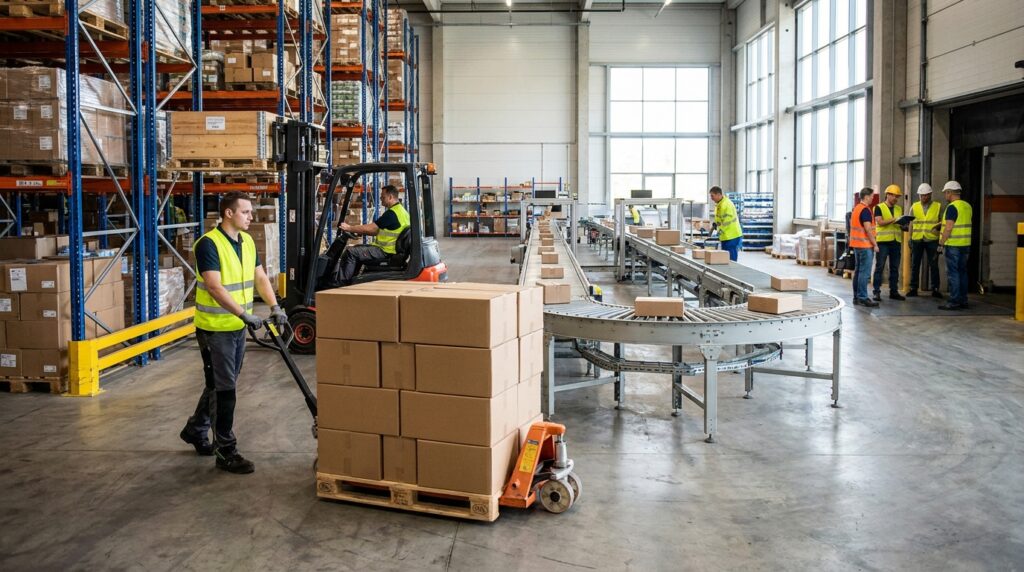
Material handling forms the backbone of every efficient warehouse, manufacturing plant, and distribution center. Understanding the principles of material handling enables facility managers and operations leaders to reduce costs, improve safety, and maximize productivity across their operations. These foundational guidelines, developed over decades of industrial experience, provide a framework for designing and optimizing material movement systems that deliver measurable results.
Whether you’re evaluating new equipment investments, redesigning workflow layouts, or troubleshooting bottlenecks, applying these established principles helps ensure your decisions align with proven best practices. This comprehensive guide explores each principle in detail, offering practical insights for industrial and facility decision-makers seeking operational excellence.
Understanding the Core Principles of Material Handling
The principles of material handling represent a collection of guidelines that govern how materials should be moved, stored, protected, and controlled throughout manufacturing and distribution processes. Originally developed by the Material Handling Institute (MHI) and refined through industry collaboration, these principles serve as a decision-making framework for anyone involved in logistics, operations, or facility management.
At their foundation, these principles aim to achieve several interconnected objectives:
- Minimize unnecessary material movement
- Reduce handling costs and labor requirements
- Improve workplace safety and ergonomics
- Optimize space utilization
- Increase throughput and operational efficiency
- Enhance product protection and quality control
The principles apply universally across industries, from automotive manufacturing and pharmaceutical distribution to food processing and e-commerce fulfillment. While specific applications vary based on product characteristics, facility constraints, and operational requirements, the underlying concepts remain consistent.
The Planning Principle
Effective material handling begins with comprehensive planning. This principle emphasizes that all material handling activities should be planned to define methods, equipment selection, and performance objectives before implementation begins.
Planning requires understanding:
- Product characteristics (weight, dimensions, fragility, hazard classification)
- Volume requirements and throughput expectations
- Facility layout constraints and expansion possibilities
- Integration with existing equipment and systems
- Workforce capabilities and training requirements
A thorough planning process prevents costly mistakes such as purchasing equipment that doesn’t fit available space, creating workflows that produce congestion, or implementing systems that workers cannot operate effectively.
The Standardization Principle
Standardizing material handling methods, equipment, software, and controls reduces variety and customization while maintaining flexibility for operational needs. Standardization delivers several advantages:
- Simplified training and reduced learning curves
- Lower maintenance costs through parts commonality
- Improved interoperability between systems
- Easier troubleshooting and faster repairs
- Better vendor negotiation leverage
For example, standardizing on a single pallet size throughout your facility eliminates the need for multiple rack configurations, diverse forklift attachments, and varied conveyor widths. This consistency ripples through every aspect of operations, from receiving to shipping.
In the realm of efficient manufacturing processes, understanding the Principles of Material Handling is crucial for optimizing operations. For a deeper insight into the essential equipment that supports these principles, you can explore a related article that discusses various types of material handling equipment and their roles in enhancing productivity. This informative piece can be found at Essential Material Handling Equipment for Efficient Manufacturing Processes.
The Work and Ergonomic Principles in Practice
Two closely related principles focus on minimizing effort while protecting workers: the work principle and the ergonomic principle. Together, they guide decisions that affect both operational efficiency and workforce well-being.
Minimizing Work Through Smart Design
The work principle states that material handling work should be minimized without sacrificing productivity or service levels. “Work” in this context refers to material handling labor measured by multiplying flow rate by distance traveled.
Practical applications include:
- Locating high-velocity items near shipping docks to reduce travel distances
- Implementing zone picking strategies that minimize picker movement
- Using gravity-fed systems where elevation changes permit
- Designing straight-line flows that eliminate unnecessary turns and backtracking
- Positioning workstations to create natural material flow patterns
Every unnecessary foot of travel, every redundant lift, and every extra handling step adds cost without adding value. Facilities that rigorously apply the work principle often achieve productivity improvements without capital investment simply by reorganizing layouts and workflows.
Protecting Workers Through Ergonomic Design
The ergonomic principle addresses the physical demands placed on workers during material handling tasks. Effective ergonomic design recognizes human capabilities and limitations, adapting work to the worker rather than forcing workers to adapt to poorly designed systems.
Key ergonomic considerations include:
- Lifting heights and weights that fall within safe limits
- Reaching distances that don’t require overextension
- Repetitive motion reduction through task rotation and mechanical assistance
- Clear sightlines and adequate lighting for safe equipment operation
- Climate control in extreme temperature environments
Beyond the ethical imperative to protect workers, ergonomic improvements deliver measurable business benefits. Reduced injury rates lower workers’ compensation costs, decrease absenteeism, and improve retention. Workers who feel protected by their employers typically demonstrate higher engagement and productivity.
For specific ergonomic requirements in your industry, verify current OSHA guidelines and ANSI standards applicable to your operations.
Unit Load and Space Utilization Principles
How materials are grouped and how space is used significantly impact overall handling efficiency. These principles guide decisions about packaging, containerization, and three-dimensional space optimization.
Optimizing Unit Loads for Handling Efficiency
The unit load principle recommends sizing and configuring loads to achieve maximum handling efficiency. A unit load consolidates multiple items into a single load for handling purposes—whether on a pallet, in a tote, or within a container.
Effective unit load design considers:
- Equipment compatibility (forklift capacity, conveyor width, rack dimensions)
- Product protection requirements during transport and storage
- Downstream handling needs at customer locations
- Return or reuse logistics for containers and pallets
- Weight distribution for stable, safe transport
The ideal unit load maximizes the payload per handling cycle while remaining within equipment capacity limits and maintaining product integrity. Poorly designed unit loads lead to wasted handling capacity, increased product damage, and safety hazards from unstable loads.
Maximizing Three-Dimensional Space Usage
The space utilization principle extends beyond floor space to include vertical dimensions, recognizing that cubic footage often represents the true capacity constraint. Effective space utilization reduces facility costs per unit handled and can defer or eliminate expansion requirements.
Strategies for improved space utilization include:
- Vertical storage systems (selective rack, VNA, AS/RS)
- Mezzanines for additional operational levels
- High-density storage methods for slower-moving inventory
- Reduced aisle widths using appropriate equipment
- Seasonal or temporary storage solutions for peak periods
When evaluating space utilization improvements, consider the total cost impact including equipment investments, energy costs, and operational complexity. Sometimes a larger footprint with simpler operations proves more economical than a compact facility requiring specialized equipment and higher labor skills.
System Integration and Automation Principles
Modern material handling rarely involves isolated equipment operating independently. The system principle and automation principle guide how equipment, software, and processes should work together as integrated solutions.
Creating Coordinated Material Handling Systems
The system principle views all material handling activities as an integrated system spanning receiving, storage, production, assembly, packaging, and shipping. This systems perspective reveals optimization opportunities invisible when evaluating individual processes in isolation.
A systems approach examines:
- Information flow coordinated with physical material flow
- Equipment interfaces and handoff points between zones
- Timing and synchronization across dependent processes
- Bottleneck identification and capacity balancing
- Total system throughput rather than local optimization
For instance, a faster picking operation that outpaces packing capability doesn’t improve overall performance—it simply moves the bottleneck downstream while creating congestion in the staging area. Systems thinking identifies these interactions and guides balanced improvements.
Implementing Automation Strategically
The automation principle encourages deploying automated material handling systems where feasible to improve operational efficiency, reduce costs, and eliminate repetitive manual labor. However, this principle also cautions against automation for its own sake.
Before implementing automation, evaluate:
- Current and projected volume requirements
- Product mix variability and rate of change
- Available capital and expected return on investment
- Technical capabilities of your workforce
- Integration requirements with existing systems
Automation exists on a spectrum from simple mechanization (powered conveyors, lift tables) to sophisticated robotics and autonomous mobile equipment. Starting with appropriate technology levels and scaling complexity as operations mature often proves more successful than attempting comprehensive automation in a single project.
In exploring the essential concepts of material handling, it is beneficial to consider related insights that enhance our understanding of the topic. For instance, an informative article on effective strategies can be found at this link, which delves into various techniques that complement the principles of material handling. By integrating these strategies, businesses can optimize their operations and improve efficiency in their supply chain processes.
Environmental and Life Cycle Considerations
Sustainable material handling practices increasingly influence purchasing decisions, regulatory compliance, and corporate responsibility initiatives. The environmental principle and life cycle cost principle provide guidance for these considerations.
Reducing Environmental Impact
The environmental principle calls for minimizing negative environmental effects throughout material handling activities. This includes:
- Energy efficiency in powered equipment selection
- Emission reduction from internal combustion vehicles
- Packaging minimization and recyclable material choices
- Waste reduction in operations and maintenance
- Sustainable facility design and construction
Many facilities are transitioning from internal combustion forklifts to electric models, implementing regenerative conveyor drives, and converting to LED lighting in storage areas. These changes typically deliver both environmental benefits and long-term cost savings.
Evaluating Total Life Cycle Costs
The life cycle cost principle emphasizes that thorough economic analysis should account for all costs throughout the entire life cycle of equipment and systems, not just initial purchase price.
A complete life cycle cost analysis includes:
- Initial purchase and installation costs
- Energy consumption over equipment lifespan
- Maintenance, repair, and parts replacement
- Training and retraining expenses
- Downtime impact on operations
- Eventual disposal or resale value
Equipment with higher initial costs frequently delivers lower total ownership costs through improved reliability, reduced energy consumption, or longer service life. Conversely, the lowest-price option often proves most expensive when evaluated over its complete life cycle.
In exploring the essential concepts of material handling, one can gain valuable insights from a related article that delves into practical applications and case studies. This resource highlights various projects that illustrate the principles of effective material handling, showcasing how they can enhance efficiency and safety in different industries. For more detailed information, you can check out the article on their projects at Fredon Handling.
Applying Material Handling Principles in Your Facility
Translating these principles of material handling into practical improvements requires systematic evaluation and prioritization. Consider the following approach for your facility:
Assessment checklist for current operations:
- Document existing material flow paths and identify redundant movements
- Measure actual versus theoretical equipment utilization rates
- Review injury records and near-miss reports for ergonomic issues
- Calculate current space utilization percentages by zone
- Evaluate system integration points for delays or data gaps
Prioritization framework:
- Address immediate safety and ergonomic concerns first
- Target high-volume processes for efficiency improvements
- Resolve system bottlenecks limiting overall throughput
- Implement standardization where variety adds cost without value
- Evaluate automation for repetitive, labor-intensive operations
Working with experienced material handling partners accelerates this process. Companies like Fredon Handling bring expertise across industries and equipment types, helping identify solutions that align with your specific operational requirements and constraints. Their consultative approach ensures recommendations address root causes rather than symptoms.
Frequently Asked Questions About Material Handling Principles
How many material handling principles exist?
The Material Handling Institute recognizes ten primary principles, though various industry sources may categorize or number them differently. The core concepts remain consistent regardless of specific numbering.
Do these principles apply to small operations?
Yes. While the scale of application differs, the underlying concepts apply to operations of any size. Even small facilities benefit from reducing unnecessary movement, protecting workers, and optimizing space usage.
How often should material handling systems be evaluated?
Review your systems whenever significant operational changes occur—new product lines, volume shifts, facility modifications, or equipment reaching end-of-life. Additionally, periodic assessments every three to five years help identify gradual efficiency losses.
What role does software play in material handling?
Warehouse management systems, inventory control software, and equipment monitoring platforms increasingly integrate with physical material handling systems. These digital tools enable real-time optimization and data-driven improvement decisions.
Implementing the principles of material handling provides a structured path toward operational excellence. By systematically applying these guidelines, facility decision-makers can reduce costs, improve safety, and build more resilient operations. For assistance evaluating your current material handling systems or exploring equipment solutions, consider reaching out to knowledgeable partners who can provide tailored recommendations for your specific challenges.