
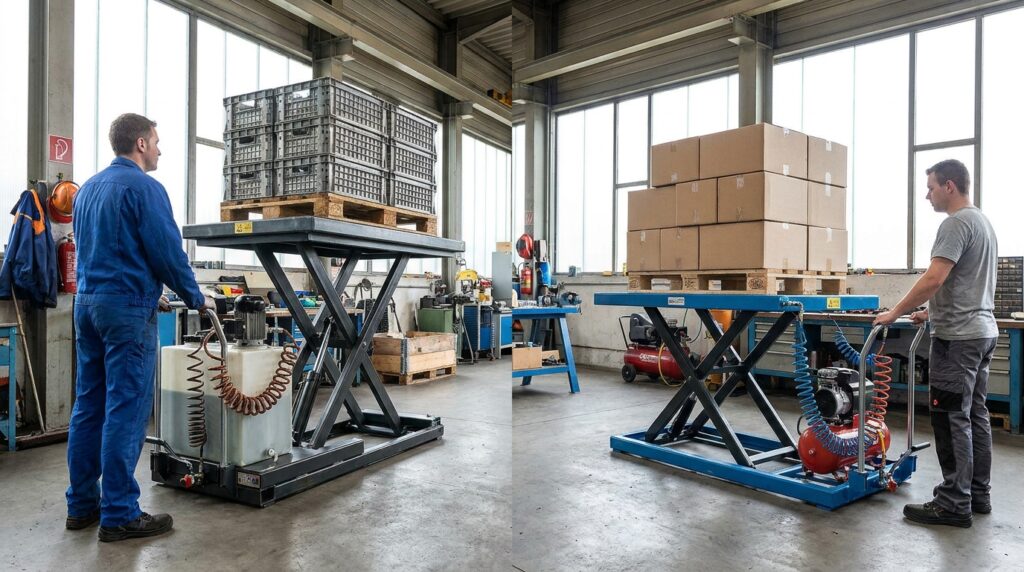
Understanding Your Lifting Needs: Hydraulic vs. Pneumatic Lift Tables for Industrial Applications
In the dynamic world of industrial operations, efficient material handling is paramount. From manufacturing floors to warehouse logistics, the ability to precisely lift, position, and transport heavy loads safely and effectively directly impacts productivity, safety, and bottom-line profitability. Among the most versatile and indispensable pieces of equipment for these tasks are lift tables. These adjustable platforms provide a crucial ergonomic solution, reducing strain on personnel and minimizing the risk of workplace injuries. However, when specifying a lift table, a key decision arises: hydraulic or pneumatic power?
While both systems achieve the fundamental goal of vertical movement, their underlying mechanisms, operational characteristics, and ideal applications differ significantly. For industrial equipment buyers, engineers, and facility managers, a thorough understanding of these distinctions is essential to making an informed choice that aligns with specific operational requirements, budget constraints, and long-term strategic goals. This comprehensive guide, brought to you by Fredon Handling, delves into the intricacies of hydraulic and pneumatic lift tables, empowering you to select the optimal solution for your facility.
When considering the advantages and disadvantages of hydraulic versus pneumatic lift tables, it’s essential to explore related topics that can provide further insights into their applications and efficiency. For a comprehensive understanding of various lifting solutions and their operational mechanisms, you can refer to this informative article on lift systems available at Fredon Handling. This resource delves into the specifics of different lifting technologies, helping you make an informed decision based on your needs.
The Core Mechanics: How Hydraulic and Pneumatic Lift Tables Work
At the heart of every lift table lies its power source and the system that translates that power into vertical motion. Understanding these fundamental principles is the first step in appreciating their differences.
Hydraulic Lift Tables: Harnessing Fluid Power
Hydraulic lift tables rely on the principle of Pascal’s Law, which states that pressure applied to an enclosed fluid is transmitted undiminished to every portion of the fluid and the walls of the containing vessel. In a hydraulic lift table, this fluid is typically hydraulic oil.
The system consists of a reservoir for the hydraulic oil, a pump (often electric or manual), a control valve, and one or more hydraulic cylinders. When activated, the pump draws oil from the reservoir and forces it under pressure into the cylinder. This pressurized oil pushes a piston within the cylinder, extending a rod. This rod is directly connected to the lift table’s platform, causing it to ascend.
To lower the platform, the control valve is operated, allowing the hydraulic oil to flow back from the cylinder into the reservoir. The rate of descent can be controlled by regulating the flow of oil.
Key Components of a Hydraulic System:
- Hydraulic Cylinder(s): The workhorse that translates fluid pressure into linear force.
- Hydraulic Pump: Generates the necessary fluid flow and pressure.
- Reservoir: Stores the hydraulic fluid.
- Control Valve(s): Directs the flow of hydraulic fluid to raise, lower, or hold the platform.
- Hydraulic Fluid: The medium through which power is transmitted.
- Hoses and Fittings: Connect the various components and carry the fluid.
Pneumatic Lift Tables: Leveraging Compressed Air
Pneumatic lift tables utilize compressed air as their power source. Similar to hydraulic systems, they employ cylinders and control valves, but instead of hydraulic oil, they use pressurized air.
A typical pneumatic system involves an air compressor (which generates and stores compressed air), an air preparation unit (which filters, regulates, and lubricates the air), control valves, and air cylinders. When a valve is activated, compressed air is directed into the cylinder, pushing a piston and extending a rod that lifts the table.
Lowering the platform involves venting the air from the cylinder. The speed of ascent and descent is controlled by regulating the airflow into and out of the cylinder.
Key Components of a Pneumatic System:
- Air Cylinder(s): The actuator that converts air pressure into linear motion.
- Air Compressor: Provides the source of compressed air.
- Air Preparation Unit (FRL – Filter, Regulator, Lubricator): Ensures clean, regulated, and properly lubricated air supply.
- Control Valve(s): Directs the flow of compressed air.
- Compressed Air: The working medium.
- Air Hoses and Fittings: Connect the pneumatic components.
Comparative Analysis: Hydraulic vs. Pneumatic Lift Table Performance
The fundamental differences in their power sources lead to distinct performance characteristics that are crucial for selecting the right lift table for your industrial environment.
Lifting Capacity and Force
Hydraulic systems are renowned for their ability to generate significant force and lift heavy loads. The incompressibility of hydraulic oil allows for precise control and the application of immense power within a relatively compact cylinder. This makes them ideal for applications involving extremely heavy materials or where precise, controlled lifting of substantial weight is required.
Pneumatic systems, while capable of lifting moderate to heavy loads, generally have lower lifting capacities compared to their hydraulic counterparts of equivalent size. The compressibility of air, though minimal, can lead to a less “stiff” or precise feel, especially under very heavy loads or during rapid movements. However, for many standard industrial applications, pneumatic systems provide more than adequate lifting capacity.
Speed and Responsiveness
Pneumatic systems are generally faster and more responsive than hydraulic systems. Compressed air can be moved and controlled much more quickly than hydraulic fluid. This makes pneumatic lift tables well-suited for applications requiring rapid cycling or frequent adjustments.
Hydraulic systems, while offering excellent control, tend to operate at slower speeds. The viscous nature of hydraulic fluid and the resistance to flow contribute to this. However, the slower speed also contributes to their smooth operation and fine-tuned control, which can be advantageous in certain precision lifting scenarios.
Precision and Control
Hydraulic lift tables offer superior precision and finer control over movement. The incompressible nature of hydraulic oil allows for very accurate positioning and holding of loads. This is critical in applications where even slight variations in height can impact the assembly or production process. Hydraulic systems are also less susceptible to variations in load weight affecting the speed of descent.
Pneumatic systems can provide good control, especially with sophisticated valve systems, but they can be more susceptible to variations in air pressure and load. For highly precise positioning tasks, hydraulic systems often have an edge.
Cost Considerations
The initial cost of pneumatic lift tables is often lower than that of hydraulic lift tables, especially for lower capacity models. The air compressor and associated infrastructure might represent an upfront investment, but the lift table itself can be more economical.
Hydraulic systems, particularly those designed for high capacities and demanding applications, can have a higher initial purchase price. This is often due to the more robust components required for high-pressure operation.
However, it’s essential to consider the total cost of ownership, which includes maintenance, energy consumption, and potential downtime.
Environmental Factors and Safety
Hydraulic Systems:
- Leakage: Hydraulic fluid leaks can create slip hazards, contaminate the work environment, and represent a significant cleanup cost. Oil spills can also pose environmental risks.
- Fire Hazard: Some hydraulic fluids are flammable, presenting a potential fire hazard in certain environments.
- Temperature Sensitivity: Hydraulic fluid performance can be affected by extreme temperatures, potentially impacting efficiency and component longevity.
- Cleanliness: Maintaining a clean hydraulic system is crucial to prevent contamination that can damage components.
Pneumatic Systems:
- Cleanliness: Pneumatic systems generally operate with cleaner exhaust air than hydraulic systems. While oil mist can be present with lubricated air, it’s often less of a concern than hydraulic fluid leaks.
- Explosion Risk: Pneumatic systems are generally considered safer in environments where flammable gases or vapors are present, as compressed air itself is not an ignition source.
- Noise: Air compressors and the exhaust of pneumatic systems can be noisy, potentially requiring noise reduction measures.
- Moisture: Water condensation in pneumatic lines can lead to corrosion and equipment malfunction.
Practical Applications: Where Each System Shines
The choice between hydraulic and pneumatic lift tables often hinges on the specific demands of the application.
Hydraulic Lift Table Applications
Hydraulic lift tables are the preferred choice for applications demanding high lifting capacities, robust performance, and precise control.
- Heavy Manufacturing: Lifting and positioning large machinery components, molds, or dies.
- Automotive Industry: Assembly line operations requiring the lifting of heavy vehicle chassis or engines.
- Metal Fabrication: Moving and positioning heavy steel plates, workpieces, or finished metal products.
- Die Handling: Precisely lifting and lowering heavy dies into presses.
- Industrial Presses: Providing a stable and controlled platform for feeding and supporting materials under a press.
- Specialty Lifting: Applications requiring exceptional stability and controlled descent, such as surgical equipment or scientific instruments.
Example: A heavy-duty hydraulic scissor lift table from Fredon Handling could be used in an automotive plant to lift entire engine blocks from a lower conveyor to an assembly line at precisely the correct height, ensuring ergonomic access for technicians and preventing strain from manual lifting.
Pneumatic Lift Table Applications
Pneumatic lift tables are ideal for applications requiring faster operation, cleaner environments, and where high lifting capacities are not the primary concern.
- Packaging and Assembly Lines: Rapidly lifting and positioning smaller to medium-sized parts or packages.
- Order Picking and Fulfillment: Assisting warehouse workers by lifting bins, totes, or shelves to ergonomic heights for efficient order fulfillment.
- Machine Tending: Quickly raising and lowering workpieces into and out of machine tools.
- Ergonomic Workstations: Providing adjustable height for assembly tasks where frequent lifting and lowering of lighter items are involved.
- Cleanroom Environments: Their cleaner operation makes them suitable for environments where contamination from hydraulic fluid is unacceptable.
- Food Processing: Due to their cleaner exhaust and ease of maintenance, they can be a good option for certain food processing applications, provided appropriate seals and materials are used.
Example: A pneumatic lift table from Fredon Handling in a fulfillment center could be used to bring a pallet of goods up to the waist height of a picker, allowing them to easily access items without bending, thereby increasing picking speed and reducing the risk of back injuries.
When considering the best options for lifting equipment, it’s essential to understand the differences between hydraulic and pneumatic lift tables. Each type has its own advantages and applications, making it crucial to choose the right one for your specific needs. For further insights on selecting the appropriate material handling equipment for your business, you can explore this informative article on how to choose the right equipment. This resource provides valuable guidance that can help you make informed decisions about your lifting solutions. You can read more about it here.
Key Features and Benefits of Fredon Handling Lift Tables
At Fredon Handling, we understand that the right equipment makes all the difference. Our range of hydraulic and pneumatic lift tables is designed to meet the diverse needs of industrial operations, prioritizing safety, efficiency, and durability.
Hydraulic Lift Table Benefits:
- Unmatched Lifting Power: Capable of handling the heaviest loads with ease.
- Precise Control: Offers exceptional accuracy in positioning and holding.
- Smooth Operation: Minimizes jarring and vibration, crucial for delicate materials or sensitive equipment.
- Durability and Longevity: Robust construction designed for demanding industrial environments.
- Wide Range of Capacities: Available in models to suit virtually any heavy-duty lifting requirement.
- Reliable in Extreme Conditions: Can be engineered to perform in a variety of temperature ranges.
Discover our selection of robust hydraulic lift tables.
Pneumatic Lift Table Benefits:
- Fast and Responsive Operation: Ideal for high-cycle applications.
- Cleaner Operation: Reduced risk of fluid contamination compared to hydraulics.
- Lower Initial Cost: Often more economical for standard applications.
- Simpler Maintenance: Generally fewer components and less complex fluid management.
- Safer in Flammable Environments: Compressed air is not an ignition source.
- Lightweight Design: Can be advantageous in certain portable or space-constrained applications.
Explore our efficient and versatile pneumatic lift tables.
Selecting the Right Lift Table: A Practical Guide for Buyers and Engineers
Choosing the optimal lift table involves a systematic approach, considering both the application’s specific needs and the available technologies.
Step 1: Define Your Lifting Requirements
- Maximum Load Capacity: What is the heaviest weight the table will ever need to lift? Always factor in a safety margin.
- Lifting Height: What is the minimum and maximum height the platform needs to reach?
- Frequency of Use: How often will the lift table be operated daily or weekly?
- Speed Requirements: Is rapid ascent/descent critical, or is slow, controlled movement preferred?
- Precision Needs: How accurately does the platform need to be positioned?
- Operating Environment: Consider temperature, humidity, presence of dust, chemicals, or flammable materials.
- Available Power Source: Do you have compressed air readily available? Is an electrical connection sufficient for a hydraulic pump?
Step 2: Consider Power Source Implications
- Hydraulic: Opt for hydraulic when dealing with very heavy loads, requiring exceptional precision, or where the slower, controlled movement is beneficial. Factor in potential leakage management and fluid maintenance.
- Pneumatic: Choose pneumatic for faster cycle times, cleaner environments, or when compressed air is already a readily available utility. Be mindful of noise levels and the need for air preparation.
Step 3: Evaluate Ancillary Features and Options
- Platform Size and Configuration: Standard rectangular, U-shaped, or custom designs to accommodate specific loads.
- Safety Features: Accordion skirts, toe guards, interlocks, pressure relief valves, emergency stops.
- Control Options: Foot pedals, hand pendants, pushbutton stations, automated controls.
- Mobility: Fixed installation or portable units with casters.
- Power Options: Electric motors, air motors, manual hand pumps.
- Specialty Materials: Stainless steel for food-grade or corrosive environments.
Step 4: Consult with Experts
This is where Fredon Handling excels. Our team of experienced sales engineers and technical specialists can guide you through the selection process. We understand the nuances of different industrial environments and can recommend the most suitable hydraulic or pneumatic lift table solution, ensuring optimal performance and return on investment.
Contact Fredon Handling today for expert advice on selecting your ideal lift table.
Ensuring Safety and Longevity: Best Practices for Lift Table Operation and Maintenance
Investing in a high-quality lift table is only half the battle; proper operation and diligent maintenance are crucial for ensuring safety, maximizing lifespan, and minimizing costly downtime.
Operational Safety Guidelines
- Operator Training: Ensure all personnel operating lift tables receive comprehensive training on their specific model’s operation, safety features, and emergency procedures.
- Load Capacity Adherence: Never exceed the specified maximum load capacity of the lift table. Overloading can lead to structural failure and serious accidents.
- Clearance Checks: Before operation, ensure the area around the lift table is clear of obstructions, personnel, and other equipment.
- Stable Placement: For portable units, ensure they are on a firm, level surface with brakes engaged if applicable.
- Secure Loads: Position loads centrally on the platform and ensure they are stable. Loose or off-center loads can shift during lifting.
- Proximity to Personnel: Minimize the time personnel spend under or in the immediate vicinity of an operating lift table.
- Emergency Stops: Familiarize yourself with the location and operation of all emergency stop buttons.
- Visual Inspections: Conduct a quick visual inspection of the lift table before each use, checking for obvious damage, leaks, or loose components.
Routine Maintenance Schedule
A proactive maintenance plan is key to preventing failures and extending the life of your lift table.
Daily Checks (Pre-Operation):
- Visual inspection for damage, leaks, or foreign objects.
- Check hydraulic fluid level (if applicable).
- Ensure controls are responsive.
Weekly Checks:
- Inspect hydraulic hoses and fittings for wear or leaks.
- Check pneumatic lines and connections for leaks (if applicable).
- Clean the platform and surrounding areas.
- Test safety features like accordion skirts and toe guards.
Monthly Checks:
- Hydraulic Systems:
- Check hydraulic fluid for contamination or degradation. Consider fluid changes based on operating hours and manufacturer recommendations.
- Inspect the pump and motor for unusual noise or vibrations.
- Lubricate pivot points and moving parts.
- Pneumatic Systems:
- Check and clean air filters in the FRL unit.
- Inspect pressure regulator for proper function.
- Lubricate air cylinder (if required by manufacturer).
- Drain any accumulated water from the air system.
Annual Inspections (or as per manufacturer recommendations):
- Thorough inspection of all structural components, welds, and fasteners.
- Hydraulic fluid analysis.
- Replacement of worn seals, hoses, or filters.
- Functional testing of all safety systems.
- Calibration of controls if necessary.
Regularly consulting the manufacturer’s operation and maintenance manual for your specific lift table model is paramount. Fredon Handling offers comprehensive maintenance and support services to help you keep your equipment in optimal condition.
Frequently Asked Questions About Lift Tables
Q1: When is a hydraulic lift table the better choice over a pneumatic one?
A1: Hydraulic lift tables are generally preferred for applications requiring very high load capacities, exceptional precision, or very smooth, controlled movement. They are ideal for heavy manufacturing, die handling, and situations where even slight variations in position are critical.
Q2: What are the primary advantages of pneumatic lift tables?
A2: Pneumatic lift tables offer faster operating speeds, cleaner exhaust air, and often a lower initial cost compared to hydraulic systems for similar lifting capacities. They are also a safer choice in environments with flammable vapors.
Q3: Can pneumatic lift tables be used in hazardous locations?
A3: Yes, pneumatic systems are often a safer choice in hazardous locations where flammable gases or vapors are present because compressed air is not an ignition source. However, ensure all components meet the specific safety ratings for the hazardous area classification.
Q4: How do I determine the correct load capacity for my lift table?
A4: Always determine the maximum weight you will need to lift and add a safety factor (typically 10-25%) to account for dynamic loads, shock, and future needs. Consult with a Fredon Handling expert if you are unsure.
Q5: What maintenance is typically required for hydraulic fluid?
A5: Hydraulic fluid needs to be monitored for contamination and degradation. Regular checks of the fluid level and condition are essential. Fluid changes should be performed according to the manufacturer’s recommendations or based on fluid analysis, typically every 1,000-2,000 operating hours, but this can vary significantly.
Q6: Are there any special considerations for using lift tables in food processing or cleanroom environments?
A6: Yes, in food processing and cleanroom environments, it’s crucial to specify lift tables made with food-grade stainless steel, appropriate seals, and to consider the exhaust of pneumatic systems for cleanliness. Hydraulic systems may require specialized, non-toxic hydraulic fluids. Fredon Handling offers solutions tailored for these demanding applications.
Empower Your Operations with Fredon Handling
Navigating the choice between hydraulic and pneumatic lift tables is a critical decision that impacts the efficiency, safety, and productivity of your industrial operations. By understanding the core mechanics, performance differences, and application-specific advantages of each system, you can make an informed selection.
Fredon Handling is your trusted partner for all your material handling needs. Our extensive range of high-quality hydraulic and pneumatic lift tables, coupled with our expert technical support and commitment to customer satisfaction, ensures you receive the optimal solution for your unique challenges.
Don’t let inefficient or unsafe lifting practices hinder your progress. Contact Fredon Handling today to discuss your specific requirements and let us help you engineer a more productive and safer workspace with the perfect lift table solution.