
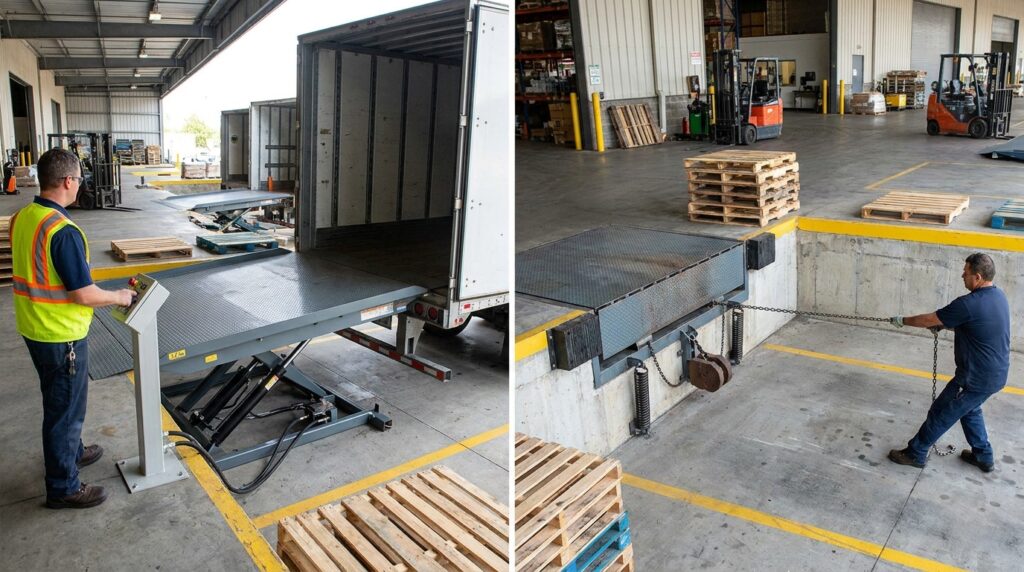
Understanding Your Loading Dock’s Backbone: Hydraulic vs. Mechanical Dock Levelers
In the bustling world of industrial logistics, the loading dock is the critical nexus between a facility’s interior and the external transportation network. It’s where goods are transferred efficiently and safely, forming the backbone of any supply chain operation. At the heart of this crucial interface lies the dock leveler, a device engineered to bridge the gap between the loading dock floor and the trailer bed. For warehouse managers, facility managers, safety managers, and purchasing professionals, selecting the right dock leveler is not merely a procurement decision; it’s a strategic investment that impacts operational efficiency, safety, and ultimately, profitability.
Two primary types of dock levelers dominate the market: hydraulic and mechanical. While both serve the same fundamental purpose, their underlying mechanisms, operational characteristics, and cost implications differ significantly. This article delves deep into the nuances of hydraulic versus mechanical dock levelers, providing you with the comprehensive knowledge needed to make an informed decision that aligns with your facility’s unique needs. We will explore their operational principles, compare their advantages and disadvantages, examine selection criteria, highlight safety considerations, and offer insights into maintenance.
When considering the advantages and disadvantages of hydraulic versus mechanical dock levelers, it’s essential to explore related topics that can provide further insights into material handling solutions. For a comprehensive understanding of various equipment options and best practices in the industry, you can refer to this informative article on material handling: Material Handling Insights. This resource delves into different types of handling equipment, helping you make an informed decision regarding your dock leveler needs.
The Mechanics of Movement: How They Work
Understanding the core engineering behind each type of dock leveler is fundamental to appreciating their differences. Each system employs distinct methods to achieve the crucial task of bridging the height differential between the dock and trailer.
How Hydraulic Dock Levelers Operate
Hydraulic dock levelers harness the power of fluid pressure to lift and position the leveler. At its core, a hydraulic system consists of a reservoir for hydraulic fluid, a pump (often driven by an electric motor), a control valve, and one or more hydraulic cylinders.
When activated, the electric motor powers the pump, which draws hydraulic fluid from the reservoir. This fluid is then pressurized and directed through the control valve to the hydraulic cylinder(s). The pressurized fluid acts upon the piston within the cylinder, extending it and thereby lifting the dock leveler’s deck. The speed and force of the lift are controlled by the flow rate and pressure of the hydraulic fluid.
To lower the leveler, the control valve is manipulated to allow the hydraulic fluid to flow back into the reservoir. This controlled release of pressure enables the deck to descend smoothly. The lip, a critical component that extends to meet the trailer bed, is typically deployed and retracted automatically as the deck is raised and lowered, often through a mechanical linkage connected to the main cylinder operation or a secondary hydraulic function.
The entire process is managed by a control panel, usually featuring simple push-button operation. This provides a user-friendly interface for operators to raise, lower, and stop the leveler at the desired position.
How Mechanical Dock Levelers Operate
Mechanical dock levelers, in contrast, rely on a system of counterweights, springs, and leverage to facilitate their operation. Their design is often simpler and more robust, utilizing the physical forces of tension and compression.
The most common type of mechanical dock leveler utilizes a spring-loaded counterbalance system. When the leveler is in its stored position (flush with the dock floor), a powerful spring mechanism is held under tension. To activate the leveler, the operator pulls a pull chain or lever. This action releases the tension on the spring, allowing it to expand. The force generated by the expanding spring assists in lifting the leveler deck.
As the deck rises, it pivots upwards, and a lip mechanism, often actuated by a cam or roller system engaging a ramp on the deck, automatically extends. The operator typically uses their body weight or pulls on the deck to help guide it into its final position, where it can be secured. The spring tension is designed to counterbalance the weight of the deck, making it relatively easy to operate with minimal physical exertion.
Lowering a mechanical dock leveler involves reversing the process. The lip is usually disengaged, and the operator allows the deck to descend under control, often by gently pushing down or releasing a locking mechanism that holds it in place.
The simplicity of the mechanical design means there are fewer potential points of failure compared to hydraulic systems, as there are no fluids, pumps, or electrical components involved in the primary lifting mechanism.
Comparing the Contenders: Pros and Cons
The choice between hydraulic and mechanical dock levelers hinges on a careful evaluation of their respective strengths and weaknesses relative to your operational demands.
Advantages of Hydraulic Dock Levelers
Hydraulic dock levelers offer a suite of advantages that make them a popular choice for high-traffic, demanding environments.
- Ease of Operation: The push-button activation of hydraulic levelers makes them exceptionally user-friendly. This minimizes the physical strain on operators, reducing the risk of fatigue-related injuries and increasing overall throughput. This is a significant advantage for facilities with a large volume of trailer movements.
- Smooth and Controlled Movement: Hydraulic systems provide incredibly smooth and precise control over the lifting and lowering process. This smooth operation reduces jarring and impact, which is beneficial for handling sensitive or fragile goods and for protecting the integrity of both the dock equipment and the vehicles.
- Adjustable Height and Positioning: Hydraulic levelers offer greater flexibility in fine-tuning the leveler’s height and position, allowing for precise adjustments to accommodate variations in trailer bed heights. This can be crucial for docks that service a wide range of trailer types.
- Higher Lifting Capacity: Hydraulic systems generally provide greater lifting power, allowing them to handle heavier loads and larger deck sizes. This is an advantage for facilities dealing with heavy-duty equipment or exceptionally large loads.
- Built-in Safety Features: Many hydraulic levelers come equipped with integrated safety features, such as automatic fall-off protection, velocity-fuse protection to prevent rapid descent in case of hose failure, and emergency stop capabilities.
- Lower Maintenance Downtime (Potentially): While hydraulics require maintenance, their operational simplicity from an user perspective can lead to quicker turnaround times on dock operations. When properly maintained, they can offer reliable service.
Disadvantages of Hydraulic Dock Levelers
Despite their benefits, hydraulic dock levelers also present certain drawbacks to consider.
- Higher Initial Cost: Hydraulic systems typically have a higher upfront purchase price compared to their mechanical counterparts due to the complexity of their components and the inclusion of electrical and hydraulic systems.
- Potential for Leaks: Hydraulic systems rely on pressurized fluid. Over time, seals can degrade, leading to potential hydraulic fluid leaks. These leaks can create slip hazards on the dock floor, posing a safety risk, and can also lead to environmental concerns if not managed properly.
- Dependence on Power: Hydraulic levelers require a reliable source of electricity to operate. Power outages can render them inoperable, potentially disrupting loading and unloading operations. Backup power solutions might be necessary in critical facilities.
- More Complex Maintenance: While