
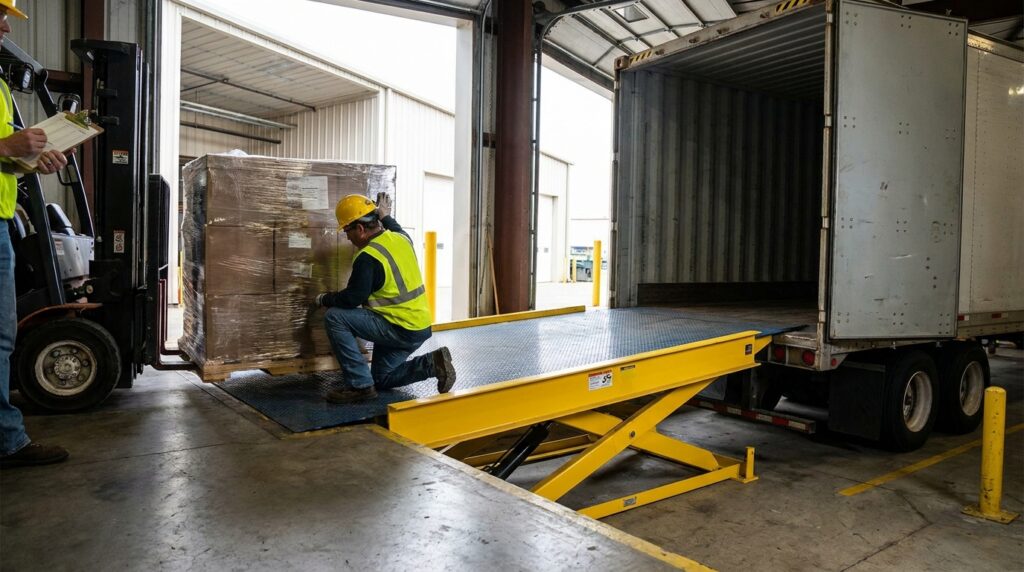
When a trailer backs into your loading dock, the gap between the dock floor and the trailer bed is a critical junction. It’s a space that, if not properly bridged, can lead to significant operational inefficiencies, equipment damage, and, most importantly, serious safety hazards. The unsung hero of this transition is the dock leveler. But not all dock levelers are created equal, and choosing the right one, particularly concerning its dock leveler capacity, is paramount for smooth, safe, and productive warehouse operations.
As a warehouse manager, facility manager, safety manager, or purchasing professional, your responsibility extends beyond just ensuring goods move in and out. It’s about optimizing every touchpoint, mitigating risks, and making informed investments that pay dividends in productivity and safety. This comprehensive guide will delve into the intricacies of selecting the appropriate dock leveler capacity, ensuring your facility is equipped to handle its unique demands. We’ll explore the factors that influence capacity needs, understand the terminology, compare different types of levelers, and highlight the critical safety and maintenance considerations.
Understanding Dock Leveler Capacity: More Than Just a Number
The term “dock leveler capacity” refers to the maximum weight a dock leveler is designed to safely support and operate under. This isn’t a theoretical maximum; it’s a carefully engineered specification based on the structural integrity of the leveler’s components, including the deck, lip, hydraulic system (if applicable), and even its mounting structure. Exceeding this capacity can lead to catastrophic failure, resulting in severe damage to the dock leveler, the forklift, the trailer, and potentially causing severe injury or fatality to personnel.
Defining Key Terminology: What Does “Capacity” Really Mean?
When you see a dock leveler advertised with a specific capacity, such as “60,000 lbs” or “80,000 lbs,” it’s crucial to understand what this figure represents.
- Rated Capacity: This is the standard industry designation for the maximum load the dock leveler can safely handle. It’s typically expressed in pounds.
- Dynamic Load: This refers to the weight being applied to the dock leveler during operation, usually by a forklift or other material handling equipment carrying a load. This is the most critical figure to consider when selecting your dock leveler’s capacity.
- Static Load: This is the weight applied to the dock leveler when it is not in motion, such as when a trailer is parked and the leveler is in its stored position. While less impactful than dynamic load, it’s still a consideration for overall structural integrity.
- Impact Load: This is a less common but important consideration. It accounts for the forces generated when a forklift’s wheels make contact with the dock leveler, especially if there’s a slight jarring motion. Higher impact loads require more robust construction and, consequently, higher capacity ratings.
It’s important to note that manufacturer specifications are based on rigorous testing and engineering standards. Always refer to the manufacturer’s documentation for precise definitions and testing methodologies. At Fredon Handling, we provide detailed specifications for all our dock leveler offerings to ensure you can make an informed decision. You can find a wide range of durable and reliable dock levelers within our Loading Dock Equipment category.
The Science Behind Capacity: Engineering for Durability
The capacity of a dock leveler is a function of several key engineering principles and components:
- Deck Construction: The deck, the primary surface of the leveler, is typically made of heavy-duty steel. Its thickness, internal reinforcement (e.g., cross-bracing), and material grade directly influence its load-bearing capabilities.
- Lip Design and Material: The lip extends from the deck to bridge the gap. Its thickness, length, and the grade of steel used are critical for withstanding the shear forces exerted by moving equipment.
- Lip Hinge and Pivot Points: These are high-stress areas. The design and strength of the hinge mechanism, often involving robust pins and bearings, are crucial for maintaining integrity under load.
- Hydraulic System (for hydraulic levelers): The cylinders, hoses, and pump are designed to lift and hold specific weights. The system’s pressure rating and the cylinder’s bore diameter contribute to the overall capacity.
- Mechanical Spring Systems (for mechanical levelers): The tension and material strength of the springs, along with the counterbalance mechanism, are engineered to support and assist the operation of the deck and lip.
- Frame and Mounting: The structural steel frame that supports the dock leveler and the way it is anchored to the dock structure are integral to its ability to transfer loads safely to the building.
Understanding these elements helps appreciate why simply choosing the “highest capacity” might not always be the most economical or practical solution, but understanding your operational needs is key to selecting the right capacity.
When considering the appropriate dock leveler capacity for your facility, it’s essential to understand not only the specifications of the leveler itself but also the various factors that influence its performance. A related article that provides valuable insights on this topic is “Understanding Dock Leveler Specifications,” which delves into the different types of dock levelers and their respective capacities. For more information or to get in touch with experts who can assist you in making the right choice, visit this link.
Evaluating Your Operational Demands: The Crucial First Step
Selecting the correct dock leveler capacity isn’t about guesswork; it’s about a thorough assessment of your facility’s specific material handling operations. Overestimating can lead to unnecessary costs, while underestimating is a significant safety and operational risk.
Assessing Forklift and Pallet Jack Weights
The most direct influence on dock leveler capacity is the weight of the equipment that will traverse it, along with the typical load it carries.
- Types of Equipment: Are you primarily using manual pallet jacks, electric pallet jacks, order pickers, sit-down forklifts, or stand-up forklifts? Each has different operating weights and load capacities.
- Load Weights: What is the average and maximum weight of the goods being transported on pallets or other loads? Consider peak loads and any specialized heavy-duty items that might pass over the dock.
- Combined Weight: The critical figure is the combined weight of the equipment plus its load. For example, a forklift weighing 8,000 lbs carrying a 4,000 lb pallet results in a total dynamic load of 12,000 lbs.
- Frequent vs. Occasional Heavy Loads: Do you regularly move exceptionally heavy loads, or is it an occasional occurrence? If occasional, a leveler with a higher capacity might be specified for those infrequent but critical moments.
Practical Example:
A facility primarily uses electric pallet jacks that weigh 1,500 lbs unloaded, carrying loads of up to 3,000 lbs. The combined dynamic load is 4,500 lbs. However, once a week, a sit-down forklift weighing 10,000 lbs arrives with a load of 15,000 lbs, totaling 25,000 lbs. In this scenario, you would need a dock leveler that can safely handle at least 25,000 lbs, and ideally, a safety margin would be applied.
Considering Trailer Types and Load Distribution
The types of trailers that frequent your dock can also influence capacity requirements, particularly regarding how the load is distributed.
- Trailer Bed Height Variation: While dock levelers are designed to compensate for height differences, extreme variations can put more stress on the leveler.
- Trailer Floor Strength: The strength and condition of the trailer floor are important. A worn or damaged trailer floor may not distribute the forklift’s weight as effectively, leading to higher localized stress on the dock leveler.
- Load Stability: Unstable loads or loads that shift during transit can create dynamic forces that exceed the static weight.
Regulatory and Industry Standards: A Safety Net
While specific regulations might not dictate precise dock leveler capacity (beyond general safety guidelines), industry best practices and recommendations from organizations like the Occupational Safety and Health Administration (OSHA) emphasize the importance of using equipment rated for the intended application. OSHA’s General Duty Clause requires employers to provide a workplace free from recognized hazards. Using undersized or inadequate dock levelers could be considered a violation if it creates a hazard.
Safety managers should always ensure that equipment meets or exceeds the requirements for the tasks it will perform. This often involves consulting with the equipment supplier to confirm that the chosen capacity offers a sufficient safety margin above the maximum anticipated operational load.
Dock Leveler Types and Their Capacity Implications
Fredon Handling offers a variety of dock leveler solutions, and the type of leveler you choose can have implications for its typical capacity range and how that capacity is achieved. Understanding these differences will help you align the right leveler with your capacity needs.
Mechanical Dock Levelers
Mechanical dock levelers rely on a spring-loaded counterbalance system to raise and lower the deck and lip. They are generally simpler in design and often more budget-friendly upfront.
- Capacity Range: Mechanical dock levelers are commonly available in capacities ranging from 30,000 lbs to 80,000 lbs and sometimes higher for specialized applications.
- How Capacity is Achieved: Their capacity is determined by the strength of the springs, the robustness of the steel construction for the deck and lip, and the structural integrity of the pivot and hinge mechanisms.
- Pros for Capacity: Robust construction often makes them suitable for high-traffic, heavy-duty environments.
- Cons for Capacity: While durable, some very high-capacity needs might be more efficiently or ergonomically met with hydraulic systems.
We offer a range of durable mechanical dock levelers designed for demanding warehouse environments. Explore options that might suit your capacity requirements.
Hydraulic Dock Levelers
Hydraulic dock levelers use a hydraulic power unit (pump and cylinder) to lift and lower the deck and lip. They offer a smooth, controlled operation and are often preferred for higher capacities and heavier workloads.
- Capacity Range: Hydraulic dock levelers are available in a very wide range, from standard 60,000 lbs up to 100,000 lbs and even beyond for exceptionally heavy-duty applications.
- How Capacity is Achieved: The capacity is primarily determined by the strength and size of the hydraulic cylinder, the pressure rating of the hydraulic system, and the heavy-duty steel construction of the deck, lip, and frame.
- Pros for Capacity: Excellent for consistently handling very heavy loads and provide smooth, powered operation that reduces operator fatigue. They also typically offer better control for precise positioning.
- Cons for Capacity: Higher initial cost and require electrical power. Maintenance of the hydraulic system is also a consideration.
Fredon Handling provides state-of-the-art hydraulic dock levelers designed for maximum efficiency and safety. Consider our hydraulic options when your operations demand the highest level of performance and capacity.
Air-Powered Dock Levelers
Air-powered dock levelers utilize compressed air, often from the facility’s shop air supply or a dedicated on-board compressor, to raise and lower the deck.
- Capacity Range: Typically available in capacities similar to mechanical and hydraulic levelers, often in the 60,000 lbs to 80,000 lbs range, but can be engineered for higher.
- How Capacity is Achieved: The capacity is determined by the strength of the air bladder or lifting bags, the reinforcement of the deck, and the structural components.
- Pros for Capacity: Offer a smooth operation and can be a good alternative for facilities without readily available hydraulic power. They are often seen as a middle ground between mechanical and hydraulic in terms of operation and cost.
- Cons for Capacity: Reliance on a compressed air source, which requires maintenance of the air system.
Edge-of-Dock Levelers
Edge-of-dock levelers are a simpler, more cost-effective solution designed for lighter duty applications. They mount directly to the dock face, extending out from the dock edge.
- Capacity Range: Generally have lower capacities compared to pit-style levelers, typically ranging from 20,000 lbs to 40,000 lbs.
- How Capacity is Achieved: Simpler spring-loaded or manual lever mechanisms with lighter-duty steel construction.
- Pros for Capacity: Ideal for facilities where only pallet jacks or lighter forklifts are used and the height differential is minimal.
- Cons for Capacity: Not suitable for heavy forklifts or significant vertical travel.
While edge-of-dock levelers are a viable option for specific scenarios, they are not designed for the heavy-duty capacities often required in general warehousing. Ensure your operational needs align with their limitations.
The Importance of a Safety Margin: Beyond the Minimum Requirement
It is critically important to understand that the rated capacity of a dock leveler is the maximum it is designed to handle. Operating at the absolute limit of a dock leveler’s capacity is not recommended and can significantly shorten its lifespan, increase the risk of premature failure, and compromise safety.
Why a Safety Factor is Essential
- Unexpected Loads: During operations, unexpected surges in weight can occur due to how loads are stacked, movement within the trailer, or even minor impacts.
- Equipment Wear and Tear: Over time, components can experience wear, reducing their inherent strength. A safety margin accounts for this gradual degradation.
- Dynamic Forces: As mentioned earlier, forklifts don’t just place weight; they create dynamic forces through acceleration, braking, and turning. These forces can momentarily exceed the static weight of the load.
- Environmental Factors: Extreme temperatures or exposure to certain chemicals can, over time, affect the material properties of the dock leveler, potentially impacting its load-bearing capabilities.
- Maintenance Lapses: While regular maintenance is crucial, occasional oversights can happen. A safety margin provides a buffer.
Calculating and Applying a Safety Margin
A common practice in engineering and industrial applications is to apply a safety factor. For dock levelers, a general recommendation is to select a capacity that is at least 25% to 50% higher than your maximum anticipated dynamic load.
Formula:
Required Dock Leveler Capacity = Maximum Dynamic Load x (1 + Safety Margin Percentage)
Example:
If your maximum anticipated dynamic load is 40,000 lbs, and you apply a 25% safety margin:
Required Dock Leveler Capacity = 40,000 lbs x (1 + 0.25) = 50,000 lbs
If you apply a 50% safety margin:
Required Dock Leveler Capacity = 40,000 lbs x (1 + 0.50) = 60,000 lbs
Consulting with Fredon Handling’s experts can help you determine the appropriate safety margin based on your specific operational context and risk assessment.
When considering the right dock leveler capacity for your facility, it’s essential to understand the various factors that influence your choice. A related article that provides valuable insights on this topic can be found at Fredon Handling, where you can explore additional tips and guidelines to ensure you select the most suitable dock leveler for your operational needs. This resource can help you make informed decisions that enhance efficiency and safety in your loading and unloading processes.
Selection Criteria: A Holistic Approach to Choosing Your Dock Leveler
Beyond capacity, several other factors should influence your decision when selecting a dock leveler. These elements ensure that the chosen equipment not only meets your weight requirements but also integrates seamlessly with your operations and facility.
Functional Requirements and Throughput
- Frequency of Use: High-traffic docks require more durable equipment that can withstand constant operation. Hydraulic levelers are often preferred for very high-volume areas due to their smooth operation and durability.
- Speed of Operation: How quickly do you need to transition trailers? Hydraulic levelers generally offer faster operation cycles compared to mechanical ones.
- Trailer Bed Heights: Do you handle trailers with significantly varying bed heights? Some levelers offer a wider range of vertical adjustment.
- Dock Leveler Type: As discussed, mechanical, hydraulic, and air-powered levelers each have unique operational characteristics that might align better with your facility’s needs and existing infrastructure.
Environmental Considerations
- Indoor vs. Outdoor Use: While most dock levelers are designed for indoor dock bays, some components might be more susceptible to extreme weather.
- Temperature Extremes: Extreme cold can affect hydraulic fluid viscosity, and extreme heat can impact rubber seals and other components. Ensure the chosen leveler is rated for your operating environment.
- Exposure to Chemicals or Corrosives: If your facility handles materials that could corrode standard steel, consider levelers with specialized coatings or materials.
Budget and Total Cost of Ownership
- Initial Purchase Price: Mechanical levelers often have a lower upfront cost, while hydraulic and air-powered units are typically more expensive initially.
- Installation Costs: Installation complexity can vary, impacting overall project costs.
- Maintenance Costs: Consider the ongoing costs of maintaining hydraulic systems (fluid, seals), spring systems, and general wear and tear.
- Energy Consumption: Hydraulic and air-powered units consume electricity.
- Lifespan: A higher initial investment in a robust, high-capacity hydraulic leveler might offer a longer service life and lower total cost of ownership in a high-demand environment compared to a less expensive mechanical unit that may require earlier replacement.
Safety Features and Compliance
- **Safety