
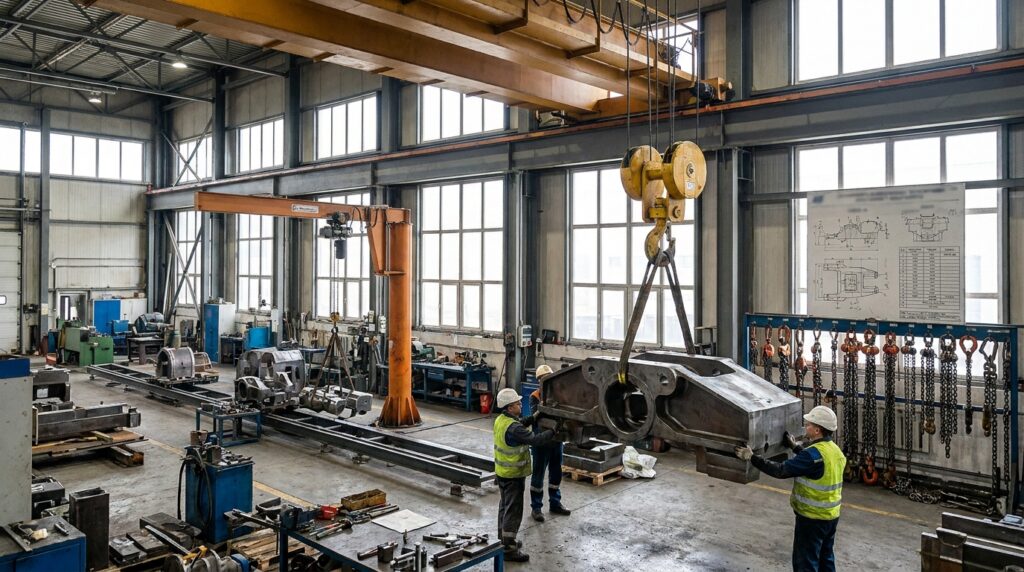
Understanding Crane Duty Classifications: A Guide for Optimal Equipment Selection
Keyword: Crane Duty Classifications
SEO Title: Crane Duty Classifications Explained: Selecting the Right Crane for Your Application | Fredon Handling
Meta Description: Demystify crane duty classifications (Group A-H) and their impact on load frequency and duration. Learn how to choose the optimal crane for manufacturing, warehousing, and industrial environments with Fredon Handling.
URL Slug: crane-duty-classifications-explained-selecting-for-frequency-and-load
The effective and safe operation of any industrial facility hinges on the judicious selection of material handling equipment. Among the most critical components in lifting and moving heavy loads are cranes. However, not all cranes are created equal. Their intended use, frequency of operation, and the nature of the loads they handle dictate specific design considerations and performance standards. This is where the concept of crane duty classifications becomes paramount. Understanding these classifications is not merely a technical detail; it’s fundamental to ensuring operational efficiency, equipment longevity, and, most importantly, worker safety.
This comprehensive guide, brought to you by Fredon Handling, aims to demystify crane duty classifications, providing manufacturing managers, warehouse operators, engineers, maintenance teams, and industrial equipment buyers with the knowledge to make informed decisions. We will delve into the factors that define these classifications, explore the different duty groups, and offer practical advice on selecting the right crane for your specific operational needs.
For those interested in understanding the nuances of crane duty classifications, a related article that delves deeper into the practical applications of these classifications can be found at Fredon Handling Projects. This resource provides valuable insights into how different duty classifications impact crane selection based on frequency and load requirements, helping professionals make informed decisions for their specific lifting needs.
The Foundation of Crane Selection: Defining Duty and Load
Before diving into specific classifications, it’s crucial to understand the underlying principles that govern them. Crane duty classifications are primarily determined by two key factors: the frequency of use and the load factor. These elements directly influence the mechanical stresses placed on the crane’s components, impacting its design, construction, and expected lifespan.
Understanding Load Factor
The load factor is a measure of how close the crane operates to its rated capacity. A crane operating at or near its maximum rated load will experience significantly higher stresses than one consistently lifting loads well below its capacity.
- Constant Maximum Load: This refers to operations where the crane frequently lifts loads at or very near its full rated capacity. Such demanding applications necessitate robust construction and heavier-duty components.
- Variable Loads: Many operations involve lifting loads of varying weights, some close to the maximum and others much lighter. The classification must account for the average load and the frequency of heavy lifts.
- Light Loads: In some scenarios, a crane might be used for tasks that are consistently light relative to its maximum capacity. While this might seem less demanding, the frequency of operation still plays a role.
Assessing Frequency of Operation
The frequency of operation, often referred to as service hours or duty cycle, dictates how often the crane’s components are subjected to stress and movement.
- Continuous Duty: This signifies operation for a significant portion of the working day, potentially multiple shifts. Components will experience constant cycling and fatigue.
- Intermittent Duty: The crane is used frequently but not continuously throughout the entire work period. There are periods of rest between operational cycles.
- Occasional Duty: The crane is used only for short periods, with long intervals of inactivity.
These two factors – load factor and frequency of operation – are combined to determine the appropriate ASME (American Society of Mechanical Engineers) or CMAA (Crane Manufacturers Association of America) duty classification for a crane. These classifications are typically represented by letters, often ranging from Group A (lightest duty) to Group H (heaviest duty).
Decoding Crane Duty Classifications: Group A Through Group H
The crane industry, guided by standards like those from ASME and CMAA, categorizes cranes into distinct duty groups. These groups are not arbitrary; they are derived from detailed engineering analysis of anticipated usage patterns and their impact on crane lifespan and reliability. Understanding these groups is the cornerstone of selecting equipment that will perform optimally and safely within your specific operational environment.
Group A: Infrequent Duty
- Description: Cranes in Group A are designed for the lightest of duty cycles. They are intended for applications where the crane is used for very short periods, infrequently, and typically handles light loads.
- Applications: Examples include basic inspection services, occasional lifting of light maintenance equipment, or infrequent lifting in a general shop environment where the primary purpose is not continuous material movement.
- Load Factor: Typically operates at a very low load factor, well below rated capacity.
- Frequency: Minimal operational hours per day or week. Long periods of inactivity are expected.
- Construction: Lighter structural components, less robust motor sizing, and simpler controls are common.
Group B: Light Duty
- Description: Group B cranes are for light service applications involving a limited number of lifts per day at or below rated capacity.
- Applications: Found in repair shops, light assembly areas, or as utility cranes in larger facilities for occasional use.
- Load Factor: Operates at a low load factor, usually lifting loads significantly below the crane’s maximum capacity.
- Frequency: Low frequency of operation, with limited daily usage.
- Construction: Similar to Group A but with slightly more robust construction to accommodate the slightly increased usage.
Group C: Moderate Duty
- Description: These cranes are designed for moderate duty applications where the crane is used more regularly throughout the workday, often in general-purpose production or assembly operations.
- Applications: Common in manufacturing plants for assembly lines, parts handling, and medium-duty fabrication.
- Load Factor: Operates at moderate load factors, handling loads that may approach rated capacity, but not consistently.
- Frequency: Moderate frequency of operation, with several lifts per hour.
- Construction: Features more robust structural components, higher-rated motors, and more durable electrical systems compared to Groups A and B.
Group D: Heavy Duty
- Description: Group D cranes are built for heavy-duty service in production or manufacturing areas where the crane operates at or near its rated capacity for a significant portion of the workday.
- Applications: Typically found in heavy fabrication shops, foundries, steel mills, and other demanding industrial environments.
- Load Factor: High load factor, with frequent lifts at or near the crane’s maximum rated capacity.
- Frequency: High frequency of operation, often running for extended periods throughout the shift.
- Construction: Requires heavy-duty girders, robust trolley and hoist mechanisms, powerful motors, and high-durability electrical components designed to withstand constant stress and heat.
Group E: Extra Heavy Duty
- Description: Cranes in this group are engineered for severe duty, meaning they operate continuously under strenuous conditions, handling loads up to their rated capacity.
- Applications: Primarily used in applications like continuous operation foundries, steel mills, and other heavy industrial facilities where lifting is constant and loads are consistently heavy.
- Load Factor: Consistently operates at or near its rated capacity.
- Frequency: Continuous duty cycle, operating for the entire work duration, often multiple shifts.
- Construction: Maximum structural integrity, oversized motors, heavy-duty gearing, robust braking systems, and specially designed electrical systems to manage heat and wear.
Group F: Specialized Heavy Duty
- Description: This classification is for cranes designed for specialized applications that exceed the requirements of Group E. They operate under very demanding conditions with loads up to their rated capacity, but with an emphasis on specific operational characteristics or duty cycles not covered by Group E.
- Applications: Such as those in the pulp and paper industry, heavy manufacturing where very large components are moved with precision and regularity, or certain automated process operations.
- Load Factor: Near-constant operation at or near rated capacity.
- Frequency: Extremely high frequency and duration of use.
- Construction: Custom-engineered for extreme environments, often featuring specialized materials, enhanced cooling systems, and exceptionally robust drive trains.
Group G and H: Extremely Heavy Duty (Less Common for Standard Overhead Cranes)
- Description: Groups G and H represent the highest levels of duty classification. These cranes are designed for exceptionally severe, continuous service in the most demanding environments. While less common for standard overhead cranes, they are found in highly specialized industrial settings.
- Applications: Examples might include the most extreme heavy-duty mill cranes or specialized lifting equipment in highly automated, high-throughput manufacturing processes that operate 24/7.
- Load Factor: Constant operation at or above rated capacity.
- Frequency: Continuous, 24/7 operation.
- Construction: The pinnacle of crane engineering, utilizing the strongest materials, most powerful and efficient drive systems, and advanced control technologies to ensure extreme durability and reliability.
Important Note on Classifications: While the ABC to H classification system is widely recognized, specific manufacturers may use slightly different terminology or grouping structures. Always refer to the manufacturer’s specifications and load rating charts for precise details. Fredon Handling works with reputable manufacturers who adhere to industry-leading standards.
Matching Duty Classifications to Your Operational Needs
Selecting the correct crane duty classification is a strategic decision that impacts more than just the initial purchase price. It influences operational efficiency, maintenance costs, equipment lifespan, and safety. A mismatch can lead to premature wear, unexpected downtime, and potential safety hazards.
Analyzing Your Application Requirements
To accurately determine the appropriate duty classification, a thorough analysis of your specific application is essential. Consider the following questions:
- What is the typical weight of the loads you will be lifting? Are you consistently lifting near the crane’s maximum capacity, or are loads usually much lighter?
- How frequently will the crane be used? Will it be in constant motion throughout the workday, or will it be used intermittently?
- What is the expected duty cycle of the crane? Estimate the percentage of time the crane will be actively lifting and moving loads during a standard workday.
- What is the environmental context? Are there extreme temperatures, corrosive substances, or dusty conditions that might affect equipment longevity?
- What are the safety and regulatory requirements? OSHA and ASME standards provide guidelines for safe crane operation and selection.
Practical Examples of Duty Classification Selection
Let’s illustrate with some practical scenarios:
- Scenario 1: A small machine shop that occasionally lifts heavy parts for repair.
- Analysis: Light loads primarily, very infrequent use.
- Recommendation: Group A or B. A Group C crane might be over-specified and unnecessarily expensive.
- Scenario 2: A general manufacturing assembly line where parts are moved regularly, but not continuously.
- Analysis: Moderate loads, moderate to high frequency of use throughout the day.
- Recommendation: Group C or D. A Group C crane might suffice if loads are consistently below maximum, but a Group D offers more robustness for higher frequency and occasional heavier lifts.
- Scenario 3: A steel fabrication facility where heavy beams are constantly being moved and welded.
- Analysis: Heavy loads approaching rated capacity, continuous operation.
- Recommendation: Group D or E. A Group D crane is a strong contender for heavy production. If operation is truly continuous and near full capacity for the entire shift, Group E might be necessary for extended lifespan.
- Scenario 4: A critical process in a chemical plant that requires the constant movement of heavy materials 24/7.
- Analysis: Heavy to very heavy loads, continuous operation, potentially harsh environment.
- Recommendation: Group E or F. The specific demands of continuous, heavy lifting in a demanding environment necessitate the highest duty classifications.
The Cost of Underspecification vs. Overspecification
- Underspecification: Choosing a crane with a lower duty classification than required is a common but costly mistake. It leads to accelerated wear on motors, brakes, gears, and structural components. This results in:
- Frequent breakdowns and increased downtime, impacting production schedules.
- Higher maintenance and repair costs.
- Reduced equipment lifespan, requiring premature replacement.
- Increased risk of accidents due to component failure.
- Overspecification: While generally safer and leading to longer lifespan, choosing a crane with a duty classification significantly higher than needed can result in:
- Higher initial purchase cost.
- Potentially heavier, more complex equipment that might be overkill for the application, leading to inefficiencies in other areas.
The ideal choice is a crane that precisely matches the operational demands, providing reliability without unnecessary expense. Fredon Handling’s experts can assist in this critical assessment to avoid both pitfalls.
Understanding crane duty classifications is crucial for selecting the right equipment for specific tasks, and for further insights on this topic, you might find the article on crane operation best practices particularly helpful. This resource delves into the nuances of crane usage, emphasizing the importance of matching the crane’s capabilities with the frequency and load requirements of various applications. By exploring these related concepts, you can make more informed decisions when it comes to crane selection and operation.
Key Crane Components and Duty Classification Impact
The duty classification of a crane dictates the design and specification of its various components. Understanding how these classifications affect critical parts of the crane ensures you appreciate the underlying engineering that goes into building a robust lifting solution.
Hoist and Trolley Systems
The hoist and trolley are the workhorses of the crane. Higher duty classifications require:
- Motor Sizing: Larger, more powerful motors with higher duty cycle ratings to handle frequent starts, stops, and continuous operation without overheating.
- Gearboxes: Robust, heavy-duty gearboxes with larger gears and stronger bearings designed for prolonged use and high torque.
- Brakes: More powerful and durable braking systems, often multiple brakes, to ensure precise control and safe stopping under heavy loads and frequent operation.
- Wire Rope: Heavier-duty wire rope with higher breaking strengths and better resistance to wear and abrasion.
- Sheave Wheels: Larger diameter sheaves and materials that reduce rope wear.
Structural Components
The crane’s bridge girders, end trucks, and other structural elements are designed to withstand the stresses of lifting.
- Material Strength: Higher-grade steel and thicker plating are used in higher duty classes to resist bending, torsion, and fatigue.
- Fabrication: More rigorous welding and inspection standards are applied to ensure structural integrity.
- Deflection Limits: Stricter deflection limits are imposed on girders to maintain positional accuracy, especially crucial for automated or precise operations.
Electrical Systems and Controls
The electrical components must also be built for longevity under demanding conditions.
- Cable Management: Heavy-duty festooning or energy chains designed for continuous movement and high cycle counts.
- Motors and Drives: Motors with higher thermal ratings and Variable Frequency Drives (VFDs) that offer smoother acceleration/deceleration, reducing mechanical shock and wear.
- Control Panels: Industrial-grade components designed to withstand vibration, dust, and temperature fluctuations. Higher duty classes may feature more sophisticated control systems for precise movement and load management.
- Limit Switches and Sensors: Robust, industrial-rated switches designed for high cycle life.
End Trucks and Crane Drives
The mechanisms that move the crane along the runway.
- Wheel Design: Heavy-duty wheels with hardened treads to withstand high loads and frequent travel.
- Drive Motors and Gearboxes: Sized to provide adequate torque and speed for the crane’s bridge, designed for continuous duty.
Safety Considerations and Regulatory Compliance
Safety is paramount in any industrial operation, and crane selection is intrinsically linked to ensuring a safe working environment. Crane duty classifications play a significant role in meeting regulatory requirements and preventing accidents.
OSHA and ASME Standards
- OSHA (Occupational Safety and Health Administration): OSHA regulations, particularly those found in 29 CFR 1910.179 (Powered Industrial Trucks), address the safe operation, inspection, and maintenance of overhead and gantry cranes. While OSHA doesn’t explicitly define duty classifications, their requirements for load testing, inspection frequencies, and proper maintenance are directly influenced by the anticipated usage – which is what duty classifications address.
- ASME (American Society of Mechanical Engineers): ASME B30.2 (Safety Standard for Overhead and Gantry Cranes) and related standards are foundational in defining crane design, construction, and operational parameters. These standards provide the framework for the duty classification system, ensuring that cranes are designed and built to withstand the stresses associated with their intended service.
How Duty Classification Enhances Safety
- Preventing Component Failure: A crane designed for its specific duty class is less likely to experience premature component failure due to fatigue or overload. This directly reduces the risk of dropped loads, collisions, or structural collapse.
- Ensuring Control and Stability: Higher duty classifications often involve more robust braking and control systems, crucial for maintaining stability, especially when handling heavy loads or operating in demanding conditions.
- Predictable Performance: Correctly classified cranes offer predictable performance, allowing operators to work with confidence and follow established safety procedures.
- Meeting Regulatory Inspections: Proper classification and adherence to maintenance schedules (as dictated by usage and classification) are critical for passing regulatory inspections and maintaining compliance.
Training and Operator Competency
While equipment selection is vital, it’s only one part of the safety equation. OSHA also mandates proper training for crane operators. Operators must be competent in:
- Understanding load charts and crane capacities.
- Recognizing potential hazards.
- Performing pre-operational checks.
- Operating the crane smoothly and efficiently, avoiding jerky movements that can stress components.
- Following communication protocols.
Fredon Handling can advise on equipment that facilitates safe operation, but the ultimate responsibility for safe use lies with the implementing organization and its trained personnel.
Maintenance and Longevity: Maximizing Your Investment
Proper maintenance is crucial for the longevity and reliable performance of any piece of industrial equipment, and cranes are no exception. The duty classification directly influences the maintenance strategy required to keep your crane operating efficiently and safely.
Tailoring Maintenance to Duty Class
- Higher Duty Classifications (D, E, F, G, H): Cranes operating under heavy or continuous duty cycles require more frequent and thorough inspections and preventative maintenance.
- Daily Checks: Visual inspections for wear, damage, or leaks.
- Weekly/Monthly Checks: Lubrication of critical moving parts, inspection of wire rope for fraying or kinks, testing of brakes and limit switches.
- Annual/Semi-Annual Inspections: Comprehensive load testing (where applicable and safe), detailed examination of structural welds, electrical system checks, and gearbox inspections.
- Component Replacement: High-wear components like wire rope, brake pads, and electrical contacts will need replacement more frequently.
- Lower Duty Classifications (A, B, C): While still requiring diligent maintenance, these cranes may have slightly extended intervals between comprehensive inspections, as the wear and tear are less severe. However, adherence to a scheduled maintenance program remains vital to prevent minor issues from escalating.
Key Maintenance Areas to Focus On
Regardless of the duty class, certain areas demand consistent attention:
- Lubrication: Proper lubrication of gears, bearings, and wire ropes is essential to reduce friction and wear.
- Wire Rope Inspection: Regularly check for broken wires, kinking, crushing, corrosion, and proper spooling on the hoist drum.
- Brake System: Ensure brakes are functioning correctly, adjust as needed, and inspect for wear.
- Electrical Systems: Check connections, motor temperatures, and control panel functionality.
- Structural Integrity: Inspect welds, bolts, and structural members for signs of fatigue, cracks, or deformation.
- Wheels and Rails: Ensure proper alignment and check for wear on crane wheels and runway rails.
The Role of Fredon Handling in Maintenance Support
Fredon Handling understands that selecting the right crane is only the beginning. We offer:
- Expert Consultation: Helping you establish an appropriate preventative maintenance schedule based on your chosen crane’s duty classification and operational environment.
- Replacement Parts: Providing access to high-quality replacement parts to minimize downtime during repairs.
- Service and Support: Connecting you with qualified service technicians for inspections, repairs, and upgrades.
Investing in a well-maintained crane, correctly specified for its duty, is an investment in the operational continuity and profitability of your business.
Making the Right Choice: Purchasing Advice for Crane Buyers
Choosing the right crane can be a complex process. With the understanding of duty classifications now established, here’s practical advice for industrial equipment buyers to ensure they make an informed purchase.
The Fredon Handling Advantage: Partnering for Success
At Fredon Handling, we don’t just sell equipment; we partner with you to find the optimal solution. Our approach involves:
- Needs Assessment: We begin by deeply understanding your specific lifting requirements, including load types, frequencies, operational environments, and safety protocols.
- Expert Guidance: Our experienced team will guide you through the complexities of crane duty classifications, helping you accurately assess your needs and select the most appropriate group.
- Customization and Configuration: Where standard solutions may not fit perfectly, we can explore customized configurations and options to meet unique challenges.
- Compliance Assurance: We ensure the equipment we recommend meets relevant ASME, OSHA, and other applicable industry standards.
- Long-Term Support: From installation and commissioning to ongoing maintenance and parts supply, Fredon Handling is your dedicated partner for the life of your crane.
Key Considerations When Purchasing
- Total Cost of Ownership: Don’t just look at the initial price tag. Consider the long-term costs of maintenance, repair, energy consumption, and potential downtime associated with different duty classes.
- Manufacturer Reputation: Partner with reputable manufacturers known for quality, durability, and adherence to safety standards. Fredon Handling works with leading brands in the industry.
- Service and Support Network: Ensure the manufacturer and your supplier have a robust service and support network to assist with troubleshooting, repairs, and parts availability.
- Future-Proofing: Consider potential future changes in your operational demands. While not always feasible, a slightly higher duty class might offer more flexibility for growth.
- Operator Training: Factor in the cost and availability of training for your operators.
Useful Table: Crane Duty Classification Summary
| Duty Group | Description | Load Factor | Frequency of Use | Typical Applications |
| :– | : | : | : | :- |
| A | Infrequent Duty | Very Light | Very Low | Light maintenance, inspection, occasional utility lifting |
| B | Light Duty | Light | Low | Repair shops, light assembly, general utility in larger facilities |
| C | Moderate Duty | Moderate | Moderate | General production, assembly lines, medium-duty fabrication |
| D | Heavy Duty | High | High | Heavy fabrication, steel mills (production areas), demanding manufacturing |
| E | Extra Heavy Duty | Very High | Continuous | Continuous foundries, heavy industrial, high-throughput production |
| F | Specialized Heavy Duty | Very High | Continuous | Pulp & paper, specialized heavy manufacturing, automated process operations |
| G/H | Extremely Heavy Duty (Rare) | Extreme | 24/7 Continuous | Highly specialized, extreme heavy-duty mill cranes, critical continuous processes |
(Note: This table provides a general overview. Specific parameters and definitions can vary slightly between manufacturers and standards.)
Frequently Asked Questions About Crane Duty Classifications
What is the most common crane duty classification for general manufacturing?
For general manufacturing environments where cranes are used regularly throughout the workday but not necessarily continuously, Group C (Moderate Duty) or Group D (Heavy Duty) are the most common classifications. The choice between C and D depends on the frequency of lifts, the proximity of loads to the crane’s rated capacity, and the desired lifespan.
Can I use a lower duty classification crane than recommended to save costs?
While it might seem like a cost-saving measure initially, using a crane with a lower duty classification than recommended is strongly discouraged. This practice leads to accelerated wear, premature failure of components, increased downtime, higher maintenance costs, and a significantly higher risk of accidents. It compromises safety and operational efficiency in the long run.
How do environmental factors influence crane duty classification selection?
Harsh environmental factors such as extreme temperatures, high humidity, corrosive atmospheres, or excessive dust can accelerate wear on crane components. In such conditions, it might be prudent to select a crane with a slightly higher duty classification or specify additional protective features (e.g., enhanced sealing, special coatings) to ensure longevity and reliable performance.
Does duty classification affect the price of a crane?
Yes, duty classification significantly impacts the price of a crane. Higher duty classifications (like D, E, F) require more robust materials, heavier-duty components, more powerful motors, and more complex engineering, all of which increase the manufacturing cost and, consequently, the purchase price. However, this higher initial investment is often offset by greater reliability, reduced downtime, and a longer operational lifespan.
Conclusion: Partner with Fredon Handling for Optimal Crane Solutions
The selection of the correct crane duty classification is a critical decision that impacts the efficiency, safety, and longevity of your material handling operations. By understanding the nuances of load factors, frequency of use, and the specific requirements of each duty group (from Group A to H), you can avoid costly mistakes and ensure your investment delivers maximum value.
Fredon Handling is your trusted partner in navigating these complexities. We leverage our expertise and relationships with leading manufacturers to provide the most suitable crane solutions for your unique industrial needs. Whether you operate a small fabrication shop or a large-scale manufacturing facility, we are committed to helping you select equipment that aligns with ASME and OSHA standards, enhances your operational capabilities, and prioritizes safety.
Don’t leave your critical lifting decisions to chance. Contact Fredon Handling today to discuss your project and discover how our expertly selected and specified cranes can elevate your operations.