
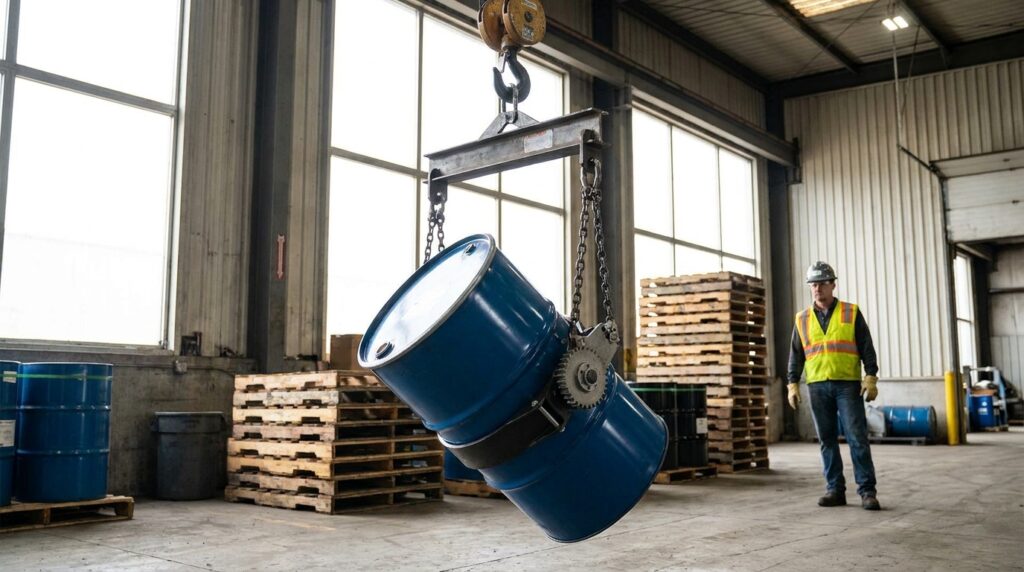
Below-the-Hook Drum Lifters: Mastering Safe and Efficient Drum Handling
In the demanding environments of warehouses, manufacturing plants, and industrial facilities, the efficient and safe handling of drums is paramount. Drums, whether filled with raw materials, chemicals, or finished products, represent significant weight and potential hazards. Incorrect handling can lead to spills, injuries, and costly downtime. This is where below-the-hook drum lifters emerge as indispensable tools, providing secure and ergonomic solutions for lifting, moving, and manipulating these essential containers.
This comprehensive guide explores the diverse world of below-the-hook drum lifters, detailing their types, applications, and crucial selection factors. Whether you are a warehouse manager optimizing workflow, a plant engineer ensuring operational efficiency, a safety manager prioritizing workforce well-being, or an industrial equipment buyer seeking the best solutions, understanding these lifters is key to improving your operations. At Fredon Handling, we specialize in providing high-quality, reliable drum handling equipment designed to meet the rigorous demands of modern industry.
For those interested in learning more about Below-the-Hook Drum Lifters, a related article that provides comprehensive insights into various material handling equipment can be found at Fredon Handling Products. This resource covers a wide range of lifting solutions, including drum lifters, and offers guidance on their applications, benefits, and selection criteria, making it an invaluable tool for anyone looking to enhance their understanding of industrial lifting equipment.
Understanding the Role of Below-the-Hook Drum Lifters
Below-the-hook drum lifters are specialized lifting attachments designed to connect to an overhead lifting device, such as an overhead crane, hoist, or forklift attachment, and securely grip or engage a drum for vertical movement. They are distinct from drum handlers that are directly mounted onto forklifts. The “below-the-hook” designation signifies their position and function in the lifting chain.
These lifters are engineered to overcome the inherent challenges of drum handling:
- Weight: Drums, especially when full, can weigh hundreds of pounds. Manual lifting is often impossible and always dangerous.
- Ergonomics: The awkward shape and size of drums make them difficult to grasp and maneuver without specialized equipment, leading to strain and injury.
- Containment: Spills of hazardous materials can have severe consequences for personnel, the environment, and the facility.
- Space Constraints: Industrial environments often have limited maneuverability.
- Process Integration: Drums need to be accurately positioned for filling, emptying, mixing, or transferring.
Below-the-hook drum lifters address these challenges by providing a safe, controlled, and efficient method for handling drums in various orientations and configurations. Their purpose is to integrate seamlessly with existing overhead lifting infrastructure, transforming it into a versatile drum handling system.
Key Types of Below-the-Hook Drum Lifters Explained
The market offers a variety of below-the-hook drum lifters, each designed for specific drum types, materials, and operational needs. Understanding these variations is the first step in selecting the most appropriate equipment.
Drum Clamps and Grippers
Drum clamps and grippers are perhaps the most common type of below-the-hook drum lifters. They utilize mechanical force to secure the drum around its circumference.
- Mechanism: These lifters typically feature two or more clamping arms that engage the rim or body of the drum. When lifted, the weight of the drum forces the clamps to tighten, ensuring a secure grip.
- Types of Clamps:
- Automatic Drum Clamps: These are highly efficient as they automatically grip and release the drum as it is lifted and lowered, requiring no manual intervention once engaged. They are ideal for high-volume operations.
- Manual Drum Clamps: While still requiring some manual adjustment, they offer a robust and reliable grip for less frequent use or where the automatic mechanism might be overkill.
- Material Compatibility: Primarily designed for standard steel or plastic drums with a reinforcing rim. Some specialized models can accommodate variations in drum construction.
- Size and Weight: These lifters are designed to accommodate standard drum sizes (e.g., 55-gallon drums) and can typically handle weights from a few hundred pounds up to 1,000 lbs or more, depending on the model’s robust construction.
- Applications: Ideal for general warehousing, chemical storage, food processing, and any facility that frequently moves standard drums from pallets or racks. They excel at moving drums vertically without tilting.
Drum Grabs and Tongs
Drum grabs and tongs work by applying pressure to the top and bottom rims of the drum, or by engaging the side of the drum with opposing jaws.
- Mechanism: They use leverage and pressure to hold the drum securely. Some are designed for vertical lifting, while others allow for tilting.
- Types of Grabs:
- Over-the-Rim Grabs: These grip the upper rim of the drum. They are simple and effective for basic vertical lifting.
- Horizontal Grabs/Tongs: These are designed to grip the drum’s side, often with a pressure pad, allowing for horizontal movement and positioning.
- Material Compatibility: Suitable for steel drums and some robust plastic drums. The pressure points must be able to withstand the clamping force without damage.
- Size and Weight: Similar to clamps, they are available for standard drum sizes and capacities ranging from a few hundred to over a thousand pounds.
- Applications: Useful for moving drums from tight spaces or for applications where precise positioning is needed. Horizontal grabs are particularly valuable for transferring drums between machines or into containment areas.
Drum Lifter with Forks
This type of lifter integrates fork-like arms that slide underneath the drum, supporting it from below.
- Mechanism: The forks provide a stable base for the drum, allowing for secure lifting and transportation. They are often used in conjunction with a tilting mechanism.
- Types:
- Fixed Forks: Provide a stable platform for vertical lifting.
- Tilting Forks: Allow the drum to be tilted forward or backward for pouring or emptying. This is a significant advantage for process integration.
- Material Compatibility: Excellent for almost any type of drum, including plastic drums that might be susceptible to crushing by clamps.
- Size and Weight: These can handle standard drum sizes and substantial weights, often exceeding 1,000 lbs. The fork design distributes the weight effectively.
- Applications: Widely used in chemical plants, paint manufacturers, and any process industry where drums need to be emptied or mixed. The tilting capability is a major workflow enhancer.
Drum Lifters with Hooks or Straps
These lifters utilize hooks or heavy-duty straps to secure the drum, often in conjunction with a cradle or platform.
- Mechanism: The drum is placed into a cradle, and then secured with adjustable straps or hooks that engage the drum’s rim or body.
- Material Compatibility: Very versatile, suitable for steel and plastic drums, and even some non-standard container shapes.
- Size and Weight: Capacities vary widely, from light-duty models for smaller drums to heavy-duty units for larger containers.
- Applications: Ideal for handling drums of various materials and dimensions, or when a gentle grip is required to prevent damage. Often used in pharmaceutical or food-grade environments where container integrity is critical.
Specialized Drum Handling Systems
Beyond the common categories, there are specialized below-the-hook solutions for specific needs.
- Drum Rotators/Inverters: These advanced systems not only lift but also rotate drums, allowing for controlled pouring and mixing. They can be integrated with overhead cranes or forklifts.
- Drum Stackers: Designed to lift and stack drums to significant heights, optimizing vertical storage space.
- Palletized Drum Lifters: Attachments that can lift an entire pallet of drums.
Critical Factors for Selecting the Right Drum Lifter
Choosing the correct below-the-hook drum lifter is a critical decision that impacts safety, efficiency, and cost-effectiveness. Several factors must be carefully considered.
Drum Specifications: Material, Size, Weight, and Capacity
The characteristics of the drums themselves are the primary drivers of selection.
- Drum Material:
- Steel Drums: Generally robust and can withstand clamping forces. Rims are often reinforced, making them ideal for clamp-style lifters.
- Plastic Drums (HDPE): More susceptible to deformation or damage from excessive clamping pressure. Drum lifters with forks or those that distribute pressure evenly are often preferred.
- Fiber Drums: Require gentler handling. Lifters with straps or specific cradles are necessary.
- Drum Size: Standard drum sizes are typically 55-gallon (205-liter) or 30-gallon (115-liter). Ensure the chosen lifter is compatible with the diameter and height of your drums. Some lifters are adjustable, offering greater versatility.
- Drum Weight: This is a crucial safety consideration. Always select a lifter with a rated capacity significantly higher than the maximum weight of the drums you intend to handle, including the drum itself and its contents. Exceeding capacity is extremely dangerous and can lead to equipment failure and accidents. Look for the Working Load Limit (WLL), which is the maximum load the equipment is designed to lift safely.
- Drum Contents: If handling hazardous materials, the lifter must be compatible with potential spills and emissions. Ensuring a secure grip is paramount to prevent leaks. For food-grade or pharmaceutical applications, the lifter material should not contaminate the product.
Equipment Compatibility and Integration
The chosen drum lifter must seamlessly integrate with your existing lifting infrastructure.
- Overhead Crane/Hoist: The lifter’s attachment point (e.g., shackle, hook eye) must be compatible with your crane’s hoist hook or rigging.
- Forklift: If using a drum lifter with a forklift attachment, ensure the attachment is compatible with your forklift’s mast and carriage.
- Operating Environment: Consider the aisle widths, ceiling heights, and available headroom in your facility. Some lifters might require more clearance than others.
Application and Workflow Requirements
The intended use of the drum lifter will dictate its features.
- Vertical Movement Only: Standard drum clamps or grabs are often sufficient.
- Tilting and Pouring: Drum lifters with tilting forks or dedicated drum rotator attachments are essential.
- High-Volume Operations: Automatic clamps and systems that minimize manual intervention improve throughput.
- Tight Spaces: Compact lifters or those designed for precise maneuverability are needed.
- Stacking: Specialized drum stackers are required for vertical storage.
Drum Material Construction and Features
The physical attributes of the drum itself play a role.
- Rim Condition: Drums with damaged or missing rims may not be suitable for clamp-type lifters.
- Lid Type: Open-head vs. closed-head drums will influence the gripping mechanism.
Safety Features
Safety should always be the top priority.
- Secure Locking Mechanisms: Ensure the lifter has robust locking systems to prevent accidental release.
- Load Indicators: Some advanced lifters may include indicators to confirm proper engagement.
- Operator Training: Proper training on the operation and limitations of any lifting equipment is non-negotiable.
Durability and Maintenance
Industrial equipment needs to be robust and easy to maintain.
- Construction Quality: Look for heavy-duty steel construction with durable finishes to resist corrosion and wear.
- Ease of Maintenance: Consider how easily components can be inspected, lubricated, or replaced.
- Manufacturer Support: Reliable manufacturers offer spare parts and technical support.
When considering the various types of Below-the-Hook Drum Lifters, it’s essential to understand their applications and how they fit into the broader context of material handling. For a deeper insight into the principles and practices that govern this field, you can explore an informative article on material handling. This resource provides valuable information that can enhance your understanding of how drum lifters and other equipment can improve efficiency and safety in various industrial settings.
Applications of Below-the-Hook Drum Lifters in Industry
The versatility of below-the-hook drum lifters makes them valuable assets across a wide spectrum of industrial sectors.
Warehousing and Logistics
- Receiving and Put-away: Safely unloading drums from delivery trucks and placing them onto racks or into storage locations.
- Order Picking: Retrieving drums from storage for shipment.
- Cross-docking: Efficiently transferring drums between inbound and outbound logistics.
- Space Optimization: Enabling the stacking of drums to maximize vertical storage capacity.
Chemical Manufacturing and Processing
- Material Transfer: Moving drums of raw materials to mixing vessels or processing equipment.
- Product Packaging: Positioning drums for filling with finished chemical products.
- Sampling and Quality Control: Safely retrieving samples from drums.
- Hazardous Material Handling: Minimizing human contact and the risk of spills with hazardous substances. Drum lifters with secure containment features are critical.
Food and Beverage Production
- Ingredient Handling: Moving drums of food ingredients, syrups, or flavorings.
- Product Transfer: Transferring bulk ingredients to processing lines.
- Cleaning and Sanitation: Facilitating the movement of drums during cleaning operations.
- Compliance: Ensuring equipment meets hygiene standards and does not contaminate products. Stainless steel options may be necessary.
Pharmaceutical and Medical Industries
- Raw Material Handling: Safely moving drums of sensitive pharmaceutical ingredients.
- Product Packaging: Accurate positioning of drums for filling and sealing.
- Sterile Environments: Lifters made with materials that can be easily sterilized and that won’t shed particles.
- High Purity Applications: Ensuring no contamination of high-value products.
Oil and Gas Sector
- Lubricant and Additive Handling: Moving drums of oils, greases, and various additives.
- Onshore and Offshore Operations: Robust, corrosion-resistant lifters are essential in harsh environments.
- Maintenance and Repair: Handling drums of lubricants and cleaning agents used in equipment maintenance.
Manufacturing and Metalworking
- Material Handling: Moving drums of metalworking fluids, lubricants, coolants, and cleaning agents.
- Waste Management: Transporting drums of industrial waste or spent chemicals.
- Assembly Lines: Positioning drums for dispensing or refilling during manufacturing processes.
Safety Considerations When Using Below-the-Hook Drum Lifters
Safety is non-negotiable when operating any lifting equipment. Below-the-hook drum lifters, while designed to enhance safety, require diligent adherence to safety protocols.
Pre-Operation Checks
- Visual Inspection: Before each use, thoroughly inspect the lifter for any signs of damage, wear, loose parts, or corrosion. Check the lifting mechanism, chains, straps, and attachment points.
- Load Capacity Verification: Ensure the drum’s weight does not exceed the lifter’s rated Working Load Limit (WLL).
- Crane/Hoist Inspection: Verify that the overhead lifting device is in good working order and has passed its regular inspections.
- Environment Check: Ensure the lifting path is clear of obstructions, personnel, and any potential hazards.
Operational Safety
- Secure Engagement: Always ensure the lifter is fully and securely engaged with the drum before attempting to lift. Listen for any audible clicks or confirmation signals.
- Controlled Movement: Lift and lower drums slowly and smoothly. Avoid sudden starts, stops, or swings.
- Clearance: Maintain adequate clearance from overhead structures, walls, and other equipment.
- Personnel Safety: Keep personnel clear of the suspended load at all times. Never allow anyone to walk or stand beneath a lifted drum.
- Load Stability: Ensure the drum is stable within the lifter. For tilting operations, secure the drum firmly to prevent it from slipping.
- Two-Person Operation (if necessary): For larger or more complex operations, consider having a spotter to assist the operator.
- Never Exceed WLL: This is the most critical safety rule.
Post-Operation Procedures
- Proper Storage: Store the drum lifter in a clean, dry, and designated area when not in use.
- Lockout/Tagout: Implement lockout/tagout procedures for maintenance or repair.
Training and Competency
- Operator Training: All personnel operating drum lifters must receive comprehensive training on their specific models, safe operating procedures, and emergency protocols.
- Regular Refreshers: Conduct periodic refresher training to reinforce best practices and address any changes in procedures or equipment.
Maintenance Tips for Longevity and Reliability
Regular and proper maintenance is key to ensuring your below-the-hook drum lifters remain safe, reliable, and productive for years to come.
Routine Inspections
- Daily/Weekly Visual Checks: As mentioned in safety, perform quick daily or weekly visual checks for obvious damage.
- Monthly/Quarterly Detailed Inspections: Conduct more thorough inspections to check for wear on critical components, lubrication levels, and functionality of moving parts.
- Annual Load Tests: Depending on local regulations and manufacturer recommendations, annual load tests may be required to verify the lifter’s capacity.
Lubrication
- Moving Parts: Lubricate all pivot points, bearings, and moving mechanisms according to the manufacturer’s schedule and recommended lubricant type.
- Corrosion Prevention: Use appropriate lubricants or protectants to prevent rust and corrosion, especially in humid or corrosive environments.
Cleaning
- Remove Debris: Regularly clean the lifter to remove dust, dirt, oil, and any accumulated debris that could interfere with its operation or cause premature wear.
- Chemical Compatibility: Use cleaning agents that are compatible with the lifter’s materials to avoid damage.
Component Replacement
- Worn Parts: Promptly replace any worn or damaged components, such as clamping pads, straps, or pins, following manufacturer guidelines.
- Genuine Parts: Whenever possible, use genuine replacement parts from the manufacturer to ensure compatibility and performance.
Record Keeping
- Maintenance Logs: Maintain detailed records of all inspections, maintenance activities, repairs, and load tests. This documentation is crucial for tracking the equipment’s history, identifying potential issues, and ensuring compliance.
Frequently Asked Questions About Below-the-Hook Drum Lifters
Q1: What is the difference between a below-the-hook drum lifter and a drum handler attached to a forklift?
A1: A below-the-hook drum lifter connects to an overhead lifting device like a crane or hoist. A forklift drum handler is an attachment that mounts directly onto a forklift, allowing the forklift to grip and move drums. Both serve to lift and move drums, but they utilize different primary lifting mechanisms.
Q2: Can I use a single drum lifter for both steel and plastic drums?
A2: It depends on the specific lifter model. Some universal drum lifters are designed to accommodate both materials, often with adjustable clamping pressure or specialized gripping surfaces. However, plastic drums are more susceptible to damage, so lifters with forks or those that distribute pressure evenly are generally safer for plastic drums. Always check the manufacturer’s specifications for material compatibility.
Q3: What does “Working Load Limit (WLL)” mean for a drum lifter?
A3: The Working Load Limit (WLL) is the maximum weight that the lifting equipment is designed to safely handle. It is a critical safety factor. You must always ensure the total weight of the drum and its contents does not exceed the WLL of the lifter. It’s good practice to select equipment with a WLL that provides a safety margin.
Q4: How do I ensure a drum is securely held by a drum lifter?
A4: The method of ensuring a secure hold depends on the lifter type. For clamp-style lifters, ensure the clamps are fully engaged with the drum’s rim or body and that the drum’s weight is causing the clamps to tighten. For fork-style lifters, ensure the forks are properly positioned and supporting the drum’s base. Always perform a slight upward lift to test engagement before proceeding with the full lift. Refer to the operator’s manual for specific instructions for your model.
Q5: Are there any specific safety regulations I need to be aware of when using drum lifters?
A5: Safety regulations vary by region and industry. Common standards relate to overhead lifting equipment, load testing, operator training, and the handling of hazardous materials. It’s essential to consult with your local regulatory bodies (e.g., OSHA in the US, HSE in the UK) and adhere to the manufacturer’s safety guidelines. Always ensure your equipment is regularly inspected and maintained to meet these standards.
Partner with Fredon Handling for Your Drum Lifting Needs
Efficient and safe drum handling is a cornerstone of productive operations in any industrial setting. The right below-the-hook drum lifter can transform challenging tasks into simple, secure processes, protecting your workforce and your assets. Fredon Handling offers a comprehensive range of high-quality drum handling solutions, including an extensive selection of below-the-hook drum lifters designed to meet diverse application needs.
Our expertise lies in understanding your unique operational challenges and recommending equipment that enhances safety, boosts productivity, and provides long-term value. We are committed to providing durable, reliable, and ergonomically sound solutions that integrate seamlessly into your existing workflows.
Ready to optimize your drum handling operations?
Contact Fredon Handling today for a personalized consultation. Our team of experts is eager to discuss your specific requirements and help you find the perfect below-the-hook drum lifter solution for your facility. Visit us at https://fredonhandling.com/drum-handling-equipment/ or call us to explore our extensive product line and benefit from our industrial expertise. Let Fredon Handling be your trusted partner in achieving safer and more efficient material handling.