
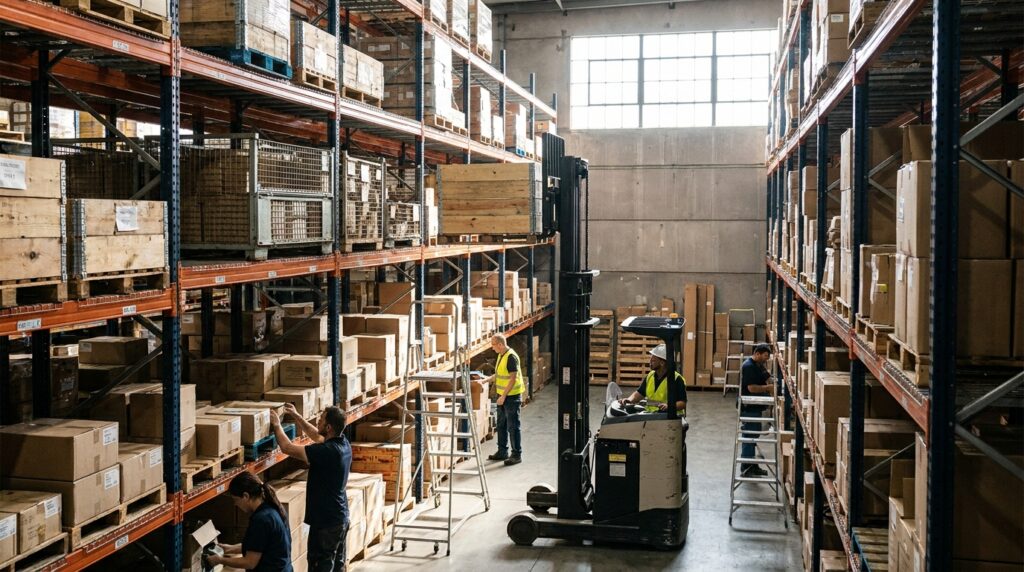
Understanding Your Space: The Foundation of Smart Shelving
Before you even think about buying shelves, you need to get to know your warehouse. It’s not just a big empty box; it’s a working environment with specific needs. Think about what you store, how often you access it, and how your team moves around. This groundwork is crucial for choosing the right shelving and making it work its best.
Assessing Your Inventory: What Are You Storing?
The first step is a deep dive into your inventory. What types of products do you handle? Are they large and bulky, like furniture or machinery parts? Or are they small and numerous, like electronics components or pharmaceuticals? Do you deal with a lot of items that are the same size and shape, or is it a wide variety? The dimensions, weight, and fragility of your goods will heavily influence the type of shelving you need.
Categorizing by Size and Weight
Group your inventory by general size and weight categories. For instance, you might have a section for palletized goods, another for medium-sized boxes, and a third for small bins or individual items. Understanding the weight capacity required for each category is vital. Overlooking this can lead to damaged shelves, accidents, and lost product.
Analyzing Turnover Rate
How quickly do items move in and out of your warehouse? High-turnover items, those accessed frequently, should ideally be stored in easily accessible locations, closer to picking areas. Low-turnover items, which sit for longer periods, can be stored in less prime real estate within the warehouse, perhaps at higher levels or further away. This “slotting” strategy, informed by your shelving choices, directly impacts efficiency.
Mapping Your Warehouse Layout: More Than Just Walls
Your warehouse isn’t just defined by its walls; it’s about the flow of goods and people. A thorough understanding of your layout will reveal opportunities for better space utilization. This includes not only the floor space but also the vertical space, which is often the most underutilized asset.
Identifying Traffic Patterns
Observe how your forklifts, pallet jacks, and personnel move through the warehouse. Are there bottlenecks? Are aisles wide enough for efficient movement, especially during peak times? The placement of your shelving should support, not hinder, these traffic patterns. Wasted aisle space is essentially wasted storage space.
Measuring and Documenting
Get out a measuring tape and document everything. Measure the dimensions of your warehouse, including ceiling height. Note the location of any structural columns, doors, loading docks, and fire exits. These physical constraints will dictate where shelving can and cannot be placed and what types might be feasible.
To further enhance your understanding of optimizing warehouse space, you may find the article on selecting the right industrial shelving solutions particularly useful. This resource provides insights into various shelving options and their benefits, helping you make informed decisions for your storage needs. You can read more about it here: Selecting the Right Industrial Shelving Solutions.
Choosing the Right Shelving Systems: Matching Form to Function
With a clear understanding of your inventory and warehouse layout, you can start looking at the different types of industrial shelving available. There’s a wide range of options, each designed to optimize specific storage scenarios. It’s rarely a one-size-fits-all situation. The key is to find the system that best matches your specific needs for accessibility, density, and product type.
Selective Pallet Racking: The Workhorse of Warehousing
This is the most common type of racking you’ll see. It’s designed to store palletized loads and allows for immediate access to every single pallet. This makes it ideal for businesses with a high volume of different products that need to be picked individually.
Understanding Configurations
Selective pallet racking comes in various configurations, like roll-formed and structural. Roll-formed is generally more economical and quicker to install, while structural racking offers greater strength and durability, often used for heavier loads or seismic zones. You’ll also encounter different beam and upright designs that affect load capacity and aisle width.
Benefits for Accessibility and Inventory Control
The primary benefit of selective racking is 100% accessibility. Every pallet is within reach, which dramatically speeds up order picking and simplifies inventory management. This is crucial for businesses that need to track individual items and fulfill diverse orders quickly.
Drive-In and Drive-Thru Racking: Maximizing Density
When space is at a premium and you have many pallets of the same SKU, drive-in and drive-thru systems become incredibly valuable. They allow forklifts to drive directly into the racking structure to store and retrieve pallets, significantly increasing storage density.
First-In, Last-Out (FILO) Dynamics
Drive-in racking operates on a First-In, Last-Out (FILO) principle. Pallets are loaded onto rails and pushed back. The last pallet loaded is the first one to be removed. This is suitable for products where exact order of stock rotation isn’t critical.
First-In, First-Out (FIFO) Possibilities
Drive-thru racking, on the other hand, allows for First-In, First-Out (FIFO) inventory management. Pallets are loaded from one side and retrieved from the opposite side. This is ideal for perishable goods or products with strict rotation requirements.
To effectively enhance your warehouse efficiency, exploring various strategies is essential, and one insightful resource is the article on optimizing warehouse layouts. This piece provides valuable tips on how to arrange your space for maximum productivity, complementing the techniques discussed in “How to Maximize Warehouse Space with Industrial Shelving.” By integrating both shelving solutions and layout optimization, you can create a more organized and functional warehouse environment.
Flow Racking Systems: Optimizing Order Picking
Flow racks, also known as carton flow or gravity flow racks, use inclined wheels or rollers to move products from the loading side to the picking side. This system is excellent for organizing and picking smaller, fast-moving items like individual units or cases.
Gravity-Powered Efficiency
The inherent advantage of flow racking is its use of gravity. Once loaded, items automatically move to the front for easy picking, eliminating the need for forklifts or personnel to repeatedly access the back of the rack. This streamlines the picking process and reduces labor.
Ideal for High-Volume Small Parts
This system is a game-changer for businesses dealing with a high volume of small items, such as e-commerce fulfillment centers, pharmaceutical distributors, or electronics manufacturers. It ensures that the oldest stock is always at the front, maintaining FIFO.
Cantilever Racking: For Long or Awkward Items
When you’re storing items that don’t fit neatly onto standard shelves or pallets – think lumber, pipes, steel beams, or long extrusions – cantilever racking is the solution. It features horizontal arms that extend from a vertical column, providing unobstructed access.
Unimpeded Storage Access
The open design of cantilever racks means there are no vertical uprights to interfere with loading and unloading. This makes it incredibly efficient for handling long or oddly shaped items, significantly reducing loading and unloading times.
Strength and Versatility
Cantilever racks are designed for heavy-duty applications and can be configured to accommodate a wide range of lengths and weights. They can be single-sided (against a wall) or double-sided, further maximizing space utilization.
Optimizing Vertical Space: Reaching New Heights in Storage
The floor is only one dimension of your warehouse.