
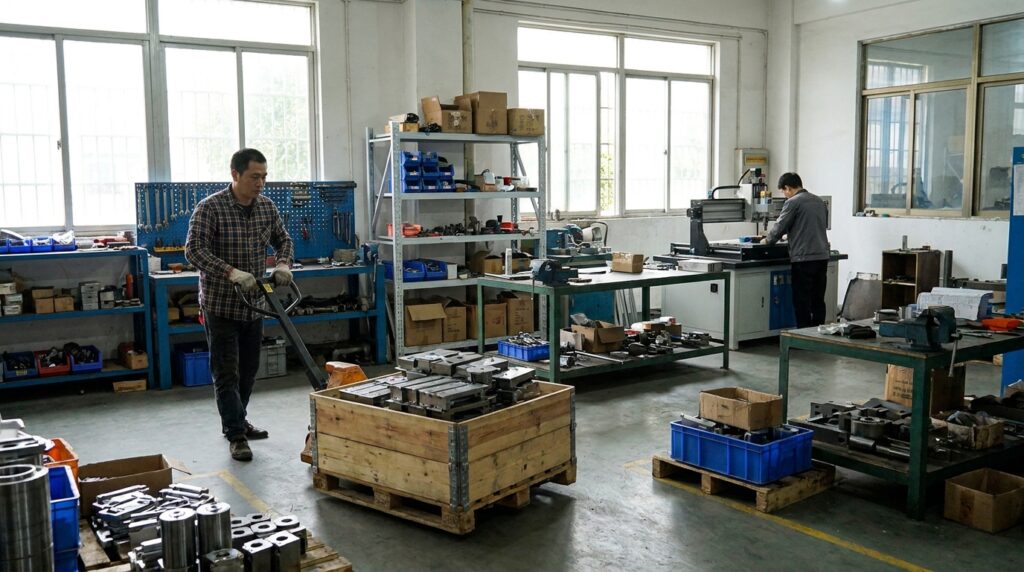
Small manufacturers face unique challenges when it comes to moving materials efficiently through their operations. Unlike large enterprises with dedicated logistics teams and substantial capital budgets, smaller facilities must maximize productivity while working within tighter constraints. Effective material handling for small manufacturers isn’t about replicating what industry giants do—it’s about implementing right-sized solutions that deliver measurable returns without overextending resources.
Whether you’re operating a job shop, a growing production facility, or a specialized manufacturing operation, the way you move, store, and manage materials directly impacts your bottom line. Poor material flow creates bottlenecks, increases labor costs, raises injury risks, and ultimately limits your capacity to take on new business. The good news is that strategic improvements in material handling can transform operational efficiency at any scale.
Why Material Handling Matters for Smaller Operations
Material handling encompasses every activity involved in moving, protecting, storing, and controlling materials throughout manufacturing processes. For small manufacturers, these activities often consume a disproportionate amount of time and labor compared to larger operations that benefit from economies of scale and automation.
Consider the typical small manufacturing environment: workers frequently interrupt production tasks to retrieve materials, search for components, or transport finished goods. These interruptions fragment workflows and reduce the time available for value-added activities. Studies consistently show that material handling can account for 25% or more of total labor costs in manufacturing—a percentage that often runs higher in facilities lacking systematic approaches.
Beyond labor costs, inefficient material handling creates hidden expenses. Damaged materials from improper handling require replacement or rework. Disorganized storage leads to excess inventory and obsolete stock. Safety incidents from manual lifting or unstable loads result in workers’ compensation claims and lost productivity. Each of these factors erodes margins that small manufacturers can’t afford to lose.
The competitive landscape adds urgency to these concerns. Customers increasingly expect shorter lead times, smaller batch sizes, and flexible delivery schedules. Meeting these expectations requires material flow systems that support agility rather than impede it.
For small manufacturers looking to optimize their operations, understanding the various types of material handling equipment is crucial. A related article that provides valuable insights into this topic is available at Top Material Handling Equipment for Efficient Warehouse Operations. This resource outlines essential equipment options that can enhance efficiency and streamline processes in a warehouse setting, making it a must-read for those in the manufacturing sector.
Assessing Your Current Material Flow and Identifying Bottlenecks
Before investing in equipment or reorganizing your facility, you need a clear picture of how materials currently move through your operation. A systematic assessment reveals improvement opportunities that might otherwise remain invisible.
Mapping Material Movement Patterns
Start by documenting the physical path materials take from receiving through shipping. Track the movement of your highest-volume items and your most time-consuming products. Note every touch point—each time materials are picked up, set down, transferred between containers, or moved between workstations.
Create a simple spaghetti diagram by tracing these paths on your facility layout. This visual representation often reveals surprising inefficiencies: excessive travel distances, crossing paths that create congestion, materials stored far from their point of use, or multiple handling steps that could be consolidated.
Quantifying Handling Time and Labor
Time studies don’t require sophisticated software. Observe and record how long workers spend on material handling tasks versus actual production work. Track how often production stops because materials aren’t available at workstations. Note delays caused by searching for items, waiting for equipment, or clearing congested aisles.
This baseline data serves two purposes: it helps prioritize improvement efforts and provides benchmarks for measuring results after changes are implemented.
Recognizing Common Problem Areas
Small manufacturing facilities frequently share certain material handling challenges:
- Receiving areas that lack adequate staging space, forcing rushed put-away decisions
- Production workstations cluttered with excess inventory that impedes work
- Finished goods accumulating in production areas due to inefficient transfer to shipping
- Narrow or obstructed aisles that slow material movement and create safety hazards
- Over-reliance on manual lifting for tasks that could be mechanized
- Inconsistent container sizes that complicate storage and transport
Identifying which issues most significantly impact your specific operation allows you to focus resources where they’ll generate the greatest returns.
Essential Material Handling Equipment for Limited Budgets and Space
Small manufacturers don’t need massive automated systems to improve material handling. A thoughtfully selected mix of basic equipment, matched to actual operational requirements, often delivers better results than over-engineered solutions.
Manual and Semi-Powered Transport Equipment
Hand trucks, platform carts, and pallet jacks form the foundation of material transport in most small facilities. These tools are affordable, require minimal maintenance, and adapt to varied tasks. When selecting manual equipment, consider load capacities that match your typical material weights with appropriate safety margins.
Pallet jacks remain indispensable for facilities handling palletized materials. Manual pallet jacks work well for shorter distances and lighter loads, while semi-electric versions reduce operator fatigue during frequent use or when moving heavier pallets. Powered pallet jacks become cost-effective when transport distances exceed approximately 100 feet or when workers spend significant time moving palletized materials.
Carts and trucks should match your specific applications. Wire carts work well for components that need visibility and ventilation. Shelf carts organize smaller parts efficiently. Panel carts handle sheet materials safely. Investing in the right cart types reduces improvisation and the material damage that often results.
Lift Equipment Considerations
Forklifts represent a significant investment for small operations, and many facilities operate successfully without them. Before purchasing or leasing a forklift, honestly assess whether your material handling requirements justify the costs of the equipment itself plus operator training, maintenance, fuel or charging infrastructure, and liability insurance.
Alternatives to traditional forklifts often serve small manufacturers well. Walkie stackers provide lifting capability in a smaller footprint with lower costs and reduced training requirements compared to sit-down forklifts. Order pickers allow workers to access elevated storage safely. Manual or powered stackers handle lighter loads economically.
When a forklift is genuinely necessary, match specifications to your actual requirements. An undersized unit creates safety risks and productivity problems, while an oversized unit wastes capital and may not fit your facility.
Storage Systems That Maximize Space
Vertical space represents an underutilized asset in many small facilities. Selective pallet racking, when properly designed and installed, dramatically increases storage density while improving organization and accessibility. Cantilever racking handles long materials like bar stock, tubing, or lumber that don’t fit standard systems.
For smaller items, industrial shelving with appropriate bin systems keeps components organized and accessible. Modular drawer cabinets provide high-density storage for precision parts and tooling. Vertical carousels or vertical lift modules offer automated retrieval for facilities with extensive small-parts inventories, though these systems require careful ROI analysis.
Whatever storage systems you implement, maintain clear aisle widths that accommodate your transport equipment and comply with fire codes and safety requirements.
Optimizing Facility Layout for Efficient Material Flow
Equipment alone doesn’t solve material handling challenges. How you arrange your facility—the relationship between receiving, storage, production, and shipping areas—fundamentally shapes operational efficiency.
Principles of Flow-Based Layout
Effective layouts minimize backtracking and cross-traffic. Materials should generally flow in one direction through the facility, from receiving through production stages to shipping. This principle applies whether your facility is 5,000 square feet or 50,000 square feet.
Position high-velocity items—materials you use frequently—for easy access. Store them at ergonomic heights near their points of use. Reserve less accessible locations for slower-moving inventory.
Workstation design matters as much as overall layout. Point-of-use storage keeps materials within arm’s reach of workers, eliminating trips to remote storage areas. This approach requires balancing material availability against workstation clutter—typically achieved by storing only what’s needed for current production runs.
Practical Layout Improvements
Many layout improvements require more planning than investment. Relocating a workstation to reduce travel distances costs nothing beyond the time to move it. Reassigning storage locations to position materials closer to where they’re used improves efficiency immediately.
Painted floor markings—for aisles, staging areas, hazardous zones, and equipment positioning—provide visual organization that helps maintain discipline. This visual management costs little but contributes significantly to orderly operations.
Consider material flow when adding equipment or expanding operations. New machines should integrate with existing flow patterns rather than disrupting them. Temporary solutions have a way of becoming permanent, so take time to position additions thoughtfully.
Addressing Space Constraints
Small facilities rarely have excess space. When square footage is limited, look upward and outward. Mezzanines create additional floor space for storage, light assembly, or office functions without expanding your building footprint. Outdoor storage, properly protected, handles materials that tolerate weather exposure.
Lean out excess inventory. Many small manufacturers carry more raw materials and work-in-progress than necessary, consuming space that could support production. Better supplier relationships, smaller order quantities, and improved scheduling often free substantial floor space.
For small manufacturers looking to optimize their operations, understanding the principles of material handling is crucial. A related article that delves deeper into this topic can be found at this link, where you can explore various strategies and best practices that can enhance efficiency and productivity in your manufacturing processes. By implementing effective material handling techniques, small manufacturers can significantly reduce costs and improve workflow.
Safety Compliance and Risk Reduction in Material Handling
Material handling activities generate a significant portion of workplace injuries in manufacturing environments. Small manufacturers, who often lack dedicated safety staff, must build safe practices into their material handling systems from the start.
Understanding Regulatory Requirements
OSHA regulations establish baseline requirements for material handling safety. Standards address powered industrial trucks, walking-working surfaces, ergonomics, and general duty obligations to maintain safe workplaces. ANSI standards provide additional guidance on equipment design and use.
Because regulations evolve and enforcement interpretations vary, verify current requirements with OSHA resources, industry associations like MHI, or qualified safety consultants. Compliance isn’t optional, and penalties can severely impact small businesses.
Reducing Common Injury Risks
Manual lifting injuries remain prevalent despite decades of awareness efforts. Engineering controls—lift assists, adjustable work surfaces, properly positioned materials—work better than training alone at reducing ergonomic injuries. Evaluate tasks that involve frequent lifting, awkward postures, or heavy loads, and implement mechanical solutions where feasible.
Struck-by and caught-between injuries occur around forklifts and other mobile equipment. Establish designated pedestrian walkways separated from vehicle traffic. Require operators to sound horns at intersections and limit travel speeds in congested areas.
Falling objects represent another significant hazard. Ensure storage systems are rated for actual loads, materials are stacked stably, and workers use appropriate safety footwear.
Building a Safety-Conscious Culture
Equipment and procedures only work when people follow them consistently. Engage workers in identifying hazards and developing solutions—they often recognize risks that management overlooks. Investigate near-misses as seriously as actual incidents to prevent future injuries.
Regular inspections of equipment, storage areas, and practices catch problems before they cause harm. Document these inspections and address identified issues promptly.
Planning for Growth and Scaling Material Handling Capabilities
Material handling decisions made today affect your ability to grow tomorrow. Small manufacturers benefit from choosing solutions that can scale alongside their businesses.
Select modular systems when possible. Racking that can be reconfigured or extended accommodates changing inventory profiles. Equipment with appropriate capacity handles growth without immediate replacement.
Maintain relationships with material handling specialists who understand your operation. Partners like Fredon Handling work with manufacturers at all scales, helping identify solutions that match current needs while positioning facilities for future growth. Professional guidance often saves money by preventing mismatched investments and identifying options you might not discover independently.
Document your material handling systems, procedures, and improvement results. This institutional knowledge supports training, troubleshooting, and future planning.
Material handling for small manufacturers ultimately comes down to applying sound principles at appropriate scale. Assess your current state honestly, invest in equipment and layouts matched to genuine needs, maintain rigorous safety practices, and plan for the future without overbuilding for today. Continuous incremental improvements, sustained over time, transform material handling from a burden into a competitive advantage.