
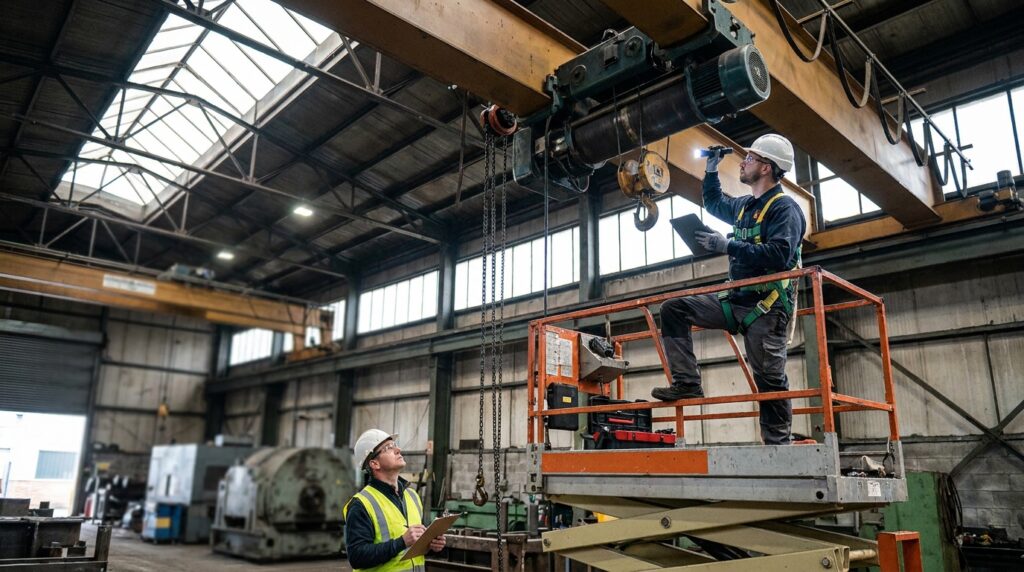
Mastering Overhead Crane & Hoist Uptime: A Comprehensive Preventive Maintenance Guide for Manufacturers
Keyword: Preventive Maintenance for Overhead Cranes and Hoists
SEO Title: Preventive Maintenance for Overhead Cranes & Hoists: Your Ultimate Guide | Fredon Handling
Meta Description: Maximize uptime and safety with Fredon Handling’s expert guide to preventive maintenance for overhead cranes and hoists. Learn best practices, inspection schedules, and troubleshooting tips for manufacturing managers, operators, and maintenance teams.
Suggested URL Slug: preventive-maintenance-overhead-cranes-hoists
Preventive maintenance for overhead cranes and hoists is crucial for ensuring safety and efficiency in industrial operations. To further understand the importance of proper material handling and its relationship to equipment maintenance, you can explore a related article that delves into the fundamentals of material handling. This resource provides valuable insights into how effective material handling practices can enhance the performance and longevity of your equipment. For more information, visit this article on material handling.
The Critical Role of Preventive Maintenance in Overhead Crane and Hoist Operations
In the fast-paced world of manufacturing and warehousing, overhead cranes and hoists are the workhorses that keep operations moving. They lift, transport, and position heavy loads, enabling efficient production and streamlined logistics. However, the relentless demands placed upon these vital pieces of equipment can lead to wear and tear, potential malfunctions, and costly downtime if not properly addressed. This is precisely where a robust preventive maintenance program becomes indispensable.
Preventive maintenance (PM) is a proactive strategy designed to identify and address potential issues before they escalate into major failures. Unlike reactive maintenance, which addresses problems after they occur, PM focuses on routine inspections, lubrication, adjustments, and minor repairs. The benefits are substantial: enhanced safety for personnel, increased equipment lifespan, reduced operational costs through minimized downtime, and improved overall productivity. For manufacturing managers, warehouse operators, engineers, and maintenance teams, understanding and implementing a comprehensive PM strategy for overhead cranes and hoists is not just a best practice – it’s a business imperative. Fredon Handling, as a leading provider of material handling solutions, is committed to empowering our clients with the knowledge and resources to achieve optimal equipment performance and longevity.
Understanding Your Overhead Crane and Hoist Systems: A Foundation for Effective Maintenance
Before delving into specific maintenance tasks, a fundamental understanding of the components and functions of your overhead crane and hoist systems is crucial. Each piece of equipment, whether a simple hoist or a complex overhead crane system, comprises several interconnected parts, each requiring specific attention. Familiarity with these components ensures that inspections are thorough and that potential issues are recognized promptly.
Key Components of Overhead Cranes and Hoists
Overhead cranes typically consist of a bridge (the horizontal beam spanning the width of the bay), a trolley (which moves along the bridge), and a hoist (mounted on the trolley to lift and lower loads). Hoists, in turn, have their own critical sub-components.
- Structure and Frame: This includes the main girders, end trucks, and any supporting structures. Regular checks for cracks, deformations, or corrosion are vital.
- Trolley and Bridge Drives: Electric motors, gearboxes, brakes, and wheels that enable movement along the runway and across the bridge. Their condition directly impacts movement speed and safety.
- Hoist Mechanism: This is the heart of the lifting operation. It includes the motor, gearbox, drum or lifting mechanism, wire rope or chain, hook, and limit switches.
- Wire Rope or Chain: This is the primary lifting medium. Inspection for wear, kinks, broken strands, or elongation is paramount.
- Hook Block and Hook: The hook itself is a critical safety component. It should be free from cracks, distortion, or excessive wear on the throat opening. The safety latch must be functional.
- Limit Switches: These devices prevent over-travel of the hook block, ensuring it doesn’t collide with the trolley or bridge.
- Brakes: Essential for controlled stopping and holding loads. Over time, brake linings can wear, affecting their stopping power.
- Electrical System: This encompasses control panels, wiring, pendant controls, power conductors, and limit switches. Electrical faults can lead to erratic operation or complete failure.
- Operator Controls: Pendant stations, radio controls, or crane operator cabs. Ergonomics and functionality are important for safe operation.
Types of Overhead Cranes and Hoists and Their Specific Maintenance Needs
The type of crane and hoist system employed will dictate specific maintenance considerations. Fredon Handling offers a wide range of solutions, from robust electric chain hoists to sophisticated workstation cranes and large industrial overhead cranes.
- Electric Hoists (Wire Rope and Chain): These are common for medium to heavy-duty lifting. Chain hoists require particular attention to chain lubrication and wear. Wire rope hoists necessitate careful inspection of the rope itself and the winding drum.
- Manual Hoists: While simpler, manual chain hoists still require lubrication and inspection of chains and hooks.
- Workstation Crane Systems (e.g., Gorbel, CraneWerks): These often involve lighter-duty cranes with enclosed track systems. Maintenance focuses on the smooth operation of the trolley within the track, the hoist, and any balancing systems.
- Top-Running and Under-Running Cranes: The distinction impacts access for inspections and the specific components of the bridge and trolley system.
- Explosion-Proof and Hazardous Location Cranes: These specialized units have unique electrical and mechanical requirements to prevent ignition sources. Maintenance must adhere strictly to their specific certifications and design considerations.
By thoroughly understanding these components and the nuances of your specific equipment, you lay the groundwork for effective and targeted preventive maintenance. This knowledge empowers your maintenance teams to conduct more insightful inspections and address potential issues with precision.
Establishing a Comprehensive Preventive Maintenance Schedule
A well-defined schedule is the backbone of any successful preventive maintenance program. It ensures that tasks are performed consistently and at appropriate intervals, maximizing effectiveness and minimizing the risk of unexpected failures. The frequency of inspections and maintenance tasks is typically dictated by a combination of manufacturer recommendations, operational usage, environmental conditions, and regulatory requirements.
Manufacturer Recommendations: The Starting Point
Your overhead crane and hoist manufacturer provides detailed documentation, including operation manuals and maintenance schedules. These recommendations are based on extensive testing and design considerations and should be treated as the primary reference point for establishing your PM program. They typically outline daily, weekly, monthly, and annual checks.
Usage and Load Cycles: Tailoring to Your Operations
The intensity of use significantly impacts wear and tear. A crane operating multiple shifts a day under heavy loads will require more frequent inspections than one used intermittently. Tracking load cycles and operational hours can help refine the PM schedule to match your specific usage patterns.
Environmental Factors: Addressing the Elements
The operating environment plays a critical role. Cranes in dusty, corrosive, or extreme temperature environments will degrade faster than those in clean, controlled settings. Factors such as humidity, chemical exposure, and particulate matter necessitate more frequent cleaning, lubrication, and inspection of corrosion-prone areas.
Regulatory Compliance: OSHA and ASME Standards
Adherence to safety regulations is paramount. In the United States, the Occupational Safety and Health Administration (OSHA) and the American Society of Mechanical Engineers (ASME) provide guidelines and standards for overhead crane and hoist operation and maintenance.
- OSHA 29 CFR 1910.179: This standard covers overhead and gantry cranes. It mandates regular inspections and outlines requirements for various components.
- ASME B30.10: This standard specifically addresses hooks, and ASME B30.11 covers monorails and underhung cranes, while ASME B30.17 covers overhead and gantry cranes. These standards often provide more detailed inspection criteria.
These regulations typically require:
- Daily Inspections: Performed by the operator before each shift.
- Monthly Inspections: More detailed checks by designated personnel.
- Annual Inspections: Thorough inspections by a qualified person, often including load testing and detailed component checks.
Building Your PM Schedule: A Tiered Approach
A practical approach involves a tiered schedule, integrating daily, weekly, monthly, and annual tasks.
- Daily Checks (Operator-Performed):
- Visual inspection of wire rope/chain for damage.
- Check hook for damage and ensure the safety latch operates correctly.
- Test hoist brakes by lifting a light load and observing for immediate stop.
- Verify limit switch function (without a load or with a minimal load to observe travel limits).
- Check pendant controls for responsiveness and damage.
- Listen for unusual noises during operation.
- Inspect for obvious leaks (if applicable).
- Weekly/Bi-Weekly Checks (Maintenance Personnel):
- Lubrication of moving parts as per manufacturer specifications.
- Inspection of wire rope/chain for lubrication and minor wear.
- Check electrical connections for tightness and corrosion.
- Verify trolley and bridge movement for smoothness.
- Monthly Checks (Qualified Personnel):
- Detailed inspection of all daily items.
- Inspect wire rope/chain for wear, broken wires/strands, or kinks.
- Check hook for wear, distortion, and proper alignment.
- Inspect brake system components for wear and proper adjustment.
- Examine electrical components, including contactors and relays.
- Check lubrication levels and condition in gearboxes.
- Inspect crane structure for signs of stress or fatigue.
- Annual Inspections (Qualified Person/Engineer):
- Comprehensive inspection of all components as per OSHA and ASME standards.
- Functional testing of all controls, limit switches, and safety devices.
- Load testing (if required by regulations or for certification).
- Detailed assessment of structural integrity.
- Review of maintenance logs and history.
- Replacement of worn or damaged parts.
By implementing this tiered approach, you create a continuous loop of vigilance, ensuring that your overhead cranes and hoists remain in optimal condition, ready to perform their critical functions safely and reliably. Fredon Handling offers comprehensive inspection services and can assist in developing customized PM schedules tailored to your specific equipment and operational needs.
Preventive maintenance for overhead cranes and hoists is crucial for ensuring safety and efficiency in industrial operations. Regular inspections and timely repairs can significantly reduce downtime and extend the lifespan of these vital pieces of equipment. For more insights on this topic, you can explore a related article that discusses best practices and strategies for effective maintenance. This resource can be found here, providing valuable information to help you implement a robust maintenance program.
Essential Preventive Maintenance Tasks and Procedures
With a schedule in place, it’s time to focus on the practical execution of preventive maintenance tasks. These tasks are designed to maintain the integrity of each component, ensuring safe and efficient operation. Always refer to the manufacturer’s specific guidelines for each piece of equipment.
Lubrication: The Lifeblood of Moving Parts
Proper lubrication is one of the most critical aspects of hoist and crane maintenance. It reduces friction, minimizes wear, prevents corrosion, and dissipates heat.
- Frequency: Depends on the type of lubricant, operating environment, and usage. Manufacturers will specify intervals.
- Types of Lubricants: Use only lubricants recommended by the manufacturer. Common types include greases for bearings and gears, and specialized oils for wire ropes or chain systems.
- Application: Ensure lubricant is applied to the correct points (bearings, gear teeth, chain links, wire rope strands) and in the correct quantity. Over-lubrication can attract dirt and cause issues, while under-lubrication leads to premature wear.
- Wire Rope Lubrication: For wire rope hoists, regular lubrication is essential to prevent corrosion and maintain flexibility. This can be done manually or through automated systems.
- Chain Lubrication: For chain hoists, regular cleaning and lubrication of the chain are vital. Use a suitable chain lubricant that adheres well and provides protection.
Inspections: Identifying Potential Issues Early
Routine inspections are the cornerstone of preventive maintenance. They allow for the early detection of wear, damage, or potential failures.
- Wire Rope/Chain Inspection:
- Visual Checks: Look for broken wires or strands, kinks, twists, crushing, abrasion, corrosion, and any signs of excessive wear.
- Measuring Wear: Measure the diameter of the rope to check for reduction, and inspect chain links for elongation or wear at the contact points.
- Record Keeping: Document the findings of each inspection, including any observed defects.
- Hook Inspection:
- Cracks and Distortion: Inspect the hook for cracks, particularly at the root of the bend. Check for any signs of twisting or bending.
- Throat Opening: Measure the throat opening to ensure it hasn’t widened beyond acceptable limits due to stretching.
- Safety Latch: Verify that the safety latch operates freely and securely closes the hook opening.
- Brake System Inspection:
- Linings/Pads: Inspect for wear. Replace when they reach the manufacturer’s specified minimum thickness.
- Adjustment: Ensure brakes engage firmly and release completely. Adjustments are often necessary as linings wear.
- Stopping Power: Test the brake’s ability to hold a load and bring the hoist to a smooth, controlled stop.
- Electrical System Inspection:
- Wiring: Check for frayed insulation, loose connections, or signs of overheating.
- Contactors and Relays: Inspect for pitting or burning of contacts.
- Limit Switches: Test their operation to ensure they prevent over-travel.
- Control Pendant: Examine for damage and ensure all buttons function correctly.
- Structural Component Inspection:
- Cracks and Deformations: Look for any visible cracks, bending, or deformation in girders, end trucks, and support structures.
- Corrosion: Inspect for rust and corrosion, especially in areas prone to moisture.
- Fasteners: Ensure all bolts and fasteners are present, tight, and free from corrosion.
Cleaning and Housekeeping: A Surprisingly Important Task
A clean operating environment and equipment contribute significantly to longevity and safety.
- Dust and Debris: Accumulated dust and debris can clog mechanisms, interfere with electrical components, and mask underlying issues. Regular cleaning of the crane, hoist, and surrounding work area is essential.
- Lubricant Application: Proper cleaning before lubrication ensures the lubricant can reach the working surfaces effectively and prevents contaminants from being worked into bearings or gears.
Adjustments and Minor Repairs: Addressing Issues Promptly
Many minor issues can be addressed during routine PM without requiring extensive downtime.
- Brake Adjustments: As brake linings wear, adjustments are often needed to maintain optimal stopping performance.
- Tension Adjustments: For certain types of equipment, belt or chain tension may require periodic adjustment.
- Minor Electrical Fixes: Tightening loose connections or replacing minor faulty switches can prevent larger electrical problems.
When performing maintenance, always use appropriate personal protective equipment (PPE), including safety glasses, gloves, and hard hats. Ensure the crane is de-energized and properly locked out and tagged out (LOTO) before performing any maintenance tasks that could expose personnel to hazardous energy. Fredon Handling provides a range of high-quality replacement parts and can offer expertise on proper maintenance procedures for your specific equipment.
Effective preventive maintenance for overhead cranes and hoists is crucial for ensuring safety and operational efficiency in industrial settings. For those looking to deepen their understanding of this topic, a related article can be found at Fredon Handling, which provides valuable insights into best practices and strategies for maintaining these essential pieces of equipment. By implementing a robust maintenance program, businesses can minimize downtime and extend the lifespan of their cranes and hoists.
Troubleshooting Common Overhead Crane and Hoist Issues
Despite diligent preventive maintenance, occasional issues may arise. Prompt and accurate troubleshooting is key to minimizing downtime and preventing further damage. Understanding common problems and their likely causes can significantly speed up the resolution process.
Performance Issues: When Things Don’t Move as Expected
- Slow or Jerky Movement:
- Possible Causes: Insufficient lubrication, worn bearings, electrical motor issues, brake drag, control system malfunction, overloaded condition.
- Troubleshooting: Check lubrication levels and apply more if needed. Inspect bearings for wear. Test the motor under load. Check brake clearance and adjustment. Examine control signals.
- Failure to Lift or Move:
- Possible Causes: Power interruption, blown fuse or tripped circuit breaker, motor failure, brake failure (engaged), faulty limit switch (erroneously activated), emergency stop engaged.
- Troubleshooting: Verify power supply. Check electrical panel for tripped breakers or blown fuses. Test motor for voltage and continuity. Inspect brake mechanism. Test limit switches and emergency stop buttons.
- Unusual Noises:
- Possible Causes: Lack of lubrication, worn gears, damaged bearings, loose components, foreign objects in mechanisms.
- Troubleshooting: Pinpoint the source of the noise. Check lubrication. Inspect gears and bearings for wear or damage. Tighten any loose components.
Safety System Malfunctions: Critical Issues Requiring Immediate Attention
- Limit Switch Not Stopping Travel:
- Possible Causes: Faulty limit switch, incorrect adjustment, wiring issue, obstruction preventing activation.
- Troubleshooting: Manually test the limit switch. Check wiring integrity. Inspect for obstructions. Adjust or replace the switch if necessary. This is a critical safety issue that requires immediate attention.
- Brake Slipping or Failing to Hold:
- Possible Causes: Worn brake linings or pads, improper adjustment, oil or grease contamination on brake surfaces, weak spring tension.
- Troubleshooting: Inspect brake linings for wear and replace if necessary. Adjust brake clearance according to manufacturer specifications. Clean brake surfaces of contaminants. Check spring tension.
Electrical Problems: The Invisible Culprit
- Intermittent Operation:
- Possible Causes: Loose electrical connections, faulty wiring, worn motor brushes (on DC motors), control system instability.
- Troubleshooting: Inspect all electrical connections for tightness and signs of damage. Check wiring for continuity and insulation integrity. Inspect and clean motor brushes.
- Overheating Components:
- Possible Causes: Overloaded motor, inadequate cooling, worn bearings causing increased friction, electrical resistance.
- Troubleshooting: Reduce load if possible. Ensure ventilation is clear. Inspect bearings for wear and proper lubrication. Check electrical connections for excessive resistance.
Hook and Lifting Gear Issues: Paramount Safety Concerns
- Hook Wobble or Excessive Movement:
- Possible Causes: Worn hook bearing or swivel, damaged hook shank.
- Troubleshooting: Inspect the hook bearing for wear or damage. Ensure the shank is not damaged or distorted.
- Wire Rope Snagging or Binding:
- Possible Causes: Damaged rope, improper spooling on the drum, worn drum grooves.
- Troubleshooting: Inspect rope for damage and replace if necessary. Ensure the rope is winding onto the drum correctly. Inspect drum grooves for wear.
When troubleshooting, always prioritize safety. Ensure the area is clear, use appropriate PPE, and if unsure, consult a qualified technician or Fredon Handling’s expert support team. Maintaining detailed maintenance and repair logs is invaluable for identifying recurring issues and refining your PM program.
Safety Considerations and Regulatory Compliance in PM
Safety is non-negotiable when it comes to overhead cranes and hoists. Preventive maintenance plays a direct and critical role in ensuring a safe working environment. Adhering to regulatory standards like OSHA and ASME is not just about compliance; it’s about protecting your workforce and preventing catastrophic accidents.
The Operator’s Role in Daily Safety Checks
The operator is the first line of defense. Daily pre-shift inspections are crucial for identifying immediate safety hazards before the crane is put into operation. This includes checking:
- The integrity of the lifting media (rope or chain).
- The hook and safety latch.
- The functionality of limit switches.
- The condition of controls and emergency stops.
- Any unusual noises or operational anomalies.
Any identified defects must be reported immediately, and the equipment should be taken out of service until corrected.
Inspections by Qualified Persons: Beyond the Operator’s Scope
While operators perform daily checks, OSHA and ASME standards require more in-depth inspections by a “qualified person.” A qualified person is typically someone with the knowledge and experience to inspect the equipment and its safety features, and who is familiar with the relevant standards and regulations.
- Monthly Inspections: These checks by designated personnel go beyond the daily visual to include functional tests, lubrication checks, and initial assessments of wear on key components like brakes and electrical connections.
- Annual Inspections: These are the most comprehensive, often involving a detailed examination of the entire crane system, structural integrity assessments, and functional load testing (where applicable and required). These inspections are critical for identifying potential failures that could occur over the year and ensuring the crane remains within design tolerances.
Load Testing and Certification
ASME B30 standards, and often OSHA interpretations, may require periodic load testing, especially for newly installed or substantially modified cranes, or after repairs to critical components like hoist brakes or structural elements.
- Purpose of Load Testing: To verify the crane’s capacity and the integrity of its lifting mechanism and structural components under a defined load.
- Procedure: Typically performed at 100% or 125% of the rated load, depending on the specific standard and crane type.
- Frequency: As required by regulations, manufacturer recommendations, or after significant repairs. Fredon Handling can assist with load testing services and certification documentation.
Lockout/Tagout (LOTO) Procedures: Essential for Maintenance Safety
Before any maintenance or repair work is performed on an overhead crane or hoist, rigorous Lockout/Tagout (LOTO) procedures must be implemented. This ensures that the equipment cannot be accidentally energized while personnel are working on it.
- Isolation: The energy source (electrical, hydraulic, pneumatic) must be isolated.
- Lockout: A lock must be applied to the isolation device.
- Tagout: A tag indicating that the equipment is being worked on and should not be operated is attached.
- Verification: Always verify that the isolation has been effective by attempting to operate the equipment.
Documentation and Record Keeping: The Audit Trail
Maintaining accurate and up-to-date records of all inspections, maintenance, repairs, and modifications is crucial.
- Compliance: This documentation serves as proof of compliance with regulatory requirements.
- Trend Analysis: It allows for the identification of recurring issues, enabling proactive adjustments to PM strategies.
- History: Provides a comprehensive history of the equipment’s maintenance, which is invaluable for troubleshooting and assessing its overall condition.
Fredon Handling emphasizes that a strong partnership between your maintenance team and qualified service providers, like ourselves, is key to maintaining the highest safety standards and ensuring ongoing compliance with OSHA and ASME regulations.
Investing in Long-Term Reliability: The Fredon Handling Advantage
Preventive maintenance for overhead cranes and hoists is not merely an expense; it’s a strategic investment in operational continuity, safety, and long-term profitability. By implementing a thorough PM program, manufacturing managers, warehouse operators, engineers, and maintenance teams can significantly reduce the risk of unexpected failures, extend the lifespan of their equipment, and ensure a safer working environment.
At Fredon Handling, we understand the critical role that reliable material handling equipment plays in your success. We offer a comprehensive suite of solutions, from cutting-edge overhead cranes and hoists to expert maintenance services and replacement parts. Our team of experienced professionals is dedicated to helping you develop and implement effective PM strategies tailored to your unique operational needs and equipment.
Don’t wait for a breakdown to impact your production. Take a proactive approach to overhead crane and hoist maintenance.
Contact Fredon Handling today to discuss your preventive maintenance needs. Let us help you maximize your equipment’s uptime, ensure the safety of your operations, and achieve peak productivity.
Frequently Asked Questions (FAQs)
Q1: How often should I lubricate my overhead crane and hoist?
A1: Lubrication frequency depends on the specific equipment, the type of lubricant used, and the operating environment. Always refer to the manufacturer’s manual for recommended intervals. As a general guideline, electric hoists and cranes may require lubrication of bearings and gearboxes every 500-1000 operating hours or annually, while wire rope or chain lubrication might be more frequent, depending on exposure to elements.
Q2: What is the difference between a daily inspection and an annual inspection?
A2: A daily inspection, typically performed by the operator, is a quick visual check for obvious defects, ensuring immediate safety before operation. An annual inspection, conducted by a qualified person, is a much more thorough examination of all components, often including functional tests and a detailed assessment of wear and structural integrity, ensuring compliance with safety standards like OSHA and ASME.
Q3: Can I perform load testing myself, or do I need a professional?
A3: Load testing of overhead cranes and hoists should ideally be performed by a qualified person or a certified third-party service provider. This ensures the test is conducted safely, accurately, and in accordance with applicable regulations (e.g., ASME B30 standards). Improper load testing can be dangerous and may lead to equipment damage or injury. Fredon Handling offers professional load testing services.
Q4: What are the most common causes of overhead crane and hoist failures?
A4: The most common causes include lack of proper lubrication, inadequate preventive maintenance (leading to wear on components like brakes and bearings), electrical system failures, damage to lifting media (wire rope or chain), and operator error or overloading. A strong PM program directly addresses most of these potential failure points.
Q5: How can I ensure my crane and hoist maintenance records are compliant with OSHA?
A5: OSHA requires that records of inspections and maintenance be maintained. This typically includes daily inspection logs, records of monthly and annual inspections by qualified persons, details of any repairs performed, and documentation of load testing. These records should be readily available for review. Fredon Handling can advise on best practices for record-keeping to ensure compliance.