
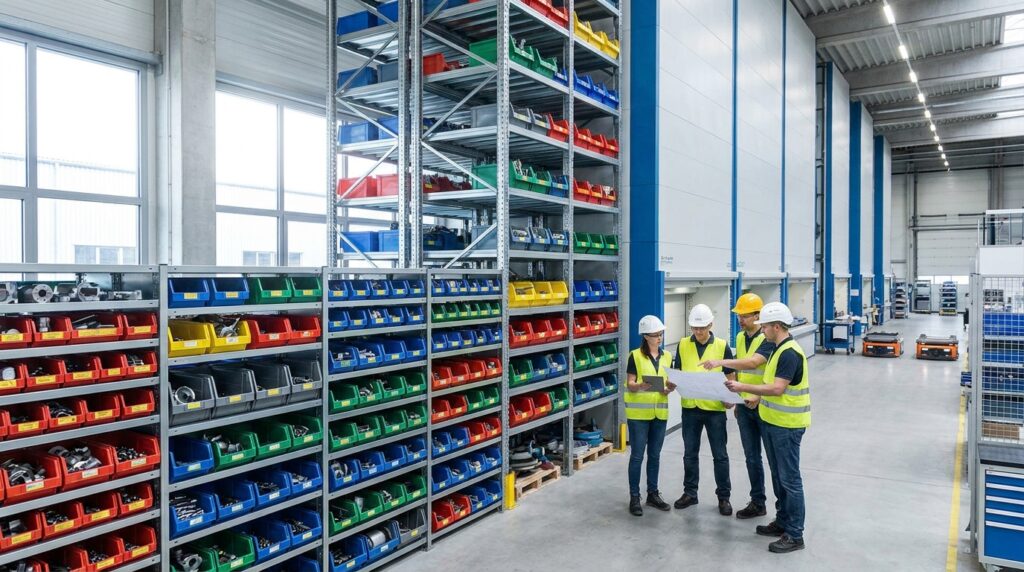
Thinking about how to store industrial parts might seem straightforward, but doing it in a way that can grow with your business is a different story. You don’t want to build a system today that you outgrow next year, forcing you to rip it all out and start over. That’s where planning for scalability comes in. It’s about setting up your storage now so it can handle more parts, more types of parts, and more activity as your company expands, without breaking the bank or your operations.
Understanding Your Current and Future Needs
Before you even think about shelves or software, you need to get a clear picture of what you’re storing and what you will be storing. This isn’t just a quick glance; it’s a deep dive. Knowing your starting point and anticipating where you’re heading is the bedrock of a storage system that won’t hold you back.
Analyzing Existing Inventory and Space
Let’s start with what you have right now. What kinds of parts are you dealing with? Are they small screws and bolts, large machine components, or a mix of everything? How much space do these parts currently occupy? Think about volume, not just square footage. Are your current storage methods efficient, or are you using more space than you need? Are there specific parts that are hard to find or access? Documenting these details is crucial. This might involve taking an inventory, measuring the dimensions of different part categories, and noting how often they are accessed. Understanding the “now” provides a baseline.
Projecting Future Growth and Demand
Now, let’s look ahead. This is where scalability truly begins. How much do you expect your inventory to grow over the next one, three, and five years? Are you launching new product lines that will require new types of parts? Will your production volume increase, leading to higher demand for raw materials and finished components? Consider external factors too: market trends, economic forecasts, and your company’s strategic goals. It’s better to overestimate slightly than to underestimate and quickly become constrained. Even rough estimates are better than no estimates at all.
Identifying Key Storage Requirements
Different parts have different needs. Some might be sensitive to moisture or temperature, requiring climate-controlled areas. Others might be heavy and require specialized lifting equipment. Some could be hazardous and need special containment. Think about what makes each type of part unique in terms of storage. Do you need dedicated areas for high-value items? Are there parts that need to be kept separate from others due to contamination risks? Listing these specific requirements for different part categories will inform your storage design.
When considering the implementation of a scalable industrial parts storage system, it’s essential to explore various resources that provide insights into effective planning and execution. A related article that delves into the fundamentals of optimizing storage solutions can be found at Fredon Handling. This resource offers valuable information on best practices and innovative strategies that can enhance your storage capabilities, ensuring that your system is both efficient and adaptable to future needs.
Designing for Flexibility and Adaptability
A scalable system isn’t rigid; it’s like a well-built modular set that can be reconfigured. It needs to be able to change and grow with your business, not be replaced by it. Flexibility means having options, and adaptability means being able to implement those options easily.
Choosing Modular Storage Solutions
Think about shelving systems that can be added to or reconfigured easily. Adjustable shelving, for example, allows you to change shelf heights as your part sizes change. Pallet racking can often be extended or re-arranged. Cantilever racking is great for long, bulky items and can be expanded as needed. The key is to avoid fixed, welded structures that are difficult to modify. Look for systems that use standard components that can be combined in different ways. This approach allows you to add more capacity or adjust layouts without major construction.
Implementing Multi-Tiered Storage Strategies
Often, the easiest way to gain more storage space without expanding your physical footprint is to go vertical. Multi-tiered storage, like mezzanines or multi-level shelving, can dramatically increase your usable storage area. This requires careful planning for access, safety, and weight distribution. You’ll need to consider how people or equipment will get to different levels and ensure the structure can support the weight of everything stored on it. This is a smart way to maximize existing floor space.
Planning for Different Part Sizes and Types
Your system needs to accommodate a wide range of items. This means having a variety of storage media within your overall system. Small parts bins for screws, larger bins or shelves for electronic components, specialized racks for pipes or bar stock, and open floor space or pallet racking for larger machinery parts. The ability to integrate these different storage methods into a cohesive system is vital. It prevents bottlenecks and ensures every part has an appropriate home.
Optimizing for Efficient Operations
Storage isn’t just about putting things away; it’s about being able to get them out quickly and accurately when needed. An efficient system saves time, reduces errors, and makes your entire operation smoother. Scalability here means that efficiency shouldn’t degrade as you grow.
Developing a Smart Slotting Strategy
Slotting is about where you put things. It’s not random. High-demand items should be stored in easily accessible locations, typically at waist height and near packing or assembly areas. Less frequently accessed items can go higher up or further away. If you have parts that are frequently used together, consider storing them near each other. This “golden zone” of accessibility can drastically cut down on travel time for your staff. As your inventory changes, you’ll need to revisit your slotting strategy to ensure it remains optimal.
Incorporating Technology for Tracking and Management
Manual tracking is a recipe for disaster when scaling up. Implementing a Warehouse Management System (WMS) or even a robust inventory management software is essential. These systems can track the location of every item, manage stock levels, guide pickers, and provide valuable data for optimizing operations. Barcode scanning or RFID technology can automate data entry and improve accuracy. As your business grows, the insights from this data become even more critical for making informed decisions about inventory and space.
Designing for Workflow and Accessibility
Think about how people and equipment will move within your storage area. Clear aisles, logical flow from receiving to storage to shipping, and adequate space for forklifts or other material handling equipment are crucial. A system that creates traffic jams or makes it difficult to reach items will quickly become inefficient. Consider one-way traffic flow in busy areas or dedicated pathways for different types of movement. This focus on workflow ensures that as your volume increases, your operations don’t grind to a halt.
Implementing Scalable Infrastructure and Technology
The physical structure of your storage is important, but so is the technological backbone that supports it. Investing in infrastructure that can grow with you means you won’t hit a wall when your business expands.
Assessing Your Current Infrastructure Limitations
Look at your current building. Does it have the ceiling height needed for vertical expansion? Are the floors strong enough to support heavy loads if you decide to stack more? Is there enough power for additional lighting or automated systems? Consider the load-bearing capacity of your existing structures and the layout of utilities like electricity and network access. Identifying these limitations early allows you to plan for upgrades or consider alternative locations if necessary.
Selecting Material Handling Equipment Wisely
As your storage capacity grows, so does the need for efficient ways to move items. This might mean investing in more advanced forklifts, automated guided vehicles (AGVs), or even robotic picking systems. The key is to choose equipment that can handle your current needs but can also be scaled up or integrated with new technologies as your business evolves. Think about the future requirements of lifting, transporting, and placing heavier or larger items, and the associated safety protocols.
Planning for Future Technology Integrations
Your storage system shouldn’t operate in isolation. It needs to communicate with your enterprise resource planning (ERP) system, your order management system, and potentially other business applications. When selecting WMS or inventory software, ensure it has robust integration capabilities (APIs) that will allow it to connect with future systems you might adopt. This interoperability is crucial for maintaining a seamless flow of information and operations as your business grows and technology advances.
When considering the best practices for designing a scalable industrial parts storage system, it’s essential to understand the broader context of material handling. A related article that provides valuable insights on this topic can be found here: material handling. This resource delves into the principles and techniques that can enhance efficiency and organization in storage solutions, making it a great complement to your planning process.
Continuous Improvement and Future-Proofing
A scalable system isn’t a set-it-and-forget-it solution. It requires ongoing attention and a willingness to adapt. Thinking about the future from the outset helps you avoid costly overhauls down the line.
Establishing Regular Review and Audit Processes
Your needs will change, so your storage system should too. Schedule regular reviews of your inventory, storage layout, and operational efficiency. This could be quarterly or annually. Conduct audits to check for accuracy in inventory counts, identify underutilized space, or spot areas where processes are becoming cumbersome. These reviews should be data-driven, using the information gathered from your WMS or other tracking systems.
Training Staff for Adaptability and New Technologies
As your storage system evolves, so does the need for skilled staff. Invest in training that prepares your team for new equipment, software, and workflows. Empower your employees to identify inefficiencies and suggest improvements. A well-trained and engaged workforce is your best asset for ensuring that your scalable storage system continues to function optimally as it grows and adapts to new challenges and opportunities.
Considering Sustainable and Eco-Friendly Options
As you plan for growth, don’t overlook the environmental impact. Scalability can also mean efficiency in resource use. This could involve optimizing energy consumption for lighting and climate control, choosing durable and recyclable storage materials, or implementing better waste reduction strategies within your warehouse. Thinking about sustainability from the start can lead to long-term cost savings and align your operations with environmental responsibility, which is increasingly important for business reputation and customer loyalty.