
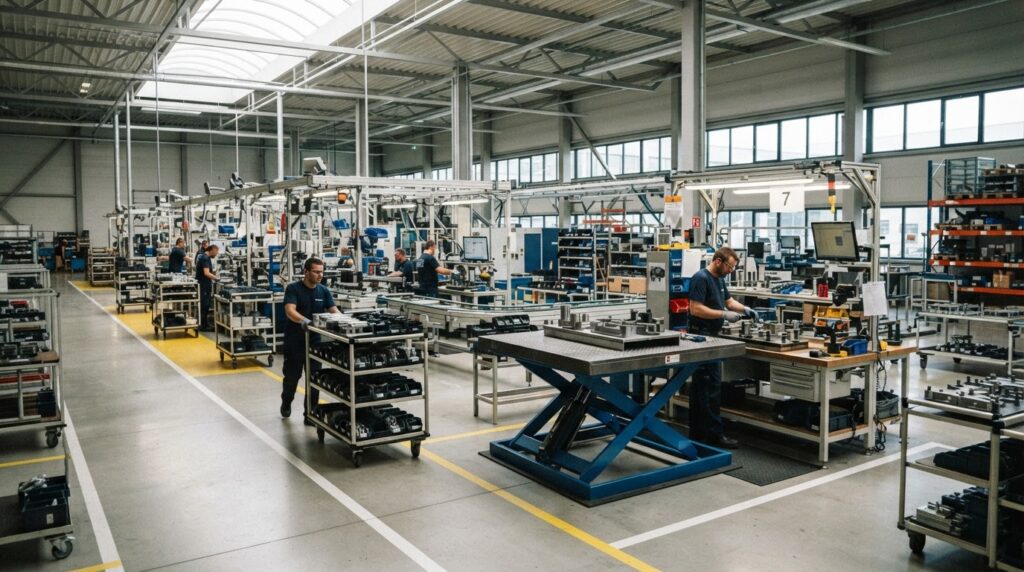
Productivity gains from material handling equipment do not come from owning more machines. They come from eliminating unnecessary movement, reducing delays, improving access and presenting materials where the next task can be completed effectively.
An improvement in one workstation is not always a gain for the whole facility. This guide focuses on the operational measures that show whether equipment actually improves the flow of work. For financial evaluation, see Fredon’s separate equipment ROI guide.
Measure the Baseline Before Buying Equipment
Record the time, distance and effort involved in a representative movement. Include waiting, loading, travel, unloading, searching and repositioning. Repeat the observation at ordinary and peak operating rates so the comparison reflects the real process.
Useful measures include touches per unit, moves per shift, travel distance, queue time, rework, product damage, picker productivity and actual throughput. Choose a few metrics closely tied to the identified problem instead of collecting numbers without a decision purpose.
Reduce Rehandling and Unnecessary Touches
Every time an item is transferred solely because of an inconvenient layout, the operation uses labor and creates an opportunity for delays or damage. Better carts, storage positions, transfer heights or organized kitting can eliminate extra steps.
For example, a component moved from a pallet to a temporary cart, then to a second container and finally to a workbench may benefit from a more direct transfer method. Map the existing steps and test whether the proposed equipment removes any of them.
Improve Working Height and Material Positioning
A hydraulic lift table or pallet positioner can help present material at a height appropriate to the task, reducing repeated manual repositioning. Workstations with organized tools and parts can likewise reduce search and reach time.
These are application-specific benefits, not guarantees. Check load geometry, required lift travel, task frequency and operator interaction. Fredon’s hydraulic lifts and industrial workstations support different tasks.
Shorten Travel by Improving Storage Location
Long travel paths often reflect the location of frequently used inventory rather than the absence of fast transport equipment. Place high-frequency items closer to their points of use when appropriate, and create clear replenishment routes.
Pallet racking, shelving and high-density parts storage should balance capacity with retrieval efficiency. Too much density can lengthen access time. See warehouse storage solutions and evaluate actual picks per hour or distance per order.
Remove Queue Time at Transfer Points
Material handling often slows at loading docks, receiving stations, staging zones and production line interfaces. A faster forklift does little for throughput if trucks wait for an unavailable dock or assembled parts accumulate before a machine.
Observe the whole process to identify the constraint. Better dock equipment, staging layout or a consistent transfer height may reduce waiting. After improvement, remeasure the next bottleneck that emerges.
Use the Right Level of Power and Automation
Manual devices may be sufficient for changing routes and moderate volumes. Powered or automated systems can be appropriate where movements are heavy, repetitive or predictable. Higher complexity also brings installation, maintenance, training and potential downtime implications.
Compare the improvement in total process time rather than maximum machine speed. A high-speed transfer that creates large queues at the next station does not necessarily improve completed output.
Protect Safety and Reliability While Improving Output
A throughput target cannot justify operating outside rated capacity, compromising pedestrian routes or bypassing safeguards. Reliability matters because recurring breakdowns can erase gains from a faster nominal process.
Plan maintenance access, inspections, operator training and contingency arrangements. Equipment chosen for a realistic duty cycle and service plan is more useful than one optimized solely for headline speed.
Track KPIs After Installation
Use the same definitions and sampling periods as the baseline. Compare handling time, touches, travel, wait time, errors and output. Document changes in product mix and staffing that might distort the apparent result.
If throughput improves at the target station but not at shipping or production output, inspect the next constraint. Continuous material-flow review prevents local gains from masking system-wide problems.
A Practical Improvement Review
Begin with one high-friction process and a measurable target, then evaluate low-cost layout and work-method changes alongside equipment. Pilot when practical. Include the people doing the work, and document what changes in the process after installation.
The right question is not merely how fast the new machine moves. It is whether materials reach the next useful step more reliably, with fewer touches and without creating new safety or maintenance burdens.
For a wider look at storage, transport, lifting and positioning, see our complete guide to material handling equipment.
Next Steps
Use Fredon’s calculators and tools and talk with a material handling specialist about measurable productivity constraints at your facility.