
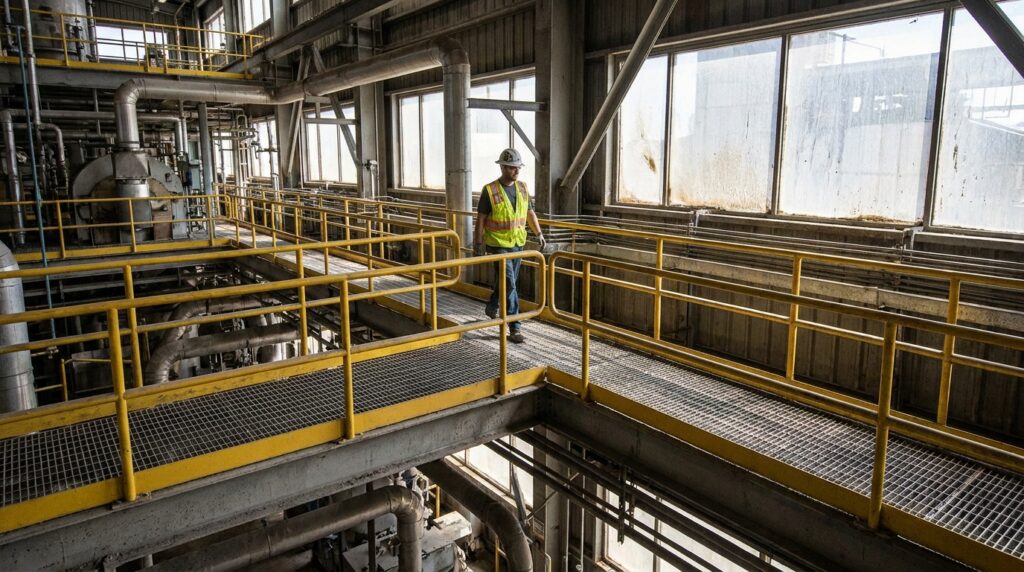
Understanding the Role of Industrial Catwalks in Modern Warehousing
In the complex and often space-constrained environments of industrial facilities, efficient access and operational flow are paramount. Industrial catwalks, essentially elevated walkways or platforms, play a crucial role in achieving these objectives. They are not merely elevated pathways but strategic elements of warehouse design that can significantly enhance productivity, safety, and the utilization of vertical space. For facility managers, engineers, warehouse operators, and purchasing professionals, understanding the design, access, and safety considerations of industrial catwalks is vital for making informed decisions that benefit their operations.
Fredon Handling specializes in providing comprehensive industrial material handling solutions, including the design and implementation of robust and efficient catwalk systems. These systems are integral to optimizing warehouse space and ensuring safe access to various operational levels.
When exploring the intricacies of industrial catwalks, it is essential to consider the broader context of material handling systems. A related article that delves into the fundamentals of material handling can provide valuable insights into how these systems interact with catwalk design and safety protocols. For more information, you can read the article here: What is Material Handling?. This resource will enhance your understanding of the various components involved in efficient and safe industrial operations.
Designing for Functionality and Structural Integrity
The design of an industrial catwalk is a multifaceted process that balances functionality, structural integrity, and integration with existing warehouse infrastructure. It’s about creating safe, accessible pathways that enhance operational efficiency without compromising safety or the overall stability of the facility.
Material Selection and Load Bearing Capacity
The choice of materials for industrial catwalks directly influences their durability, load-bearing capacity, and resistance to environmental factors. Common materials include:
- Steel: Structural steel is the most prevalent material due to its inherent strength, rigidity, and cost-effectiveness. It can be fabricated into various profiles (beams, channels, angles) to create robust and reliable structures. Steel is also amenable to corrosion-resistant coatings like galvanization, making it suitable for diverse environments.
- Aluminum: While lighter than steel, aluminum offers excellent corrosion resistance and a good strength-to-weight ratio. It can be a viable option for certain applications where weight is a critical factor or where extreme corrosion resistance is needed.
- Concrete (less common for catwalks): While concrete is a primary structural material in many industrial buildings, it’s less commonly used for the walkways themselves due to weight and installation complexity for suspended structures. However, it might be incorporated into supporting elements.
The load-bearing capacity is a critical design parameter. This refers to the maximum weight a catwalk can safely support, including the weight of personnel, equipment, and any materials being transported across it. Determining this capacity involves detailed engineering calculations based on:
- Uniformly Distributed Load (UDL): The maximum weight the catwalk can support spread evenly across its entire surface.
- Concentrated Load: The maximum weight that can be placed at a single point on the catwalk, often representing the weight of a piece of equipment or a pallet.
Engineers will consider the intended use of the catwalk – whether it’s primarily for personnel access or also for transporting lighter equipment – to establish appropriate load ratings. It’s crucial to consult with qualified engineers and refer to relevant building codes and standards for accurate load calculations and material specifications.
Integration with Existing Structures and Equipment
A well-designed catwalk system is seamlessly integrated with the existing warehouse infrastructure. This includes:
- Connection Points: How the catwalk attaches to existing building columns, walls, or other structural elements. These connections must be engineered to transfer loads safely and effectively.
- Interference with Equipment: Ensuring the catwalk does not obstruct the operation of machinery below or around it, such as forklifts, automated guided vehicles (AGVs), or conveyor systems. This involves careful spatial planning and consideration of vertical clearances.
- Aesthetics and Flow: While functionality is primary, the visual integration and how the catwalk contributes to the overall workflow and aesthetic of the warehouse are also considered.
Surface Options for Traction and Drainage
The surface of an industrial catwalk is crucial for safety, particularly in environments where spills, moisture, or dust are present. Several options exist:
- Open Grating: This is a popular choice for catwalks. It typically consists of interlocking metal bars that create a durable and slip-resistant surface.
- Advantages: Excellent drainage and ventilation, allowing liquids and debris to pass through, reducing slip hazards. It’s also lightweight and allows light to penetrate to areas below.
- Types: Various grating types exist, including welded, press-locked, and swaged, each with different load capacities and spacing.
- Diamond Plate or Textured Metal: Solid metal sheets with raised patterns provide good traction.
- Advantages: Offers a continuous, solid surface which can be beneficial for certain equipment or applications where open grating might be problematic. It also prevents small items from falling through.
- Considerations: Can accumulate debris if not properly maintained, and drainage might be less efficient than grating.
- Non-Slip Coatings: Regardless of the base material, non-slip coatings can be applied to enhance traction further. These can include epoxy-based coatings with aggregate or specialized rubberized surfaces.
The selection of the surface material depends on the specific operational environment, the types of materials handled, and the potential for slip hazards.
Ensuring Safe and Efficient Access
Access to and from industrial catwalks is a critical safety and operational consideration. It dictates how easily and safely personnel and equipment can utilize these elevated spaces.
Stairways and Ladders: Types and Considerations
The primary means of access to catwalks are stairways and ladders. The choice between them, and their specific design, depends on factors like frequency of use, load requirements, and available space.
- Stairways:
- Types: Include straight runs, L-shaped, U-shaped, and spiral stairs.
- Advantages: Offer the safest and most comfortable access, especially for frequent use, carrying tools, or when personnel might be wearing specialized footwear. They are also generally preferred for compliance with safety regulations for higher elevations.
- Design Considerations: Include tread depth, riser height, handrail design, and landings for changes in direction. Building codes often dictate minimum tread widths and maximum riser heights for stairs.
- Ladders:
- Types: Include fixed industrial ladders, ship ladders (steeper than stairs with narrower treads), and alternating tread ladders.
- Advantages: Require less horizontal space than stairways, making them suitable for areas where space is at a premium.
- Design Considerations: Fixed ladders should incorporate safety cages or fall arrest systems, especially for significant heights, to prevent falls. Handrails extending above the landing point are also crucial. Ship ladders offer a compromise between stairs and ladders, providing a more manageable ascent than a vertical ladder.
Fredon Handling’s expertise extends to designing access solutions that integrate seamlessly with your catwalk system, ensuring compliance and operational efficiency. Our material handling solutions can be integrated to support the installation and use of these access systems.
Gates and Interlocks for Controlled Access
Controlled access to catwalks is vital for safety, especially when they are elevated above active work areas or contain sensitive equipment.
- Gates: Various types of gates can be installed at the tops and bottoms of stairways and ladders.
- Self-Closing Gates: These gates automatically swing shut after passage, minimizing the risk of an opening being left unattended.
- Self-Latching Gates: These gates latch securely when closed, providing a positive closure.
- Interlock Systems: For higher security or more critical areas, interlock systems can be implemented. These systems ensure that only one access point to a catwalk can be open at a time, preventing multiple openings from being exposed simultaneously. This is particularly important in areas with potential hazards below or on the catwalk itself.
Emergency Egress and Evacuation Pathways
In the event of an emergency, clear and accessible egress pathways are essential. Catwalk designs must consider:
- Multiple Access Points: Strategically placed stairways and ladders to provide alternative routes for evacuation.
- Clear Signage: Prominent and easily visible signage indicating emergency exits and evacuation routes.
- Sufficient Width: Ensuring that catwalks and access points are wide enough to allow for the safe and rapid movement of personnel during an evacuation.
Safety Standards and Compliance
Adherence to safety standards and regulations is non-negotiable when designing and implementing industrial catwalks. These standards ensure the protection of personnel and the integrity of the facility.
Guardrails and Handrails: Essential Protective Features
Guardrails and handrails are fundamental safety features designed to prevent falls from elevated surfaces.
- Guardrails: Typically consist of a top rail, mid-rail, and intermediate posts. They are designed to prevent individuals from falling over the edge. Building codes often specify the height of the top rail and the spacing of intermediate rails to prevent passage.
- Handrails: Located at an accessible height, handrails provide support for individuals walking on the catwalk or using stairs. They are crucial for maintaining balance, especially in dynamic environments.
- Material and Strength: Guardrails and handrails must be constructed from robust materials and engineered to withstand significant lateral forces, in addition to providing a stable gripping surface.
Fall Protection Systems and Personal Protective Equipment (PPE)
While guardrails and handrails are primary protective measures, additional fall protection may be necessary depending on the specific application and risk assessment.
- Fall Arrest Systems: In situations where personnel might need to work at the edge of a catwalk or in areas where guardrails might be temporarily removed, fall arrest systems, including harnesses, lanyards, and anchor points, can be employed.
- Personal Protective Equipment (PPE): Workers on or around catwalks should be equipped with appropriate PPE, which may include safety helmets, high-visibility clothing, and slip-resistant footwear.
Building Codes and Regulatory Compliance
Industrial catwalks must comply with local, regional, and national building codes and occupational safety regulations. These codes typically cover aspects such as:
- Structural integrity and load capacities.
- Guardrail and handrail heights and strength.
- Stairway and ladder design standards (tread depth, riser height, incline).
- Clearances and aisle widths.
- Fire safety and egress requirements.
It is imperative to engage with qualified engineers and local building authorities to ensure that any catwalk installation meets all applicable requirements. Fredon Handling can assist in navigating these complexities by providing designs that are prepared with compliance in mind, working alongside your engineering and inspection teams. Our warehouse space optimization strategies often involve the intelligent integration of catwalks that adhere to these standards.
When considering the design and safety of industrial catwalks, it is essential to explore various factors that contribute to their effectiveness and compliance with regulations. A related article that delves deeper into the intricacies of material handling and its implications for workplace safety can be found here. This resource provides valuable insights that complement the discussion on catwalks, ensuring that all aspects of industrial design are thoroughly addressed. For more information, you can read the article on material handling.
Applications and Benefits of Industrial Catwalks
Industrial catwalks are versatile structures with a wide range of applications across various industries, offering significant operational and economic advantages.
Access to High-Level Storage and Equipment
One of the most common applications for catwalks is to provide safe and efficient access to:
- High-Level Shelving and Racking: Catwalks allow personnel to reach inventory stored on upper levels of racking systems, eliminating the need for potentially hazardous order picking from the ground or relying solely on specialized lifting equipment for every item. This is particularly beneficial for high-density storage solutions.
- Overhead Machinery and Equipment: In manufacturing plants or processing facilities, catwalks provide access to machinery located at elevated heights for maintenance, inspection, or operation. Examples include large pumps, HVAC units, or automated production lines.
Optimizing Vertical Warehouse Space
Catwalks are instrumental in maximizing the utility of vertical space within a warehouse.
- Creating Usable Aisles: By building catwalks, you effectively create additional “floors” or usable aisles within the existing building footprint. This allows for higher storage densities without increasing the facility’s overall square footage.
- Reduced Footprint for Access: Compared to wide aisles required for forklifts at every storage level, catwalks provide narrow access routes, significantly freeing up valuable floor space for inventory or operational activities. This is a key component of effective warehouse space optimization.
Facilitating Inspections and Maintenance
Regular inspections and maintenance are critical for operational continuity and safety. Catwalks provide:
- Safe Vantage Points: They offer secure platforms from which to inspect structural integrity, machinery, and inventory without requiring extensive scaffolding or elevated work platforms for routine checks.
- Convenient Access for Technicians: Maintenance personnel can easily access and work on equipment or systems located at elevated levels.
Enhancing Workflow and Productivity
The presence of well-designed catwalks can streamline various warehouse operations:
- Efficient Order Picking: In multi-level pick modules, catwalks facilitate faster and more ergonomic order picking processes. Operators can move quickly between pick faces on different levels.
- Material Flow: Catwalks can be part of a larger material flow strategy, connecting different operational zones within the facility at elevated levels, reducing travel time and congestion on the floor.
Fredon Handling offers a range of shelving and storage solutions that are often complemented by custom-designed catwalks to create highly efficient multi-level storage systems.
When designing industrial catwalks, it is crucial to consider not only the aesthetic aspects but also the functionality and safety measures involved. A related article that delves into essential tools for efficiency in material handling can provide valuable insights into how proper equipment complements the design of catwalks. For more information on this topic, you can explore the article on types of material handling equipment, which highlights various tools that enhance operational efficiency and safety in industrial environments.
Considerations for Different Equipment and Storage Needs
The specific type of equipment and the nature of stored goods will influence the design and requirements of industrial catwalks.
Catwalks for Manual Operations vs. Automated Systems
- Manual Operations: In warehouses relying on manual order picking or manual movement of goods, catwalks need to be designed with ergonomic considerations. This includes ensuring adequate tread depth for walking, stable handrails, and sufficient width for comfortable passage, even when carrying small tools or items.
- Automated Systems: When integrating catwalks with automated storage and retrieval systems (AS/RS) or conveyor belts, the design must ensure compatibility. This might involve providing specific mounting points for equipment, ensuring clear pathways for robotic movement, and maintaining precise tolerances for automated interfaces.
Supporting Specific Equipment Platforms and Workstations
Catwalks can be integrated with other structural elements to create specialized work areas.
- Equipment Platforms: Catwalks can lead to or be part of larger equipment platforms designed to house specific machinery or workstations. These platforms require rigorous engineering to support the dynamic and static loads of the equipment.
- Workstations: Elevated workstations can be created on catwalks for tasks like quality control, light assembly, or specialized packaging, providing a dedicated and safe working environment above the main floor.
Considerations for Different Load Types
The type of load handled on a catwalk significantly impacts its design.
- Light Loads (Personnel, Hand Tools): Requires standard guardrail and handrail strength, with load capacities sufficient for pedestrian traffic.
- Medium Loads (Small Equipment, Pallets of Light Goods): Requires enhanced structural support, wider treads, and potentially higher load ratings. Load-bearing capacity calculations become more critical here.
- Heavy Loads (Heavy Machinery, Large Pallets): These applications may move beyond typical catwalk designs and require more robust structural steel platforms. It’s crucial to consult with engineers to determine if a catwalk is the appropriate solution or if a dedicated structural steel platform is needed. Fredon Handling can advise on the best solution for your specific load requirements, whether it’s a catwalk or a more substantial structural steel platform.
By carefully considering these factors, facility managers and engineers can ensure that their industrial catwalks are not only safe and compliant but also perfectly tailored to the unique operational demands of their facility.
Frequently Asked Questions About Industrial Catwalks
Q1: What is the typical lifespan of an industrial catwalk?
A1: The lifespan of an industrial catwalk depends heavily on the materials used, the environment it’s installed in, and the level of maintenance it receives. Properly designed and maintained steel catwalks, especially those with appropriate corrosion protection (like galvanization), can last for many decades. Regular inspections and addressing any signs of wear or corrosion promptly are crucial for maximizing longevity.
Q2: Can industrial catwalks be easily relocated or modified?
A2: Relocatability and modification depend on the original design. Modular catwalk systems are designed with disassembly and reassembly in mind, making them more adaptable. However, permanently integrated catwalks that are welded or heavily bolted to existing structures can be more challenging and costly to modify or relocate. When planning, consider potential future needs for flexibility.
Q3: Do I need a permit to install an industrial catwalk?
A3: In most jurisdictions, installing an industrial catwalk will require building permits and inspections to ensure compliance with local building codes and safety regulations. It is essential to consult with your local building department and engage qualified engineering professionals to navigate the permitting process. Fredon Handling works with clients to ensure our proposed designs meet code requirements, but the ultimate responsibility for obtaining permits lies with the facility owner.
Q4: What is the difference between a catwalk and a structural steel platform?
A4: While both are elevated structures, the primary distinction lies in their purpose and load-bearing capabilities. Catwalks are typically designed for personnel access and light duty, often characterized by open grating. Structural steel platforms are engineered for heavier loads, supporting machinery, or substantial storage, and may have solid decking. Fredon Handling offers both solutions, and our experts can help you determine which is best suited for your application.
Q5: How do I ensure my catwalk is compliant with OSHA regulations?
A5: OSHA (Occupational Safety and Health Administration) provides specific guidelines for elevated walkways, guardrails, and fall protection. Key requirements include minimum guardrail heights, mid-rail spacing, handrail strength, and safe access methods (stairs or ladders with appropriate safety features). Always refer to the latest OSHA standards and consult with safety professionals and engineers to ensure full compliance. Fredon Handling designs systems with these principles in mind, and we recommend thorough review by your safety officers.
Choosing the right industrial catwalk system is a critical decision that impacts safety, efficiency, and the overall productivity of your facility. Fredon Handling is dedicated to providing tailored solutions that meet your unique material handling needs.
We invite you to contact us today for a consultation. Our team of experts can help you assess your requirements, design the optimal catwalk system, and integrate it seamlessly with your existing infrastructure, ensuring a safe, efficient, and optimized workspace.