
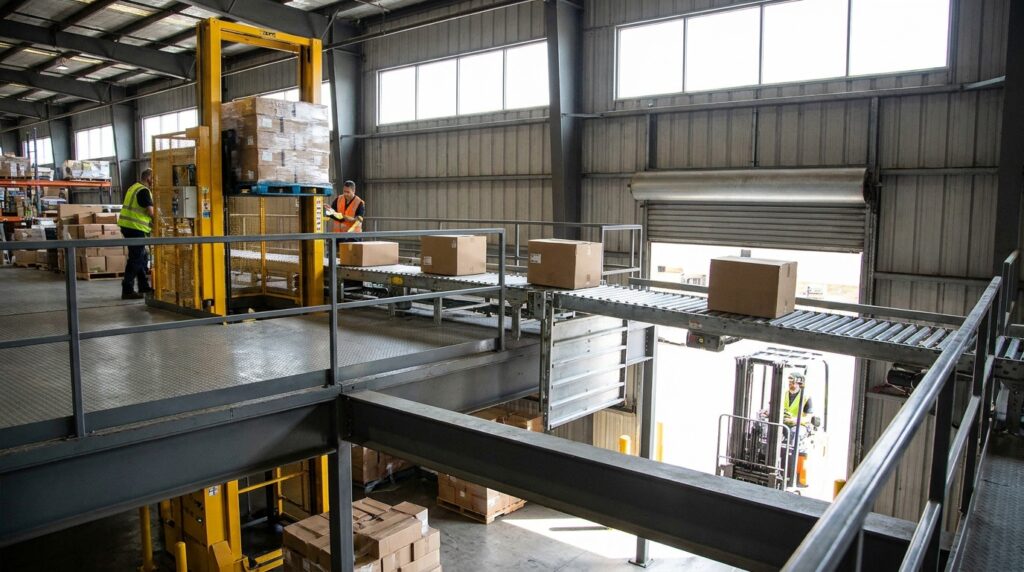
Unlocking Warehouse Potential: Mezzanines and Integrated Material Handling Systems
In the demanding world of industrial operations, maximizing available space and streamlining material flow are paramount for efficiency, productivity, and profitability. For facility managers, engineers, warehouse operators, and purchasing professionals tasked with these challenges, intelligent solutions are essential. One of the most effective strategies for achieving these goals is the strategic implementation of industrial mezzanines, often integrated with sophisticated material handling equipment. This article explores the multifaceted role of mezzanines in conjunction with lifts, conveyors, and pallet gates, providing a comprehensive overview for optimizing warehouse operations.
For those interested in enhancing their understanding of mezzanine material handling solutions, a related article can be found at this link. This resource provides valuable insights into the various types of lifts, conveyors, and pallet gates that can optimize storage efficiency and improve workflow in industrial settings.
The Strategic Advantage of Industrial Mezzanines
Industrial mezzanines, essentially elevated platforms supported by structural steel, offer a powerful way to create valuable usable space within an existing building without the significant expense and disruption of traditional construction. They effectively double or even triple the floor area, transforming underutilized vertical space into productive zones. This is particularly crucial in industries facing rising real estate costs and the constant pressure to increase throughput.
Transforming Underutilized Space
The fundamental benefit of a mezzanine is its ability to reclaim unused cubic footage. High ceilings in warehouses, often common for accommodating tall racking, can leave vast amounts of empty space above. A mezzanine system capitalizes on this vertical real estate, creating new levels for a variety of functions. This can include:
- Storage Expansion: Adding more shelving, pallet racking, or bulk storage areas without expanding the building’s footprint. This is a direct solution for warehouse space optimization.
- Production or Assembly Areas: Creating dedicated spaces for light manufacturing, assembly, kitting, or quality control operations, segregating them from the primary warehouse floor for better organization and workflow.
- Office and Administrative Space: Providing elevated offices for supervisors, inventory control personnel, or break rooms, freeing up valuable ground-level space for operational activities.
- Equipment Platforms: Mounting specialized machinery, automation equipment, or HVAC systems above the main floor, improving workflow and accessibility.
- Catwalks and Access Ways: Facilitating safe and efficient movement of personnel between different areas of a large facility, especially in complex layouts or around large machinery.
Types of Mezzanine Structures
Mezzanine systems are not one-size-fits-all. They are typically engineered from robust structural steel, designed to meet specific load requirements and site conditions. The primary types include:
- Clear Span Mezzanines: These structures offer the most open space underneath, as they are supported by columns around the perimeter. This design is ideal when unobstructed floor space is critical for equipment movement or layout flexibility.
- Multispan Mezzanines: These utilize intermediate support columns on the mezzanine deck itself, allowing for longer spans between main building columns. This can be a more cost-effective solution for larger areas where some column obstruction is acceptable.
- Rack Supported Mezzanines: These mezzanines are integrated directly into existing pallet racking systems. The racking itself acts as the primary support for the mezzanine deck, offering a highly integrated and space-efficient solution for shelving-based operations. This is an excellent example of leveraging existing infrastructure for shelving enhancements.
Integrating Material Handling Equipment with Mezzanines
The true power of a mezzanine system is unlocked when it’s seamlessly integrated with appropriate material handling equipment. This ensures that materials can be efficiently moved up, down, and across the new levels, creating a cohesive and productive workflow.
Lifts: Vertical Transportation Solutions
Lifts are indispensable for moving goods and personnel between mezzanine levels and the ground floor. The choice of lift depends on the type of material being moved, the weight, frequency of use, and vertical travel distance.
Types of Lifts for Mezzanines
- Material Lifts (e.g., Vertical Reciprocating Conveyors – VRCs): These are designed specifically for transporting materials. They can range from simple fork-style lifts to automated platform lifts. VRCs are a robust solution for frequent movement of palletized goods or bulk items. They are often a safer and more efficient alternative to forklifts or manual lifting on stairs, especially when dealing with heavier loads.
- Freight Elevators: For facilities requiring high-capacity, frequent, and heavy-duty material transport, dedicated freight elevators are an option. These are more complex and costly than VRCs but offer greater versatility and capacity.
- Personnel Lifts: While not strictly for material handling, some mezzanines may incorporate small personnel lifts for access by staff, especially if mobility issues are a concern or for quick transit between elevated work areas.
Considerations for Lift Integration
- Load Capacity: The lift must be rated to handle the maximum weight of the materials it will transport, including the load and any containers.
- Vertical Travel: The lift’s travel height must precisely match the distance between the mezzanine floor and the ground floor.
- Footprint: The lift’s base dimensions need to be accounted for in the mezzanine and warehouse floor plan.
- Cycle Time: For high-volume operations, the speed at which the lift can load, travel, and unload is a critical factor in maintaining workflow efficiency.
- Safety Features: Interlocks, safety gates, emergency stops, and overload protection are crucial for safe operation.
Conveyors: Continuous Material Flow
Conveyors are ideal for moving materials horizontally or at inclines, and their integration with mezzanines can create sophisticated automated systems for high-throughput operations.
Conveyor Applications with Mezzanines
- Infeed and Outfeed: Conveyors can bring products from ground-level receiving areas to the mezzanine for processing, storage, or order fulfillment, and then transport finished goods or outgoing orders back down.
- Cross-Aisle Transport: On larger mezzanines, conveyors can facilitate rapid movement of items between different work zones or storage bays.
- Sortation Systems: Automated sortation conveyors can be integrated onto mezzanines for efficient order picking and consolidation.
- Automated Storage and Retrieval Systems (AS/RS) Integration: Mezzanines can serve as elevated platforms for certain types of AS/RS equipment, optimizing vertical storage and retrieval.
Types of Conveyors
- Belt Conveyors: Versatile for a wide range of products, from small parts to larger boxes.
- Roller Conveyors: Excellent for handling boxes, totes, and pallets. Can be gravity-fed or powered.
- Chain Conveyors: Suitable for heavier loads and pallet handling.
- Overhead Conveyors: Ideal for moving items overhead, freeing up floor space.
Design Integration of Conveyors
- Elevation Changes: Designing the mezzanine structure to accommodate the necessary inclines and declines for conveyor systems is crucial.
- Support Structures: Conveyors require robust support structures, which can be integrated into the mezzanine design or added as separate elements.
- Transfer Points: Careful design of transfer points between different conveyor sections and between conveyors and lifts is essential to prevent product damage and ensure smooth flow.
- Automation Integration: For complex systems, close collaboration with automation specialists is necessary to ensure seamless integration of controls and logic.
Pallet Gates: Enhancing Safety at Load/Unload Points
When lifts or conveyors are used to move palletized materials to and from mezzanines, pallet gates are a critical safety component. They prevent operators or falling objects from accidentally going over the edge of the mezzanine.
Functionality and Types of Pallet Gates
Pallet gates typically consist of a dual-gate system or a sliding gate mechanism. The principle is that the gate on the mezzanine level must be closed before the gate on the lower level can open, and vice-versa. This ensures that there is always a barrier protecting the opening.
- Dual-Gate Systems: These feature two gates. When a pallet is loaded onto the mezzanine, one gate closes behind it. Then, the second gate opens to allow access to the lift or conveyor.
- Sliding Gates: A single sliding gate can be employed, often interlocked with the lift or conveyor system to ensure it’s closed before the lift car arrives or departs.
Importance of Pallet Gates
- Fall Prevention: The primary function is to prevent personnel and materials from falling from the elevated platform.
- Compliance with Safety Regulations: Many safety codes and standards mandate the use of fall protection measures at elevated openings.
- Controlled Access: They ensure that only authorized personnel and materials are moved to and from the mezzanine.
Equipment Platforms and Catwalks: Specialized Applications
Beyond general storage and workflow, mezzanines can be specifically designed as equipment platforms or to incorporate catwalks.
Equipment Platforms
These are custom-engineered elevated structures designed to support specific machinery. This could include:
- Automated machinery: Robots, pick-and-place systems, or packaging equipment.
- HVAC units or industrial fans: Relocating noisy or large equipment above the operational floor.
- Control panels or operator stations: Providing elevated vantage points for monitoring processes.
The design of equipment platforms requires close collaboration with equipment manufacturers and engineers to ensure proper load distribution, vibration isolation, and access for maintenance.
Catwalks
Catwalks are elevated walkways, often with railing, that provide safe passage over obstacles, hazardous areas, or across large open spaces on the mezzanine or within the main warehouse.
- Access to Racking: In high-bay racking systems, catwalks can provide access to upper levels for manual picking or stock checking.
- Maintenance Access: They allow maintenance personnel to safely access machinery or overhead infrastructure.
- Inter-Area Connectivity: Connecting different sections of a large facility without interfering with ground-level operations.
The design of catwalks emphasizes safety, including appropriate tread surfaces (e.g., non-slip grating), handrails, and guardrails, adhering to relevant building codes and safety standards.
Benefits and Limitations of Mezzanine Systems
While mezzanines offer significant advantages, it’s important to consider their limitations to make informed decisions.
Key Benefits
- Space Maximization: The most significant benefit, turning unused vertical space into valuable real estate. This directly addresses the need for warehouse space optimization.
- Cost-Effectiveness: Typically a fraction of the cost of new construction or building expansion.
- Rapid Deployment: Mezzanines can often be designed and installed much faster than traditional building additions, minimizing operational disruption.
- Flexibility and Adaptability: They can be reconfigured or expanded if operational needs change.
- Improved Organization and Workflow: Segregating different functions can lead to a more organized and efficient flow of materials and personnel.
- Enhanced Safety: When properly designed with integrated safety features and material handling equipment, mezzanines can improve overall site safety.
Potential Limitations
- Building Height Requirements: Mezzanines require sufficient clear height in the existing building.
- Load Capacity of Existing Structure: The existing building’s floor and columns must be able to support the additional load of the mezzanine structure and its contents. A structural engineer’s assessment is critical here.
- Fire and Building Codes: Compliance with local building codes, fire regulations, and seismic requirements is essential and may influence design and material choices.
- Accessibility Challenges: While lifts address vertical movement, the layout must ensure ergonomic access to all areas of the mezzanine.
- Integration Complexity: Seamlessly integrating lifts, conveyors, and pallet gates requires careful planning and engineering.
- Maintenance: Like any industrial infrastructure, mezzanines and their associated equipment require regular maintenance.
In the realm of mezzanine material handling, understanding the various components that enhance efficiency is crucial. For instance, lifts, conveyors, and pallet gates play significant roles in optimizing space and streamlining operations. To delve deeper into the fundamentals of material handling and its importance in various industries, you can explore this informative article on material handling. This resource provides valuable insights that complement the discussion on mezzanine systems and their applications.
Design, Safety, and Selection Criteria
The successful implementation of a mezzanine system hinges on careful design, rigorous safety considerations, and a thorough selection process.
Design Considerations
- Load Requirements: Determining the maximum live and dead loads the mezzanine must support is the first step. This includes the weight of stored goods, equipment, personnel, and the mezzanine structure itself.
- Span and Column Placement: The layout of existing building columns will influence the mezzanine design, potentially requiring clear span or multispan configurations.
- Decking Material: Options include steel decking (often with concrete or wood fill), plywood, or specialized composite materials, chosen based on load, durability, and cost.
- Access and Egress: Stairways, safety ladders, and appropriate doorways must be incorporated for personnel access and emergency egress.
- Lighting and Power: Provision for adequate lighting and electrical outlets on the mezzanine level is crucial.
- Ventilation: Depending on the use of the mezzanine, ventilation requirements may need to be addressed.
Safety First: Essential Protocols
Safety is non-negotiable. Key safety aspects include:
- Structural Integrity: All mezzanines must be designed and engineered by qualified professionals to meet or exceed relevant building codes and safety standards. This often involves obtaining permits and undergoing inspections.
- Fall Protection: Guardrails, toe boards, and safety netting are essential around all open edges. As discussed, pallet gates are critical at material transfer points.
- Fire Protection: Compliance with local fire codes regarding sprinkler systems, fire-rated materials, and emergency exits is mandatory.
- Load Labeling: Clear labeling of maximum load capacities on the mezzanine deck.
- Regular Inspections: Routine safety inspections by qualified personnel to identify and address any potential hazards or wear and tear.
- Operator Training: Comprehensive training for all personnel operating equipment or working on the mezzanine.
Selecting the Right Solution
For facility managers, engineers, warehouse operators, and purchasing professionals, the selection process should involve:
- Needs Assessment: Clearly define the purpose of the mezzanine (storage, production, office), the types of materials to be handled, and the required throughput.
- Site Evaluation: Assess the existing building’s structural capacity, clear height, and layout.
- Material Handling Integration Plan: Determine the most efficient and safe methods for moving materials to and from the mezzanine (lifts, conveyors, pallet gates).
- Budgetary Considerations: Obtain quotes and compare costs for different system configurations, including installation and ongoing maintenance.
- Supplier Expertise: Partner with reputable providers like Fredon Handling who have proven experience in designing, supplying, and installing integrated mezzanine and material handling solutions. They can offer valuable insights and ensure compliance with all relevant regulations. Consider their capabilities in material handling solutions.
- Code Compliance Review: Consult with local building authorities and qualified engineering firms to ensure all proposed designs meet local codes and regulations.
Frequently Asked Questions about Mezzanine Systems
Q1: Can any warehouse accommodate a mezzanine?
A1: Not all warehouses are suitable. Key factors include sufficient clear height (typically at least 16-20 feet or more, depending on the mezzanine height and intended use), and the structural capacity of the existing floor and building columns to support the added load. A structural engineering assessment is crucial.
Q2: What are the typical lead times for a mezzanine system?
A2: Lead times can vary significantly based on the complexity of the design, fabrication time, permitting, and installation schedule. Simple systems might be ready in a few weeks, while complex, integrated solutions could take several months.
Q3: How do I know what load rating I need for my mezzanine?
A3: This depends entirely on your specific application. You need to calculate the maximum potential weight the mezzanine will need to support, including stored inventory (considering density and stacking configurations), equipment, and personnel. A qualified structural engineer or your mezzanine provider can help with this calculation.
Q4: Are mezzanines considered permanent structures?
A4: Mezzanines are generally considered semi-permanent or permanent structures, depending on their construction. Freestanding mezzanines are often designed for disassembly and relocation, while bolt-up systems are more permanent. However, they typically require building permits and adherence to building codes.
Q5: What is the difference between a VRC and a freight elevator?
A5: A Vertical Reciprocating Conveyor (VRC) is specifically designed for transporting materials between fixed points. Freight elevators are more versatile and designed for transporting both materials and personnel between multiple floors, often with higher speeds and capacities. VRCs are typically more cost-effective for dedicated material transfer between two or three levels.
Q6: How do I ensure my mezzanine installation is safe and compliant?
A6: The most critical steps are to engage a reputable provider like Fredon Handling, hire a qualified structural engineer to design the system according to local codes, obtain all necessary building permits, and ensure thorough inspections throughout the process and upon completion.
Conclusion: Maximizing Your Warehouse’s Vertical Potential
Industrial mezzanines, when thoughtfully integrated with appropriate material handling equipment such as lifts, conveyors, and pallet gates, represent a powerful strategy for transforming underutilized warehouse space into highly productive operational areas. For facility managers, engineers, warehouse operators, and purchasing professionals, understanding the applications, benefits, and critical design and safety considerations is key to unlocking significant gains in efficiency, capacity, and profitability. By leveraging these solutions, businesses can overcome space constraints, streamline workflows, and create safer, more organized work environments.
To explore how optimized storage, vertical space utilization, and advanced material handling can benefit your operations, we invite you to consult with the experts at Fredon Handling. Our team is ready to assess your unique needs and design a custom solution for your facility.