
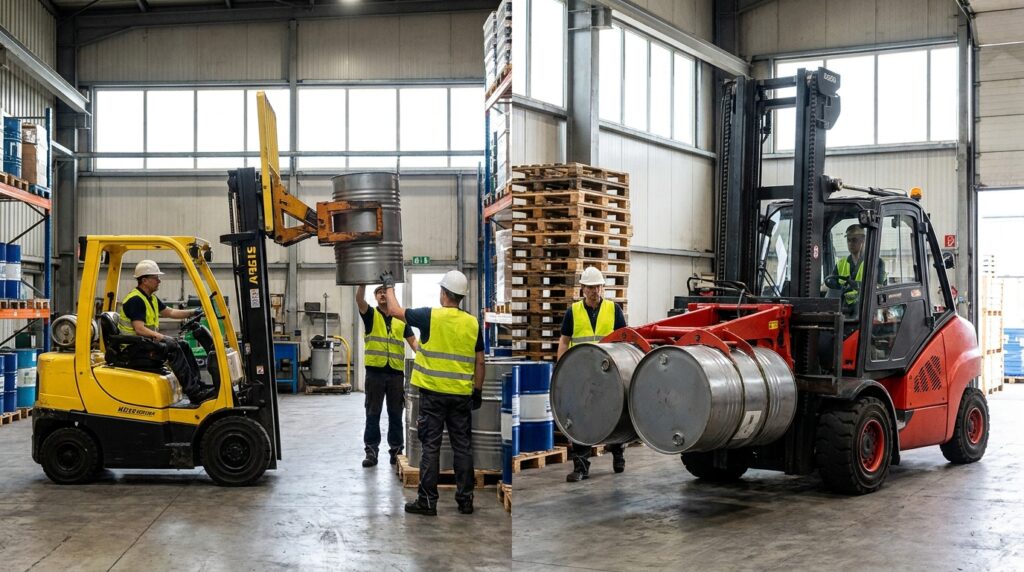
Revolutionize Your Warehouse Operations: Single vs. Double Drum Forklift Attachments
Handling drums, whether filled with liquids, powders, or viscous materials, presents a unique set of challenges in a warehouse or industrial setting. The sheer weight, awkward shape, and potential for spillage demand specialized equipment to ensure efficiency, safety, and damage prevention. Among the most popular and effective solutions are forklift drum attachments. These versatile tools transform standard forklifts into dedicated drum-handling machines, significantly streamlining operations. However, a crucial decision arises when selecting the right attachment: single drum forklift attachments versus double drum forklift attachments. This article will delve deep into the distinct advantages, applications, and considerations of each, empowering warehouse managers, plant engineers, safety managers, and industrial equipment buyers to make an informed choice that optimizes their workflow and safety protocols.
Understanding the Core Functionality of Drum Forklift Attachments
At their heart, drum forklift attachments are designed to securely grip, lift, and transport standard industrial drums (typically 55-gallon steel or plastic drums) without requiring manual intervention. This eliminates the risk of injury associated with manual lifting, reduces the likelihood of drum damage, and drastically increases the speed at which drums can be moved. They attach to the forklift’s carriage, utilizing hydraulic or mechanical systems to engage with the drum. The fundamental difference between single and double drum attachments lies in their capacity and operational focus: one is designed for individual drum handling, while the other is engineered for simultaneous transport of two drums.
For those interested in understanding the advantages and disadvantages of Single vs. Double Drum Forklift Attachments, a related article that provides valuable insights can be found at Fredon Handling’s Education Center. This resource delves into various forklift attachments, offering comprehensive information that can help you make informed decisions based on your specific handling needs.
Single Drum Forklift Attachments: Precision and Versatility
Single drum forklift attachments are the workhorses for many operations that require precise drum placement and frequent individual drum manipulation. Their design prioritizes maneuverability and direct control over a single drum, making them ideal for a wide range of applications.
How Single Drum Attachments Work
Most single drum forklift attachments employ a clamping mechanism, often a robust gripping arm or a full drum cradle, that securely fastens around the drum’s circumference. This clamping action is usually actuated hydraulically, allowing the operator to engage and disengage the grip from the forklift’s cabin. Some models may also feature a rotating function, enabling the operator to tilt or even fully invert the drum for emptying purposes.
- Clamping Mechanisms: The primary method of securing the drum. Common types include:
- Overhead Clamps: Arms that extend over the drum’s top rim, gripping it securely.
- Wrap-Around Clamps: Arms that encircle a significant portion of the drum’s body.
- Self-Dumping Mechanisms: These often combine clamping with a tilting function, allowing for controlled pouring of drum contents.
- Material Handling: Typically designed for standard 55-gallon drums, but models can often accommodate variations in drum diameter and height. The weight capacity of a single drum attachment is crucial and should always be considered in relation to the maximum weight of the drums being handled.
Advantages of Single Drum Attachments
The benefits of employing single drum forklift attachments are numerous, particularly for operations that demand flexibility and a focused approach to drum management.
- Enhanced Maneuverability: Their compact design allows for easier navigation in tight aisles and congested warehouse spaces. This is critical in facilities where space is at a premium.
- Precise Placement: Operators can meticulously position individual drums with greater accuracy, which is essential when stacking drums or placing them in specific storage locations.
- Reduced Risk of Damage: The secure grip minimizes the chance of accidental drops or impacts, protecting both the drum and its contents. This is particularly important for hazardous materials where containment is paramount.
- Versatility in Drum Types: Many single drum attachments can handle both steel and plastic drums, offering a degree of flexibility for facilities that use a mix of drum materials.
- Cost-Effectiveness: Generally, single drum attachments have a lower initial purchase price compared to their double drum counterparts, making them an attractive option for businesses with budget constraints or less intensive drum-handling needs.
Applications for Single Drum Attachments
The versatility of single drum attachments lends itself to a broad spectrum of industrial applications:
- Chemical Plants: Safely moving and dispensing chemicals stored in drums, often requiring precise pouring and containment.
- Food and Beverage Industry: Handling ingredients, syrups, and finished products stored in drums, ensuring hygiene and preventing contamination.
- Pharmaceutical Manufacturing: Transporting sensitive raw materials and finished goods where absolute containment is non-negotiable.
- Oil and Gas Operations: Managing lubricants, oils, and other fluids stored in drums, often in demanding environments.
- General Warehousing: A common solution for any facility that receives, stores, or ships goods packaged in drums.
Double Drum Forklift Attachments: Efficiency Multiplied
When the goal is to maximize throughput and minimize the time spent on drum handling, double drum forklift attachments emerge as the superior choice. These attachments are engineered to lift and transport two drums simultaneously, effectively doubling the efficiency of drum movement operations.
How Double Drum Attachments Work
Double drum forklift attachments typically employ a system of parallel gripping mechanisms or cradles designed to securely hold two drums side-by-side. Like their single drum counterparts, these attachments are usually hydraulically operated, allowing the forklift operator to engage and disengage the grip without leaving the cab. Some advanced models may also offer rotation capabilities for both drums.
- Dual Gripping Systems: Designed to securely hold two drums in tandem. This can involve:
- Two Independent Clamps: Each drum is gripped by its own dedicated clamping mechanism.
- A Combined Cradle: A larger cradle designed to accommodate two drums with integrated gripping features.
- Drum Compatibility: Primarily designed for standard 55-gallon drums, but their specific dimensions and gripping points will dictate compatibility with various drum sizes and materials. The combined weight capacity of the attachment is critical, as it must accommodate two full drums.
Advantages of Double Drum Attachments
The primary advantage of double drum forklift attachments lies in their ability to significantly boost productivity. However, there are other compelling benefits to consider.
- Increased Throughput: The most significant benefit is the ability to move twice the number of drums in a single trip. This dramatically reduces the overall time spent on drum transportation and handling, leading to substantial productivity gains.
- Reduced Labor Costs: By moving two drums at once, fewer forklift trips are required, which can translate into lower labor costs per drum handled.
- Optimized Warehouse Space: Efficiently moving multiple drums can help clear aisles and consolidate storage, leading to better utilization of warehouse space.
- Consistent Drum Handling: The robust design ensures that both drums are handled with the same level of security and stability.
- Suitable for High-Volume Operations: Ideal for warehouses and distribution centers that handle a large volume of drums on a daily basis.
Applications for Double Drum Attachments
Double drum attachments are best suited for environments where speed and volume are paramount:
- Large Distribution Centers: Where the sheer quantity of drums necessitates the fastest possible handling methods.
- Manufacturing Facilities with High Drum Output: Plants producing large volumes of products packaged in drums will benefit immensely from the increased efficiency.
- Bulk Storage Warehouses: Facilities dedicated to storing and moving large quantities of drummed goods.
- Logistics Hubs: Where rapid loading and unloading of trucks and containers with drums is a priority.
Key Selection Factors: Making the Right Choice
Choosing between a single and double drum forklift attachment isn’t a one-size-fits-all decision. Several critical factors must be carefully evaluated to ensure the chosen attachment aligns with your specific operational needs and constraints.
Drum Characteristics: Material, Size, and Weight
The type of drums you handle is the most fundamental consideration.
- Drum Material:
- Steel Drums: Generally more robust and can withstand higher clamping forces. Most attachments are designed to handle steel drums.
- Plastic Drums: Can be more susceptible to deformation under pressure. Ensure the attachment’s clamping mechanism is designed to grip plastic drums without causing damage or punctures. Look for attachments with smooth, non-marring contact points.
- Drum Size: While the standard is 55-gallon drums, variations exist. Measure the diameter and height of your drums to ensure compatibility with the attachment’s gripping range. Some attachments are adjustable to accommodate different drum sizes.
- Drum Weight and Capacity: This is paramount for safety.
- Individual Drum Weight: Determine the maximum weight of a single drum, whether full or empty, that you will be handling.
- Total Attachment Capacity: Ensure the attachment’s rated capacity significantly exceeds the weight of the heaviest drum(s) it will carry. For double drum attachments, this means considering the combined weight of two full drums. Never exceed the rated capacity of the attachment or the forklift.
Forklift Compatibility and Specifications
The attachment must seamlessly integrate with your existing forklift fleet.
- Forklift Class and Size: Attachments are typically designed for specific forklift classes (e.g., Class II, Class III). Ensure the attachment’s mounting system matches your forklift’s carriage type and size.
- Hydraulic Flow and Pressure: Many attachments rely on the forklift’s hydraulic system. Check the required hydraulic flow rate and pressure for the attachment and ensure your forklift can provide it. Some attachments have their own power units but relying on the forklift’s hydraulics is more common.
- Lift Capacity: The combined weight of the attachment and the drums it carries must not exceed the forklift’s rated lift capacity. This is especially crucial for double drum attachments carrying two heavy drums.
Operational Environment and Workflow
Consider the specific demands of your workplace.
- Aisle Width and Maneuverability Needs: If your aisles are narrow, a single drum attachment’s superior maneuverability might be essential. For wider aisles and high-volume throughput, a double drum attachment can be more efficient despite a potentially larger turning radius.
- Frequency of Drum Handling: If you move hundreds of drums daily, the productivity gains of a double drum attachment will likely outweigh the benefits of a single drum unit. For less frequent or more specialized handling, a single drum attachment may suffice.
- Stacking Requirements: If you frequently stack drums high, consider attachments with tilting and rotating features that facilitate precise placement.
- Need for Drum Emptying/Dispensing: If your operations involve regularly emptying drums, look for attachments with integrated tilting or dumping capabilities. This is a feature more commonly found on specialized single drum attachments, but some double drum models might offer limited tilting.
Safety Considerations
Safety should always be the top priority.
- Secure Gripping Mechanism: Ensure the attachment provides a reliable and secure grip on the drums to prevent slippage or drops. Look for features like non-slip linings or robust locking mechanisms.
- Visibility: The operator’s visibility of the drums and the surrounding environment is critical. Some attachments can obstruct view, so consider designs that minimize this.
- Load Stability: The attachment should provide stable lifting and carrying of the drums, minimizing the risk of tipping.
- Operator Training: Regardless of the attachment chosen, proper operator training on its safe operation is non-negotiable.
- Compliance and Standards: While specific regulatory standards for drum attachments can vary, reputable manufacturers adhere to industry best practices for safety and durability.
When considering the efficiency of warehouse operations, understanding the differences between single and double drum forklift attachments can significantly impact productivity. For a deeper insight into optimizing material handling equipment, you might find this article on top material handling equipment particularly useful. It explores various tools and techniques that can enhance your warehouse’s operational efficiency, ensuring that you make informed decisions about the attachments you choose for your forklifts.
Equipment Comparison: Single vs. Double Drum Attachments
Here’s a concise comparison to help illustrate the key differences:
| Feature | Single Drum Forklift Attachment | Double Drum Forklift Attachment |
| : | : | :- |
| Capacity | One drum at a time | Two drums simultaneously |
| Efficiency | Moderate | High |
| Maneuverability | Excellent, especially in tight spaces | Good, but potentially less agile than single units |
| Precision | High, for individual drum placement | Moderate, focusing on bulk transport |
| Cost | Lower initial investment | Higher initial investment |
| Ideal Application | Precision handling, varied drum types, moderate volume | High-volume operations, rapid transport, optimized throughput |
| Complexity | Generally simpler | Can be more complex due to dual gripping mechanisms |
| Potential for Damage | Low, with proper operation | Low, with proper operation; risk of two drums falling if one fails |
Drum Material Considerations in Detail
As mentioned, the material of your drums is critical.
- Steel Drums: Their rigid construction makes them ideal for most drum attachments. The uniformity of steel drums ensures a consistent grip.
- Plastic Drums: These require a more nuanced approach. Over-clamping can lead to deformation, cracking, or puncture, especially with older or brittle plastic. Look for attachments with:
- Adjustable Clamping Force: Allows the operator to dial in the appropriate pressure.
- Rubber or Urethane Linings: These provide a softer, more forgiving grip and prevent scratching.
- Wider Contact Surfaces: Distribute the clamping force over a larger area.
- Smooth, Rounded Edges: On the clamping arms to avoid snagging or puncturing the plastic.
Size and Weight in Practical Scenarios
Let’s consider a practical example. You have 55-gallon steel drums weighing 800 lbs when full.
- Single Drum Attachment: If you use a single drum attachment, you’ll need an attachment rated for at least 1,000 lbs (to provide a safety margin). This allows you to safely lift and move one drum at a time.
- Double Drum Attachment: If you opt for a double drum attachment, the total weight to be lifted is 1,600 lbs (800 lbs x 2). Therefore, you would need an attachment rated for at least 2,000 lbs to ensure safe operation. It’s always better to have a higher capacity rating than you strictly need for safety and longevity.
Equipment Compatibility in the Warehouse
Imagine a warehouse with narrow aisles (8 feet wide) and frequent need to move drums to and from racking.
- A single drum attachment would likely be the better choice here. Its tighter turning radius and ability to precisely position individual drums within the racking system offer superior operational efficiency and safety in this constrained environment.
- Conversely, in a large, open distribution center with wide aisles and a constant flow of incoming and outgoing drums for truck loading, a double drum attachment would drastically speed up the process. The ability to move two drums at once significantly reduces the number of trips required, making it the more productive option.
Maintenance and Longevity: Ensuring Peak Performance
To maximize the return on your investment and ensure safe, reliable operation, regular maintenance of your drum forklift attachments is essential.
Routine Inspections
- Daily Checks: Before each shift, operators should visually inspect the attachment for any signs of damage, wear, or loose components. Check hydraulic hoses for leaks or abrasions. Ensure the gripping mechanism operates smoothly.
- Weekly Inspections: A more thorough inspection should include checking all bolts and fasteners for tightness. Inspect the integrity of the clamping surfaces for wear or damage. Lubricate any moving parts as per the manufacturer’s recommendations.
Preventative Maintenance Schedule
- Follow Manufacturer Guidelines: Always adhere to the maintenance schedule provided by the attachment manufacturer. This typically includes periodic checks of hydraulic fluid levels, filter changes, and seal inspections.
- Hydraulic System: The hydraulic system is the heart of most drum attachments. Keep hydraulic fluid clean and at the correct level. Replace filters regularly to prevent contamination, which can lead to premature wear of seals and pumps.
- Wear Parts: Components like gripping pads or jaws are subject to wear. Monitor their condition and replace them promptly when they show signs of degradation to maintain a secure grip.
- Cleaning: Keep the attachment clean, especially after handling materials that could be corrosive or sticky. Accumulated debris can interfere with moving parts and lead to premature wear.
Investing in the Right Drum Handling Solution
The decision between single and double drum forklift attachments hinges on a clear understanding of your operational needs, the characteristics of your drums, and your available resources. Fredon Handling (fredonhandling.com) offers a comprehensive range of drum handling equipment designed to meet diverse industrial requirements. Whether you require the precision of a single drum attachment for intricate tasks or the high-volume efficiency of a double drum attachment for rapid throughput, we have solutions to enhance your operations.
Explore our extensive selection of drum handling equipment at https://fredonhandling.com/drum-handling-equipment/ to find the perfect fit for your warehouse or facility.
Frequently Asked Questions (FAQs)
What is the typical weight capacity of a single drum forklift attachment?
Single drum forklift attachments commonly have capacities ranging from 500 lbs to 1,000 lbs or more, designed to handle standard 55-gallon drums. Always refer to the specific product specifications for exact ratings and ensure it exceeds the weight of your heaviest drum.
Can a double drum forklift attachment handle drums of different sizes simultaneously?
Most double drum forklift attachments are designed to work with drums of uniform size. While some may have a degree of adjustability, attempting to grip drums of significantly different diameters can compromise stability and safety. It’s best to use drums of the same size with double drum attachments.
What is the difference in drum material compatibility between single and double drum attachments?
Both single and double drum attachments can generally handle steel drums. For plastic drums, look for attachments with features like adjustable clamping force, rubberized gripping surfaces, and smooth contact points to prevent damage. The material compatibility is more about the design of the gripping mechanism than the number of drums being handled.
How does aisle width affect the choice between single and double drum attachments?
In narrow aisles, the superior maneuverability of a single drum attachment is usually preferred. Double drum attachments, while efficient for transport, may have a larger turning radius, making them less suitable for extremely confined spaces.
What safety features should I look for in a drum forklift attachment?
Key safety features include a secure and reliable gripping mechanism, good operator visibility, stable load handling, and adherence to manufacturer’s weight capacity ratings. Ensure the attachment is appropriate for the type of drums you handle and that operators are properly trained.
Consult with Fredon Handling Experts Today!
Choosing the right drum forklift attachment is a critical decision that impacts efficiency, safety, and your bottom line. Don’t leave it to chance. Our team of experienced professionals at Fredon Handling is ready to discuss your specific needs, analyze your operational challenges, and recommend the ideal single or double drum forklift attachment solution. Contact us today for a personalized consultation and discover how Fredon Handling can revolutionize your drum handling operations.