
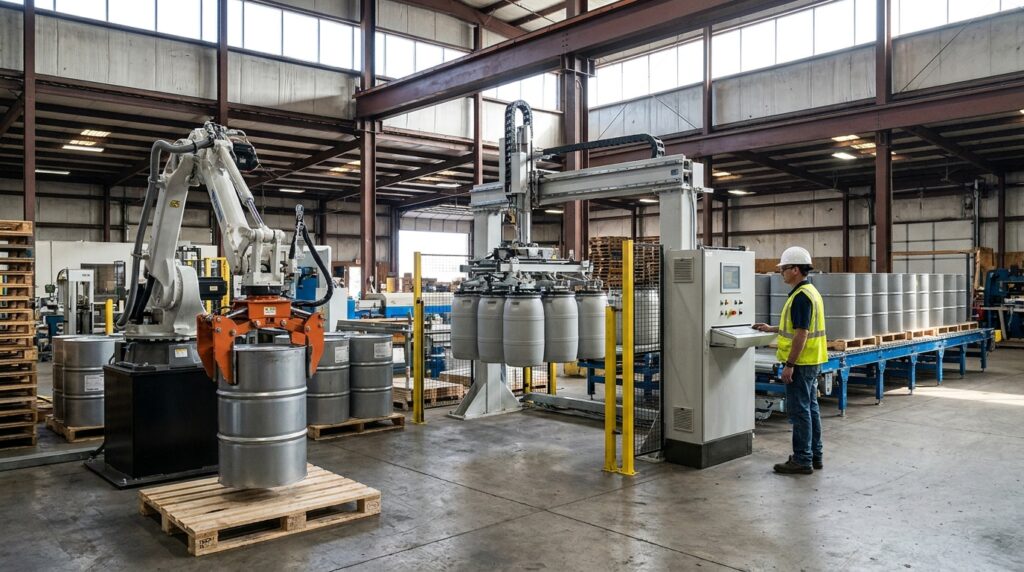
Optimize Your Warehouse Operations with Drum Palletizers: Equipment Types and Industrial Applications
SEO Title: Drum Palletizers: Revolutionize Your Warehouse with Advanced Handling Solutions | Fredon Handling
Meta Description: Discover the essential guide to drum palletizers. Explore types, applications, selection factors, and safety for warehouse managers, engineers, and buyers. Enhance efficiency with Fredon Handling.
In the complex world of industrial logistics, the efficient and safe handling of drums is paramount. From chemicals and food products to raw materials and waste, drums are a ubiquitous part of the supply chain. However, their cylindrical shape, varying weights, and potential hazardous contents present significant manual handling challenges. This is where drum palletizers emerge as indispensable tools, transforming how businesses manage these essential containers.
At Fredon Handling, we understand the critical need for robust, reliable, and innovative solutions to streamline your drum handling processes. This comprehensive guide delves into the world of drum palletizers, exploring the different types of equipment available, their diverse industrial applications, crucial selection factors, and essential safety considerations. Whether you’re a warehouse manager seeking to boost throughput, a plant engineer optimizing workflows, a safety manager prioritizing worker well-being, or an industrial equipment buyer making strategic investments, this article will equip you with the knowledge to make informed decisions and enhance your operational efficiency.
For those interested in exploring more about the various types of equipment used in industrial settings, a related article titled “Understanding the Different Types of Material Handling Equipment” provides valuable insights. This resource delves into the broader category of material handling solutions, complementing the information found in “Drum Palletizers: Equipment Types and Industrial Applications.” To read more, you can visit the article here: Understanding the Different Types of Material Handling Equipment.
Understanding the Role of Drum Palletizers in Modern Warehousing
Drum palletizers are specialized pieces of industrial equipment designed to lift, move, rotate, and place drums onto pallets, or to depalletize drums from pallets. Their primary objective is to automate or semi-automate a process that is otherwise labor-intensive, time-consuming, and poses significant ergonomic risks to human operators. By removing the need for manual lifting and maneuvering of heavy, awkward drums, these machines drastically reduce the risk of back injuries, strains, and other musculoskeletal disorders, contributing to a safer and more productive work environment.
The integration of drum palletizers into a warehouse or production facility can lead to a cascade of benefits:
Increased Throughput and Efficiency
Manual drum handling is inherently slow. Operators must carefully grip, tilt, and roll drums, often repeating these actions multiple times to position them correctly. Drum palletizers perform these tasks with speed and precision, significantly increasing the number of drums that can be palletized or depalletized within a given timeframe. This acceleration directly impacts order fulfillment, production line continuity, and overall operational efficiency.
Enhanced Safety and Ergonomics
As mentioned, manual drum handling is a leading cause of workplace injuries. Drum palletizers eliminate direct manual contact with the drums during the most strenuous parts of the process. This not only protects workers from immediate physical harm but also reduces long-term health issues associated with repetitive, heavy lifting. A safer workplace translates to fewer lost workdays, lower insurance premiums, and improved employee morale.
Improved Load Stability and Reduced Product Damage
Drum palletizers are designed to handle drums with control and precision. This controlled movement ensures that drums are placed squarely on pallets, creating stable and uniform stacks. Stable loads are less likely to shift during transit or storage, minimizing the risk of product damage, spills, or pallet collapse.
Space Optimization
Many drum palletizers offer features like controlled rotation and precise placement, allowing for tighter stacking of drums on pallets. This can lead to more efficient use of warehouse floor space, enabling businesses to store more inventory or optimize layouts for better material flow.
Versatility and Adaptability
Modern drum palletizers are engineered with versatility in mind. They can often handle a range of drum sizes, materials, and weights, and can be integrated with other material handling systems like conveyors, forklifts, and automated guided vehicles (AGVs).
Types of Drum Palletizers and Their Operational Mechanisms
The landscape of drum palletizing equipment is diverse, with various types designed to meet different operational needs, drum types, and facility constraints. Understanding these distinctions is key to selecting the right solution.
Manual Drum Lifters/Palletizers
These are the most basic form of drum handling equipment. They typically involve a chassis with a lifting mechanism, often operated manually via a hand crank or hydraulic pump. The operator uses the lifter to raise a drum, then maneuvers it into position over a pallet. Some models may have a tilting mechanism for emptying or precise placement.
- Mechanism: Mechanical or hydraulic lifting, manual maneuvering, often with a tipping mechanism.
- Applications: Lower-volume operations, facilities with limited space, occasional drum handling, where cost is a primary concern.
- Drum Compatibility: Generally designed for standard steel or plastic drums with consistent rim diameters.
- Capacity: Limited by operator strength and stamina, typically for single drums at a time.
- Advantages: Cost-effective, simple to operate, require no external power source.
- Disadvantages: Labor-intensive, slow, limited by operator’s physical capabilities, higher ergonomic risk.
Powered Drum Lifters and Palletizers
Building upon the manual concept, powered drum lifters utilize electric or pneumatic systems to lift and sometimes rotate drums. This significantly reduces the physical effort required from the operator. Many powered lifters can also be equipped with powered rotation features and specific clamping mechanisms to securely grip drums for more controlled movement and placement.
- Mechanism: Electric or pneumatic motors for lifting, often with powered rotation and powered tilting.
- Applications: Medium-volume operations, facilities where reducing manual strain is a priority, handling drums of moderate weight.
- Drum Compatibility: Can often handle a wider range of drum sizes and materials, especially with adjustable clamping mechanisms.
- Capacity: Can handle heavier drums and offer faster cycle times than manual models.
- Advantages: Reduced operator fatigue, increased speed and efficiency compared to manual lifters, enhanced control.
- Disadvantages: Requires a power source, higher initial cost than manual units, still involves significant operator interaction.
Drum Palletizing Machines (Automated Systems)
These are sophisticated, often semi-automated or fully automated systems designed for high-volume operations. They integrate advanced lifting, gripping, rotating, and placement mechanisms, often working in conjunction with conveyors, sensors, and programmable logic controllers (PLCs). These machines can handle multiple drums at once, precisely stack them according to pre-programmed patterns, and often integrate with other automated warehouse systems.
- Mechanism: Robotic arms, specialized grippers, automated lifting and rotating mechanisms, integrated with PLC control systems for precise pattern stacking.
- Applications: High-volume manufacturing, chemical plants, beverage production, large distribution centers, where maximum efficiency and throughput are critical.
- Drum Compatibility: Can be highly versatile, with interchangeable grippers and programming to accommodate various drum materials (steel, plastic, fiber), sizes, and even different container types.
- Capacity: Designed for continuous operation and high throughput, capable of palletizing dozens or hundreds of drums per hour.
- Advantages: Highest levels of efficiency and throughput, significantly reduced labor costs, consistent and precise palletizing, enhanced safety by minimizing human intervention.
- Disadvantages: Highest initial investment, requires specialized training for operation and maintenance, typically requires dedicated space and integration with existing infrastructure.
Drum Rotators and Inverters
While not strictly palletizers, drum rotators and inverters are crucial complementary equipment often integrated into palletizing systems. Rotators allow for 360-degree turning of drums, which is essential for applications like mixing or dispensing. Inverters are specifically designed to invert drums (turn them upside down) to empty their contents. Some advanced palletizers may incorporate these functions directly.
- Mechanism: Motorized rotation, often with clamp mechanisms to secure the drum.
- Applications: Mixing, blending, emptying hazardous materials, specific product dispensing needs.
- Drum Compatibility: Varies by model, but generally designed for standard steel and plastic drums.
- Capacity: Typically handles one drum at a time, focusing on the rotational function.
- Advantages: Enables processes not possible with standard palletizing, enhances product handling flexibility.
- Disadvantages: Limited to rotation or inversion; not a full palletizing solution on its own.
Key Factors for Selecting the Right Drum Palletizer
Choosing the appropriate drum palletizer involves a careful evaluation of your specific operational requirements, the characteristics of the drums you handle, and your facility’s constraints.
Drum Characteristics: Material, Size, and Weight
The physical attributes of the drums are fundamental to equipment selection.
- Material: Drums can be made of steel, plastic (HDPE, etc.), or fiberboard. The material influences the grip strength required and the potential for slippage. Steel drums are rigid and robust, while plastic drums can be more pliable and may require specialized gripping to avoid deformation. Fiber drums are lighter but can be less durable.
- Size (Diameter and Height): Standard drum sizes vary globally. For example, a common industrial drum is 55 gallons (approximately 208 liters), with a diameter of around 22.5 inches (57 cm) and a height of 35 inches (89 cm). However, smaller and larger drums, as well as drums with different profiles, are also in use. The palletizer’s gripping mechanism and overall dimensions must accommodate the range of drum sizes you handle.
- Weight: The weight of a full drum can range from a few kilograms to over 200 kg (440 lbs) for a 55-gallon drum. The palletizer’s lifting capacity must significantly exceed the maximum drum weight to ensure safe operation and longevity of the equipment. Consider the weight of the drum itself plus its contents.
Drum Capacity and Throughput Requirements
This is a critical determinant of the type of palletizer you need.
- Capacity: How many drums do you need to handle per hour, per shift, or per day?
- Low Volume (e.g., < 10 drums/hour): Manual or basic powered lifters might suffice.
- Medium Volume (e.g., 10-50 drums/hour): More advanced powered lifters with faster cycle times or semi-automated systems may be appropriate.
- High Volume (e.g., > 50 drums/hour): Fully automated drum palletizing machines are essential for efficiency.
- Palletizing Pattern: Do you need simple single-drum placement, or do you require precise stacking in specific patterns (e.g., interlocking rows) for stability and space optimization? Automated systems excel at complex pattern creation.
Equipment Compatibility and Integration
Consider how the drum palletizer will fit into your existing workflow and infrastructure.
- Forklift Integration: Will the palletizer need to be moved by a forklift? If so, ensure it has suitable fork pockets or can be easily transported.
- Conveyor Systems: If you have existing conveyor lines, can the palletizer be integrated to automatically receive drums from or send them to the conveyor?
- Other Automation: For fully automated facilities, the palletizer must be able to communicate with PLCs, AGVs, and other automation systems.
- Power Requirements: Ensure your facility’s power supply (e.g., 110V, 230V, 480V, single-phase, three-phase) matches the palletizer’s requirements. Pneumatic systems will require an appropriate compressed air supply.
Operational Environment and Space Constraints
The physical location where the palletizer will operate plays a significant role.
- Space Availability: Automated palletizers, especially robotic ones, can require a larger footprint than manual or semi-automated units. Measure your available floor space accurately, considering the movement envelope of the equipment.
- Aisle Widths: Ensure that the palletizer, when moving, can navigate your facility’s aisles without obstruction.
- Hazardous Environments: If drums contain flammable, corrosive, or otherwise hazardous materials, you may need a palletizer constructed from specific materials (e.g., stainless steel) or equipped with explosion-proof features. Ventilation and safety interlocks are also crucial in such environments.
- Cleanliness Requirements: For industries like food and beverage or pharmaceuticals, the palletizer must meet stringent sanitary standards.
Budget and Total Cost of Ownership
While initial purchase price is important, consider the long-term costs.
- Initial Investment: Automated systems have a higher upfront cost than manual or semi-automated options.
- Operating Costs: Consider energy consumption, maintenance, and spare parts.
- Labor Savings: Quantify the reduction in labor costs achieved through automation.
- Reduced Damage and Injury Costs: Factor in potential savings from fewer product damages and fewer workplace injuries.
In exploring the various types of equipment used in industrial settings, one can gain valuable insights from the article on material handling, which discusses the broader context of equipment like drum palletizers. Understanding the role of different machinery in optimizing production processes is crucial for enhancing efficiency and safety in warehouses and manufacturing plants. For a deeper dive into the principles of material handling, you can read more about it in this informative article here.
Industrial Applications of Drum Palletizers
The versatility of drum palletizers means they find applications across a wide spectrum of industries, each with unique handling challenges and requirements.
Chemical Manufacturing and Distribution
Handling drums of chemicals, whether they are raw materials, intermediates, or finished products, presents significant safety risks due to potential corrosiveness, flammability, or toxicity. Drum palletizers automate this process, minimizing human exposure to hazardous substances. They ensure precise placement, reducing spills that could lead to environmental contamination or dangerous reactions. Fredon Handling offers a range of robust solutions for the chemical industry.
Food and Beverage Processing
In this sector, hygiene and product integrity are paramount. Drum palletizers are used for handling ingredients like syrups, oils, flavorings, and processed food products. Automated systems ensure that drums are handled cleanly, preventing contamination. Precise stacking also maintains the integrity of sensitive products during storage and transport. Equipment designed for these industries often features easy-to-clean surfaces and materials compliant with food-grade standards.
Pharmaceutical and Biotechnology
Similar to food and beverage, the pharmaceutical industry demands the highest standards of cleanliness and accuracy. Drum palletizers are crucial for handling bulk ingredients, solvents, and other sensitive materials. Automated systems minimize the risk of human error and contamination, which could compromise the efficacy or safety of medications. Stainless steel construction and validated cleaning procedures are often requirements.
Petrochemical and Oil & Gas
These industries often deal with large volumes of drums containing lubricants, fuels, additives, and other petroleum-based products. The weight and potential flammability of these contents make manual handling extremely risky. Drum palletizers provide a safe and efficient method for palletizing and depalletizing these drums, improving operational speed and reducing the risk of fires or spills.
Paint, Coatings, and Adhesives Manufacturing
Drums in this sector often contain viscous, heavy, and potentially volatile substances. Palletizing these drums requires equipment that can handle their weight and ensure stable stacking to prevent leaks or accidents. Drum palletizers, especially those with controlled tilting or rotation, can also assist in mixing or dispensing these materials before palletizing.
Waste Management and Recycling
Handling drums of industrial waste, hazardous materials, or recyclables requires robust equipment that can withstand demanding conditions. Drum palletizers help efficiently move and stack these drums, often in designated containment areas, improving safety for waste handlers and ensuring compliance with environmental regulations.
Agricultural Products
In the agricultural sector, drums are used for storing and transporting fertilizers, pesticides, seeds, and various processed agricultural outputs. Drum palletizers streamline the process of moving these often heavy drums, especially during peak seasons.
Safety Considerations When Using Drum Palletizers
Safety is not an optional extra when it comes to handling drums. Implementing drum palletizers significantly enhances safety, but it’s crucial to ensure the equipment itself is used correctly and maintained properly.
Operator Training and Competency
Even with automated equipment, operators must be thoroughly trained on its safe operation, including startup procedures, emergency stops, load capacity limits, and troubleshooting. Competency should be regularly assessed.
Machine Guarding and Interlocks
Drum palletizers, especially automated ones, should be equipped with appropriate physical guarding to prevent unauthorized access to moving parts. Safety interlocks that stop the machine if guards are opened are essential.
Load Capacity and Stability
Operators must never exceed the rated load capacity of the palletizer or the pallet. Drums should be securely gripped and placed squarely on the pallet to ensure a stable load that won’t shift during transit.
Personal Protective Equipment (PPE)
Appropriate PPE, such as safety shoes, gloves, eye protection, and potentially chemical-resistant suits (depending on the drum contents), should always be worn when operating or working near drum palletizers.
Emergency Stop Procedures
All personnel working in the vicinity of a drum palletizer should be aware of the location and operation of emergency stop buttons. Regular drills can reinforce these procedures.
Regular Maintenance and Inspections
A proactive maintenance program is vital. Regular inspections of lifting mechanisms, gripping components, electrical systems, and safety features can prevent failures and potential accidents.
Hazardous Material Handling Protocols
When handling drums containing hazardous materials, specific protocols must be followed, including proper ventilation, spill containment measures, and appropriate PPE. The palletizer itself may need to be rated for use in hazardous environments.
Maintenance and Longevity of Your Drum Palletizer
To ensure your investment in a drum palletizer provides long-term value and consistent performance, a robust maintenance schedule is essential.
Routine Inspections
Daily or weekly visual inspections should be conducted by operators to check for obvious signs of wear, damage, or leaks. This includes checking hydraulic fluid levels, hydraulic hoses, electrical connections, and the condition of gripping mechanisms.
Lubrication
Moving parts, such as pivot points, gears, and chains, require regular lubrication according to the manufacturer’s recommendations. Proper lubrication reduces friction, wear, and extends the life of components.
Hydraulic System Maintenance
For hydraulic palletizers, regular checks of the hydraulic fluid are critical. The fluid should be changed periodically, and filters should be replaced to prevent contamination. Hoses and seals should be inspected for leaks and wear.
Electrical System Checks
For powered and automated systems, electrical connections, control panels, and sensors should be inspected for damage or wear. Ensure that safety circuits and interlocks are functioning correctly.
Grip Mechanism Calibration and Wear
The gripping mechanisms are crucial for safe operation. They should be regularly inspected for wear on pads or jaws and calibrated to ensure a secure and consistent grip on drums. Worn gripping elements should be replaced promptly.
Software and PLC Updates (Automated Systems)
For advanced automated systems, ensure that software and PLC programs are kept up-to-date as recommended by the manufacturer. Regular diagnostic checks can identify potential issues before they cause downtime.
Manufacturer’s Recommendations
Always adhere to the specific maintenance schedule and guidelines provided by the drum palletizer manufacturer. These recommendations are based on the equipment’s design and intended use and are crucial for optimal performance and safety.
Choosing Fredon Handling for Your Drum Palletizer Needs
At Fredon Handling, we pride ourselves on offering a comprehensive range of high-quality drum handling equipment, including sophisticated drum palletizers, designed to enhance the efficiency, safety, and productivity of your warehouse operations. Our expertise spans various industrial sectors, allowing us to provide tailored solutions that meet your specific challenges.
We understand that selecting the right equipment is a significant decision. Our team of experienced professionals is dedicated to working with you to assess your needs, understand your operational constraints, and recommend the most suitable drum palletizer or a combination of solutions. Whether you require a robust manual lifter for occasional use or a fully automated system for high-volume production, Fredon Handling has the expertise and the equipment to support your goals.
We invite you to explore our dedicated page on drum handling equipment at https://fredonhandling.com/drum-handling-equipment/ to learn more about our product offerings.
Frequently Asked Questions About Drum Palletizers
Q1: What is the average lifespan of a drum palletizer?
A1: The lifespan of a drum palletizer can vary significantly based on its type, build quality, usage intensity, and maintenance schedule. High-quality, well-maintained automated systems can last 15-20 years or more, while simpler manual units might have a slightly shorter, but still substantial, operational life. Regular servicing and using genuine replacement parts are key to maximizing longevity.
Q2: Can drum palletizers handle different types of drums simultaneously?
A2: Many modern drum palletizers, especially automated ones with adjustable or interchangeable gripping mechanisms, can be programmed to handle a range of drum sizes and materials. However, switching between vastly different drum types (e.g., from a 55-gallon steel drum to a 5-gallon plastic pail) might require adjustments, gripper changes, or re-programming, which can affect cycle times.
Q3: What is the typical return on investment (ROI) for a drum palletizer?
A3: The ROI for a drum palletizer is typically realized through reduced labor costs, decreased product damage, fewer workplace injuries, and increased operational efficiency. For high-volume operations, the ROI can often be seen within 1-3 years, depending on the initial investment and the specific cost savings achieved.
Q4: Do I need special flooring or structural support for a drum palletizer?
A4: Most standard drum palletizers, especially manual and powered lifters, can operate on existing industrial concrete flooring without special requirements. Highly automated and heavy-duty systems, particularly those with significant vertical movement or robotics, may benefit from reinforced flooring in their operating zones to ensure stability and safety. It’s always best to consult the manufacturer’s specifications.
Q5: What are the power requirements for a typical electric drum palletizer?
A5: Power requirements vary by model. Standard electric drum palletizers commonly operate on 110V or 230V single-phase power, making them suitable for most standard industrial outlets. More powerful or complex automated systems might require 230V or 480V three-phase power. Always check the equipment’s specifications for exact power needs.
Consult with Fredon Handling for Your Drum Palletizing Solution
Investing in the right drum palletizer is a strategic decision that can profoundly impact your operational efficiency, workplace safety, and bottom line. At Fredon Handling, we are committed to providing our clients with the most effective and reliable material handling solutions. Our team possesses deep industrial expertise and a thorough understanding of the challenges faced by warehouse managers, plant engineers, and safety professionals.
Don’t let inefficient drum handling processes slow you down or compromise safety. Contact Fredon Handling today for a personalized consultation. Let us help you identify the ideal drum palletizer or other material handling equipment to optimize your operations and achieve your business objectives.