
SEO Title: Effortless Drum Handling: Moving Heavy Industrial Drums Without a Forklift | Fredon Handling
Meta Description: Discover efficient, safe, and forklift-free methods for moving heavy industrial drums. Explore drum lifters, manipulators, and dollies. Optimize your warehouse operations with Fredon Handling.
Mastering the Art of Moving Heavy Industrial Drums Without a Forklift
In the bustling environment of a modern warehouse, production facility, or chemical plant, the efficient and safe movement of heavy industrial drums is paramount. While forklifts are often the go-to solution for drum transportation, they are not always available, feasible, or the most practical tool for every situation. Navigating tight spaces, working around sensitive equipment, or simply optimizing workflow can necessitate alternative methods. This comprehensive guide, designed for warehouse managers, plant engineers, safety managers, and industrial equipment buyers, delves into effective strategies and specialized equipment that allow you to move heavy industrial drums without a forklift, ensuring operational continuity, enhanced safety, and improved productivity.
The challenge of moving drums, often weighing hundreds of pounds and containing hazardous or valuable materials, requires careful consideration. Factors such as drum material, size, weight, capacity, and compatibility with existing infrastructure play a crucial role in selecting the right handling solution. Fredon Handling understands these complexities and offers a range of solutions to address these needs, empowering your team to manage drum logistics with confidence and efficiency.
If you’re looking for effective techniques to move heavy industrial drums without a forklift, you might also find it beneficial to explore the broader concepts of material handling. A related article that delves into this topic is available at What is Material Handling?. This resource provides valuable insights into various methods and equipment used in the safe and efficient movement of materials in industrial settings, complementing your understanding of drum handling techniques.
Understanding Your Drum Handling Needs
Before exploring specific equipment, it’s essential to thoroughly assess your operational requirements. This foundational step will prevent costly mistakes and ensure you invest in solutions that truly enhance your workflow.
Quantifying Drum Characteristics
The first step in effective drum handling is understanding the physical properties of the drums you need to move. This includes:
- Drum Material:
- Steel Drums: These are robust and commonly used for a wide range of liquids, chemicals, and powders. They can be single-wall or double-wall for enhanced protection. Their rigid nature makes them generally easier to grip and lift with mechanical aids.
- Plastic Drums (HDPE): Lightweight and corrosion-resistant, plastic drums are popular for corrosives and food-grade products. Their smooth surfaces can sometimes be more challenging for gripping devices to secure firmly, requiring specialized attachments. Common sizes include 55-gallon (208-liter) and 30-gallon (114-liter) drums.
- Fiber Drums: Made from compressed paper or cardboard, these are lighter than steel and plastic drums and are often used for dry goods, powders, and some solid waste. They are less durable and susceptible to moisture, requiring careful handling to avoid damage.
- Drum Size and Dimensions: Drums come in various standard sizes, with the most common being 55-gallon (208-liter). However, you may also encounter 30-gallon (114-liter), 16-gallon (60-liter), or even smaller specialized drums. Understanding the diameter and height is crucial for selecting equipment that can securely engage and lift the drum.
- Drum Weight and Capacity: The weight of an empty drum is usually less significant than its contents. A 55-gallon drum filled with a dense liquid can easily weigh over 500 pounds (227 kg). Always consider the maximum potential weight of the drums you’ll be handling, including the drum itself and its contents. This will directly influence the lifting capacity required from your handling equipment.
- Product Type and Hazardous Nature: The nature of the drum’s contents is a critical safety factor. If you’re handling flammable liquids, corrosive chemicals, or toxic substances, containment integrity and spill prevention become paramount. This will influence the type of secure gripping mechanisms and the level of precision required from the handling equipment.
Assessing Your Operational Environment
Beyond the drums themselves, the environment in which you operate presents its own set of challenges and requirements.
- Floor Surfaces: Smooth, level concrete floors are ideal for most drum handling equipment. Uneven, rough, or grated surfaces can impede the movement of wheeled equipment and may require specialized solutions like drum dollies with larger, more robust wheels or dedicated lifting equipment that can bypass uneven terrain.
- Aisle Widths and Maneuverability: Tight aisles, confined spaces, and areas with obstacles necessitate compact and highly maneuverable equipment. Equipment that can pivot, turn, and lift drums within a small footprint is essential for navigating these environments effectively.
- Stacking and Storage Requirements: Do you need to stack drums? If so, to what height? This will determine whether your equipment needs to be capable of vertical lift and the maximum lift height required.
- Ergonomic and Safety Standards: Compliance with occupational safety and health regulations (e.g., OSHA in the US) is non-negotiable. Equipment should minimize manual strain, reduce the risk of back injuries, and prevent drops or spills.
Innovative Solutions for Forklift-Free Drum Movement
Fortunately, a range of specialized manual and powered equipment exists to address the need for moving heavy industrial drums without relying on forklifts. These solutions are designed for efficiency, safety, and ease of use.
Manual Drum Dollies and Carts
For simpler, less demanding drum transport needs, manual drum dollies and carts offer an accessible and cost-effective solution. These devices leverage basic physics to make moving drums significantly easier.
Basic Drum Dollies
- Description: These are typically robust, circular or saddle-shaped bases with wheels designed to cradle a single drum. The operator positions the dolly under the drum, tilts the drum slightly to rest on the dolly, and then pushes or pulls the drum and dolly combination.
- Materials: Often constructed from steel for durability, with various wheel types (rubber, polyurethane, steel) depending on the floor surface and load capacity.
- Size and Weight: Compact and lightweight, making them easy to store. Their primary limitation is their load capacity, which typically ranges from 300 lbs to 1,000 lbs (136 kg to 454 kg).
- Applications: Ideal for moving drums over short distances on smooth, level floors in production areas, laboratories, or stockrooms. Useful for repositioning drums for dispensing or cleaning.
- Equipment Compatibility: Generally compatible with all standard steel, plastic, and fiber drums within their size and weight specifications.
- Selection Factors: Choose based on the maximum weight of your drums and the type of floor surface. Consider lockable casters for added stability.
Drum Trucks and Hand Trucks
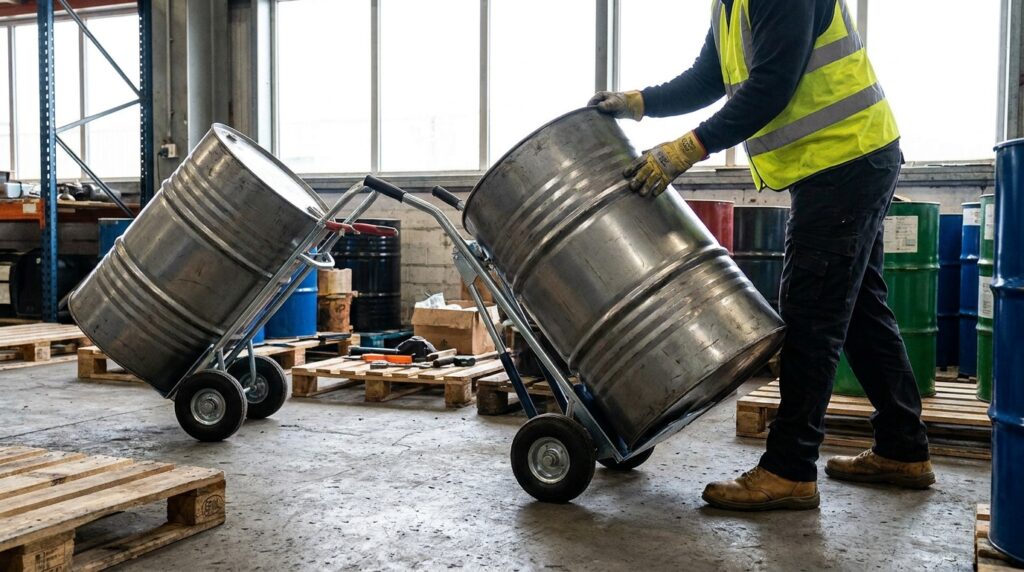
- Description: These are L-shaped devices with a base plate or a drum cradle at the bottom and handles at the top. The base is slid under the drum, the drum is tilted back onto the truck, and then the operator can walk with the drum on its two wheels.
- Materials: Commonly made from steel or aluminum. Wheels are typically rubber or solid polyurethane.
- Size and Weight: Offer a good balance of maneuverability and capacity, often handling up to 1,000 lbs (454 kg). They are generally narrower than dollies, making them suitable for tighter spaces.
- Applications: Excellent for moving drums across various warehouse environments, loading docks, or into vehicles. They are versatile for both short and medium-distance transport.
- Equipment Compatibility: Effective for steel and plastic drums. Securement mechanisms (straps or clamps) might be necessary for less stable drums.
- Selection Factors: Look for adjustable drum cradles to accommodate different drum sizes and wheel configurations (e.g., stair climbers) if you need to navigate inclines or stairs.
Drum Palletizers and Skidders
- Description: These devices are designed to lift a drum slightly off the ground and tilt it, allowing it to be easily rolled or maneuvered. They often feature a beak-like mechanism that engages the drum chime (the rim).
- Materials: Typically constructed from heavy-duty steel.
- Size and Weight: Capable of handling standard 55-gallon drums and can support weights up to 1,000 lbs (454 kg).
- Applications: Useful for moving drums into and out of pallet racks or for positioning them for filling or emptying. They provide a controlled tilt for better visibility and access.
- Equipment Compatibility: Primarily designed for steel and plastic drums with a distinct chime.
- Selection Factors: Consider the lift height and tilt angle required for your specific application.
When considering the best methods for moving heavy industrial drums without a forklift, it’s essential to also evaluate the appropriate material handling equipment for your specific needs. For a comprehensive guide on selecting the right tools for your business, you can refer to this insightful article on choosing material handling equipment. Understanding the various options available can greatly enhance efficiency and safety in your operations.
Powered Drum Manipulators and Lifters
For heavier loads, higher volumes, or situations demanding greater control and reduced manual effort, powered drum manipulators and lifters are invaluable. These devices significantly enhance safety and productivity.
Drum Lifters and Tilters (Manual and Powered)
- Description: These machines are designed to lift drums vertically and often provide a mechanism for tilting and pouring. Manual versions require operator effort to lift and tilt, while powered versions use hydraulic or electric systems.
- Materials: Robust steel construction is standard. Powered lifting and tilting mechanisms can be electric or hydraulic.
- Drum Material, Size, Weight, Capacity: These lifters are designed to accommodate standard steel and plastic drums (e.g., 55-gallon) and typically have capacities ranging from 500 lbs to 1,000 lbs (227 kg to 454 kg). Some specialized models can handle higher capacities or different drum sizes. The lifting mechanism securely grips the drum body or chime.
- Applications: Ideal for dispensing operations, charging vessels, filling smaller containers, and moving drums to elevated positions. Powered units drastically reduce operator strain and improve speed.
- Equipment Compatibility: Most models are designed for universal compatibility with common drum types. Ensure the gripping mechanism is suitable for your specific drum material and construction.
- Selection Factors: Key considerations include lift height, pouring angle, power source (electric, battery, pneumatic), and the gripping method (e.g., clamp, saddle).
Drum Rotators and Inverters
- Description: These are sophisticated pieces of equipment that can securely hold a drum and rotate it 360 degrees. This is essential for thorough mixing of drum contents or for complete emptying.
- Materials: Heavy-duty steel construction for stability and durability.
- Drum Material, Size, Weight, Capacity: Designed to handle a wide range of drum sizes and weights, typically up to 1,000 lbs (454 kg) or more for industrial-grade units. They securely clamp the drum body.
- Applications: Crucial in industries where mixing is required (e.g., paints, chemicals, food products) or where complete dispensing of viscous materials is necessary.
- Equipment Compatibility: Most are designed to be compatible with standard steel and plastic drums. Ensure the clamping mechanism can securely engage your specific drum type.
- Selection Factors: Consider the required rotation speed, the maximum drum weight and size, and whether you need stationary or mobile units.
Drum Grabs and Clamps
- Description: These are attachments designed to be used with other lifting equipment (like overhead cranes, hoists, or even some powered pallet trucks that can be fitted with specialized arms) to securely grip and lift drums. They often use mechanical or hydraulic force to clamp the drum’s chime or body.
- Materials: High-strength steel.
- Drum Material, Size, Weight, Capacity: Capacities vary widely, from a few hundred pounds to over a thousand pounds. They are designed to be compatible with standard drum dimensions and materials.
- Applications: Versatile for situations where a dedicated drum handler might be impractical. They allow for overhead lifting and precise placement.
- Equipment Compatibility: Critical to match the grab/clamp to the drum type and the lifting device. Some are designed for single-drum lifting, while others can handle multiple drums.
- Selection Factors: Ensure the gripping mechanism is appropriate for your drum material (steel vs. plastic can require different pressure or contact points). Confirm compatibility with your existing lifting apparatus.
Drum Palletizers and Stackers (Powered)
- Description: These powered machines can lift drums to significant heights, allowing for safe stacking of multiple drums. They offer controlled ascent and descent and often have features for precise positioning.
- Materials: Robust steel construction with hydraulic or electric lifting systems.
- Drum Material, Size, Weight, Capacity: Designed for common industrial drum sizes (e.g., 55-gallon) and can handle substantial weights, often exceeding 1,000 lbs (454 kg).
- Applications: Essential for optimizing vertical warehouse space and for safely managing drum inventories.
- Equipment Compatibility: Generally compatible with steel and plastic drums.
- Selection Factors: Key factors are maximum lift height, drum capacity, stability, and maneuverability in your specific warehouse layout.
Safety Considerations for Forklift-Free Drum Handling
Regardless of the equipment chosen, safety must be the absolute priority. Implementing robust safety protocols alongside the right equipment is crucial.
Personal Protective Equipment (PPE)
- Mandatory PPE: Always ensure operators wear appropriate PPE, including safety footwear, heavy-duty gloves, eye protection (safety glasses or goggles), and potentially hearing protection depending on the noise level of the equipment.
- Hazard-Specific PPE: If handling hazardous materials, ensure operators have chemical-resistant clothing, gloves, and respiratory protection as dictated by the Safety Data Sheet (SDS) for the material.
Equipment Operation Training
- Comprehensive Training: All personnel operating drum handling equipment must receive thorough, documented training on its safe and correct operation. This includes understanding load limits, proper gripping techniques, emergency procedures, and pre-operational checks.
- Regular Refresher Courses: Periodic refresher training is essential to reinforce best practices and address any new safety concerns or equipment updates.
Environmental Safety Checks
- Clearance and Obstructions: Before moving any drum, ensure the path is clear of obstructions, personnel, and any potential hazards. Pay attention to overhead clearances for any lifting equipment.
- Floor Integrity: Regularly inspect floor surfaces for damage, debris, or slippery conditions that could compromise the stability of the equipment or the drum.
- Ventilation: If handling drums containing volatile or hazardous substances, ensure adequate ventilation in the area to prevent the buildup of fumes.
Load Security and Stability
- Secure Grips: Always ensure the drum is firmly and securely gripped by the handling equipment before attempting to move it. Regularly check the grip during transit.
- Center of Gravity: Maintain the drum’s center of gravity as low as possible during movement. Avoid sudden starts, stops, or turns, which can destabilize the load.
- Securing in Place: When drums are not actively being moved, ensure they are stored securely to prevent tipping or rolling.
Maintenance and Longevity of Drum Handling Equipment
Investing in quality drum handling equipment from Fredon Handling means investing in long-term operational efficiency. Proper maintenance is key to ensuring your equipment remains safe, reliable, and performs at its best.
Daily Pre-Operational Checks
- Visual Inspection: Before each use, conduct a thorough visual inspection of the equipment. Check for any signs of wear, damage, loose fittings, or leaks (especially on hydraulic equipment).
- Functional Test: Test all moving parts, lifting mechanisms, brakes, and steering (if applicable) to ensure they are functioning smoothly and without unusual noises or resistance.
- Tire/Wheel Condition: Inspect wheels and tires for wear, damage, or foreign objects that could impede movement or cause instability.
Regular Scheduled Maintenance
- Lubrication: Regularly lubricate all moving parts, pivot points, and bearings according to the manufacturer’s recommendations. This reduces friction, wear, and potential for seizing.
- Hydraulic Systems: For hydraulic equipment, regularly check hydraulic fluid levels and look for any leaks. Schedule periodic fluid changes and filter replacements as recommended.
- Fastener Tightness: Periodically check and tighten all bolts, nuts, and screws to ensure structural integrity and prevent components from becoming loose.
- Wear Parts: Identify and replace any components that show signs of excessive wear, such as grip pads, rollers, or bushings, before they fail.
Cleaning and Storage
- Regular Cleaning: Keep the equipment clean. Remove any dust, dirt, or chemical residue that could interfere with operation or cause corrosion.
- Proper Storage: When not in use, store drum handling equipment in a designated, dry, and secure area. Protect it from the elements if stored outdoors. For electric equipment, ensure batteries are charged and maintained according to manufacturer guidelines.
Choosing the Right Fredon Handling Solution
Navigating the diverse options for moving heavy industrial drums without a forklift can be complex. Fredon Handling offers a comprehensive range of solutions, backed by industrial expertise and a commitment to quality. Our team is dedicated to helping you find the perfect fit for your unique operational needs.
When selecting equipment, always consider the specifications of the drums you handle (material, size, weight, capacity) and the environment in which you operate (floor conditions, aisle width, storage requirements). Fredon Handling provides robust, durable, and ergonomically designed drum handling equipment to optimize your workflow and enhance safety.
We encourage you to explore our dedicated drum handling equipment page at https://fredonhandling.com/drum-handling-equipment/ to view our extensive product catalog.
Frequently Asked Questions About Forklift-Free Drum Handling
Q1: What is the maximum weight a manual drum dolly can typically handle?
A1: Manual drum dollies generally range in capacity from 300 lbs (136 kg) to 1,000 lbs (454 kg). Always check the specific product specifications to ensure it meets your needs. For heavier drums, powered solutions are recommended.
Q2: Can I use a drum manipulator to move plastic drums?
A2: Yes, many drum manipulators and lifters are designed to securely handle both steel and plastic drums. However, it’s crucial to ensure the gripping mechanism is appropriate for the smooth surface of plastic drums, and to always check the equipment’s compatibility with your specific drum type.
Q3: How do I ensure the safety of my staff when using drum handling equipment?
A3: Safety is paramount. Ensure all operators receive comprehensive training on the specific equipment they will use. Mandate the use of appropriate Personal Protective Equipment (PPE) and conduct regular pre-operational checks of the equipment. Always ensure the work area is clear and safe before moving any drums.
Q4: What maintenance is required for powered drum lifters?
A4: Powered drum lifters, especially those with hydraulic systems, require regular checks of hydraulic fluid levels, seals, and hoses. Lubrication of moving parts, battery maintenance (for electric models), and regular inspections for wear and tear are also essential. Refer to the manufacturer’s manual for detailed maintenance schedules.
Q5: Are drum dollies suitable for moving drums across uneven surfaces?
A5: Standard drum dollies with small wheels are best suited for smooth, level surfaces. For uneven or rough terrain, consider drum trucks with larger wheels, pneumatic tires, or specialized all-terrain drum dollies. In some cases, powered lifting equipment might be a more suitable and safer option.
Experience the Fredon Handling Difference: Consult With Our Experts
Moving heavy industrial drums efficiently and safely without a forklift is achievable with the right equipment and knowledge. Fredon Handling is your trusted partner in optimizing your material handling processes. Our extensive range of drum handling solutions, from manual dollies to sophisticated powered manipulators, is designed to meet the diverse needs of modern industrial operations.
Don’t let forklift limitations hinder your productivity or compromise safety. Contact Fredon Handling today for a personalized consultation. Our team of industrial equipment experts is ready to assess your specific requirements, recommend the most suitable forklift-free drum handling solutions, and help you implement a safer, more efficient workflow. Let us help you move your drums with confidence.