
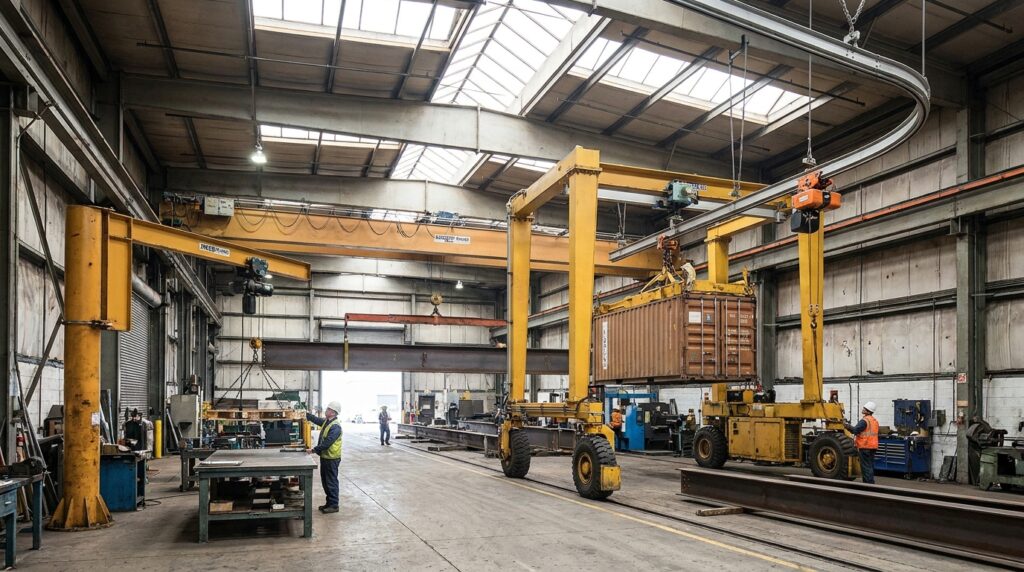
Overhead Crane Types: Bridge, Jib, Gantry & Monorail Systems Explained
Understanding Overhead Crane Systems for Enhanced Material Handling
In the demanding world of manufacturing and warehousing, efficient and safe material handling is not just a convenience; it’s a critical component of operational success. Overhead cranes, in their various forms, represent the backbone of heavy lifting and precise movement in countless industrial settings. From lifting massive components on an assembly line to transferring finished goods, the right overhead crane system can significantly boost productivity, improve workplace safety, and reduce operational costs. This comprehensive guide, brought to you by Fredon Handling, delves deep into the most common types of overhead cranes—bridge, jib, gantry, and monorail systems—explaining their unique characteristics, applications, and selection criteria to help you make informed decisions for your facility.
For those looking to deepen their understanding of material handling solutions, a related article titled “How to Choose the Right Material Handling Equipment for Your Business” provides valuable insights into selecting the appropriate equipment for specific operational needs. This resource complements the discussion on overhead crane types, including bridge, jib, gantry, and monorail systems, by offering guidance on evaluating various factors that influence equipment choice. You can read the article here: How to Choose the Right Material Handling Equipment for Your Business.
Bridge Cranes: The Versatile Workhorses of Industry
Bridge cranes, often referred to as overhead travelling cranes (OTCs), are the most prevalent type of industrial crane. Their fundamental design consists of a parallel set of fixed runways (or tracks) with a travelling bridge spanning the gap between them. A hoist and trolley system moves along the bridge, allowing for both lengthwise and crosswise movement within a defined rectangular area. This comprehensive coverage makes them exceptionally versatile for a wide range of applications.
## Understanding the Components of a Bridge Crane
A bridge crane system is comprised of several key elements, each playing a vital role in its operation:
- End Trucks: These are the wheeled units attached to the ends of the bridge girder. They run on the elevated runways, facilitating the crane’s longitudinal travel.
- Bridge Girder: This is the main structural component that spans the width of the work area. It supports the hoist and trolley. Bridge girders can be single-beam or double-beam, depending on the required lifting capacity and span. Double-beam designs are typically used for heavier loads and longer spans due to their superior strength and rigidity.
- Hoisting Mechanism: This is the part of the crane that provides the vertical lifting power. It typically consists of a motor, gearbox, drum around which the wire rope (or chain) is wound, and a hook or other lifting attachment.
- Trolley: The trolley travels along the bridge girder, carrying the hoisting mechanism. This allows for the lateral movement of the load across the width of the crane.
- Runways: These are the fixed tracks, usually I-beams, installed at an elevated level along the sides of the workspace. The end trucks of the crane travel on these runways.
- Control System: This can range from simple pendant controls operated by an on-site technician to sophisticated radio remote controls or even fully automated systems.
## Common Configurations and Applications of Bridge Cranes
Bridge cranes are highly adaptable and come in various configurations to suit specific needs:
- Top-Running Bridge Cranes: In this configuration, the bridge travels on top of the runways. This is the most common type, offering maximum hook height and efficient use of space. They are ideal for general manufacturing, assembly, shipbuilding, and heavy fabrication. For example, a top-running double-girder bridge crane is essential in an automotive plant for lifting heavy engine blocks or car bodies during assembly. Fredon Handling offers a comprehensive range of top-running bridge cranes designed for robust performance in demanding environments.
- Under-Running Bridge Cranes: Here, the bridge hangs below the runways, and the trolley travels on the bottom flange of the bridge girder. This configuration is often chosen when headroom is limited or when existing building structures can readily accommodate the runways. They are well-suited for lighter applications, such as warehousing, distribution centers, and smaller workshops. Consider a scenario in a furniture warehouse where under-running cranes can efficiently move palletized goods without interfering with other overhead structures.
- Workstation Bridge Cranes: These are often lighter-duty bridge cranes designed for specific work cells or workstations. They provide targeted lifting capabilities within a localized area, improving ergonomics and safety for operators performing repetitive tasks. A workstation bridge crane might be used in a machining cell to load and unload heavy parts from a CNC machine.
## Selection Criteria for Bridge Cranes
Choosing the right bridge crane involves careful consideration of several factors:
- Lifting Capacity: Determine the maximum weight the crane needs to lift, including the load, rigging, and any lifting attachments.
- Span: Measure the distance between the crane’s runways. This dictates the size of the bridge girder required.
- Lift Height: Calculate the required vertical travel distance from the floor to the highest point the hook needs to reach.
- Duty Cycle: Consider how frequently and intensely the crane will be used. OSHA and ASME standards classify cranes based on their duty cycle (e.g., Class A for infrequent use, Class D for heavy use).
- Environment: Assess the operating environment, including temperature, humidity, presence of dust, chemicals, or explosive materials.
- Power Source: Most cranes are electric, but the available power supply (voltage, phase) must be considered.
Jib Cranes: Focused Lifting Power for Defined Areas
Jib cranes are designed to provide localized lifting and material handling within a specific radius. Unlike bridge cranes that cover a large rectangular area, jib cranes excel at repetitive lifting tasks in a circular or semi-circular zone. They are characterized by a horizontal boom (or jib) that supports a hoist and trolley.
## Types of Jib Cranes and Their Configurations
Jib cranes are available in several configurations, each suited to different installation and operational requirements:
- Wall-Mounted Jib Cranes: These are attached directly to a building column or wall. They offer excellent maneuverability in tight spaces and are ideal for workstations where overhead bridge cranes are not feasible. A typical application would be at a welding station where a jib crane can precisely position metal parts for fabrication.
- Freestanding Jib Cranes: These cranes are supported by a floor-mounted base, allowing them to be installed anywhere within a facility, regardless of wall or column availability. They offer a larger working radius than wall-mounted versions and are available in various boom lengths and capacities. A freestanding jib crane is perfect for a loading dock area, providing immediate lifting support for incoming and outgoing goods. Fredon Handling provides robust freestanding jib cranes that offer excellent reach and stability.
- Mast-Type Jib Cranes: Similar to freestanding cranes, these utilize a vertical mast to support the boom. They can offer a greater working radius and higher lifting heights compared to some other jib types.
## Advantages and Applications of Jib Cranes
The primary advantage of jib cranes lies in their ability to provide precise, point-of-use material handling.
- Ergonomic Support: They significantly reduce the physical strain on workers by automating the lifting of heavy or awkward objects, thereby improving ergonomics and preventing injuries.
- Increased Productivity: By having a dedicated lifting solution at each workstation, cycle times are reduced, and overall productivity is enhanced.
- Space Efficiency: Jib cranes require minimal floor space, especially wall-mounted and mast-type versions, making them ideal for crowded facilities.
- Applications: Common applications include loading/unloading machines, assembly stations, welding operations, packaging areas, and tool room support. For instance, in a tool and die shop, a jib crane can precisely lift and position heavy dies onto a press, a task that would be extremely difficult and dangerous manually.
## Jib Crane Selection Considerations
When selecting a jib crane, consider:
- Working Radius: The horizontal distance the boom needs to reach from the pivot point.
- Rotation Angle: The degree of rotation required (e.g., 180°, 270°, 360°).
- Lifting Capacity: The maximum weight the hoist needs to handle.
- Headroom: The available vertical space for installation and operation.
- Mounting Method: Whether a wall, floor, or mast mounting is most suitable.
Gantry Cranes: Mobile Lifting for Outdoor and Large Area Applications
Gantry cranes are a type of overhead crane where the bridge is supported by self-propelled or manually propelled legs that move along the ground or on elevated rails. This design allows them to be used in areas where it’s impractical or impossible to install runway beams for bridge cranes, such as outdoors, in large open yards, or in facilities with limited overhead structural support.
## Exploring Different Gantry Crane Designs
Gantry cranes come in various forms, each catering to specific industrial needs:
- Full Gantry Cranes: These have legs that are tall enough to straddle the entire work area or material being handled. They can be used for lifting large, bulky items like pre-fabricated building sections or large industrial machinery.
- Semi-Gantry Cranes: In this configuration, one end of the bridge is supported by a leg that runs on the ground or rail, while the other end is supported by a trolley running on an elevated runway. This design is a hybrid, offering some of the benefits of both bridge and gantry cranes, often used where a portion of the facility has existing runway structures.
- Portable Gantry Cranes: These are smaller, lighter-duty gantry cranes designed to be easily moved around a facility. They are ideal for temporary lifting needs or for providing flexible lifting solutions in smaller workshops or maintenance areas. Fredon Handling offers a range of portable gantry cranes that provide on-demand lifting where and when you need it.
- Adjustable Height Gantry Cranes: These allow for the gantry height to be adjusted, making them versatile for handling loads of varying heights or for navigating different floor levels.
## Key Applications and Benefits of Gantry Cranes
Gantry cranes are invaluable in situations requiring robust, mobile lifting solutions.
- Outdoor Operations: They are widely used in shipyards, rail yards, construction sites, and lumber yards for handling heavy materials like steel beams, shipping containers, and prefabricated components.
- Large Span Requirements: When the distance to be covered is too large for a typical bridge crane, gantry cranes can be an effective solution.
- Flexibility and Mobility: Many gantry cranes are designed with wheels or casters, allowing them to be moved to different locations as needed, offering significant operational flexibility.
- Cost-Effectiveness: For facilities that cannot support overhead runway systems, gantry cranes can be a more cost-effective lifting solution than constructing new support structures.
- Applications: Consider a steel fabrication yard where large beams need to be moved from storage to cutting stations and then to welding bays. A robust gantry crane can efficiently handle these movements across the entire yard.
## Factors Influencing Gantry Crane Selection
- Load Capacity: The maximum weight the crane must lift.
- Span and Height: The dimensions of the area to be covered and the clearance needed.
- Mobility Requirements: Whether the crane needs to be fixed, manually moved, or self-propelled.
- Ground Conditions: The surface on which the crane’s legs will travel (e.g., concrete, asphalt, gravel).
- Environmental Exposure: For outdoor use, consider weather resistance and corrosion protection.
For those looking to deepen their understanding of material handling equipment, a related article that explores essential tools for efficient manufacturing processes can be quite beneficial. This resource provides insights into various equipment types and their applications, complementing the information found in the article on overhead crane types such as bridge, jib, gantry, and monorail systems. You can read more about these essential tools in the article here.
Monorail Systems: Continuous Flow for Linear Material Movement
Monorail systems consist of a single elevated track (the monorail) along which a trolley and hoist travel. Unlike bridge cranes which offer 2D movement within a rectangular area, monorail systems excel at providing linear or multi-directional material movement along fixed paths. They are ideal for applications requiring continuous flow and transportation of materials between different stations or processes.
## How Monorail Systems Enhance Workflow
Monorail systems are designed for efficiency and integration into production lines.
- Linear Transport: They provide an efficient means of moving materials from one point to another along a defined path, such as from a receiving area to a production line, or between different processing stations.
- Automated or Manual Operation: Monorails can be manually pushed, or they can be equipped with powered trolleys for automated movement, further increasing efficiency and reducing manual labor.
- Flexibility in Routing: Monorail tracks can be configured with curves, switches, and drop sections, allowing for complex routing and integration into existing facility layouts.
- Space Saving: By utilizing overhead space, monorail systems free up valuable floor space for other operations.
- Applications: Typical applications include assembly lines where parts need to be moved sequentially through various stages, paint shops where products are moved through drying and curing processes, and shipping areas for the efficient movement of finished goods to loading docks. For instance, in an electronics manufacturing facility, a monorail system can transport circuit boards through automated soldering, testing, and assembly stations, ensuring a consistent and efficient workflow. Fredon Handling offers custom monorail solutions that can be designed to optimize your material flow.
## Components and Considerations for Monorail Systems
A typical monorail system includes:
- Monorail Track: The elevated rail along which the system operates.
- Trolley: The mechanism that travels along the track, carrying the hoist.
- Hoist: The lifting device attached to the trolley.
- Support Structures: Brackets and hangers that attach the monorail track to the building structure.
- Controls: Manual push buttons, pendant controls, or automated system integration.
When considering a monorail system, key factors include:
- Path and Layout: The precise route the materials need to follow.
- Speed and Flow Rate: The required speed of movement and the number of items to be transported per hour.
- Load Capacity: The weight of the items being transported.
- Integration: How the system will integrate with existing machinery and processes.
For those looking to deepen their understanding of material handling systems, the article on the importance and methods of material handling provides valuable insights. It discusses various techniques and equipment that enhance efficiency in industrial settings, complementing the information found in the article about overhead crane types, including bridge, jib, gantry, and monorail systems. To explore more about the significance of these systems in optimizing operations, you can read the full article here.
Safety, Maintenance, and Compliance in Overhead Crane Operation
Regardless of the type of overhead crane system chosen, safety and proper maintenance are paramount. Adherence to regulations and best practices ensures the longevity of your equipment and the well-being of your workforce.
## Understanding Regulatory Requirements
In the United States, the Occupational Safety and Health Administration (OSHA) and the American Society of Mechanical Engineers (ASME) provide critical standards for overhead crane operation.
- OSHA Standards: OSHA’s general industry standards (29 CFR 1910) and construction industry standards (29 CFR 1926) cover aspects like crane inspection, operator training, and load limits. For instance, OSHA mandates regular inspections of cranes and hoists to ensure they are in safe operating condition.
- ASME Standards: ASME B30.17 (Overhead and Gantry Cranes) and ASME B30.11 (Monorails and Under-hung Cranes) provide detailed technical requirements for the design, installation, inspection, testing, maintenance, and operation of various crane types.
## Essential Safety Practices
- Operator Training and Certification: Ensure all crane operators are properly trained, qualified, and authorized to operate the specific equipment they are assigned. This includes understanding load charts, rigging procedures, and emergency protocols.
- Pre-Shift Inspections: Operators must conduct a thorough visual inspection of the crane and its components before each shift. This includes checking the hook, wire rope, brakes, limit switches, and controls for any signs of damage or malfunction.
- Proper Rigging: Using the correct lifting devices (slings, shackles, spreader bars) and ensuring they are properly attached to the load and the hook is crucial to prevent dropped loads.
- Load Capacity Awareness: Never exceed the rated load capacity of the crane or hoist. Overloading is a primary cause of crane failure and accidents.
- Clear Communication: Establish clear communication signals between the operator and any ground personnel involved in guiding the load.
- Work Area Safety: Ensure the area around the crane’s operation is clear of obstructions and unauthorized personnel.
## Maintenance Best Practices
Regular and proactive maintenance is key to preventing unexpected downtime and ensuring safe operation.
- Preventive Maintenance (PM) Programs: Implement a structured PM program based on manufacturer recommendations and regulatory guidelines. This includes routine lubrication, inspections of wear items, and adjustments.
- Corrective Maintenance: Promptly address any identified issues or malfunctions. Ignoring minor problems can lead to more significant and costly repairs later.
- Record Keeping: Maintain detailed records of all inspections, maintenance activities, and repairs performed on each crane. This documentation is vital for tracking equipment history, planning future maintenance, and demonstrating compliance.
- Qualified Technicians: Ensure all maintenance and repair work is performed by trained and qualified technicians. Fredon Handling offers expert crane maintenance services to keep your equipment in optimal condition.
Choosing the Right Partner for Your Material Handling Needs
Selecting the appropriate overhead crane system is a significant investment that impacts your facility’s productivity, safety, and bottom line. The right system depends on your specific application, load requirements, facility layout, and budget.
## Fredon Handling: Your Expert Partner
At Fredon Handling, we understand the complexities of industrial material handling. We partner with leading manufacturers to provide a comprehensive range of overhead crane solutions, including bridge cranes, jib cranes, gantry cranes, and monorail systems. Our experienced team is dedicated to helping you assess your needs, select the most suitable equipment, and ensure seamless installation and ongoing support.
We offer:
- Expert Consultation: Our specialists work closely with you to understand your unique operational challenges and recommend the optimal lifting solution.
- Quality Equipment: We supply durable, reliable, and high-performance cranes from trusted brands, engineered to meet rigorous industry standards.
- Customized Solutions: For unique applications, we can design and implement tailored overhead crane systems to meet specific requirements.
- Comprehensive Support: From initial design and installation to ongoing maintenance and after-sales service, Fredon Handling is your dedicated partner.
## Investing in Efficiency and Safety
An investment in the right overhead crane system is an investment in your operational efficiency, employee safety, and overall business success. By understanding the different types of cranes available and working with an experienced provider like Fredon Handling, you can ensure your facility is equipped to handle its material lifting needs effectively and safely for years to come.
Don’t let inefficient material handling slow down your operations. Contact Fredon Handling today to discuss your specific requirements and discover how our expert solutions can elevate your productivity and safety standards.
Frequently Asked Questions (FAQs)
## What is the difference between a bridge crane and a gantry crane?
The primary difference lies in their support structure. Bridge cranes are supported by elevated runways attached to the building structure, while gantry cranes are supported by legs that move on the ground or on rails at ground level. This makes gantry cranes ideal for outdoor use or where building structures cannot support runway beams.
## How do I determine the required lifting capacity for my crane?
You need to calculate the maximum weight of the loads you will be lifting, including the load itself, any rigging equipment (slings, hooks, shackles), and the weight of the lifting attachment. It’s always advisable to add a safety margin. Consult with a Fredon Handling expert for precise calculations.
## What is the importance of OSHA and ASME standards for overhead cranes?
OSHA and ASME standards provide critical guidelines for the safe design, installation, operation, inspection, and maintenance of overhead cranes. Adhering to these standards is crucial for preventing accidents, ensuring worker safety, and maintaining regulatory compliance.
## Can monorail systems be integrated with other equipment?
Yes, monorail systems are highly adaptable and can be integrated with various other equipment, such as automated guided vehicles (AGVs), conveyors, and robotic systems, to create comprehensive automated material handling solutions. Fredon Handling can help design such integrated systems.
## How often should overhead cranes be inspected?
Inspection frequency depends on the crane’s duty cycle and application, as well as regulatory requirements. OSHA and ASME standards generally require frequent (daily or pre-shift) inspections by operators, periodic inspections (monthly or quarterly) by designated personnel, and thorough annual inspections by qualified persons. Fredon Handling offers comprehensive inspection services.
## What is the typical lifespan of an overhead crane?
The lifespan of an overhead crane can vary significantly based on its quality, the intensity of its use (duty cycle), the operating environment, and the maintenance program in place. With proper maintenance and adherence to operating guidelines, many overhead cranes can last 20 years or more.