
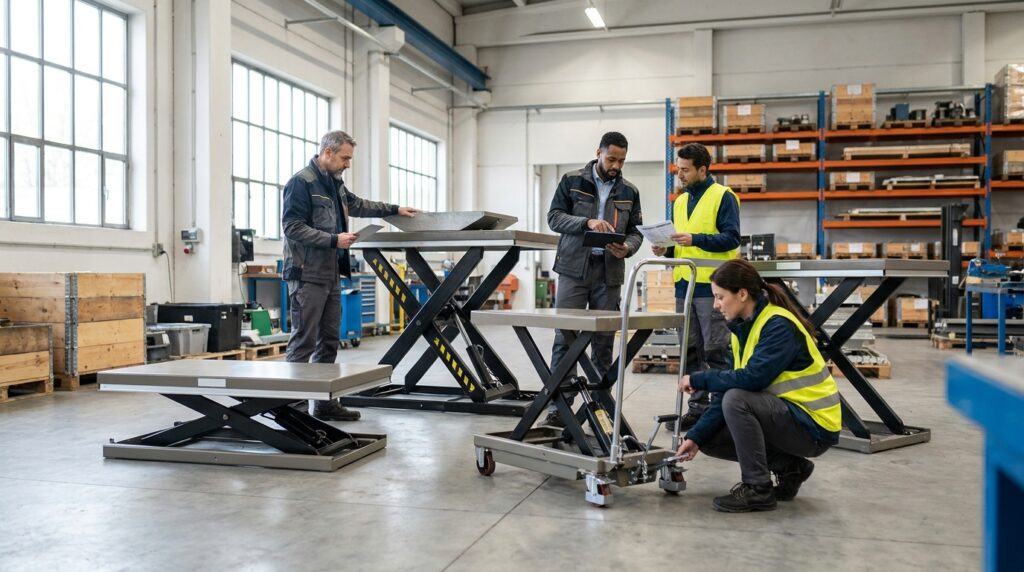
Choosing the right hydraulic lift table is a critical decision for any industrial operation aiming to enhance productivity, improve ergonomics, and ensure workplace safety. These versatile pieces of equipment are indispensable for a multitude of tasks, from material handling and assembly to maintenance and warehousing. The selection process, however, can be complex, involving an understanding of various technical specifications, application requirements, and operational considerations. Fredon Handling, a trusted provider of industrial material handling solutions, is dedicated to guiding businesses through this process, ensuring they invest in equipment that delivers optimal performance and long-term value. This comprehensive guide will delve into the key factors to consider when selecting a hydraulic lift table, empowering industrial equipment buyers, engineers, and facility managers to make informed decisions.
Understanding the Core Functionality and Types of Hydraulic Lift Tables
At their heart, hydraulic lift tables are designed to elevate and lower heavy loads with ease, reducing manual strain and improving efficiency. They operate using a hydraulic system, typically comprising a power unit (motor, pump, reservoir), cylinders, and a control system. This system generates fluid pressure that is applied to the cylinder, extending or retracting a ram, which in turn moves the table platform. The simplicity and robustness of this mechanism contribute to their reliability and widespread adoption.
Basic Hydraulic Lift Table Principles
The fundamental operation involves a reservoir of hydraulic fluid, a pump that draws fluid from the reservoir and pressurizes it, and a control valve that directs the flow of this pressurized fluid to one or more hydraulic cylinders. When the control is activated to raise the table, the valve opens, allowing fluid to enter the cylinder(s) and push a piston upwards, thereby lifting the platform. Conversely, to lower the table, the valve directs the fluid back to the reservoir, allowing gravity and the load to control the descent.
Differentiating Common Hydraulic Lift Table Designs
The vast array of hydraulic lift tables available can be categorized by their design and intended application. Understanding these differences is the first step in narrowing down your options.
Standard Scissor Lift Tables
These are the most common type, characterized by their “X” shaped scissor mechanism. As the hydraulic cylinder extends, the scissor legs open, raising the platform. They offer a wide range of lifting capacities and platform sizes.
- Applications: General material handling, assembly lines, machine feeding, order picking, and loading/unloading.
- Benefits: Versatile, compact when lowered, offers significant vertical travel.
- Fredon Handling’s Standard Scissor Lift Tables: Explore our range of robust standard scissor lift tables designed for everyday industrial challenges. [Link to Fredon Handling Standard Lift Tables Page]
Low Profile Lift Tables
Designed with a very low collapsed height, these tables often eliminate the need for pits or deep foundations, making installation easier and more cost-effective. They are ideal for applications where a minimal approach height is required.
- Applications: Ergonomic workstation upgrades, pallet handling where a dock is unavailable, and areas with space constraints.
- Benefits: Easy access, reduced installation complexity, ideal for ergonomic improvements.
- Fredon Handling’s Low Profile Lift Tables: Discover how our low profile solutions can optimize your workflow and reduce installation hurdles. [Link to Fredon Handling Low Profile Lift Tables Page]
Heavy Duty Lift Tables
Engineered for demanding industrial environments, these tables feature robust construction, higher lifting capacities, and often more powerful hydraulic systems to handle exceptionally heavy loads.
- Applications: Lifting heavy machinery, large dies, automotive components, and significant industrial material loads.
- Benefits: Superior strength, durability, and lifting capacity for the most challenging tasks.
- Fredon Handling’s Heavy Duty Lift Tables: When your needs demand uncompromising strength, our heavy-duty tables are built to perform. [Link to Fredon Handling Heavy Duty Lift Tables Page]
Portable Lift Tables
Equipped with casters and a more compact design, portable lift tables offer flexibility and mobility, allowing them to be moved to different workstations as needed.
- Applications: Relocating equipment, providing temporary lifting solutions at various points in a facility, and supporting maintenance tasks in different areas.
- Benefits: Mobility, adaptability to changing operational needs, and cost-effectiveness for multi-purpose use.
- Fredon Handling’s Portable Lift Tables: Gain the flexibility you need with our mobile and adaptable portable lift table options. [Link to Fredon Handling Portable Lift Tables Page]
When selecting the right hydraulic lift table for your needs, it’s essential to consider various factors such as load capacity, height range, and safety features. For a deeper understanding of the broader context of material handling, you might find the article on What is Material Handling particularly insightful. This resource provides valuable information on the principles and practices involved in efficient material handling, which can help inform your decision-making process when choosing the appropriate hydraulic lift table.
Defining Your Specific Application Requirements for Optimal Performance
The most crucial aspect of choosing the right hydraulic lift table lies in accurately defining the application’s specific requirements. Overlooking details here can lead to an underperforming or unsuitable piece of equipment, ultimately costing more in the long run.
Determining the Required Lifting Capacity
This is perhaps the most critical specification. You need to consider the maximum weight the table will ever need to lift. It’s prudent to add a safety margin of 10-20% to your calculated maximum load to account for potential future needs or unexpected weight variations. Exceeding the rated capacity can lead to premature wear, component failure, and safety hazards.
- Example: If you consistently lift pallets weighing 2,000 lbs, but occasionally handle a larger component at 2,500 lbs, you should look for a lift table with a capacity of at least 3,000 lbs.
Establishing the Necessary Lift Height and Travel Distance
The vertical travel required dictates the height the table needs to reach. This is influenced by factors such as the height of machinery, conveyor systems, or the stacking height of materials. Consider both the minimum (collapsed) and maximum (extended) height.
- Example: If you need to lift a workpiece from floor level to a conveyor belt that is 5 feet high, and the collapsed height of your current setup is 8 inches, you’ll need a lift table with at least 4 feet 4 inches of travel.
Assessing Platform Size and Configuration
The dimensions of the platform must be adequate to securely accommodate the load. Consider the largest item you will be lifting and ensure there is sufficient space for safe positioning and stability. Custom platform sizes and configurations (e.g., U-shaped, pit-mounted) are often available to meet unique needs.
- Example: Lifting large sheet metal would require a wider and longer platform than lifting small boxes. A U-shaped platform might be beneficial for loading/unloading with a forklift without obstruction.
Evaluating Key Technical Specifications and Features for Durability and Efficiency
Beyond the basic application requirements, several technical specifications and optional features can significantly impact the lift table’s performance, longevity, and ease of use.
Understanding Hydraulic System Components and Performance
The hydraulic system is the powerhouse of the lift table. Key components to consider include the motor power (HP or kW), pump type, and reservoir capacity. These factors influence lifting speed, cycle time, and the ability to handle continuous operation.
- Motor Power: Higher motor power generally translates to faster lifting speeds and the ability to handle heavier loads more efficiently.
- Pump Type: Gear pumps are common for their durability, while vane pumps can offer quieter operation.
- Reservoir Capacity: A larger reservoir helps to prevent overheating during sustained use.
Power Source and Electrical Requirements
Lift tables typically operate on standard industrial power supplies (e.g., 230V/460V, 3-phase). Ensure compatibility with your facility’s electrical infrastructure. Explosion-proof or intrinsically safe options may be necessary for hazardous environments.
Control Systems and Ergonomics
The control system dictates how the lift table is operated. Options range from simple push-button controls to foot switches, remote pendants, and programmable logic controllers (PLCs) for automated systems. Ergonomic considerations, such as the placement and type of controls, can significantly impact operator comfort and efficiency.
- Safety Features Integrated into Controls: Many lift tables incorporate safety interlocks, emergency stop buttons, and overload protection within their control systems.
Material and Construction Quality
The materials used in the construction of the lift table directly affect its durability and resistance to wear and tear. Look for high-quality steel construction, robust welds, and wear-resistant components.
- Platform Material: Standard steel is common, but stainless steel might be necessary for food processing or corrosive environments.
- Cylinder Seals: High-quality seals are crucial for preventing leaks and ensuring smooth operation.
Optional Features for Enhanced Functionality
- Safety Features: Beyond standard interlocks, consider features like bellows or skirting for pinch point protection, safety ramps, and load-holding valves to prevent uncontrolled descent.
- Tilting and Rotating Capabilities: Some advanced lift tables incorporate tilting or rotating mechanisms for specific assembly or material handling tasks.
- Conveyor Integration: Tables designed for easy integration with conveyor systems can streamline automated material flow.
- Customization: Don’t hesitate to explore customization options for unique platform shapes, lifting speeds, or control configurations. Fredon Handling excels in providing tailored solutions. [Link to Fredon Handling Custom Solutions Page]
Selecting the Right Lift Table for Common Industrial Applications
By understanding the core principles and features, we can now explore how hydraulic lift tables are applied in various industrial settings.
Material Handling and Logistics
In warehouses and distribution centers, lift tables are crucial for efficiently moving goods. They facilitate the loading and unloading of trucks, the transfer of items between different levels, and the ergonomic presentation of goods for picking and packing.
- Specific Equipment: Standard scissor lifts, low profile lifts for pallet access, and heavy-duty lifts for full pallet loads are commonly used.
- Benefits: Reduces forklift traffic, improves loading dock efficiency, and enhances worker safety by minimizing manual lifting.
Manufacturing and Assembly Lines
Within manufacturing plants, lift tables are integral to creating ergonomic workstations and facilitating assembly processes. They bring parts to the operator at an optimal working height, reducing strain and improving precision.
- Specific Equipment: Standard scissor lifts with custom platforms, tilting lift tables for ergonomic positioning of components, and lift tables integrated into automated assembly lines.
- Benefits: Improves worker ergonomics, increases production speed, reduces scrap due to better component presentation, and ensures consistent workflow.
Automotive Industry Applications
The automotive sector utilizes lift tables extensively for everything from component handling on the production line to vehicle maintenance and repair.
- Specific Equipment: Heavy-duty lifts for engine and chassis components, specialized scissor lifts for tire and wheel installation, and low profile lifts for vehicle undercarriage access.
- Benefits: Enhances safety during assembly and maintenance, increases efficiency in part delivery, and provides ergonomic support for technicians.
Food and Pharmaceutical Industries
In environments requiring high levels of hygiene and specific material handling needs, hydraulic lift tables play a vital role. Stainless steel construction and washdown capabilities are often essential.
- Specific Equipment: Stainless steel scissor lifts, tables with specialized hygienic coatings, and lift tables designed for easy cleaning and sanitization.
- Benefits: Ensures product integrity, meets stringent regulatory requirements, and provides ergonomic solutions for handling sensitive materials.
When selecting the ideal hydraulic lift table for your needs, it’s essential to consider various factors such as load capacity, height range, and mobility features. For a deeper understanding of the different types of lift tables available and their specific applications, you might find this informative article on hydraulic lift tables particularly useful. It provides valuable insights that can help streamline your decision-making process and ensure you choose the right equipment for your operations.
Ensuring Safety and Implementing Effective Maintenance Strategies
The safe operation and longevity of any industrial equipment, including hydraulic lift tables, depend heavily on proper usage and regular maintenance.
Essential Safety Guidelines for Hydraulic Lift Tables
- Training: Ensure all operators are thoroughly trained on the specific lift table’s operation, safety features, and emergency procedures.
- Pre-Operation Checks: Before each use, conduct a visual inspection for any signs of damage, leaks, or loose components. Test controls to ensure proper functionality.
- Load Stability: Ensure loads are centered and stable on the platform before lifting. Avoid overloading.
- Clearance: Maintain adequate clearance around the lift table during operation to prevent collisions with personnel or equipment.
- Never Enter Underneath: Never go or place any body part under a raised lift table unless it is properly secured with safety blocks or supports.
- Emergency Stops: Familiarize yourself with the location and function of emergency stop buttons.
- Regular Inspections: Adhere to recommended inspection schedules, both visual and more detailed, as outlined by the manufacturer.
Proactive Maintenance for Longevity and Reliability
A well-maintained hydraulic lift table will provide years of reliable service and prevent costly downtime.
Routine Checks and Lubrication
- Daily/Weekly: Visually inspect for leaks, damaged hoses, or worn components. Check for proper operation of controls. Lubricate pivot points and moving parts as recommended by the manufacturer.
- Monthly: Check hydraulic fluid levels and quality. Inspect hydraulic hoses for signs of wear or damage. Verify the condition of safety devices like limit switches.
Hydraulic System Maintenance
- Fluid Analysis: Periodically have the hydraulic fluid analyzed to detect contamination or degradation, which can indicate internal wear.
- Filter Replacement: Replace hydraulic filters according to the manufacturer’s schedule to ensure the cleanliness of the hydraulic fluid.
- Seal Inspection: Regularly inspect hydraulic cylinder seals for leaks and signs of wear. Leaking seals can lead to system inefficiency and potential failure.
Structural and Mechanical Maintenance
- Structural Integrity: Periodically inspect the scissor mechanism, frame, and platform for any signs of fatigue, cracks, or deformation.
- Fastener Checks: Ensure all bolts and fasteners are tight. Vibrations can loosen them over time.
- Wear Parts: Inspect wear pads or guides for signs of excessive wear and replace them as needed to maintain smooth operation and prevent damage to the main structure.
Professional Servicing and Repairs
For any complex issues, fluid changes, or component replacements, it is often best to engage a qualified service technician. Fredon Handling offers expert maintenance and repair services to keep your equipment in optimal condition. [Link to Fredon Handling Service & Support Page]
Frequently Asked Questions About Hydraulic Lift Tables
Q1: What is the typical lifespan of a hydraulic lift table?
A1: The lifespan of a hydraulic lift table can vary significantly based on its construction quality, the intensity of its use, and the diligence of its maintenance. With proper care and routine maintenance, many industrial-grade hydraulic lift tables can last 15-20 years or even longer.
Q2: Can hydraulic lift tables be used outdoors?
A2: While some hydraulic lift tables are designed with weather-resistant coatings and components, continuous outdoor exposure can accelerate wear and tear due to elements like moisture, UV radiation, and temperature fluctuations. It’s essential to select a model specifically rated for outdoor use or to provide adequate protection and regular maintenance if using a standard model outdoors.
Q3: How do I determine the correct hydraulic fluid for my lift table?
A3: Always refer to the manufacturer’s specifications for the recommended hydraulic fluid type and viscosity. Using the incorrect fluid can lead to system damage, poor performance, and reduced component life. Common fluids include AW (anti-wear) hydraulic oils.
Q4: What is the difference between a hydraulic lift table and a pneumatic lift table?
A4: Hydraulic lift tables use hydraulic fluid under pressure to lift loads, offering high lifting capacities and precise control. Pneumatic lift tables use compressed air, which generally results in lighter construction, faster lifting speeds, and is often suitable for less demanding applications where extreme precision is not required.
Q5: Are custom hydraulic lift tables expensive?
A5: While standard lift tables offer excellent value, custom solutions are tailored to very specific needs. The cost will depend on the complexity of the customization, materials used, and required features. Fredon Handling works closely with clients to provide cost-effective custom solutions that meet unique operational demands. [Link to Fredon Handling Custom Solutions Page]
Q6: What safety precautions should I take if a hydraulic lift table malfunctions?
A6: If a hydraulic lift table malfunctions, immediately cease operation and press the emergency stop button. Do not attempt to force the operation or repair it yourself unless you are a qualified technician. Secure the platform if it is partially raised to prevent accidental movement. Contact Fredon Handling’s service department for prompt diagnosis and repair. [Link to Fredon Handling Service & Support Page]
Investing in Efficiency and Safety with Fredon Handling
Choosing the right hydraulic lift table is an investment in your facility’s operational efficiency, employee well-being, and overall safety. By thoroughly understanding your application needs, evaluating the technical specifications, and prioritizing safety and maintenance, you can select a hydraulic lift table that will serve your business effectively for years to come.
Fredon Handling is committed to providing superior industrial material handling solutions. Our extensive range of hydraulic lift tables, coupled with our expertise in customization and customer support, ensures that you will find the perfect equipment to meet your specific challenges.
Ready to optimize your material handling operations and enhance workplace safety? Contact Fredon Handling today to discuss your hydraulic lift table needs and discover how our expert solutions can benefit your business.
Call us at [Phone Number] or visit our website at fredonhandling.com to explore our product offerings and request a consultation.