
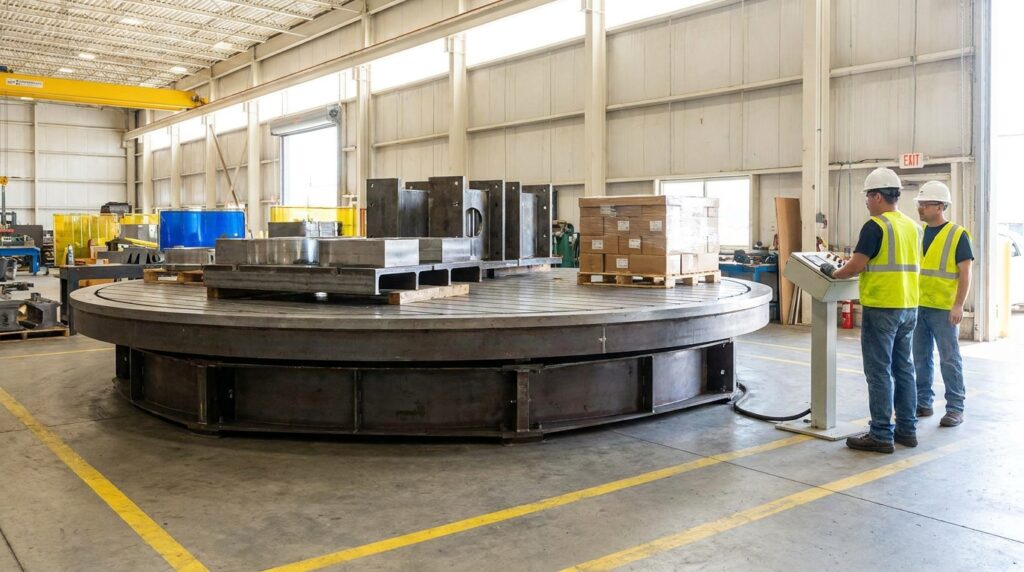
Revolutionizing Material Flow: A Deep Dive into Industrial Turntables and Their Applications
In the intricate choreography of modern industrial operations, efficient material handling is paramount. Bottlenecks, manual labor strains, and wasted motion can cripple productivity and inflate operational costs. Among the unsung heroes of optimized material flow are industrial turntables. These ingenious devices, often overlooked, play a crucial role in facilitating smooth, precise, and safe movement of goods, components, and even finished products through complex manufacturing, assembly, and logistics environments. Whether it’s rotating a heavy workpiece for welding, repositioning a pallet for optimal stacking, or guiding a conveyor line, industrial turntables offer a dynamic solution to static material handling challenges.
At Fredon Handling (fredonhandling.com), we understand the multifaceted needs of industrial buyers, engineers, and facility managers. Our comprehensive range of material handling solutions, including a robust selection of industrial turntables, is designed to enhance efficiency, improve ergonomics, and bolster safety across diverse applications. This in-depth guide will explore the various types of industrial turntables, their extensive uses, the tangible benefits they offer, crucial considerations for selection, and best practices for safe operation and maintenance.
For those interested in learning more about the various applications and benefits of industrial turntables, a related article can be found at Fredon Handling’s Education Center. This resource provides in-depth insights into the different types of turntables available, their specific uses in various industries, and how they can enhance operational efficiency and safety in material handling processes.
Understanding the Core Functionality and Benefits of Industrial Turntables
At its heart, an industrial turntable is a rotating platform designed to change the orientation of an object without requiring extensive manual repositioning or complex conveyor reconfigurations. This simple yet profound functionality unlocks a cascade of benefits for businesses.
Enhancing Ergonomics and Reducing Strain
One of the most immediate advantages of integrating turntables is the significant improvement in workplace ergonomics. Manually rotating heavy or awkwardly shaped items is a leading cause of musculoskeletal injuries in industrial settings. Turntables eliminate this strenuous activity, allowing operators to work with objects at comfortable heights and orientations, thereby reducing fatigue and the risk of accidents. For instance, in an automotive assembly line, a turntable can position a car door at the ideal angle for mechanics to install components, drastically reducing the need for them to bend, twist, or reach unnaturally.
Optimizing Workflow and Increasing Throughput
By providing a controlled and precise method for reorienting materials, turntables directly contribute to a more streamlined workflow. They can eliminate the need for additional personnel or complex machinery to perform simple rotational tasks. This leads to faster processing times and increased throughput. Consider a packaging operation where products arrive on a conveyor. A turntable can rotate them 90 degrees to perfectly align with the packaging machine, ensuring a seamless and uninterrupted flow of goods. This reduces dwell time and maximizes the efficiency of subsequent processes.
Improving Accessibility and Operational Space
In facilities where space is at a premium, turntables offer a clever solution for managing directional changes. Instead of requiring lengthy straight runs for conveyors or extensive floor space for manual maneuvering, a turntable can achieve a 90, 180, or even 360-degree turn in a compact area. This is particularly valuable in multi-stage manufacturing processes where components need to move between different workstations or inspection points. An example would be a machine shop where finished parts need to be rotated for deburring or inspection from all sides; a turntable allows this to happen without requiring the entire part to be moved to a different fixture or conveyor section.
Enhancing Safety in Material Handling
Manual handling of heavy or unwieldy items is inherently risky. Turntables mitigate these risks by allowing for controlled movement, reducing the likelihood of dropped loads, collisions, or operator injury. Furthermore, many industrial turntables are designed with safety features such as emergency stop buttons, guards, and interlocks, further safeguarding personnel and equipment. In warehousing, for example, a turntable at the end of a conveyor can rotate a pallet of goods 180 degrees to facilitate easier access for forklift loading, minimizing the need for forklifts to maneuver in tight spaces near human operators.
Diverse Types of Industrial Turntables and Their Unique Capabilities
The term “industrial turntable” encompasses a broad spectrum of designs, each tailored to specific load capacities, operational requirements, and environmental conditions. Understanding these distinctions is key to selecting the most appropriate solution.
Rotary Tables (Manual and Powered)
Rotary tables are perhaps the most fundamental type of industrial turntable. They consist of a circular platform that rotates around a central axis.
Manual Rotary Tables
These rely on operator input for rotation, often via a handwheel or lever. They are best suited for lighter loads and applications where precise, rapid rotation is not critical.
Applications:
- Workbench aids: Positioning small components for assembly or inspection.
- Welding and fabrication: Rotating workpieces for easier access to all surfaces during welding.
- Machining operations: Holding and rotating parts for secondary operations.
Powered Rotary Tables
Equipped with electric motors, gearboxes, and control systems, powered rotary tables offer automated and precise rotation. They can be programmed for specific angles or continuous rotation.
Applications:
- Conveyor system transitions: Seamlessly changing the direction of items moving on a conveyor.
- Automated assembly lines: Positioning parts for robotic pick-and-place operations or automated welding stations.
- Packaging machinery integration: Rotating products for optimal feeding into filling or sealing machines.
Example: In an electronics manufacturing facility, a powered rotary table might be used to rotate a printed circuit board (PCB) at precise intervals, allowing automated soldering machines to access different sides of the board without manual intervention.
Pallet Turntables
Specifically designed for the material handling industry, pallet turntables are robust units capable of supporting and rotating standard or oversized pallets with heavy loads.
Types of Pallet Turntables:
- Low-profile manual pallet turntables: Require minimal forklift or pallet jack effort to move into position, suitable for occasional use or manual load turning.
- Heavy-duty powered pallet turntables: Motorized units designed for frequent use and heavy loads, often integrated into palletizing or depalletizing systems. These can include features for load centering and stability.
Applications:
- Palletizing and depalletizing: Rotating pallets to allow for optimal stacking of boxes or for efficient unloading.
- Warehousing and distribution: Repositioning pallets for easier forklift access or for storage optimization.
- Stretch wrapping: Rotating pallets to facilitate consistent and secure application of stretch film.
Example: A food processing plant might use a heavy-duty powered pallet turntable in its shipping area to rotate pallets of finished goods. This allows workers to efficiently load products onto trucks, ensuring that the pallet is correctly oriented for stable transport and maximizing truck space utilization. Fredon Handling offers a range of robust pallet handling solutions, including powered pallet turners, designed for these demanding applications.
Drum and Tote Turntables
These specialized turntables are designed to securely hold and rotate drums (e.g., 55-gallon drums) or totes, facilitating access for filling, emptying, or mixing.
Features:
- Securing mechanisms: Clamps, cradles, or bands to keep drums and totes stable during rotation.
- Height adjustability: Some models allow for height adjustment to match existing workflows.
- Explosion-proof options: Available for hazardous material handling.
Applications:
- Chemical and pharmaceutical industries: Safely filling or emptying drums of liquids or powders.
- Food and beverage manufacturing: Rotating drums for ingredient mixing or product transfer.
- Waste management: Repositioning drums for controlled emptying into disposal systems.
Example: In a manufacturing plant that handles hazardous chemicals, a drum turntable with explosion-proof features can safely rotate a drum to a specific angle, allowing operators to connect a dispensing hose for precise filling of smaller containers, minimizing the risk of spills and operator exposure.
Conveyor Turntables
These are integrated into conveyor lines to redirect items or change their orientation without interrupting the overall flow.
Types:
- 90-degree and 180-degree roller or belt turntables: Used to change the direction of product travel along a conveyor line.
- Multi-directional turntables: Can redirect products to multiple different conveyor lines or destinations.
Applications:
- Sortation systems: Directing products to different outbound conveyors based on destination or product type.
- Assembly lines: Routing components or sub-assemblies between different workstations.
- Packaging and labeling operations: Orienting products for automated packaging or labeling machinery.
Example: An e-commerce fulfillment center might utilize conveyor turntables to efficiently sort incoming orders. As packages move along the main conveyor, a turntable can divert specific packages to different outbound conveyors leading to the appropriate shipping lanes based on destination, weight, or service level.
Custom and Specialized Turntables
Beyond standard designs, many applications require custom-engineered turntables to meet unique specifications. This can include:
- High-capacity turntables: For extremely heavy loads.
- Wash-down or sanitary designs: For food, beverage, and pharmaceutical industries requiring rigorous cleaning.
- Integrated weighing systems: For combining rotation with in-line weighing.
- Robotic integration: Turntables designed to work seamlessly with robotic arms for automated pick-and-place or assembly tasks.
Fredon Handling excels in providing customized material handling solutions. If your application demands a unique turntable design, our engineering team can collaborate with you to develop a bespoke solution.
Key Benefits of Implementing Industrial Turntables in Your Operations
The strategic implementation of industrial turntables yields a significant return on investment through a multitude of operational advantages.
Enhanced Productivity and Efficiency
- Reduced cycle times: By eliminating manual repositioning, tasks are completed faster.
- Seamless workflow integration: Turntables bridge gaps between processes, ensuring a continuous flow.
- Automation potential: Facilitates the integration of automated machinery and robotics.
Improved Workplace Safety and Ergonomics
- Reduced risk of injuries: Eliminates the need for manual lifting and awkward repositioning.
- Operator comfort: Allows for more natural working postures, reducing fatigue.
- Controlled movement: Minimizes the chance of dropped loads or collisions.
Cost Savings and Resource Optimization
- Reduced labor requirements: Automating rotational tasks can decrease the need for manual labor.
- Minimized product damage: Controlled rotation prevents accidental drops or impacts.
- Optimized space utilization: Compact turning capabilities can reduce the need for extensive floor space.
Increased Precision and Accuracy
- Exact positioning: Powered turntables offer repeatable and precise angular positioning for critical operations.
- Consistent orientation: Ensures products are always presented in the correct orientation for subsequent processes.
Industrial turntables play a crucial role in optimizing material handling processes, and understanding their various types and uses can significantly enhance operational efficiency. For those looking to delve deeper into the broader spectrum of material handling equipment, a related article discusses the top equipment essential for efficient warehouse operations. You can explore this insightful resource here to gain a comprehensive understanding of how different tools, including turntables, contribute to streamlined workflows.
Selecting the Right Industrial Turntable for Your Application
Choosing the optimal industrial turntable is a critical decision that requires a thorough understanding of your specific operational needs. Several factors must be considered to ensure maximum efficiency, longevity, and safety.
Load Capacity and Size
This is the most fundamental consideration. The turntable must be rated to safely handle the maximum weight of the items it will rotate, including any fixtures or tooling. The platform dimensions should also accommodate the largest items being handled, with sufficient clearance around the edges.
Rotation Requirements
- Degrees of rotation: Do you need 90, 180, 360 degrees, or continuous rotation?
- Speed of rotation: Is rapid rotation necessary, or is a slower, controlled movement sufficient?
- Precision: How critical is the exact angular positioning of the rotated item?
Environmental Conditions
Consider the operating environment:
- Temperature and humidity: Extreme conditions may require specialized materials or enclosed systems.
- Presence of dust, debris, or corrosive elements: These may necessitate sealed units or specific finishes.
- Hygiene requirements: For food, pharmaceutical, or medical applications, wash-down capabilities and sanitary designs are crucial.
Power Source and Control System
- Manual vs. powered: Will manual operation suffice, or is automation required?
- Electrical requirements: Ensure compatibility with your facility’s power supply.
- Control interface: Will a simple on/off switch be sufficient, or is a programmable logic controller (PLC) integration needed for complex sequences?
Integration with Existing Systems
Consider how the turntable will interface with other material handling equipment, such as conveyors, robots, or packaging machines. Ensure compatibility in terms of height, width, and control signals. Fredon Handling’s expertise in integrated material handling systems can assist in ensuring seamless integration.
Safety Features
Prioritize safety by looking for features like:
- Emergency stop buttons: Easily accessible for immediate shutdown.
- Guards and enclosures: To prevent operator access to moving parts.
- Interlocks: To ensure the turntable only operates when safe.
- Load stability features: For heavy or unstable loads.
Maintenance and Durability
- Ease of maintenance: Consider accessibility for lubrication, inspection, and repairs.
- Material quality: Choose durable materials suitable for the intended application.
- Manufacturer support: Reliable after-sales support and parts availability are essential.
Industrial turntables play a crucial role in various manufacturing and logistics processes, enhancing efficiency and safety. For those looking to explore the different types and uses of these essential tools, a related article can provide valuable insights. You can read more about it in this informative piece on industrial handling solutions, which delves into the various applications and benefits of turntables in different industries.
Safe Operation and Maintenance of Industrial Turntables
Ensuring the safe and reliable operation of industrial turntables is as crucial as selecting the right model. Adherence to proper procedures can prevent accidents, prolong equipment life, and maintain operational efficiency.
Pre-Operation Checks
Before each use, operators should perform a visual inspection:
- Clearance: Ensure the area around the turntable is free of obstructions.
- Platform condition: Check for any damage, debris, or loose components on the platform.
- Safety guards: Verify that all guards are in place and secure.
- Emergency stop: Test the function of the emergency stop button.
- Load limits: Confirm that the load to be rotated does not exceed the turntable’s capacity.
During Operation Best Practices
- Center the load: Position the load as close to the center of the turntable as possible to maintain stability and prevent excessive stress on the mechanism.
- Secure the load: For unstable items, use appropriate strapping, blocking, or specialized fixtures to prevent shifting during rotation.
- Controlled rotation: Avoid sudden starts or stops, especially with heavy loads. Allow the turntable to accelerate and decelerate smoothly.
- Operator awareness: Ensure operators are trained on the specific turntable model and understand its operational parameters and safety features. Maintain clear communication channels if multiple operators are involved.
- Never overload: Exceeding the load capacity is a primary cause of equipment failure and accidents.
Routine Maintenance Schedule
A proactive maintenance schedule is essential for preventing breakdowns and ensuring longevity:
- Daily checks: Visual inspection for debris, loose parts, and proper functioning of safety features.
- Weekly checks: Lubrication of bearings and moving parts as per manufacturer recommendations. Check for wear on drive components.
- Monthly checks: Inspect electrical connections, drive belts (if applicable), and verify the calibration of any sensors or limit switches. Check for signs of corrosion or structural fatigue.
- Annual inspections: A comprehensive inspection by a qualified technician to assess the overall condition of the turntable, including structural integrity, motor performance, and control system functionality. This may involve more in-depth checks of the gearbox, bearings, and structural components.
Record Keeping: Maintain a detailed log of all inspections, maintenance activities, and repairs. This documentation is invaluable for troubleshooting, warranty claims, and identifying recurring issues.
Frequently Asked Questions About Industrial Turntables
Q1: What is the typical lifespan of an industrial turntable?
The lifespan of an industrial turntable can vary significantly based on the quality of its construction, the intensity of its use, the operating environment, and the diligence of its maintenance. High-quality, well-maintained turntables in less demanding applications can last 10-15 years or even longer. However, heavy-duty applications with continuous use might see a lifespan of 5-10 years before requiring significant overhauls or replacement.
Q2: Can industrial turntables be customized for specific needs?
Absolutely. At Fredon Handling, we specialize in offering customized material handling solutions. This includes designing and manufacturing turntables with specific dimensions, load capacities, rotation speeds, power requirements, and integrated features to perfectly match unique operational demands.
Q3: How much do industrial turntables cost?
The cost of industrial turntables varies widely, from a few hundred dollars for basic manual rotary tables to tens of thousands of dollars for heavy-duty, fully automated powered units with custom features. Factors influencing cost include load capacity, automation level, materials of construction, and any specialized integrations.
Q4: What are the safety standards I should look for when purchasing an industrial turntable?
When purchasing industrial turntables, prioritize models that comply with relevant safety standards such as ANSI (American National Standards Institute) and OSHA (Occupational Safety and Health Administration) guidelines. Look for features like robust guarding, accessible emergency stops, and clear load capacity markings. Manufacturers should be able to provide documentation on their compliance.
Q5: How do I determine the correct load capacity for my application?
To determine the correct load capacity, you need to consider the heaviest item you will be rotating, plus any fixtures, tooling, or containers. It’s also wise to add a safety margin of 20-25% to account for dynamic loads (e.g., sudden starts/stops) or unforeseen circumstances. Consulting with Fredon Handling’s technical experts can help ensure you select a turntable with adequate capacity.
Q6: Are explosion-proof industrial turntables available for hazardous environments?
Yes, explosion-proof (ATEX or Class/Division rated) industrial turntables are available for environments where flammable gases, vapors, or dusts may be present. These units are designed with specialized components and construction to prevent ignition sources. Fredon Handling can assist in sourcing and specifying these critical safety components.
Conclusion: Investing in Efficiency and Safety with Industrial Turntables
Industrial turntables are far more than simple rotating platforms; they are sophisticated tools that empower businesses to optimize material flow, enhance workplace safety, and drive operational efficiency. By understanding the diverse types of turntables, their applications, and the critical factors for selection and maintenance, industrial buyers, engineers, and facility managers can make informed decisions that deliver tangible benefits.
Whether you are looking to streamline your assembly line, improve your warehousing operations, or enhance the safety of your material handling processes, Fredon Handling is your trusted partner. Our extensive expertise and comprehensive range of industrial turntables and other material handling solutions are designed to meet the most demanding challenges.
Ready to transform your material handling operations? Explore our selection of industrial turntables and other material handling equipment at fredonhandling.com or contact our expert team today for a personalized consultation. Let us help you find the perfect solution to boost your productivity, improve ergonomics, and ensure a safer working environment.