
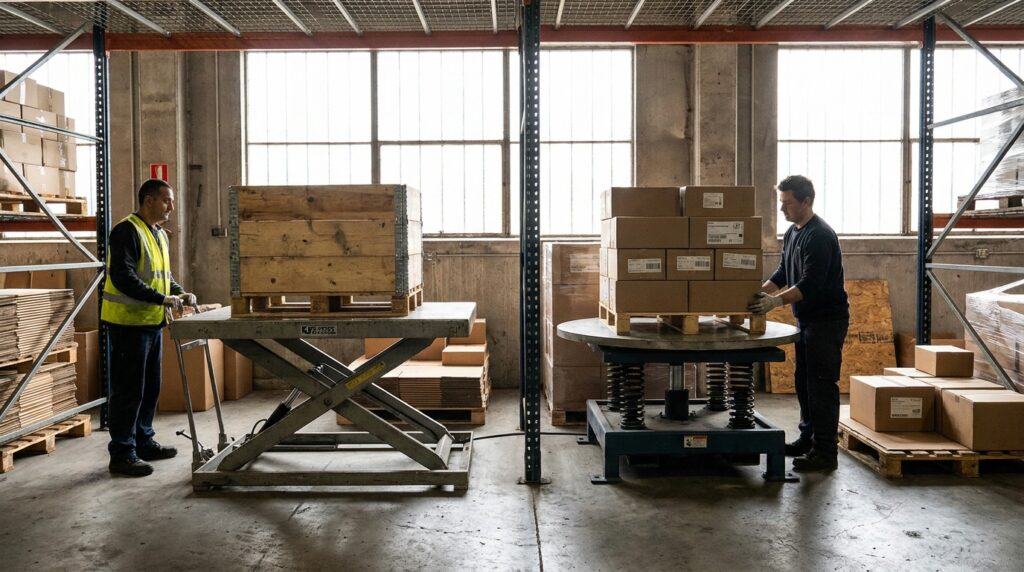
Understanding the Critical Differences: Lift Tables vs. Pallet Positioners for Enhanced Industrial Efficiency
In the demanding world of industrial operations, optimizing material handling is not merely a matter of convenience; it’s a critical factor influencing productivity, safety, and overall profitability. Two pieces of equipment frequently considered for ergonomic improvements and workflow streamlining are lift tables and pallet positioners. While both serve to raise and manipulate loads, their fundamental design, intended applications, and operational nuances differ significantly. For industrial equipment buyers, engineers, and facility managers tasked with selecting the right tools for their unique challenges, a thorough understanding of these distinctions is paramount. This comprehensive guide from Fredon Handling delves deep into the world of lift tables and pallet positioners, equipping you with the knowledge to make informed decisions that will elevate your operations.
When considering the advantages of Lift Tables versus Pallet Positioners, it’s essential to explore related topics that delve deeper into material handling solutions. For instance, an informative article on the importance of ergonomic design in workplace equipment can provide valuable insights. You can read more about this in the article available at Fredon Handling, which discusses how proper equipment can enhance productivity and safety in various industrial settings.
The Core Functionality: What Sets Them Apart
At their most basic, both lift tables and pallet positioners are designed to facilitate the lifting and positioning of goods. However, the how and why they achieve this separation is where their value proposition lies.
Lift Tables: Versatility in Elevation
Lift tables, also known as hydraulic lift tables or scissor lifts, are characterized by their robust scissor-like mechanism that allows them to raise and lower heavy loads vertically. Their primary function is to bring materials to an ergonomic working height, reducing the need for manual bending, stretching, and reaching, which are common causes of musculoskeletal injuries.
- Mechanism: Typically powered by hydraulics, though pneumatic and mechanical options exist, lift tables utilize a series of interlinked steel bars that extend or retract to achieve height adjustment.
- Load Capacity: They come in a wide range of capacities, from a few hundred pounds to tens of thousands of pounds, catering to diverse industrial needs.
- Platform Size: The platform size is equally varied, accommodating everything from small components to large pallets and machinery.
- Applications: Lift tables are incredibly versatile. They are found in assembly lines, manufacturing facilities, warehousing, shipping and receiving docks, and maintenance departments. Their ability to precisely position a load at a comfortable working height makes them indispensable for tasks involving:
- Assembly and Fabrication: Bringing parts to an ideal height for workers to comfortably assemble or fabricate them.
- Loading and Unloading: Lifting or lowering goods from trucks or conveyors to floor level, or vice versa.
- Machine Feeding: Positioning materials at the correct height for automated machinery.
- Maintenance and Repair: Providing easy access to equipment that needs servicing.
- Ergonomic Workstations: Creating custom workstations that adapt to different users and tasks.
Pallet Positioners: Optimizing Palletized Workflows
Pallet positioners, on the other hand, are specifically engineered to manipulate loads on pallets, primarily to optimize ergonomic access during tasks like order picking, packing, and pallet loading/unloading. Their core objective is to keep the top surface of a pallet at a consistent, ergonomic height throughout the process of adding or removing items.
- Mechanism: Most pallet positioners utilize a spring-loaded or air-powered mechanism.
- Spring-Loaded: These units contain a series of heavy-duty springs that compress as weight is added to the platform. As items are removed, the springs expand, automatically raising the remaining load to a consistent working height. This “self-adjusting” nature is a key feature.
- Air-Powered (Pneumatic): These utilize compressed air to maintain a specific pallet height, offering more precise control over the lifting force and can often be adjusted to different load weights.
- Load Capacity: Pallet positioners are generally designed for standard pallet weights, with capacities typically ranging from 500 to 2,000 pounds.
- Platform Size: They are designed to accommodate standard pallet dimensions (e.g., 40″ x 48″).
- Applications: Their specialized design makes them ideal for operations heavily reliant on palletized goods:
- Order Picking: As items are picked from a pallet, the positioner automatically raises the remaining goods, reducing bending and reaching.
- Packing: When packing items onto a pallet, the positioner maintains the top surface at an ergonomic height.
- Loading/Unloading of Pallets: While not as versatile as lift tables for direct truck loading (unless integrated with a dock leveler system), they are excellent for staging pallets at a consistent height for easier forklift transfer or manual movement.
- Repetitive Pallet Operations: Any process where workers repeatedly interact with the contents of a pallet benefits from the consistent height provided by a positioner.
Key Distinctions in Design and Application
The fundamental differences in their design translate directly into their optimal applications and the problems they are best suited to solve.
Lift Tables: The All-Rounders of Vertical Movement
The scissor mechanism of a lift table allows for a significant range of vertical travel, making them suitable for bridging large height discrepancies.
- Height Adjustment: Lift tables can offer extensive vertical travel, allowing them to raise loads from floor level to several feet high. This is crucial for applications like loading dock operations where goods need to be moved between different levels.
- Platform Versatility: The platform of a lift table can be customized with various features, including wheels, casters, turntables, and even containment rails, further enhancing their adaptability. This makes them suitable for moving items that aren’t strictly palletized.
- Precision Control: Hydraulic lift tables often provide very fine control over the lifting and lowering speed, which is beneficial for delicate operations or when precise alignment is required.
- Independent Operation: Lift tables can be used as standalone units in various locations within a facility, independent of other conveyor or lifting systems.
Pallet Positioners: Masters of Pallet Workflow Optimization
Pallet positioners excel in streamlining workflows where the primary interface is with a pallet. Their self-adjusting nature is a significant advantage in high-volume, repetitive tasks.
- Ergonomic Consistency: The “constant-height” aspect of pallet positioners is their defining feature. As workers pick or place items, the pallet’s surface remains at the same comfortable height, dramatically reducing strain over extended periods.
- Reduced Manual Intervention: Spring-loaded pallet positioners require minimal operator input. They automatically adjust, allowing workers to focus solely on the task of moving items.
- Flow and Throughput: By maintaining an optimal working height, pallet positioners can significantly increase the speed and efficiency of order picking and packing operations.
- Space Efficiency: Many pallet positioners are designed to be relatively compact, fitting easily within existing workstations without requiring extensive modifications.
When to Choose Which: Practical Scenarios and Equipment Selection
The decision between a lift table and a pallet positioner hinges on a detailed analysis of your specific operational needs, workflow, and the types of materials being handled.
Scenarios Favoring Lift Tables
Consider a lift table when:
- Significant Height Differences Need to be Bridged:
- Example: A manufacturing plant needs to load heavy metal stampings from a floor-level pallet onto a high-speed conveyor system. A robust hydraulic lift table with a substantial vertical travel range is ideal for this.
- Fredon Handling Advantage: Explore our range of heavy-duty lift tables designed for high-capacity, high-lift applications, perfect for bridging significant elevation gaps in manufacturing and logistics.
- Handling of Non-Palletized or Irregularly Shaped Items:
- Example: A workshop needs to lift and position large, heavy engine blocks for assembly or repair. A lift table with a suitable platform, potentially equipped with custom fixtures, can accommodate these unique loads.
- Fredon Handling Advantage: Our custom lift table solutions can be tailored with specialized platforms and accessories to handle a wide variety of loads, including those that are not palletized.
- Precise Positioning and Alignment are Critical:
- Example: In an electronics assembly line, small, delicate components need to be placed onto a circuit board at a precise height. A lift table with fine height control and a stable platform ensures accuracy and prevents damage.
- Versatility is a Priority:
- Example: A logistics company handles a diverse range of goods, some on pallets, some in crates, and some as individual items. A versatile lift table can be used in various capacities across different departments for loading, unloading, and workstation adjustments.
- Fredon Handling Advantage: Our ergonomic lift tables are designed for ease of use and can be deployed in multiple areas to address various lifting and positioning needs.
Scenarios Favoring Pallet Positioners
Opt for a pallet positioner when:
- Optimizing Repetitive Order Picking or Packing of Palletized Goods:
- Example: A distribution center fulfills hundreds of online orders daily, with pickers needing to repeatedly access items from the same pallet. A spring-loaded pallet positioner keeps the top layer of goods at an ergonomic height, significantly reducing strain and increasing picking speed.
- Fredon Handling Advantage: Discover our ergonomic pallet positioners specifically engineered to improve efficiency and reduce injury in high-volume order fulfillment.
- Maintaining a Consistent Working Height for Palletized Loads is Paramount:
- Example: A company packaging products onto pallets needs workers to consistently place items at a comfortable height without constant readjustment. A pallet positioner ensures this consistency.
- Fredon Handling Advantage: Our variable height pallet positioners offer precise control, ensuring that the pallet’s surface remains at the optimal level for your specific packing process.
- Minimizing Operator Fatigue and Musculoskeletal Injuries is a Primary Goal:
- Example: In a warehouse where workers spend their entire shift interacting with pallets, the ergonomic benefits of a pallet positioner are substantial, leading to a healthier workforce and reduced absenteeism.
- Simple, Automated Height Adjustment for Pallets is Desired:
- Example: A small business wants to improve their pallet loading process without investing in complex machinery. A spring-loaded pallet positioner offers a cost-effective and user-friendly solution.
When considering the best equipment for material handling, it’s essential to understand the differences between lift tables and pallet positioners. For a more in-depth exploration of this topic, you can check out a related article that discusses various material handling solutions and their applications. This resource can provide valuable insights into how these tools can improve efficiency in your operations. To learn more, visit this article for further details.
Beyond the Basics: Advanced Features and Considerations
Both lift tables and pallet positioners offer a range of features that can further enhance their utility and suitability for specific environments.
Lift Table Enhancements
- Powered Rotation/Tilting: Some lift tables can be equipped with rotating or tilting platforms, allowing for more precise manipulation of loads during assembly or maintenance.
- Conveyor Integration: Lift tables can be integrated with conveyor systems to create seamless material flow, allowing items to be automatically transferred on and off the table.
- Customizable Platforms: As mentioned, platforms can be designed with specific cutouts, supports, or clamping mechanisms to secure unique loads.
- Safety Features: Integrated safety skirts, emergency stops, and pressure relief valves are standard on many models.
Pallet Positioner Enhancements
- Air-Lift Models with Height Adjustment: For applications requiring more precise control over the lifted height or the ability to adjust for different load weights, air-powered pallet positioners offer greater flexibility than spring-loaded models.
- Base Rotation: Some pallet positioners include a rotating base, allowing workers to easily access all sides of the pallet without having to manually move their position.
- Mobility: While many are stationary, some pallet positioners can be integrated with mobile bases or be designed for easy relocation within a facility.
- Higher Capacities: While generally designed for standard pallet weights, some heavy-duty pallet positioners can accommodate higher loads.
Safety First: Operating and Maintaining Your Equipment
Regardless of your choice, safety and proper maintenance are paramount for the longevity and reliable operation of both lift tables and pallet positioners.
Safety Guidelines for Lift Tables
- Read the Manual: Always thoroughly read and understand the operator’s manual before using any lift table.
- Inspect Before Each Use: Check for any visible damage, leaks, or obstructions. Ensure that all safety features are functioning correctly.
- Do Not Exceed Load Capacity: Never overload the lift table. Refer to the manufacturer’s specifications for the maximum weight capacity.
- Ensure Stable Grounding: The lift table should be placed on a firm, level surface.
- Keep Clear of the Scissor Mechanism: Never place hands or feet near the scissor mechanism while it is in operation.
- Use Safety Skirts: If equipped, ensure safety skirts are in place to prevent pinch points.
- Controlled Descent: Lower the load slowly and smoothly.
- Proper Training: Ensure all operators are adequately trained on the safe operation of the lift table.
Safety Guidelines for Pallet Positioners
- Inspect Springs/Air System: Regularly check the condition of springs (for wear or damage) or the air system (for leaks or pressure issues).
- Ensure Level Surface: Place the pallet positioner on a stable, level floor.
- Avoid Overloading: Respect the weight capacity of the positioner.
- Clearance: Ensure there is adequate clearance around the unit for safe operation and access.
- No Riding: Never allow anyone to ride on the pallet positioner.
- Proper Pallet Placement: Ensure pallets are centered on the platform for balanced weight distribution.
- Regular Lubrication: Follow manufacturer recommendations for lubricating moving parts.
Maintenance for Both Equipment Types
- Regular Inspections: Implement a schedule for regular visual inspections of all components, including hydraulic lines, cylinders, electrical connections, and structural integrity.
- Lubrication: Lubricate all moving parts according to the manufacturer’s recommendations to ensure smooth operation and prevent wear.
- Hydraulic Fluid (for Lift Tables): Check hydraulic fluid levels and condition periodically. Replace fluid as per the manufacturer’s schedule. Inspect for leaks.
- Air System Maintenance (for Air-Powered Positioners): Monitor air pressure, drain moisture from air lines, and check for leaks.
- Cleaning: Keep the equipment clean, free from debris, oil, and grease, which can create slip hazards and interfere with operation.
- Repair Promptly: Address any worn or damaged parts immediately. Do not operate equipment that is in need of repair.
- Professional Servicing: Consider scheduling periodic professional servicing from a qualified technician to ensure all systems are functioning optimally and to identify potential issues before they become serious.
Understanding the Investment: Cost and ROI
The initial cost of a lift table or pallet positioner can vary significantly based on their capacity, features, and brand. However, the return on investment (ROI) is often substantial and multifaceted.
- Reduced Labor Costs: By improving efficiency and throughput, both types of equipment can lead to reduced labor hours required for certain tasks.
- Increased Productivity: Smoother workflows, faster cycle times, and reduced downtime contribute directly to increased overall productivity.
- Lower Injury Rates: The ergonomic benefits of both lift tables and pallet positioners are undeniable. Reducing workplace injuries leads to lower workers’ compensation claims, reduced insurance premiums, and less lost productivity due to employee absence.
- Improved Product Quality: Precise positioning can lead to fewer errors and less damage to goods, improving overall product quality and reducing scrap.
- Extended Equipment Lifespan: By reducing manual strain and providing consistent support, these devices can prolong the life of both the materials being handled and the workers themselves.
When evaluating the cost, it’s essential to consider the long-term benefits and the cost of not implementing such solutions, which can include high injury rates, slow throughput, and associated costs.
Fredon Handling: Your Partner in Material Handling Solutions
At Fredon Handling, we understand that selecting the right material handling equipment is a critical decision that impacts your entire operation. Our expertise spans a wide range of industrial solutions, and we are dedicated to providing you with the most efficient, safe, and cost-effective options. Whether you need the versatile elevation capabilities of a lift table or the specialized workflow optimization of a pallet positioner, Fredon Handling has the knowledge and the product range to meet your needs.
We encourage you to explore our comprehensive selection of lift tables and pallet positioners on our website. Our team of experienced professionals is ready to discuss your specific requirements, provide tailored recommendations, and help you navigate the complexities of equipment selection.
Frequently Asked Questions (FAQs)
Q1: What is the primary difference between a lift table and a pallet positioner?
A1: A lift table is designed for general vertical lifting and positioning of various loads to ergonomic working heights, offering a wide range of vertical travel. A pallet positioner is specialized for palletized loads, maintaining the top surface of the pallet at a consistent ergonomic height as items are added or removed, typically using a spring or air-powered mechanism.
Q2: Can a lift table be used as a pallet positioner?
A2: While a lift table can lift a pallet, it doesn’t offer the automatic, constant-height adjustment that a pallet positioner provides during the picking or packing process. A lift table would require continuous manual adjustment to maintain the same ergonomic working height as items are removed from a pallet, making it less efficient for repetitive palletized workflows compared to a dedicated pallet positioner.
Q3: Are pallet positioners suitable for heavy-duty industrial applications?
A3: While many pallet positioners are designed for standard pallet weights, heavy-duty models are available with higher capacities. For applications involving exceptionally heavy loads or significant height adjustments, a robust hydraulic lift table might be a more appropriate solution. Always check the specifications of the model to ensure it meets your load requirements.
Q4: How do I determine the correct capacity for my lift table or pallet positioner?
A4: You should determine the maximum weight of the items you will be lifting, including the weight of any containers or pallets. It’s also advisable to add a safety margin to this figure. Consult with your Fredon Handling representative to ensure you select equipment with adequate capacity for your specific application.
Q5: What are the key safety features to look for in a lift table?
A5: Important safety features include safety skirts around the lifting mechanism to prevent entrapment, emergency stop buttons, pressure relief valves in hydraulic systems, stable base designs, and clear operating instructions. Always ensure the equipment meets relevant safety standards.
Q6: How often should I perform maintenance on my material handling equipment?
A6: Regular visual inspections should be conducted before each use. Scheduled preventative maintenance, including lubrication and checks of moving parts, should be performed according to the manufacturer’s recommendations, typically on a weekly, monthly, or quarterly basis, depending on usage. Professional servicing is also recommended periodically.
Elevate Your Operations with Fredon Handling
The choice between a lift table and a pallet positioner is a strategic one, impacting your operational efficiency, employee well-being, and overall profitability. By understanding the distinct capabilities and applications of each, you can make an informed decision that best serves your facility’s unique needs.
Fredon Handling is your trusted partner in achieving peak industrial efficiency. We invite you to contact us today to discuss your material handling challenges. Our team is ready to provide expert guidance, product recommendations, and customized solutions to help you select the ideal lift table or pallet positioner that will transform your workflow and contribute to a safer, more productive workplace.