
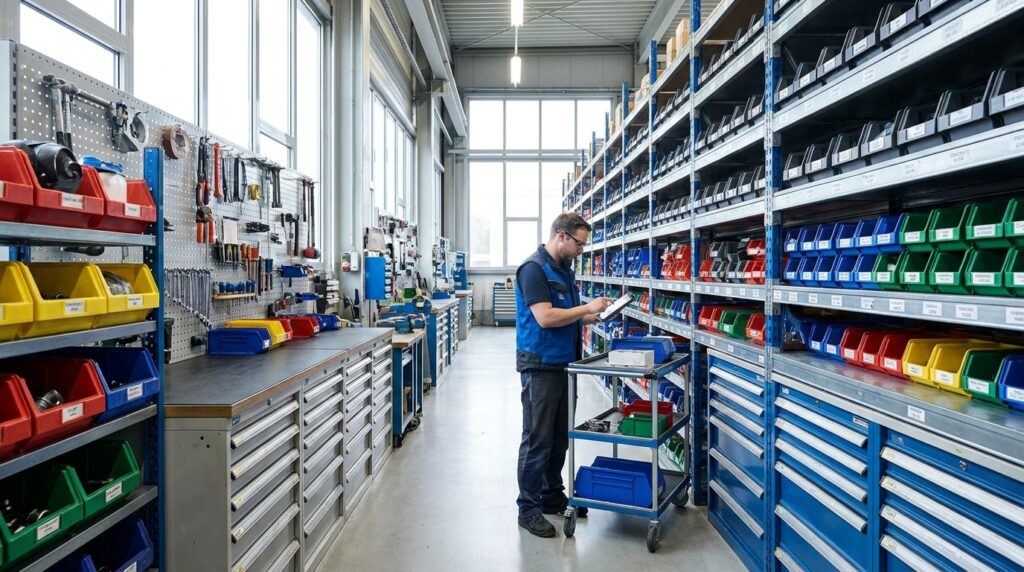
How to Organize an Industrial Parts Room for Maximum Efficiency
An organized industrial parts room is more than just a tidy space; it’s the backbone of efficient operations for any manufacturing facility or large maintenance department. When critical components are readily accessible, downtime is minimized, productivity soars, and operational costs are significantly reduced. This is where Fredon Handling, your trusted partner in industrial material handling and storage solutions, excels. We understand the intricate needs of businesses requiring streamlined inventory management and optimized workspace. This comprehensive guide will walk you through the essential steps to organize an industrial parts room for maximum efficiency, covering everything from equipment selection to space optimization and safety protocols.
For those looking to enhance their understanding of efficient organization in industrial settings, a related article titled “What is Material Handling?” provides valuable insights into the broader context of managing materials and parts effectively. This resource can help you grasp the principles that underpin effective organization strategies in an industrial parts room. To explore this topic further, visit the article here: What is Material Handling?.
Understanding the Core Components of an Efficient Parts Room
A truly efficient industrial parts room is built upon a foundation of intelligent design and the right equipment. Before diving into the specifics of layout and organization, it’s crucial to understand the types of components and the storage solutions that best suit their needs. This involves a thorough analysis of the parts themselves – their size, weight, frequency of use, and storage requirements.
Categorizing Your Inventory: The First Step to Order
Effective organization begins with a clear understanding of what you have. Not all parts are created equal, and a systematic approach to categorization is paramount.
Analyzing Part Types and Their Unique Needs
Consider the diversity of your inventory:
- Small, high-frequency items: Nuts, bolts, washers, screws, electronic components, seals. These often require small, compartmentalized storage.
- Medium-sized components: Bearings, filters, small motor parts, electrical relays. These may fit in bins or drawers.
- Large, heavy items: Motors, pumps, hydraulic cylinders, structural components. These demand robust shelving and potentially specialized handling equipment.
- Long or awkward items: Pipes, shafts, tubing, electrical conduit. These often require specific racking solutions.
- Consumables: Lubricants, cleaning supplies, rags, PPE. These need to be stored safely and accessibly, often in dedicated areas.
- Sensitive or delicate parts: Electronic boards, precision instruments. These may require anti-static bins, climate-controlled environments, or specialized packaging.
Implementing a Clear Labeling System
A universal and consistent labeling system is non-negotiable. Without it, even the most well-designed system will fail.
- Unique Part Numbers: Ensure every item has a distinct identifier.
- Descriptive Names: Include a brief, clear description of the part.
- Location Codes: Assign a specific location (e.g., Aisle 3, Shelf 5, Bin 12) to each item.
- Quantity Information: Clearly display current stock levels where appropriate.
- Color-Coding: Use color-coded labels or bins for quick visual identification of part categories or usage frequency.
- QR Codes or Barcodes: For larger operations, integrating barcode scanning can significantly speed up inventory checks and order fulfillment.
Essential Equipment for Your Industrial Parts Room
The right equipment is fundamental to maximizing space, ensuring accessibility, and maintaining the integrity of your parts. Fredon Handling offers a comprehensive range of solutions designed to meet diverse industrial needs.
Shelving Systems: The Backbone of Storage
The type of shelving you choose will significantly impact your storage capacity and accessibility.
- Adjustable Shelving: Offers flexibility to accommodate parts of varying sizes and can be reconfigured as your inventory changes. Ideal for a mix of small and medium-sized items.
- Heavy-Duty Shelving: Designed to support substantial weight, crucial for storing large or dense components.
- Closed Cabinets and Drawers: Provide dust protection and security for smaller, high-value, or sensitive parts. Drawer units can be particularly effective for organizing a large number of small items with a system of dividers.
- Cantilever Racking: Specifically designed for storing long, bulky, or irregularly shaped items like pipes, lumber, or metal extrusions.
- Pallet Racking: Essential for storing bulk inventory or larger components that are typically received and stored on pallets.
Bins and Containers: Containing and Organizing
Bins and containers are vital for segmenting and managing smaller parts.
- Stacking Bins: Maximize vertical space and can be easily rearranged. Available in various sizes and with options like open fronts for easy access.
- Divided Bins and Drawer Organizers: Perfect for segregating small hardware like screws, nuts, and washers.
- Conductive or Anti-Static Bins: Crucial for storing sensitive electronic components to prevent electrostatic discharge damage.
- Clear Bins: Allow for quick visual identification of contents without needing to open or label every container.
Specialized Storage Solutions
Depending on your specific inventory, you may need more tailored solutions.
- Bin and Drawer Cabinets: Combine the benefits of drawers with the organized structure of cabinets, offering a high density of storage for small parts.
- Rotary Carousels (Vertical or Horizontal): Excellent for high-density storage of small to medium-sized parts, bringing items to the operator, reducing reach time and improving ergonomics.
- Automated Storage and Retrieval Systems (AS/RS): For very large inventories or high-volume operations, AS/RS can provide unparalleled efficiency and space savings, though they represent a significant investment. Fredon Handling can advise on the suitability of such systems.
Strategic Layout and Workflow Design
A well-organized parts room isn’t just about the equipment; it’s about the flow of people and materials within the space. A strategic layout minimizes wasted movement and makes locating and retrieving parts intuitive.
Optimizing Flow and Accessibility
The goal is to create a logical path that reduces travel time and effort for personnel.
- Zoning: Divide your parts room into distinct zones based on part type, usage frequency, or application. For example, a “fast-moving parts” zone near the workbench or service area, a “heavy components” zone, and a “less frequently used” zone.
- High-Frequency Access: Place the most commonly used parts in the most accessible locations – at waist or chest height, and near the point of use. This is a fundamental principle of organizing an industrial parts room for maximum efficiency.
- Heavy Items: Store heavy items on lower shelves or the floor to prevent injuries and facilitate easier retrieval using appropriate lifting equipment.
- Clear Aisles: Ensure all aisles are wide enough for comfortable passage, even when carrying tools or parts. Avoid cluttering aisles with temporary storage.
Implementing a First-In, First-Out (FIFO) System
For perishable items or components with a shelf life, a FIFO system is essential to prevent obsolescence and waste.
- Placement: New stock should always be placed behind older stock within the same bin or location.
- Training: Ensure all personnel understand and adhere to the FIFO principle.
- Visual Cues: Use clear signage or color-coding to reinforce the FIFO process.
Incorporating Space Optimization Techniques
Every square foot of an industrial parts room is valuable. Smart techniques can significantly increase storage density and accessibility.
- Vertical Space Utilization: Think upwards! High-density shelving, multi-tier shelving systems, and vertical carousels can dramatically increase storage capacity without expanding the footprint. Fredon Handling offers solutions that leverage vertical space effectively.
- Consolidation: Regularly review your inventory and consolidate duplicate items or parts that are no longer in use.
- Customization: Adapt shelving and bin systems to the exact dimensions of your parts. Custom inserts for drawers or specialized bin configurations can prevent wasted space.
- Mobile Shelving: For areas with limited space, consider mobile shelving units that can be moved to create access aisles only when needed, significantly increasing storage density.
Inventory Management and Control
Beyond physical organization, robust inventory management systems are crucial for maintaining accuracy, preventing stockouts, and controlling costs.
Leveraging Technology for Accuracy
Manual inventory tracking is prone to errors and time-consuming.
- Inventory Management Software (IMS): Invest in or utilize an IMS that can track stock levels, reorder points, part usage history, and generate reports.
- Barcode Scanning: Integrate barcode scanners with your IMS for rapid and accurate stock counts, receiving, and issuing of parts.
- Automated Reordering: Set up your IMS to automatically generate purchase orders when stock levels fall below predetermined reorder points.
Establishing Clear Procedures for Receiving and Issuing Parts
Standardized procedures ensure consistency and accountability.
- Receiving:
- Verify all incoming shipments against purchase orders.
- Inspect parts for damage.
- Accurately record received items into your IMS and assign them to their designated storage locations.
- Label all received parts immediately.
- Issuing:
- Require a requisition form or digital request for all parts issued.
- Ensure the correct part and quantity are dispensed.
- Update the IMS immediately upon issuing to reflect reduced stock levels.
- Track who is issuing which part for accountability.
Regular Audits and Cycle Counting
To maintain the integrity of your inventory data, regular checks are vital.
- Cycle Counting: Instead of a full annual inventory, implement a system of cycle counting where a small portion of the inventory is counted each day or week. This helps identify discrepancies early and allows for continuous accuracy improvement.
- Full Audits: Conduct periodic full physical inventories to reconcile your IMS with actual stock.
When organizing an industrial parts room for maximum efficiency, it’s essential to consider the types of equipment that will best suit your operations. For insights on selecting the appropriate tools, you might find this article on choosing the right material handling equipment particularly helpful. By understanding the equipment options available, you can enhance the overall functionality and organization of your parts room, ensuring that everything is easily accessible and efficiently managed.
Safety and Ergonomics in the Parts Room
An organized parts room is also a safe parts room. Prioritizing safety and ergonomics benefits your team and your operations.
Ensuring a Safe Working Environment
Safety should be paramount in any industrial setting.
- Clear Signage: Implement clear signage for emergency exits, safety equipment, and hazardous material storage.
- Proper Lighting: Ensure the parts room is adequately lit to prevent accidents and improve visibility.
- Material Handling Equipment: Provide and maintain appropriate equipment for lifting and moving heavy parts, such as forklifts, pallet jacks, or lifting aids. Fredon Handling can supply suitable material handling equipment.
- Spill Containment: Have readily available spill kits and protocols for handling any leaks or spills of lubricants or other fluids.
- Fire Safety: Ensure appropriate fire extinguishers and suppression systems are in place and regularly inspected.
Promoting Ergonomic Practices
Minimizing strain on your employees leads to fewer injuries and improved morale.
- Accessible Storage: Store heavier items at lower heights and frequently used items at ergonomic levels (waist to chest height).
- Lifting Aids: Encourage the use of mechanical aids for lifting heavy or awkward items.
- Ergonomic Workstations: If parts are being picked or kitted within the room, ensure workstations are set up ergonomically.
- Training: Provide training on safe lifting techniques and the proper use of material handling equipment.
When considering the best practices for optimizing your workspace, you might find it helpful to explore a related article on effective inventory management strategies. This resource provides valuable insights that can complement your efforts in organizing an industrial parts room for maximum efficiency. By implementing these strategies, you can streamline your operations and enhance productivity. For more information, check out this informative article on inventory management.
Practical Tips and FAQs for an Efficient Parts Room
Q1: How often should I conduct inventory audits?
A: For optimal accuracy, implement a cycle counting program that counts a portion of your inventory regularly (daily or weekly). Supplement this with a full physical inventory at least annually.
Q2: What is the best way to store small hardware like screws and nuts?
A: Use divided bins, modular drawer units, or small parts cabinets with compartmentalized drawers. Ensure each compartment is clearly labeled with the part number and description.
Q3: How can I prevent dust and debris from accumulating on parts?
A: Utilize closed cabinets, drawers, or bins with lids. Ensure good housekeeping practices and consider a regular cleaning schedule for the parts room.
Q4: What if my parts room is too small to implement all these suggestions?
A: Focus on maximizing vertical space with high-density shelving or multi-tier systems. Consider solutions like rotary carousels or mobile shelving. Fredon Handling can assess your space and recommend the most effective solutions.
Q5: Should I color-code my parts?
A: Color-coding can be very effective for quick visual identification of part categories (e.g., by type, by urgency, by supplier). Ensure the color-coding system is logical and consistently applied.
Q6: How do I handle obsolete or slow-moving parts?
A: Regularly review your inventory. Implement a policy for identifying and disposing of or discounting obsolete parts. Consider a designated area for slow-moving items if space is extremely limited, but aim to minimize their presence.
Conclusion and Call to Action: Achieving Peak Efficiency with Fredon Handling
Effectively organizing an industrial parts room for maximum efficiency is an ongoing process that requires a strategic approach, the right equipment, and consistent attention. By categorizing your inventory, investing in appropriate shelving and bin systems, designing a logical layout, implementing robust inventory management, and prioritizing safety, you can transform your parts room from a potential bottleneck into a powerful asset.
At Fredon Handling, we are dedicated to providing the industrial material handling and storage solutions that drive operational excellence. Our expert team understands the challenges faced by warehouse managers, manufacturers, maintenance teams, and purchasing professionals. We are here to help you design, implement, and maintain an industrial parts room that is not only organized but truly optimized for productivity, safety, and cost-effectiveness.
Ready to unlock the full potential of your industrial parts room? Contact Fredon Handling today for a personalized consultation. Let us help you find the perfect storage and material handling solutions tailored to your unique needs. Request a quote or a site assessment now!