
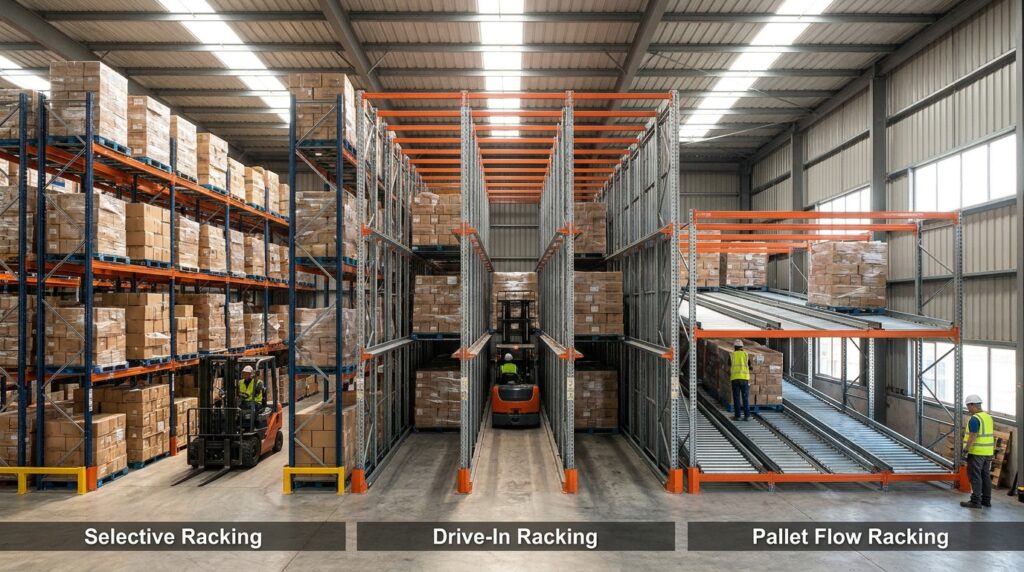
Maximizing Warehouse Efficiency: A Deep Dive into Selective, Drive-In, and Pallet Flow Racking Systems
In the dynamic world of manufacturing and distribution, optimizing warehouse space and streamlining operations are paramount to success. For businesses in Michigan and beyond, finding the right material handling solutions can be the difference between efficient throughput and costly bottlenecks. Fredon Handling, a trusted Michigan-based industrial material handling supplier since 1975, understands these challenges intimately. This comprehensive guide will explore three fundamental pallet racking systems – Selective, Drive-In, and Pallet Flow – dissecting their unique advantages, applications, and critical considerations for warehouse managers, manufacturers, engineers, and facility operators. By understanding the nuances of each system, you can make informed decisions to enhance your inventory management, improve accessibility, and ultimately, boost your bottom line.
For those interested in understanding the nuances of warehouse storage solutions, a related article can be found at the Fredon Handling Education Center. This resource delves into various racking systems, including Selective, Drive-In, and Pallet Flow Racking, providing insights into their advantages and ideal applications. To explore more about these racking options and enhance your knowledge on optimizing warehouse space, visit Fredon Handling Education Center.
Understanding the Core Pallet Racking Systems
At the heart of efficient warehousing lies the intelligent organization of inventory. Pallet racking systems are the backbone of this organization, providing structured storage for goods. While numerous configurations exist, Selective, Drive-In, and Pallet Flow racking represent three of the most prevalent and impactful solutions. Each offers a distinct approach to storing and retrieving palletized goods, catering to different operational needs, inventory types, and space utilization goals. Fredon Handling, with its decades of experience, offers expertise in designing and implementing all three, ensuring Michigan businesses have access to the optimal solution for their unique challenges.
Selective Pallet Racking: The Universal Workhorse
Selective pallet racking is, by far, the most common and versatile pallet racking system employed in warehouses today. Its design prioritizes immediate accessibility to every single pallet stored within the system. This “first-in, first-out” (FIFO) retrieval method makes it ideal for operations where inventory turnover is high and easy access to specific items is crucial.
How Selective Racking Works
The fundamental structure of selective racking consists of upright frames and horizontal beams. Pallets are loaded onto these beams, typically by forklifts or other material handling equipment. Each pallet slot is individually accessible from the aisle, allowing operators to pick or place any pallet without disturbing others.
- Upright Frames: These are the vertical components of the racking system, providing structural support. They are typically made of heavy-duty steel and come in various depths and heights to accommodate different warehouse dimensions and storage needs. Frames often include pre-punched holes for beam attachment, allowing for flexible shelf height adjustments.
- Beams: The horizontal members that connect the upright frames and support the pallets. Beams are designed to carry specific weight loads and are available in different lengths to match standard pallet sizes. They are often equipped with safety pins or locking mechanisms to prevent accidental dislodgement.
- Decks (Optional): While many selective racks store pallets directly on the beams, some applications utilize decks for added safety or to accommodate irregular loads. These can be solid metal, wire mesh, or wooden decks.
Key Advantages of Selective Racking
The widespread adoption of selective racking is due to its inherent benefits:
- 100% Accessibility: Every pallet is immediately accessible, facilitating rapid retrieval and put-away. This is crucial for operations with a large number of SKUs and frequent order picking.
- High Throughput: The direct access significantly speeds up order fulfillment processes, leading to higher operational efficiency.
- Flexibility: The system is highly adaptable. Beam levels can be easily adjusted to accommodate varying pallet heights, and the racking layout can be reconfigured as operational needs change.
- FIFO Inventory Management: This inherent characteristic helps minimize spoilage and obsolescence of perishable or time-sensitive goods.
- Suitable for Various Load Types: Selective racking can accommodate a wide range of pallet sizes and weights with appropriate beam selection.
Ideal Applications for Selective Racking
Selective pallet racking is an excellent choice for businesses that:
- Require rapid access to a high volume of SKUs.
- Operate with a strong emphasis on FIFO inventory management.
- Have a steady flow of inbound and outbound goods.
- Need flexibility in their storage configuration.
- Examples include food and beverage distributors, e-commerce fulfillment centers, and manufacturers with diverse product lines.
Limitations of Selective Racking
Despite its advantages, selective racking has some limitations:
- Lower Space Utilization: Compared to high-density systems, selective racking occupies more floor space due to the need for aisles between racks. This results in a lower storage density.
- Higher Initial Cost per Stored Pallet: While the system itself might seem straightforward, achieving high storage density often requires more racking infrastructure compared to denser systems.
Considering Load Capacity and Safety
When implementing selective pallet racking, understanding load capacity is paramount. Fredon Handling works with clients to ensure that the chosen beam and frame configurations can safely support the weight of their inventory. This involves considering the maximum weight per pallet, the number of pallets per beam level, and the overall load on each bay. Safety features like safety clips on beams, upright column protectors, and rack inspections are critical to preventing accidents and ensuring the longevity of the system.
Drive-In Pallet Racking: Maximizing Storage Density
For warehouses where space is at a premium and inventory turnover is less critical, drive-in pallet racking presents a compelling solution for maximizing storage density. This system allows forklifts to drive directly into the racking structure to store and retrieve pallets, significantly reducing the need for aisles.
How Drive-In Racking Works
Drive-in racking systems are characterized by continuous lanes of racking where pallets are stored one behind the other on integrated rails or L-shaped supports. Forklift operators drive their trucks into the lane and deposit the pallet onto the rails.
- Continuous Lanes: Instead of individual pallet slots, drive-in racks create lanes that can hold multiple pallets deep.
- Pallet Supports/Rails: These are integrated into the racking structure and run the length of the lane, supporting the pallet.
- Loading and Unloading: Forklifts drive into the lane, lift the pallet, and place it onto the supports. Retrieval involves backing the forklift into the lane to pick up the pallet.
Key Advantages of Drive-In Racking
The primary benefit of drive-in racking lies in its ability to store a large volume of similar products in a compact footprint:
- High Storage Density: By eliminating most aisles, drive-in racking can store significantly more pallets in the same square footage compared to selective racking. This can be as high as 70-85% more space utilization.
- Cost-Effective for High Volume Storage: When storing large quantities of the same SKU, drive-in racking offers a lower cost per stored pallet compared to selective systems.
- Suitable for FIFO (with careful management) or LIFO: While typically considered a Last-In, First-Out (LIFO) system by nature, drive-in racking can be managed for FIFO by designating specific lanes for incoming and outgoing pallets, albeit with more operational complexity.
Ideal Applications for Drive-In Racking
Drive-in racking is best suited for:
- Warehouses with limited floor space but ample vertical height.
- Operations that store large quantities of identical SKUs.
- Businesses with lower inventory turnover rates for specific product lines.
- Industries like cold storage (where space efficiency is critical due to energy costs), food and beverage processing, and bulk storage facilities.
Limitations of Drive-In Racking
The advantages of high density come with certain trade-offs:
- Limited Accessibility: Only the front pallet in each lane is directly accessible. To retrieve a pallet in the back, all pallets in front of it must be removed first. This makes it unsuitable for operations requiring frequent access to individual pallets.
- Slower Retrieval Times: The process of driving into the rack and potentially moving other pallets can lead to longer retrieval times compared to selective racking.
- Potential for Pallet Damage: Forklift operators need to be highly skilled to avoid damaging pallets or the racking structure when navigating the narrow lanes.
- Strict Product Uniformity Required: The system is most efficient when storing identical sized and weighted pallets.
Load Capacity and Safety in Drive-In Systems
Load capacity in drive-in racking is determined by the strength of the rails and the supporting structure. It’s crucial to ensure the system is designed to handle the weight of the fullest lanes. Safety is a paramount concern. Forklifts must be equipped with appropriate guidance systems, and operators need specialized training to navigate the confined spaces safely. Fredon Handling can advise on appropriate safety features, including lane guides and end-of-lane protectors, to mitigate risks.
Pallet Flow Racking: The Power of Gravity and FIFO
Pallet flow racking, also known as gravity flow or dynamic pallet racking, combines the high-density storage benefits of drive-in systems with the FIFO inventory management advantages of selective racking. It leverages gravity to move pallets through the system, making it an efficient solution for high-volume, fast-moving inventory.
How Pallet Flow Racking Works
Pallet flow racking systems consist of inclined lanes equipped with roller tracks or skate wheels. Pallets are loaded onto the higher end of the incline and, utilizing gravity, automatically roll down to the picking face at the lower end.
- Inclined Lanes: The core of the system is the slope, which allows pallets to move from the loading to the unloading side.
- Roller Tracks or Skate Wheels: These are mounted on the inclined lanes and provide a low-friction surface for pallets to glide on.
- Dividers: These are often placed between lanes to ensure pallets travel smoothly and do not collide.
- Bumpers and Braking Systems: Essential safety features that control the speed of the pallets and prevent them from impacting the unloading face.
Key Advantages of Pallet Flow Racking
Pallet flow racking offers a unique blend of benefits:
- Excellent FIFO Inventory Management: As pallets automatically move to the picking face, the first pallet loaded is always the first one retrieved, ensuring true FIFO.
- High Storage Density: Similar to drive-in systems, pallet flow racking significantly reduces aisle space, allowing for dense storage.
- Increased Throughput: The automatic movement of pallets streamlines the picking process, as pallets are presented to the operator, reducing travel time for material handling equipment.
- Reduced Forklift Traffic: Since forklifts only need to load at the rear and pick at the front, the internal traffic within the racking area is significantly reduced, improving safety and efficiency.
- Suitable for High-Volume, Fast-Moving Goods: Ideal for products with short shelf lives or high demand.
Ideal Applications for Pallet Flow Racking
Pallet flow racking is exceptionally well-suited for:
- Distribution centers with a high volume of fast-moving consumer goods (FMCG).
- Operations requiring strict FIFO compliance, such as food and beverage, pharmaceutical, and cosmetics industries.
- Businesses looking to improve order fulfillment speed and accuracy.
- Applications where product rotation is critical.
Limitations of Pallet Flow Racking
While powerful, pallet flow systems have considerations:
- Higher Initial Investment: Pallet flow racking systems generally have a higher upfront cost compared to selective or drive-in racking due to the specialized components like rollers and braking systems.
- Less Flexibility: The system is designed for specific pallet sizes and weights. Modifications or changes to product dimensions can require significant adjustments or even system redesign.
- Potential for Jamming: If pallets are damaged or not loaded correctly, they can cause jams in the roller system, requiring manual intervention.
- Requires Consistent Pallet Quality: Damaged or non-uniform pallets can hinder smooth flow.
Load Capacity and Safety in Pallet Flow Systems
Load capacity is determined by the strength of the roller tracks, the support structure, and the braking systems. Fredon Handling ensures that the system is designed to handle the maximum weight of the pallets and the dynamic forces generated by their movement. Safety is paramount. Integrated braking systems are crucial to control pallet speed, and durable bumpers at the picking face protect both the product and personnel. Proper lane design and regular maintenance of the roller tracks are essential for reliable and safe operation.
Comparative Analysis: Making the Right Choice for Your Michigan Warehouse
Choosing the right pallet racking system is a strategic decision that impacts warehouse efficiency, cost, and operational flow. Fredon Handling, with its deep understanding of Michigan’s industrial landscape, guides businesses through this critical selection process. Here’s a comparative look at Selective, Drive-In, and Pallet Flow racking, highlighting their key differences and ideal use cases.
Storage Density and Space Utilization
- Selective Racking: Offers the lowest storage density due to the need for wider aisles to provide immediate access to every pallet. This is its primary trade-off for accessibility.
- Drive-In Racking: Provides very high storage density by eliminating most aisles, allowing forklifts to travel within the rack structure itself. This maximizes vertical and horizontal space utilization for homogenous inventory.
- Pallet Flow Racking: Achieves high storage density, comparable to drive-in, by leveraging gravity and minimizing aisle space. It offers the added advantage of true FIFO.
Inventory Accessibility and Throughput
- Selective Racking: Offers 100% accessibility, enabling the fastest picking and put-away times. It is the ideal choice for high SKU counts and rapid order fulfillment.
- Drive-In Racking: Offers limited accessibility; only the front pallet in each lane is immediately available. Retrieval of inner pallets requires moving those in front, leading to slower throughput for specific items.
- Pallet Flow Racking: Offers excellent accessibility at the picking face (FIFO), with automatic replenishment. Throughput is high for the products stored in the system due to presented pallets.
Inventory Management and Product Rotation
- Selective Racking: Naturally supports FIFO inventory management, crucial for perishable or time-sensitive goods.
- Drive-In Racking: Primarily operates on a LIFO principle. FIFO can be achieved with careful management of specific lanes but adds operational complexity.
- Pallet Flow Racking: Guarantees true FIFO inventory management through gravity-driven product movement, essential for products with expiration dates or high demand.
Cost Considerations
- Selective Racking: Generally has a moderate initial investment, with the cost per stored pallet increasing as density needs to be maintained through more infrastructure.
- Drive-In Racking: Can be a cost-effective solution for high-volume storage of identical items, offering a lower cost per stored pallet in such scenarios.
- Pallet Flow Racking: Typically involves a higher initial investment due to specialized components like rollers, brakes, and inclines. However, it can offer long-term cost savings through increased efficiency and reduced product loss.
Operational Complexity and Skill Requirements
- Selective Racking: Relatively straightforward operation, requiring standard forklift operation skills.
- Drive-In Racking: Requires highly skilled forklift operators due to narrow aisles and the need for precise maneuvering to avoid damage.
- Pallet Flow Racking: Operation is streamlined at the picking face. Loading requires trained operators to ensure smooth pallet entry onto the rollers. Maintenance of the roller system is also a consideration.
When to Choose Which System: Practical Examples
- Scenario 1: A Michigan-based E-commerce Fulfillment Center: Needs to handle thousands of different SKUs with rapid order picking. Selective Pallet Racking is the ideal choice due to its 100% accessibility and FIFO capabilities, ensuring fast fulfillment and accurate inventory management. Fredon Handling can design a comprehensive selective racking layout to maximize their available space while maintaining optimal picking efficiency.
- Scenario 2: A Cold Storage Facility in Grand Rapids: Must store large quantities of a limited number of frozen food items. Space is at a premium due to high energy costs. Drive-In Pallet Racking would be a strong contender, offering exceptional storage density for their homogenous inventory and minimizing the operational costs associated with maintaining large, refrigerated spaces.
- Scenario 3: A Beverage Distributor in Detroit: Deals with high-volume, fast-moving drinks with expiration dates. Pallet Flow Racking would be the most suitable solution. It ensures strict FIFO rotation, minimizing product spoilage and guaranteeing that the oldest stock is always picked first, which is critical for maintaining product quality and customer satisfaction. Fredon Handling can engineer a pallet flow system that integrates seamlessly with their receiving and shipping operations.
Installation, Maintenance, and Safety: Ensuring Long-Term Performance
Regardless of the chosen system, proper installation, regular maintenance, and a strong emphasis on safety are critical for the long-term performance and reliability of any pallet racking solution. Fredon Handling, as a seasoned Michigan material handling expert, prioritizes these aspects in every project.
Professional Installation is Key
- Expertise Matters: Racking systems are structural components within a warehouse. Incorrect installation can compromise their load capacity, stability, and safety, leading to costly damage or potential collapse. Fredon Handling’s experienced installation teams ensure that all racking is assembled according to manufacturer specifications and relevant building codes.
- Site Assessment: Before installation, a thorough site assessment is conducted to evaluate floor conditions, ceiling heights, load-bearing capacities, and existing infrastructure. This ensures the chosen racking system is optimally suited for the specific warehouse environment.
- Integration with Existing Operations: Installation plans are developed to minimize disruption to ongoing warehouse operations, ensuring a smooth transition and rapid return to full productivity.
Proactive Maintenance for Longevity
- Regular Inspections: A proactive maintenance schedule is crucial. This includes visual inspections for bent beams, damaged uprights, loose connections, and worn components. Fredon Handling offers inspection services to identify potential issues before they become critical.
- Load Capacity Verification: Periodically verify that the weight of stored inventory does not exceed the rated load capacity of the racking. This might involve re-evaluating storage plans as inventory profiles change.
- Cleanliness: Keeping racking systems clean and free from debris can prevent damage and improve visibility for safety inspections.
- Component Replacement: Prompt replacement of any damaged or worn components is essential to maintain the integrity and safety of the entire system.
Safety as a Top Priority
- Operator Training: Comprehensive training for all material handling equipment operators is non-negotiable. This includes proper loading and unloading techniques, understanding load capacities, and safe maneuvering within racking systems, especially in narrower aisles.
- Rack Protection: Implementing rack protection measures such as column guards, end-of-aisle protectors, and rack aisle entry guards can significantly reduce the risk of accidental damage from forklifts.
- Clearance and Load Limits: Ensure that all load limits are clearly posted and understood by personnel. Maintain adequate clearances between stored goods and sprinkler systems or lighting fixtures.
- Emergency Procedures: Establish clear emergency procedures for rack incidents, including evacuation plans and reporting protocols.
- Compliance with Regulations: Stay informed about and comply with all relevant OSHA (Occupational Safety and Health Administration) regulations and local building codes pertaining to industrial racking systems. Fredon Handling is well-versed in these requirements for Michigan businesses.
When considering the best storage solutions for your warehouse, it’s essential to understand the differences between selective, drive-in, and pallet flow racking systems. Each type offers unique advantages depending on your inventory management needs and space constraints. For a deeper insight into these racking systems and their applications, you can explore a related article that discusses various warehouse solutions in detail. This resource can help you make informed decisions about optimizing your storage space effectively. To learn more, visit this article for comprehensive information.
Frequently Asked Questions About Pallet Racking Systems
As a leading supplier of industrial material handling solutions in Michigan, Fredon Handling frequently addresses common questions from warehouse managers, engineers, and facility operators. Here are answers to some of the most common inquiries regarding selective, drive-in, and pallet flow racking:
What is the average lifespan of a pallet racking system?
The lifespan of a pallet racking system can vary significantly depending on factors such as the quality of the materials used, the environment it’s installed in (e.g., exposure to moisture, chemicals), the intensity of usage, and the diligence of its maintenance program. High-quality steel racking systems, when properly installed, used within their load capacities, and regularly inspected and maintained, can last for 20 to 30 years or even longer. Drive-in and pallet flow systems, with their more complex moving parts, may require more frequent maintenance of those components to ensure continued longevity.
How do I determine the correct load capacity for my racking system?
Determining the correct load capacity is a critical safety and operational requirement. It begins with understanding the weight of your heaviest typical pallet load. This weight should then be factored into the design specifications of the racking system, specifically the beams and uprights. Manufacturers provide load charts that indicate the maximum weight a specific beam configuration can safely support at a given span. For drive-in and pallet flow systems, the load capacity calculations must also consider the dynamic forces of moving pallets and the structural integrity of the rails and supports. Fredon Handling works closely with clients to perform these calculations and recommend racking that meets or exceeds their specific load requirements, ensuring compliance with safety standards.
Can I combine different types of racking in my warehouse?
Yes, it is often highly beneficial and practical to combine different types of racking within a single warehouse facility. Many warehouses operate with diverse inventory needs, requiring a multi-faceted approach to storage. For instance, a facility might use selective racking for its high-turnover, high-SKU products that require immediate access, while simultaneously utilizing drive-in racking for bulk storage of a single, slow-moving product line. Similarly, pallet flow racking could be used for a specific product category that demands strict FIFO rotation. Fredon Handling excels at designing integrated warehouse layouts that strategically combine different racking systems to optimize space, efficiency, and inventory management across the entire facility.
What are the key differences in installation time and cost between these systems?
The installation time and cost vary significantly based on the system’s complexity:
- Selective Racking: Generally has the quickest installation time and the lowest initial cost per square foot for basic configurations. Its modular design and simpler assembly contribute to this.
- Drive-In Racking: Installation takes longer than selective racking due to the more intricate structure and the need for precise alignment of lanes and rails. Costs are typically higher than selective racking, but can be more economical than pallet flow for high-density storage.
- Pallet Flow Racking: Usually has the longest installation time and the highest initial cost. This is attributed to the specialized components like inclined roller beds, braking systems, and structural modifications required to support the gravity flow. However, the long-term operational efficiencies and space savings can often justify the higher upfront investment.
Fredon Handling provides detailed project estimates, including installation, for each proposed system, allowing clients to make a well-informed financial decision.
Are there specific regulations or certifications I need to be aware of for pallet racking in Michigan?
In Michigan, as in all U.S. states, pallet racking systems must comply with federal OSHA standards. Additionally, state and local building codes may apply, particularly concerning seismic requirements or specific warehouse safety regulations. The Rack Manufacturers Institute (RMI) publishes industry standards and guidelines that are widely recognized and often referenced in safety protocols. Fredon Handling stays current with all applicable regulations and ensures that all proposed and installed racking systems meet or exceed these requirements, providing peace of mind for Michigan businesses.
Partner with Fredon Handling for Your Material Handling Needs
In the competitive landscape of manufacturing and distribution, optimizing your warehouse operations is not just a goal – it’s a necessity for sustained growth and profitability. Understanding the distinct advantages and applications of Selective, Drive-In, and Pallet Flow racking systems is the first step towards achieving that optimization. From maximizing space utilization with high-density drive-in systems to ensuring precise inventory rotation with pallet flow, and providing versatile accessibility with selective racking, Fredon Handling has been Michigan’s trusted partner since 1975.
Our team of experienced material handling specialists is dedicated to helping you navigate the complexities of warehouse design and equipment selection. We don’t just sell racks; we provide comprehensive solutions tailored to your unique operational challenges, inventory profiles, and budget. Whether you’re looking to improve throughput, reduce operational costs, enhance safety, or simply make better use of your existing warehouse space, Fredon Handling has the expertise and the product range to deliver.
Don’t let inefficient storage hold your business back. Contact Fredon Handling today to request a quote or book a consultation with our material handling experts. Let us help you design and implement the most effective racking solution for your Michigan-based facility, ensuring a more efficient, productive, and profitable future.