
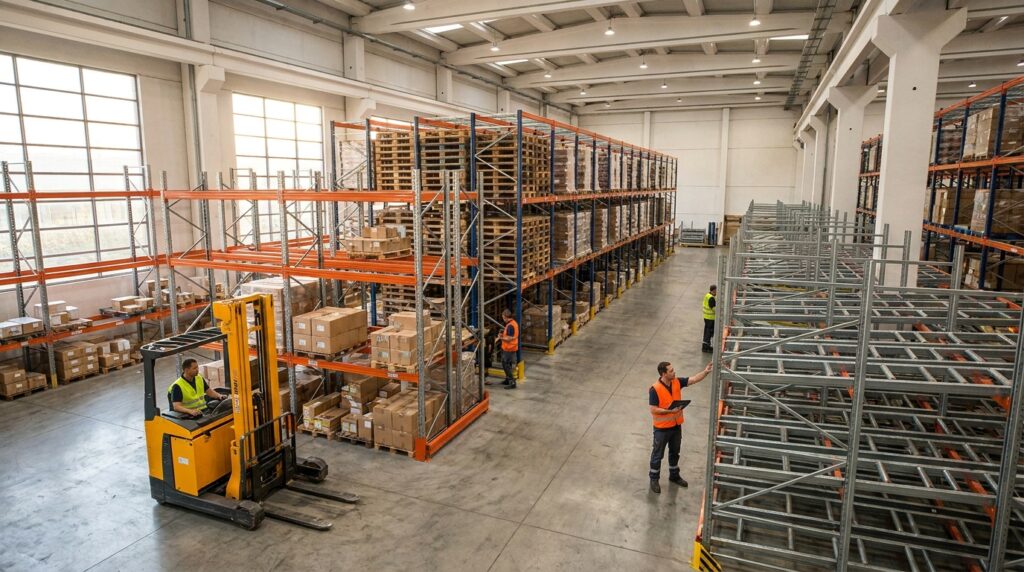
Unlocking Warehouse Efficiency: A Deep Dive into Pallet Racking Systems
In the dynamic world of manufacturing and logistics, efficient material handling is the bedrock of operational success. For businesses across Michigan and beyond, optimizing warehouse space and ensuring the safe, accessible storage of goods isn’t just a goal; it’s a competitive imperative. Established in 1975, Fredon Handling has been at the forefront of providing industrial material handling solutions, and a cornerstone of any well-functioning warehouse is its pallet racking system. Choosing the right type of pallet racking is a critical decision that impacts everything from storage density and inventory accessibility to operational safety and overall cost-effectiveness. This comprehensive guide, designed for warehouse managers, manufacturers, engineers, and facility operators, will delve into the diverse world of pallet racking, empowering you to make an informed selection that aligns with your unique operational needs. We’ll explore the various pallet racking options, their benefits, applications, and the key factors to consider, ensuring you find the perfect fit for your Michigan-based facility.
When considering the various types of pallet racking systems available, it’s essential to understand the specific needs of your warehouse or storage facility. A related article that delves deeper into this topic is available at Fredon Handling, where you can find valuable insights on choosing the right pallet racking system tailored to your operational requirements. This resource can help you make informed decisions to optimize your storage efficiency and improve overall workflow.
Understanding Your Storage Needs: The Foundation of Pallet Racking Selection
Before diving into the specific types of pallet racking, it’s crucial to conduct a thorough assessment of your operational requirements. This foundational step will guide your decision-making process and prevent costly missteps. Fredon Handling understands that no two warehouses are identical, and a personalized approach is always best.
Assessing Inventory Characteristics
The nature of the goods you store significantly influences the type of racking system you’ll need. Consider the following:
- Product Dimensions and Weight: Are your items consistently sized, or do they vary greatly? What is the average and maximum weight of your pallets? This information is critical for determining load capacities and the structural integrity required of your chosen system. Overburdening a rack can lead to catastrophic failure, posing a serious safety risk and incurring significant financial losses. Fredon Handling offers a range of robust systems designed to accommodate a wide spectrum of weight requirements.
- Inventory Turnover Rate: How quickly do your products move in and out of your warehouse? High-turnover items require easily accessible storage, often prioritizing First-In, First-Out (FIFO) principles. Low-turnover items might tolerate more dense storage solutions where direct access is less critical.
- Storage Volume and SKUs: The sheer volume of inventory and the number of different Stock Keeping Units (SKUs) you manage will dictate the overall storage capacity you need to achieve. Some racking systems are inherently more space-efficient than others.
- Product Handling Requirements: Do your products require specialized handling, such as climate control or protection from damage? This might influence the design of your racking and the overall warehouse layout.
Evaluating Operational Workflow and Constraints
Beyond the inventory itself, your daily operations and physical limitations play a vital role in selecting the optimal pallet racking system.
- Warehouse Layout and Footprint: The dimensions, ceiling height, and any existing structural elements within your warehouse will constrain your options. Maximizing vertical space is often a key objective, but this must be balanced with aisle width requirements for safe and efficient forklift operation.
- Forklift and Material Handling Equipment: The type of forklifts, reach trucks, or other equipment you utilize will dictate the required aisle widths. Narrower aisles allow for higher storage density but require specialized equipment. Fredon Handling can advise on the best racking configurations to optimize your existing or planned material handling fleet.
- Throughput Requirements: How many pallets need to be moved in and out of the warehouse per hour or day? High throughput demands quick and easy access to inventory, influencing the choice between selective and more automated systems.
- Safety Regulations and Best Practices: Michigan, like all states, has stringent safety regulations for warehouse operations. Compliance with OSHA guidelines and industry best practices is paramount. This includes ensuring proper load capacities are clearly marked and that the racking itself meets established safety standards. Fredon Handling prioritizes safety in all its product offerings and can help ensure your installation is compliant.
- Budgetary Considerations: While optimizing efficiency is key, budget constraints are a reality for most businesses. Different types of pallet racking have varying upfront costs, installation complexities, and long-term maintenance requirements. Understanding your budget will help narrow down the most feasible options.
Exploring the Spectrum of Pallet Racking: A Comprehensive Overview
The pallet racking landscape offers a variety of solutions, each with its unique strengths. Understanding these differences is essential for making an informed decision. Fredon Handling offers a comprehensive range of these systems, designed to meet the diverse needs of Michigan’s industrial sector.
Selective Pallet Racking: The Industry Standard
Selective pallet racking is by far the most common and widely used type of pallet racking in warehouses today. Its popularity stems from its simplicity, versatility, and direct access to every pallet.
How it Works
Selective racks consist of vertical upright frames and horizontal beams. Pallets are stored directly on the beams, with each pallet having its own dedicated location. This “selective” nature means that any pallet can be accessed directly without having to move other pallets.
Advantages
- 100% Accessibility: Every pallet is immediately accessible, making it ideal for inventory with high turnover rates or a large number of SKUs.
- FIFO Capability: Facilitates a First-In, First-Out inventory management system, crucial for perishable goods or products with expiration dates.
- Cost-Effective: Generally, selective pallet racking offers a lower upfront cost compared to more complex systems.
- Simple Installation and Adjustment: Beams can typically be easily adjusted to accommodate different pallet heights, offering flexibility. Fredon Handling’s expert installation teams ensure a seamless setup.
- Versatility: Suitable for a wide range of products and warehouse environments.
Disadvantages
- Lower Storage Density: Compared to some other systems, selective racking requires wider aisles, leading to less efficient use of horizontal space.
- Potential for Damage: Pallets stored at lower levels can be susceptible to damage from forklifts.
Applications
- Distribution centers
- Retail backrooms
- Manufacturing facilities
- Warehouses requiring high inventory rotation
Drive-In / Drive-Thru Racking: Maximizing Storage Density
For warehouses where maximizing storage density is the primary objective, drive-in and drive-thru racking systems offer an excellent solution. These systems are designed to store a high volume of similar products with limited SKUs.
How it Works
Drive-in racking allows forklifts to drive directly into the racking lanes to store and retrieve pallets. Pallets are stored on continuous rails. In a drive-in system, loading and unloading occur from the same aisle.
Drive-thru racking is similar, but it has an entry and exit point on opposite sides of the rack. This allows for a true FIFO (First-In, First-Out) system where pallets are loaded from one side and retrieved from the other.
Advantages
- High Storage Density: Significantly increases storage capacity within a given footprint by minimizing aisle space.
- Cost-Effective for Bulk Storage: Offers a lower cost per pallet stored when dealing with large quantities of the same SKU.
- Ideal for FIFO (Drive-Thru): The drive-thru configuration inherently supports FIFO inventory management.
Disadvantages
- Limited Accessibility: Not all pallets are directly accessible. In drive-in systems, the last pallet loaded is the first one retrieved (LIFO – Last-In, First-Out).
- Requires Specialized Equipment: Often requires forklifts capable of maneuvering within the racking lanes.
- Potential for Product Damage: Pallets can be susceptible to damage if not loaded carefully.
- Not Suitable for High SKU Diversity: Best suited for warehouses storing a limited number of different products.
Applications
- Food and beverage cold storage
- Agricultural product storage
- Bulk storage operations with limited SKUs
- Distribution centers focused on high-volume, low-variety goods
When considering the various types of pallet racking systems, it’s essential to understand the broader context of material handling in warehouses and distribution centers. A related article that provides valuable insights into this topic can be found here. This resource delves into the fundamentals of material handling, helping you make informed decisions about the right pallet racking system for your specific needs. By exploring both pallet racking options and material handling principles, you can optimize your storage solutions effectively.
Push-Back Racking: Balancing Density and Selectivity
Push-back racking offers a compromise between the high density of drive-in systems and the accessibility of selective racking. It’s a popular choice for facilities that need to store a significant volume of product while still maintaining a reasonable level of inventory selectivity.
How it Works
Push-back racks utilize a series of nested carts that move on inclined rails. When a pallet is loaded onto a cart, it is pushed back by subsequent pallets. Pallets are retrieved from the front of the lane, with the carts automatically moving forward to present the next pallet.
Advantages
- Increased Storage Density: Offers higher density than selective racking, typically storing 2 to 5 pallets deep per lane.
- Good Pallet Selectivity: While not 100% selective like standard selective racks, push-back offers better selectivity than drive-in systems, especially in lanes with fewer than 4-5 pallets deep.
- LIFO Operation: Primarily operates on a Last-In, First-Out (LIFO) basis.
- Reduced Forklift Maneuvering: Forklifts only need to access the front of the lane, reducing travel time and potential for damage.
Disadvantages
- Higher Cost: Generally more expensive than selective pallet racking.
- Potential for Product Damage: Pallets can be bumped during loading and unloading, though less so than in drive-in systems.
- Limited Rack Height: The cart system can limit the overall height of the racking.
Applications
- Distribution centers requiring a balance of density and accessibility
- Warehouses storing medium-turnover inventory
- Operations needing to store multiple cases or pallets of the same SKU
Pallet Flow Racking (Dynamic Racking): The FIFO Powerhouse
Pallet flow racking, also known as dynamic racking or gravity flow racking, is a highly efficient system for managing FIFO inventory with absolute precision. It leverages gravity to move pallets through the system.
How it Works
Pallet flow racks consist of inclined lanes equipped with rollers or skatewheels. Pallets are loaded at the higher end of the lane and, as they are removed from the lower end, gravity gently moves the remaining pallets forward.
Advantages
- Absolute FIFO: Guarantees a perfect First-In, First-Out inventory flow, essential for perishable goods, pharmaceuticals, and products with strict expiration dates.
- High Storage Density: Offers excellent space utilization, especially when configured in multi-lane systems.
- Reduced Forklift Traffic: Forklifts are only needed at the loading and unloading ends of the lanes, improving safety and efficiency.
- Increased Throughput: The automated movement of pallets can significantly increase throughput rates.
Disadvantages
- Higher Initial Investment: Pallet flow systems typically have a higher upfront cost than selective racking.
- Requires Consistent Pallet Load: Pallets must be of consistent size and weight for smooth operation.
- Limited Flexibility: Once installed, the lane configuration is generally fixed, making it less adaptable to significant changes in product dimensions.
- Maintenance: Roller systems require periodic maintenance to ensure smooth operation.
Applications
- Food and beverage processing and distribution
- Pharmaceutical manufacturing and warehousing
- Any industry where strict FIFO is critical and high volume is involved
Cantilever Racking: For Long or Bulky Items
Cantilever racking is specifically designed to store long, heavy, or irregularly shaped items that cannot be easily accommodated by traditional pallet racking.
How it Works
Cantilever racks consist of vertical columns with horizontal arms extending from the columns. Products are loaded directly onto these arms. There are no front uprights, allowing for unobstructed access.
Advantages
- Ideal for Long Items: Perfect for storing materials like lumber, pipes, tubing, steel, carpet rolls, and furniture.
- Unobstructed Access: The absence of front uprights allows for easy loading and unloading with forklifts or other handling equipment.
- Customizable: Arms can be spaced to accommodate varying product lengths and weights.
Disadvantages
- Lower Storage Density: Compared to pallet racking, cantilever racking is generally less dense for standard palletized goods.
- Requires Specific Handling Equipment: May require specialized forklifts or cranes for loading and unloading.
- Potential for Product Shift: Load stability is crucial; products must be properly secured.
Applications
- Lumber yards
- Metal service centers
- Furniture manufacturers and distributors
- Carpet warehouses
Conclusion: Partnering with Fredon Handling for Your Pallet Racking Solution
Choosing the right type of pallet racking is a strategic decision that can profoundly impact your warehouse’s efficiency, safety, and profitability. From the ubiquitous selective racking to the high-density drive-in systems, the dynamic pallet flow, and the specialized cantilever solutions, each offers distinct advantages tailored to specific operational needs.
Fredon Handling, with its deep roots in Michigan’s industrial landscape and a legacy dating back to 1975, is your trusted partner in navigating this critical choice. We understand the unique challenges faced by manufacturers, warehouse managers, engineers, and facility operators. Our experienced team is dedicated to providing not just high-quality racking systems but also the expertise and support necessary to design, implement, and maintain a material handling solution that drives your business forward.
Don’t let inefficient storage hold your operations back. Let Fredon Handling help you unlock the full potential of your warehouse space.
Request a Quote or Schedule a Consultation
Ready to optimize your warehouse storage and material handling processes? Contact Fredon Handling today to discuss your specific needs. Our experts are eager to provide a personalized assessment and recommend the ideal pallet racking solution for your business.
Call us at [Your Phone Number] or visit [Your Website] to request a quote or book a no-obligation consultation.
Frequently Asked Questions about Pallet Racking
Here are some common questions warehouse professionals have about pallet racking systems:
What is the most common type of pallet racking?
The most common type of pallet racking is Selective Pallet Racking. Its widespread adoption is due to its versatility, cost-effectiveness, and the fact that it provides 100% accessibility to every pallet. This makes it ideal for warehouses with a high number of SKUs and a need for First-In, First-Out (FIFO) inventory management. Fredon Handling provides robust selective racking solutions for a wide range of Michigan businesses.
How do I determine the correct load capacity for my pallet racking?
Determining the correct load capacity is critical for safety and operational integrity. You need to consider:
- Pallet Weight: The maximum weight of your heaviest loaded pallet.
- Beam Capacity: The weight each individual beam can safely support. This is usually specified by the manufacturer and is based on the beam’s length and cross-section.
- Bay Load Capacity: The maximum total weight the entire bay (the combination of uprights and beams) can support.
- Rack Section Load Capacity: The overall weight capacity for a specific vertical section of the rack.
It’s crucial to consult the manufacturer’s specifications and ensure that your loaded pallets do not exceed these limits. Fredon Handling works closely with clients to ensure their racking systems are specified with appropriate load capacities to meet their inventory requirements safely.
What are the safety considerations when installing and using pallet racking?
Safety is paramount in any warehouse operation. Key considerations include:
- Proper Installation: Racking must be installed on a level surface by qualified professionals. Ensure all components are securely fastened. Fredon Handling’s installation teams adhere to the highest safety standards.
- Load Capacity Labeling: Clearly visible load capacity labels on each bay are essential.
- Regular Inspections: Conduct frequent visual inspections for damage, wear, or deformation. Look for bent beams, damaged uprights, or loose connections.
- Aisle Clearances: Maintain adequate aisle widths to prevent collisions with forklifts.
- Training: Ensure all personnel operating forklifts or interacting with the racking are properly trained on safe operating procedures.
- Anchoring: Racking systems should be properly anchored to the floor to prevent tipping.
- Rack Protection: Consider installing rack guards or end-of-aisle protectors to mitigate damage from impacts.
How does pallet racking affect warehouse space utilization?
Different types of pallet racking impact space utilization differently.
- Selective Racking: Offers lower density due to wider aisles, but provides excellent accessibility.
- Drive-In/Drive-Thru Racking: Significantly increases density by minimizing aisle space, ideal for bulk storage of similar items.
- Push-Back Racking: Offers a good balance between density and selectivity, typically storing 2-5 pallets deep.
- Pallet Flow Racking: Achieves high density while maintaining FIFO, ideal for high-volume, time-sensitive inventory.
- Cantilever Racking: Designed for long items, its density is optimized for that specific product type.
Fredon Handling can help you analyze your inventory and operational needs to select a system that maximizes your usable storage space while maintaining operational efficiency.
What is the difference between LIFO and FIFO in pallet racking systems?
- LIFO (Last-In, First-Out): In a LIFO system, the last pallet loaded into a rack is the first one to be removed. This is common in drive-in racking and some push-back configurations. It’s efficient for storing large quantities of similar items where inventory age is not a primary concern.
- FIFO (First-In, First-Out): In a FIFO system, the first pallet loaded is the first one to be removed. This is essential for perishable goods, products with expiration dates, or items where obsolescence is a risk. Selective racking and pallet flow racking are designed to facilitate FIFO.
Understanding your inventory management strategy is key to selecting the appropriate racking system.