
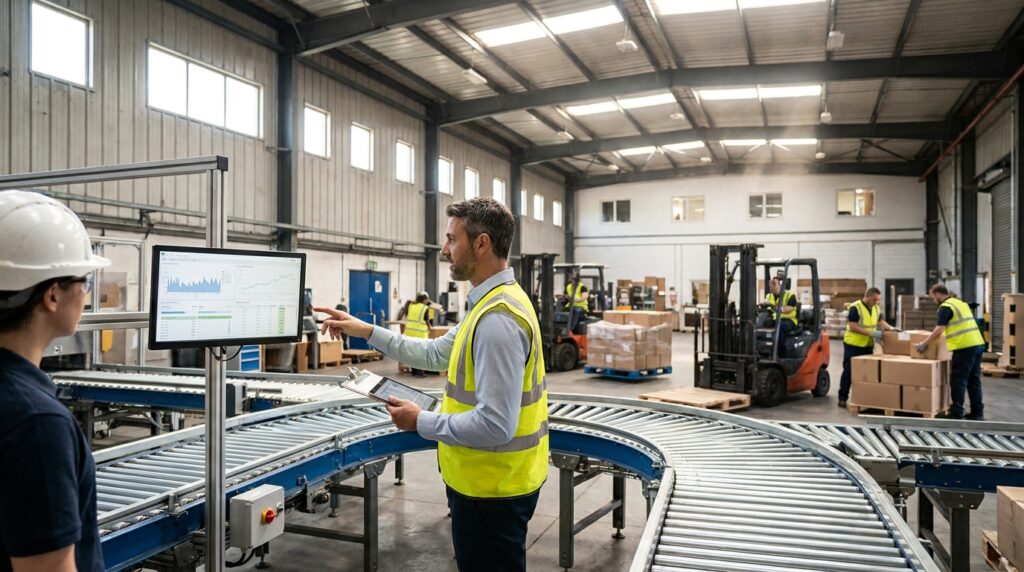
Investing in material handling equipment represents a significant capital expenditure for warehouses, manufacturing facilities, and distribution centers. Whether you’re considering forklifts, conveyor systems, automated storage solutions, or pallet jacks, understanding how to calculate material handling equipment ROI ensures you make data-driven purchasing decisions that deliver measurable value to your operation.
This comprehensive guide walks you through the essential formulas, key cost factors, and practical methodologies for determining return on investment on material handling assets. By mastering these calculations, facility managers and operations leaders can justify equipment purchases, compare alternatives objectively, and optimize their material handling strategies for long-term profitability.
Understanding Material Handling Equipment ROI Fundamentals
Return on investment for material handling equipment measures the financial return generated by equipment purchases relative to their total cost of ownership. Unlike simple payback calculations, a thorough ROI analysis accounts for both direct savings and indirect operational improvements that contribute to your bottom line.
The Basic ROI Formula for Equipment Investments
The standard formula for calculating material handling equipment ROI is:
ROI = (Net Benefits – Total Investment Costs) / Total Investment Costs × 100
For example, if a new conveyor system costs $150,000 and generates $45,000 in annual net benefits, the calculation over a five-year period would be:
- Total Investment Costs: $150,000
- Net Benefits over 5 years: $225,000
- ROI = ($225,000 – $150,000) / $150,000 × 100 = 50%
This 50% ROI indicates that for every dollar invested, the equipment returns $1.50 over the evaluation period.
Why Traditional ROI Calculations Often Fall Short
Many organizations make the mistake of focusing solely on equipment purchase price when evaluating investments. True material handling equipment ROI must encompass the complete financial picture, including installation, training, maintenance, energy consumption, and the opportunity costs of not upgrading outdated systems.
A thorough analysis also considers qualitative benefits that translate into quantifiable value—improved worker safety, reduced product damage, enhanced customer satisfaction through faster fulfillment, and increased operational flexibility.
When considering how to calculate the return on investment (ROI) for material handling equipment, it’s also beneficial to explore the essential types of equipment that can enhance manufacturing efficiency. A related article that provides valuable insights into this topic is available at Essential Material Handling Equipment for Efficient Manufacturing Processes. This resource outlines various equipment options and their impact on operational productivity, which can further inform your ROI calculations.
Identifying All Cost Components in Your ROI Analysis
Accurate ROI calculations depend on capturing every relevant cost associated with equipment acquisition and operation. Overlooking expenses leads to inflated projections and disappointed stakeholders when actual returns fall short of expectations.
Upfront Capital Expenditures
Initial investment costs extend beyond the equipment sticker price:
- Purchase price or lease terms – The base cost of the equipment
- Shipping and freight charges – Transportation from manufacturer to your facility
- Installation and integration – Professional setup, electrical work, and integration with existing systems
- Site preparation – Flooring modifications, structural reinforcements, or facility reconfiguration
- Software and controls – Warehouse management system updates, programming, and licensing
- Initial training – Employee education on safe operation and maintenance procedures
Ongoing Operational Expenses
Recurring costs significantly impact long-term ROI:
- Energy consumption – Electricity, fuel, or battery charging costs
- Preventive maintenance – Scheduled service, inspections, and component replacement
- Repair costs – Unplanned breakdowns and parts replacement
- Consumables – Lubricants, filters, tires, and wear items
- Insurance premiums – Coverage for equipment damage and liability
- Operator labor – Wages for equipment operators, including benefits
- Refresher training – Ongoing certification and skill development
Hidden and Often-Overlooked Costs
Experienced facility managers know to watch for these frequently missed expenses:
- Downtime during implementation – Production losses while installing new equipment
- Learning curve productivity dips – Temporary efficiency reductions as workers adapt
- Increased utility costs – Higher electrical demand or HVAC requirements
- Storage requirements – Space needed for spare parts inventory
- End-of-life disposal – Decommissioning, removal, and recycling expenses
Quantifying Benefits and Operational Improvements
The benefit side of your ROI equation requires careful analysis of how new equipment improves operations. Converting operational improvements into dollar figures demands a systematic approach and realistic assumptions.
Direct Labor Savings
Labor typically represents the largest opportunity for measurable returns:
Labor Savings Calculation:
- Current process time per unit × Units processed annually = Current total labor hours
- New process time per unit × Units processed annually = New total labor hours
- Hours saved × Fully loaded labor rate = Annual labor savings
For instance, if automated pallet handling reduces processing time from 3 minutes to 1.5 minutes per pallet, and your facility handles 50,000 pallets annually with a loaded labor rate of $28 per hour:
- Current: 3 min × 50,000 = 2,500 hours
- New: 1.5 min × 50,000 = 1,250 hours
- Savings: 1,250 hours × $28 = $35,000 annually
Throughput and Capacity Improvements
Increased processing capacity creates value through:
- Revenue growth potential – Ability to handle more orders without facility expansion
- Reduced overtime costs – Meeting demand within standard shifts
- Improved customer service – Faster order fulfillment and reduced lead times
- Seasonal flexibility – Handling peak volumes without temporary staffing
To calculate capacity value, estimate the additional revenue or cost avoidance enabled by throughput improvements.
Quality and Damage Reduction
Modern material handling equipment often reduces product damage and handling errors:
- Damaged goods reduction – Track current damage rates and apply improvement percentages based on equipment specifications or case studies
- Return processing savings – Fewer customer returns mean lower reverse logistics costs
- Inventory accuracy gains – Reduced shrinkage and write-offs from improved handling
Safety and Risk Mitigation
While harder to quantify, safety improvements deliver real financial value:
- Workers’ compensation premium reductions – Insurers often offer lower rates for safer equipment
- Reduced accident-related costs – Medical expenses, lost time, OSHA penalties, and litigation
- Lower employee turnover – Safer workplaces improve retention, reducing hiring and training costs
Note: For specific safety requirements and compliance standards, always verify current OSHA, ANSI, and relevant industry regulations. Consult with qualified safety professionals when evaluating equipment safety features.
Applying ROI Calculation Methods to Real Scenarios
Abstract formulas become actionable when applied to realistic equipment decisions. These examples demonstrate how to calculate material handling equipment ROI for common investments.
Forklift Fleet Replacement Analysis
Scenario: Replacing five aging propane forklifts with electric models
Investment Costs:
- Five electric forklifts: $175,000
- Charging infrastructure: $25,000
- Installation and training: $8,000
- Total Investment: $208,000
Annual Benefits:
- Fuel savings (propane vs. electricity): $18,000
- Reduced maintenance costs: $7,500
- Improved productivity (faster operation): $12,000
- Elimination of propane storage compliance costs: $3,500
- Total Annual Benefits: $41,000
ROI Calculation (5-year horizon):
- Total Benefits: $41,000 × 5 = $205,000
- ROI = ($205,000 – $208,000) / $208,000 × 100 = -1.4%
This initial calculation shows near break-even over five years. However, extending to a seven-year equipment life (common for electric forklifts):
- Total Benefits: $41,000 × 7 = $287,000
- ROI = ($287,000 – $208,000) / $208,000 × 100 = 38%
This analysis reveals the importance of appropriate evaluation periods when calculating material handling equipment ROI.
Conveyor System Installation
Scenario: Installing a 200-foot powered conveyor to replace manual cart transport
Investment Costs:
- Conveyor system and components: $85,000
- Installation and integration: $15,000
- Controls and sensors: $12,000
- Training: $3,000
- Total Investment: $115,000
Annual Benefits:
- Labor reduction (2 FTE reallocated): $95,000
- Reduced product damage: $8,000
- Improved throughput value: $15,000
- Total Annual Benefits: $118,000
ROI Calculation (First Year):
- ROI = ($118,000 – $115,000) / $115,000 × 100 = 2.6%
Payback Period: Less than 12 months
This scenario demonstrates how high-impact automation can deliver rapid returns, though actual results depend heavily on facility-specific factors.
When considering the financial implications of investing in material handling equipment, understanding how to calculate the return on investment (ROI) is crucial. A related article that delves deeper into this topic can be found at Fredon Handling, where you can explore various factors that influence ROI and learn about best practices for maximizing efficiency in your operations. By leveraging insights from such resources, businesses can make informed decisions that enhance productivity and profitability.
Building a Comprehensive ROI Evaluation Framework
Moving beyond individual calculations, successful organizations establish systematic approaches to equipment investment analysis that ensure consistency and capture organizational learning.
Creating Your Equipment Evaluation Checklist
Before calculating ROI, gather complete information:
Current State Assessment:
- [ ] Document existing equipment specifications and age
- [ ] Measure current throughput rates and cycle times
- [ ] Calculate present labor costs for affected processes
- [ ] Record maintenance expenses and downtime frequency
- [ ] Identify quality issues and damage rates
- [ ] Review safety incident history
Proposed Solution Analysis:
- [ ] Obtain detailed equipment specifications from vendors
- [ ] Request installation timelines and requirements
- [ ] Clarify warranty terms and expected service life
- [ ] Understand training requirements and ongoing support
- [ ] Verify compatibility with existing systems
- [ ] Confirm energy requirements and utility impacts
Financial Projection Development:
- [ ] Build multi-year cost models with inflation adjustments
- [ ] Apply conservative benefit assumptions
- [ ] Include sensitivity analysis for key variables
- [ ] Consider financing costs if applicable
- [ ] Account for tax implications and depreciation
Sensitivity Analysis for Risk Assessment
No projection is certain. Test your ROI calculations against varying assumptions:
- Best case: Optimistic benefit realization, minimal unexpected costs
- Expected case: Realistic assumptions based on similar projects
- Worst case: Reduced benefits, higher costs, implementation delays
This range provides decision-makers with a clearer picture of potential outcomes and associated risks.
Comparing Multiple Equipment Alternatives
When evaluating competing solutions, normalize comparisons using:
- Net Present Value (NPV): Accounts for time value of money
- Internal Rate of Return (IRR): Annualized return percentage
- Equivalent Annual Cost: Useful for comparing equipment with different lifespans
These metrics complement basic ROI calculations and support more sophisticated capital budgeting decisions.
Frequently Asked Questions About Material Handling Equipment ROI
What is a good ROI for material handling equipment?
Acceptable ROI thresholds vary by organization and risk tolerance. Many companies target minimum ROIs of 15-25% over the equipment’s useful life. However, strategic investments in safety, compliance, or capacity may justify lower returns when qualitative benefits are significant.
How long should the evaluation period be for ROI calculations?
Match your evaluation period to the expected useful life of the equipment, typically 5-10 years for most material handling assets. Consider manufacturer warranties, industry benchmarks, and your organization’s replacement cycles when determining appropriate timeframes.
Should I include soft benefits in ROI calculations?
Include soft benefits when they can be reasonably quantified and documented. Benefits like improved employee morale or enhanced company image are real but difficult to measure. Focus primarily on benefits you can defend with data while acknowledging qualitative advantages separately in your business case.
How do I account for inflation in multi-year calculations?
Apply appropriate inflation factors to both costs (labor, energy, maintenance) and benefits. Using net present value calculations with a discount rate automatically addresses time value of money. Common practice uses 2-4% annual inflation for costs and your organization’s hurdle rate for discounting.
When should I involve equipment suppliers in ROI analysis?
Reputable suppliers can provide valuable data including productivity benchmarks, maintenance cost projections, and case studies from similar applications. However, verify supplier claims independently and apply conservative adjustments to optimistic projections.
Taking Action on Your Equipment Investment Decisions
Calculating material handling equipment ROI empowers facility leaders to make confident, defensible investment decisions. By systematically analyzing costs, quantifying benefits, and applying appropriate evaluation methodologies, you transform equipment purchases from gut-feeling gambles into strategic business decisions.
Remember that ROI analysis is both art and science. While formulas provide structure, the assumptions underlying your calculations ultimately determine accuracy. Invest time in gathering quality data, validating assumptions with operational stakeholders, and building realistic models that reflect your specific facility conditions.
For organizations seeking guidance on equipment selection and ROI optimization, working with experienced material handling specialists can accelerate the evaluation process. Fredon Handling’s team regularly assists facilities in analyzing equipment alternatives and developing investment justifications that meet financial scrutiny. Whether you’re exploring your first automation project or upgrading an existing fleet, expert consultation helps ensure your calculations capture the complete value picture and set realistic expectations for your material handling investments.