
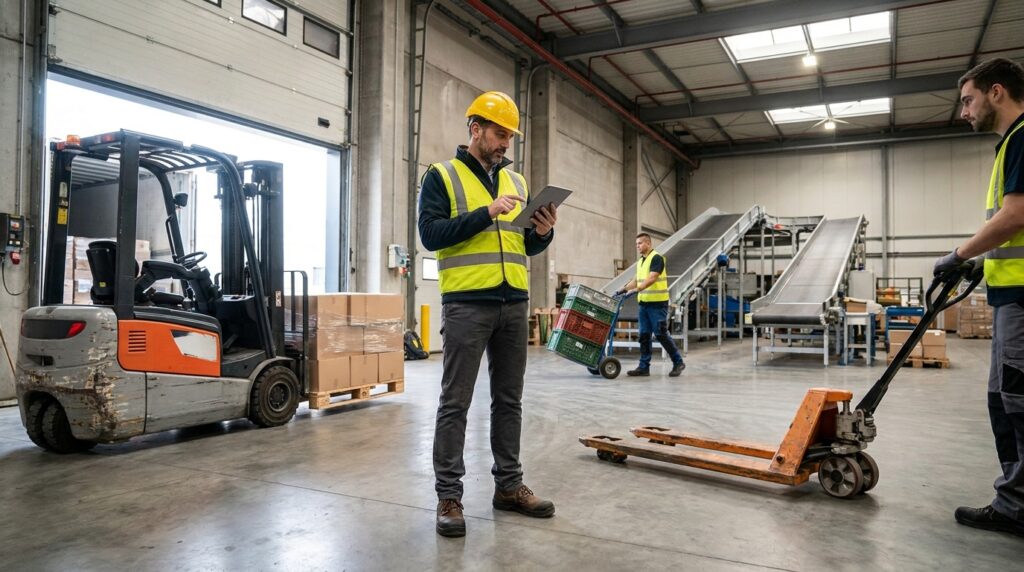
Selecting the right material handling equipment is one of the most consequential decisions an operations professional can make. The wrong choice leads to bottlenecks, safety incidents, wasted labor hours and premature capital replacement. The right choice streamlines workflows, protects workers and delivers measurable returns for years. This guide walks through the essential factors, equipment categories and evaluation methods that industrial buyers, facility managers and warehouse operators need to make confident, informed purchasing decisions.
Understanding Your Operational Requirements Before You Shop
Before browsing catalogs or requesting quotes, the most productive step you can take is a thorough assessment of your current and projected operational needs. Skipping this phase is the single biggest reason businesses end up with equipment that underperforms or sits idle.
Mapping Your Material Flow
Start by documenting every step a product or material takes from the moment it arrives at your facility until it ships out or reaches the end user. This material flow analysis reveals where handling occurs, how frequently items are moved, the distances involved and the labor currently dedicated to each step.
Key questions to answer include:
- What are you moving? Raw materials, finished goods, palletized loads, loose items, liquids, rolls or irregularly shaped products all require different handling approaches.
- How much does it weigh? Load weight determines whether you need manual aids, powered equipment or heavy-duty systems like overhead cranes and hoists.
- How far does it travel? Short movements within a workstation call for very different solutions than transfers across a 200,000-square-foot distribution center.
- How often does the movement happen? A task performed twice a day may justify a simple manual solution, while hundreds of daily repetitions demand automation or powered equipment.
- What is the environment? Temperature extremes, moisture, dust, flammable atmospheres and clean-room requirements all constrain your equipment options.
Defining Performance Targets
Once you understand the current state, define what success looks like. Are you trying to increase throughput by 20 percent? Reduce product damage? Eliminate manual lifting injuries? Cut dock-to-stock time? Clear, measurable goals help you compare equipment options objectively rather than defaulting to the cheapest or most familiar option.
Also factor in growth projections. If your volume is expected to increase significantly over the next three to five years, choosing equipment that can scale—or facilities infrastructure like mezzanines that can expand your usable space—avoids the cost and disruption of replacing undersized systems prematurely.
When selecting the appropriate material handling equipment, it’s essential to consider various factors such as the type of materials being handled, the environment, and the specific tasks to be performed. For further insights into optimizing your material handling processes, you might find the article on effective warehouse management strategies helpful. You can read more about it by visiting this link: Effective Warehouse Management Strategies. This resource provides valuable tips that complement the information on choosing the right equipment.
Evaluating the Core Categories of Material Handling Equipment
Material handling equipment spans an enormous range, from a simple gravity roller conveyor to a fully automated storage and retrieval system. Understanding the major categories helps you narrow the field quickly.
Storage and Retrieval Systems
How and where you store materials directly affects picking speed, space utilization and inventory accuracy. Options include:
- Pallet racking — Selective, drive-in, push-back and pallet flow configurations each optimize for different combinations of SKU count, access frequency and density. Selective racking offers immediate access to every pallet position, making it ideal for high-SKU environments. Drive-in and push-back racking sacrifice some selectivity for substantially higher storage density, which is valuable when floor space is constrained.
- Shelving and bin systems — For smaller, lighter items, industrial shelving with bins or divided compartments keeps parts organized and accessible at workstations or in pick areas.
- Mezzanines — When you need more usable floor area but cannot expand your building footprint, a structural mezzanine doubles the productive space in a defined area. Mezzanines can house additional storage, assembly workstations, office space or order-packing operations.
Lifting and Positioning Equipment
Moving loads vertically is often the most physically demanding and hazardous part of material handling. Choosing the right lifting solution protects workers and speeds operations.
- Hydraulic lift tables and scissor lifts — These bring work to an ergonomic height, reducing bending and reaching. They are essential at packing stations, assembly workstations, and anywhere operators repeatedly load or unload from pallets.
- Overhead cranes and hoists — For heavy or oversized loads, bridge cranes, jib cranes and chain or wire rope hoists provide controlled, repeatable lifting. They are common in manufacturing cells, maintenance bays and loading areas where forklifts cannot safely reach.
- Stackers and lift trucks — Powered pallet stackers and counterbalance forklifts cover the middle ground, handling palletized loads from floor level to elevated rack positions.
Transport Equipment
Getting materials from point A to point B efficiently depends on distance, frequency and load characteristics.
- Forklifts and powered pallet trucks — The workhorses of most warehouses and manufacturing plants. Selecting the right type—counterbalance, reach truck, order picker, walkie-rider—depends on aisle width, lift height and throughput requirements.
- Conveyors — Belt, roller, chain and overhead conveyors move materials continuously along fixed paths. They excel in high-volume, repetitive-movement applications where a fixed route makes sense.
- Carts and tugger trains — For lower-volume or flexible routing needs, industrial carts pulled by tugger vehicles offer simplicity and adaptability without the infrastructure commitment of conveyors.
Loading Dock Equipment
The dock is the gateway between your internal operations and the outside supply chain. Properly equipped docks prevent bottlenecks and protect both workers and cargo.
- Dock levelers — Hydraulic, mechanical or air-powered levelers bridge the gap and height difference between the dock and the trailer bed.
- Dock seals and shelters — These maintain environmental control and protect goods from weather during loading and unloading.
- Vehicle restraints — Trailer restraints prevent premature departure, one of the most dangerous dock hazards.
- Dock lights and communication systems — Visibility and clear signaling between dock workers and drivers reduce accidents and speed turnaround.
Ergonomic Workstations and Accessories
Workstations are where operators spend the most sustained time, making ergonomic design critically important. Adjustable-height workstations, anti-fatigue matting, tool balancers and parts-presentation systems reduce fatigue, cut cycle times and lower the risk of repetitive-strain injuries. When selecting workstations, consider integration with lifts, conveyors or overhead handling so materials arrive and leave the station with minimal manual effort.
Weighing Total Cost of Ownership Against Purchase Price
A common mistake when choosing material handling equipment is focusing narrowly on the initial purchase price. The true cost picture includes several additional factors that often outweigh the sticker price.
Acquisition and Installation Costs
Beyond the equipment itself, account for freight, rigging, concrete work or floor reinforcement, electrical connections, compressed-air supply and any structural modifications needed. A mezzanine, for example, may require permitting and engineering review. An overhead crane may need runway beams and building-column reinforcement. These costs should be part of the initial budget, not surprises discovered after the purchase order is signed.
Operating and Maintenance Costs
Energy consumption, replacement parts, scheduled maintenance labor and consumables like hydraulic fluid or lubricants add up over years of service. Electric-powered equipment generally has lower operating costs than internal-combustion alternatives, but battery replacement and charging infrastructure must be considered.
Downtime and Productivity Impact
Equipment that breaks down frequently or requires lengthy service intervals costs far more in lost production than its repair bills suggest. Evaluate manufacturer reliability data, local service availability and spare-parts lead times. Choosing a supplier with strong local support—like Fredon Handling—reduces the risk of extended downtime.
Labor and Training Costs
More complex equipment may reduce the number of operators needed but require higher skill levels and ongoing training. Simpler equipment may need more operators but less specialized knowledge. Neither approach is inherently better; the right answer depends on your labor market, wage rates and operational complexity.
Lifespan and Residual Value
High-quality pallet racking, structural mezzanines and well-maintained hydraulic lifts can serve reliably for decades. Cheaper alternatives may need replacement in a fraction of that time. Calculate the annualized cost over the realistic useful life of each option to make fair comparisons.
Safety, Compliance and Ergonomic Considerations
Material handling accounts for a disproportionate share of workplace injuries. Equipment selection is a frontline defense.
Regulatory Requirements
OSHA standards, ANSI specifications and local building codes set minimum requirements for equipment design, installation, inspection and operator training. For example:
- Pallet racking must comply with RMI (Rack Manufacturers Institute) guidelines and local seismic requirements.
- Overhead cranes and hoists must meet ASME B30 standards and undergo periodic inspections.
- Dock levelers and vehicle restraints must be maintained per ANSI MH30.1.
- Forklifts require operator certification under OSHA 29 CFR 1910.178.
Non-compliance exposes your organization to citations, fines and—far worse—preventable injuries.
Ergonomic Impact
Every piece of equipment you select either reduces or increases the physical demands on your workforce. Prioritize solutions that minimize manual lifting, awkward postures, repetitive motions and prolonged standing. Hydraulic lift tables that raise pallets to waist height, adjustable workstations that accommodate different operator heights, and powered transport that eliminates long manual carries are investments that pay for themselves through reduced injury claims and improved retention.
Facility Layout and Traffic Management
Equipment choices affect traffic patterns. Adding a conveyor line changes pedestrian and forklift routes. Installing a new crane runway may restrict overhead clearance. Evaluate how each option integrates into your existing layout, and plan designated travel lanes, pedestrian barriers and signage accordingly.
When selecting the appropriate material handling equipment, it’s essential to understand the various types of equipment available and their specific applications. A helpful resource that delves deeper into the fundamentals of material handling is an article that explains what material handling is and its importance in various industries. You can read more about it in this informative piece on material handling. This background knowledge can significantly aid in making informed decisions regarding the right equipment for your needs.
A Practical Framework for Making Your Final Selection
With dozens of variables in play, a structured evaluation process keeps the decision manageable and defensible.
Step 1: Prioritize Your Requirements
Rank your operational goals. If safety improvement is the top priority, weight ergonomic and compliance factors heavily. If throughput is the bottleneck, prioritize speed and capacity. If space is the primary constraint, focus on density solutions like drive-in racking or mezzanines.
Step 2: Shortlist Equipment Options
For each handling task, identify two or three viable equipment types. For instance, moving pallets from receiving to storage could be handled by a counterbalance forklift, a reach truck or a conveyor-fed automated storage system. Each has different cost, space and labor implications.
Step 3: Request Expert Consultation and Site Assessment
Reputable material handling suppliers will conduct an on-site assessment, review your material flow data and recommend solutions tailored to your specific conditions. This is not a sales formality—it is where experienced engineers catch issues that catalog specifications alone cannot reveal, such as floor condition, ceiling height limitations, utility access and traffic conflicts.
Step 4: Compare Options Using Total Cost of Ownership
Build a side-by-side comparison that includes acquisition, installation, operating, maintenance and projected downtime costs over the equipment’s useful life. Factor in productivity gains and injury-reduction savings to calculate true return on investment.
Step 5: Plan for Implementation and Training
Before committing, confirm the implementation timeline, who is responsible for installation and commissioning, what operator training is included, and what warranty and ongoing support look like. A phased rollout may be appropriate for larger projects to minimize operational disruption.
Step 6: Review and Optimize Post-Installation
After equipment is in service, track the performance metrics you defined at the start. Are throughput targets being met? Have injury rates dropped? Is maintenance cost in line with projections? Use this data to fine-tune processes and inform future equipment decisions.
When selecting the appropriate material handling equipment, it’s essential to consider various factors such as the type of materials being handled, the layout of your workspace, and the specific tasks at hand. For a more comprehensive understanding of this topic, you might find it helpful to read a related article that delves into the benefits of different types of equipment and how they can improve efficiency in your operations. You can explore this further in the article on material handling solutions. This resource provides valuable insights that can aid in making informed decisions tailored to your unique needs.
Partnering With the Right Material Handling Supplier
Equipment is only as good as the expertise behind it. A knowledgeable supplier does more than ship products—they help you design solutions that fit your facility, your workflows and your budget. Look for a partner who offers a broad product range covering pallet racking, hydraulic lifts, ergonomic workstations, loading dock equipment, cranes, hoists, mezzanines and related material handling equipment, so you can source integrated solutions rather than piecing together components from multiple vendors.
Equally important is local knowledge and responsive support. When a dock leveler needs emergency service on a Monday morning or you need to reconfigure racking for a new product line, a supplier who understands your operation and can respond quickly makes a tangible difference.
Fredon Handling brings decades of material handling expertise, a comprehensive equipment portfolio and a consultative approach to every project. Whether you are outfitting a new facility, upgrading aging systems or solving a specific bottleneck, their team can assess your needs and recommend solutions grounded in practical, real-world experience.
Ready to find the right material handling equipment for your operation? Talk to a Fredon material handling expert today to get a tailored recommendation based on your specific facility, workflows and goals.