
Will new material handling equipment actually pay for itself?
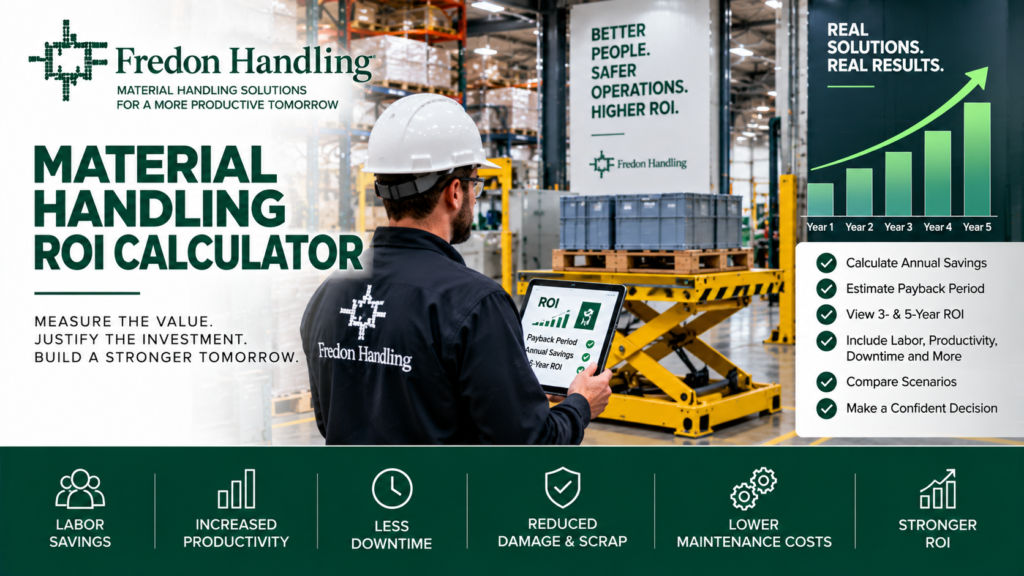
Fredon Handling’s Material Handling Equipment ROI Calculator helps manufacturers, warehouses and industrial facilities estimate the financial impact of equipment investments using labor savings, productivity improvements, downtime reduction, product-damage savings, maintenance changes and other measurable operating benefits.
Use the calculator to estimate annual savings, payback period, 1-year, 3-year and 5-year ROI, net present value, internal rate of return and the potential cost of delaying an equipment investment.
The goal is not simply to ask, “What does the equipment cost?”
A better question is:
“What does our current material-handling process cost us, and what could change if we improve it?”
Material Handling Equipment ROI Calculator
Fredon Handling Business-Case Tool
Material Handling Equipment ROI Calculator
Build a defensible preliminary business case for material handling equipment using labor savings, added throughput, downtime reduction, damage reduction, maintenance differences, recurring costs, payback, ROI, NPV, and IRR.
Estimated Business Case
Material Handling Investment Results
Annual Benefit Breakdown
See exactly where the projected value comes from.
Core Financial Metrics
- Initial investment
- —
- Labor hours saved / year
- —
- Gross annual benefit
- —
- Recurring annual cost
- —
- Annual return / investment
- —
- 3-year ROI
- —
- Estimated IRR
- —
- 5-year net benefit
- —
- Cost of waiting / month
- —
Cumulative Cash Flow
Initial investment at Year 0 followed by estimated annual net benefit.
Scenario Stress Test
Benefits vary in the real world. This compares a conservative case, your expected case, and a stronger-than-expected case while holding recurring costs constant.
Decision Signals
Year-by-Year Business Case
Undiscounted cumulative cash flow and discounted present value.
| Year | Net Cash Flow | Cumulative Cash Flow | Discounted Cash Flow | Cumulative NPV |
|---|
Methodology & formulas
Labor value = employees × minutes saved/day ÷ 60 × operating days/year × loaded labor rate × realization factor.
Throughput value = additional units/day × contribution value/unit × production days/year × capture factor. Use only when this value is not already counted as labor savings.
Downtime value = downtime hours/month × 12 × reduction percentage × cost/hour.
Damage value = current annual damage/scrap cost × expected reduction percentage.
Net annual benefit = labor + throughput + downtime + damage + other verified savings + maintenance difference − other new recurring costs.
Simple payback = initial investment ÷ net annual benefit. ROI = (cumulative benefit − initial investment) ÷ initial investment. NPV discounts each annual net benefit using the entered discount rate.
The model assumes constant annual benefit after Year 1, excludes tax effects, depreciation, financing structure, salvage value, and inflation, and does not assign speculative monetary value to safety outcomes.
Turn the estimate into a real application review
Want Fredon to pressure-test your assumptions?
Send your investment, annual benefit, payback, and 5-year ROI with one click so Fredon can help evaluate the equipment application and business case.
Realization factor
The realization factor reduces theoretical labor time savings to the portion you expect will actually become productive or financially useful. For example, if a task saves 100 theoretical labor hours but only 80% can be converted into useful capacity, enter 80%.
What Does the ROI Calculator Measure?
The calculator compares the estimated cost of a material handling investment against the financial benefits the equipment may generate over time.
Depending on your application, those benefits may include:
- Labor hours saved
- Reduced handling time
- Increased throughput
- Reduced downtime
- Lower product damage or scrap
- Reduced maintenance expense
- Lower recurring operating costs
- Improved equipment availability
- Reduced overtime
- Other measurable process savings
The calculator then converts those inputs into a financial business case.
Results can include:
- Estimated annual gross benefit
- Estimated annual net savings
- Simple payback period
- 1-year ROI
- 3-year ROI
- 5-year ROI
- 5-year net benefit
- Net present value
- Internal rate of return
- Break-even timing
- Cost of waiting
- Year-by-year cash flow
- Conservative, expected and stronger-performance scenarios
Why Calculate Material Handling Equipment ROI?
Industrial equipment is often evaluated first by purchase price.
That can be misleading.
A lower-cost solution may actually be more expensive over time if it requires more labor, causes greater downtime, creates additional handling or does not address the underlying problem.
Likewise, a more substantial equipment investment may make financial sense if it produces enough measurable savings.
ROI analysis helps compare the cost of the investment with the economic value of the operational improvement.
For example, a hydraulic lift table may require an upfront investment, but the business case could include:
- Fewer labor hours per pallet
- Reduced need for two-person handling
- Higher production output
- Less product damage
- Lower overtime
- Reduced downtime
The purchase price is only one part of the decision.
How Material Handling ROI Is Calculated
At a basic level, return on investment compares financial gain with the cost of the investment.
A simplified ROI calculation is:
ROI = (Financial Benefit − Investment Cost) ÷ Investment Cost × 100
However, industrial equipment decisions are often more complicated than that simple formula.
Fredon’s calculator goes further by considering recurring benefits, recurring costs, project investment and the time value of money.
Equipment Investment Cost
Start by identifying the total initial investment.
Depending on the project, this may include:
- Equipment purchase
- Installation
- Freight
- Electrical work
- Controls
- Integration
- Site preparation
- Training
- Accessories
- Engineering or project costs
Using the complete project investment rather than only the equipment purchase price creates a more realistic analysis.
Labor Savings
Labor improvement is one of the most common sources of material handling ROI.
Equipment may reduce:
- Minutes per cycle
- Number of employees required
- Travel time
- Waiting
- Repetitive repositioning
- Manual lifting
- Handling steps
- Forklift trips
The calculator allows you to estimate labor savings using factors such as:
- Employees affected
- Minutes saved
- Cycles per day
- Working days per year
- Loaded labor rate
A loaded labor rate may include more than hourly wages. Depending on how your organization calculates labor costs, it may also include payroll burden, benefits and other employment costs.
Use a Realistic Labor-Savings Factor
Not every minute theoretically saved becomes a fully recoverable dollar.
For that reason, the Fredon ROI Calculator includes a realization factor.
Suppose a new process theoretically saves 1,000 labor hours per year.
If you believe only 70% of those hours will translate into usable economic value, the calculator can apply that factor rather than assuming all 1,000 hours create immediate savings.
This produces a more conservative and credible business case.
Productivity and Throughput Gains
Some equipment investments do more than reduce labor.
They may allow the same employees and facility to produce or process more material.
Examples may include:
- Faster pallet handling
- Higher production output
- Reduced waiting for forklifts
- Faster machine loading
- Improved order processing
- Reduced handling bottlenecks
Throughput improvement can be economically valuable, but it should be entered carefully.
If higher throughput value is already represented in labor savings, production savings or revenue calculations, adding it again can double-count the benefit.
The calculator includes this consideration so the ROI case remains defensible.
Downtime Reduction
Material handling problems can create downtime when:
- Equipment repeatedly fails
- Materials are not available when needed
- Forklifts are unavailable
- Employees wait for lifting equipment
- Production stops for manual repositioning
- Aging equipment requires frequent repair
Reducing downtime can have significant financial value.
If your current process creates measurable downtime costs, enter the estimated annual reduction produced by the proposed solution.
Product Damage and Scrap Reduction
Poor material handling can contribute to:
- Damaged products
- Dropped components
- Scratched finished goods
- Damaged packaging
- Bent materials
- Broken parts
- Scrap
- Rework
Appropriate storage, lifting or positioning equipment may reduce some of these losses.
If product-damage or scrap savings can be estimated from actual facility data, they can become part of the equipment ROI calculation.
Maintenance Savings
Older equipment may require increasingly frequent repairs.
A replacement or alternative material-handling system could change:
- Preventive maintenance expense
- Repair expense
- Parts replacement
- Outside service
- Unplanned downtime
The calculator allows maintenance differences to be included in the business case.
Be realistic here.
New equipment may reduce maintenance compared with aging equipment, but every mechanical system still has operating and maintenance costs.
Recurring Costs
A good ROI model should account for ongoing expenses as well as savings.
Recurring costs may include:
- Preventive maintenance
- Energy
- Inspection
- Software or controls
- Service agreements
- Replacement parts
- Consumables
- Periodic certification or testing where applicable
These costs reduce annual net benefit and should not be ignored.
What Is Payback Period?
Payback period estimates how long it takes for cumulative savings to recover the initial investment.
For example:
If an equipment project costs $60,000 and generates $30,000 in annual net savings, the simple payback period is approximately:
2 years
Shorter payback periods may make a capital project easier to justify, but payback should not be the only metric used.
An investment with a longer payback period may still create significantly more value over its total operating life.
What Is 5-Year ROI?
Five-year ROI looks beyond the first year and evaluates the cumulative financial return over five years.
This is often more useful for industrial equipment because the benefits continue long after the initial capital expense.
Suppose an equipment project costs $75,000 and produces $35,000 per year in net benefit.
Over five years, the cumulative benefit may substantially exceed the original investment.
The calculator provides this longer-term perspective.
What Is Net Present Value?
Net present value, or NPV, accounts for the fact that money available today is generally worth more than the same amount received years in the future.
NPV discounts future cash flows back to their present value using a discount rate.
A positive NPV generally indicates that the projected financial benefits exceed the investment under the assumptions entered.
NPV can be useful when comparing capital projects with different investment levels and benefit timelines.
What Is Internal Rate of Return?
Internal rate of return, or IRR, estimates the discount rate at which the present value of future project cash flows equals the initial investment.
Organizations sometimes use IRR when comparing capital investments against internal return requirements or alternative uses of capital.
The Fredon calculator includes IRR as an additional decision-support metric rather than relying only on simple ROI.
The Cost of Waiting
There can also be a cost associated with postponing an equipment investment.
If an inefficient process is costing the facility $50,000 per year, waiting another year may mean another year of avoidable operating expense.
The calculator can estimate the potential financial value lost by delaying the improvement.
This does not mean every project should be approved immediately.
It simply helps make the status quo measurable.
Example Material Handling ROI Calculation
Consider a hypothetical equipment project with:
- $70,000 total installed cost
- 1.5 labor hours saved per day
- $38 loaded hourly labor rate
- 250 operating days per year
- $8,000 annual downtime savings
- $5,000 annual product-damage reduction
- $2,500 additional annual maintenance and operating cost
The calculator combines these factors to estimate annual net benefit.
It can then show:
- Estimated payback period
- 1-year ROI
- 3-year ROI
- 5-year ROI
- Five-year net cash benefit
- NPV
- IRR
This provides a more complete picture than comparing purchase price alone.
Equipment That May Produce Measurable ROI
Material handling ROI can apply to many different equipment categories.
Hydraulic Lift Tables
Lift tables may reduce repetitive positioning time and improve how employees access palletized materials.
Industrial Workstations
Better workstation layout can reduce reach, travel, searching and unnecessary movement during assembly or packaging.
Cranes & Hoists
Overhead handling systems may reduce forklift dependence, manual handling and waiting associated with heavy component movement.
Pallet Racking & Storage Systems
Improved storage layouts may increase capacity, reduce travel and delay the need for facility expansion.
Industrial Mezzanines
A mezzanine may create additional usable floor area without immediately adding building square footage.
Loading Dock Equipment
Updated dock equipment may reduce loading delays, equipment downtime and inefficiencies at receiving and shipping.
Drum Handling Equipment
Specialized drum handling equipment may reduce manual movement and make lifting, rotating or dispensing drums more efficient.
ROI for Ergonomic Material Handling
Ergonomic improvements are sometimes difficult to evaluate strictly in dollars.
Possible measurable benefits may include:
- Reduced task time
- Reduced need for multiple employees
- Less overtime
- Improved throughput
- Lower product damage
- Lower lost production from material-handling problems
Other potential benefits may be important but harder to assign a defensible financial value.
When building an ROI case, use measurable operating data wherever possible instead of inventing speculative savings.
ROI for Warehouse Storage Improvements
Warehouse storage projects may create value through:
- Additional pallet positions
- Reduced forklift travel
- Better picking efficiency
- Reduced off-site storage
- Delayed facility expansion
- Reduced product movement
- Better inventory accessibility
A pallet rack or mezzanine project may therefore have an ROI case that extends beyond the physical equipment itself.
ROI for Overhead Handling Equipment
Cranes, hoists and other overhead handling systems may create financial value when they:
- Reduce manual handling
- Reduce forklift waiting
- Improve machine loading
- Increase positioning efficiency
- Reduce component damage
- Improve production flow
The best analysis should compare the existing process with the proposed process.
Use Actual Facility Data Whenever Possible
An ROI calculator is only as useful as the assumptions entered.
For the strongest business case, use actual operating information such as:
- Payroll or loaded labor rates
- Production records
- Maintenance history
- Downtime reports
- Scrap records
- Damage reports
- Cycle times
- Equipment service costs
Avoid entering savings simply because they make the project look more attractive.
A conservative analysis is often more credible to management.
Conservative, Expected and Stronger-Performance Scenarios
Industrial projects rarely perform exactly as predicted.
For that reason, it can be useful to compare multiple scenarios.
Conservative Scenario
Assume lower savings or slower adoption.
Expected Scenario
Use the most reasonable estimate based on current information.
Stronger-Performance Scenario
Model what happens if the project performs somewhat better than expected.
Comparing these scenarios helps decision-makers understand the range of possible outcomes rather than relying on one precise number.
Questions to Ask Before Approving Material Handling Equipment
Before making a capital decision, consider:
- What problem are we solving?
- What is the current process costing us?
- How many labor hours can realistically be recovered?
- Will the equipment increase throughput?
- Will downtime decrease?
- Will product damage decrease?
- What are the recurring costs?
- How long will the equipment be used?
- What happens if we do nothing?
- Are there less expensive ways to solve the same problem?
The best investment is not always the lowest-cost option or the most sophisticated equipment.
It is the solution that produces the right operational result at a justifiable cost.
Calculator Limitations
The Material Handling Equipment ROI Calculator is intended for preliminary business planning.
Results depend entirely on the assumptions and information entered by the user.
The calculator does not guarantee:
- Actual labor savings
- Production improvements
- Future revenue
- Maintenance savings
- Tax treatment
- Accounting treatment
- Equipment performance
- Financing terms
Actual results can vary based on equipment selection, installation, operator adoption, production volume, maintenance, facility conditions and many other factors.
Financial projections should be reviewed using your organization’s actual operating and financial information.
Frequently Asked Questions
What is a good ROI for material handling equipment?
There is no universal ROI threshold appropriate for every company. Organizations may use payback period, internal rate of return, NPV or internal capital requirements when evaluating equipment investments.
How do you calculate material handling equipment ROI?
Estimate the total project investment and compare it with annual economic benefits such as labor savings, downtime reduction, productivity gains and damage reduction, minus recurring operating costs.
What is a good payback period for industrial equipment?
Acceptable payback periods vary by company, project type and capital policy. Some organizations prioritize projects with short payback periods, while others evaluate longer-term strategic benefits.
Should labor savings be counted at 100%?
Not necessarily. If saved minutes do not translate directly into reduced labor cost or additional productive work, using a realization factor can create a more conservative estimate.
Can productivity increases be included in ROI?
Yes, when the economic value can be measured reasonably. Be careful not to count the same benefit twice through both labor savings and throughput gains.
What costs should be included in the equipment investment?
Include the costs needed to put the equipment into service, such as purchase price, installation, freight, integration, electrical work, training and other project-specific expenses.
What is the difference between ROI and payback period?
ROI measures the financial return relative to investment cost. Payback period measures how long cumulative savings take to recover the original investment.
What is the difference between ROI and NPV?
ROI is generally expressed as a percentage. NPV considers the timing of future cash flows and discounts them back to their present value.
Build a Stronger Business Case for Your Material Handling Project
A material handling investment should solve a real operational problem and create measurable value.
Fredon Handling can help evaluate the equipment side of the equation while your team evaluates the financial impact.
If you are considering new storage, lifting, positioning, workstation, loading dock or overhead handling equipment, use the calculator to estimate the business case and then send your results to Fredon.