
Estimate Trailer Throughput, Dock Door Utilization, and Warehouse Loading Capacity
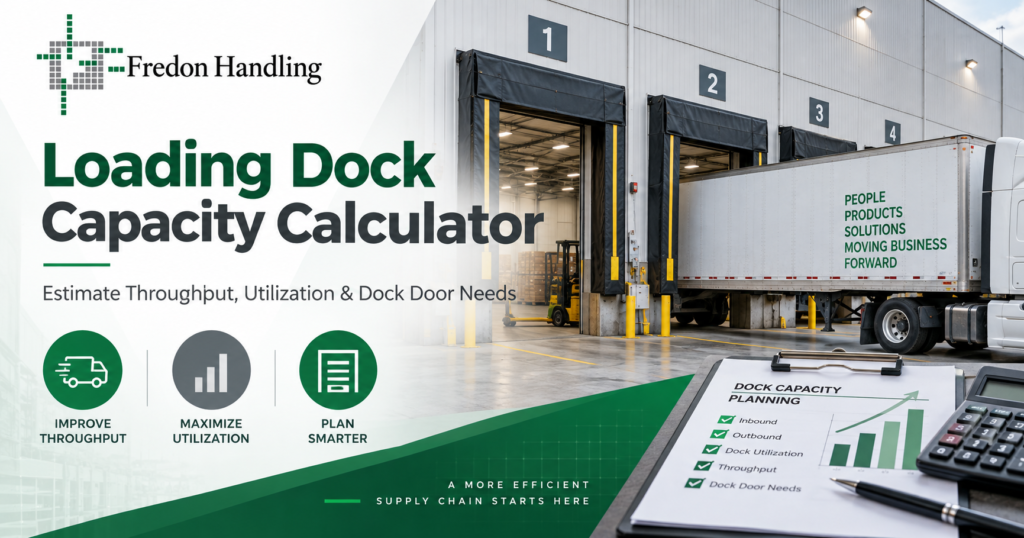
Is your loading dock keeping up with your shipping and receiving demands? Whether you operate a warehouse, manufacturing facility, distribution center, or industrial operation, understanding your loading dock capacity is essential for maintaining efficient material flow.
Fredon Handling’s free Loading Dock Capacity Calculator helps you estimate how many trailers your facility can process, evaluate dock door utilization, identify potential bottlenecks, and plan for future growth.
Use this interactive tool to make informed decisions about loading dock equipment, facility expansion, and operational improvements.
Free Loading Dock Capacity Calculator
Enter your facility’s loading dock information below to estimate your current and projected loading dock capacity.
Estimate trailer-processing capacity, dock utilization, and additional doors needed for peak demand. Fredon Handling can help review your dock workflow, equipment, and operational requirements.Loading Dock Capacity & Throughput Calculator
Preliminary Loading Dock Planning Results
Average-day dock utilization
Current and future demand comparison
Scenario Trailers/day Raw utilization Doors at target
Disclaimer: This calculator provides preliminary planning estimates based on your inputs and operational assumptions. Actual loading dock performance depends on trailer arrival patterns, labor availability, forklift traffic, staging capacity, equipment conditions, and other facility-specific factors. Results should not be considered an engineering assessment or guaranteed operational capacity.
Need Help Improving Your Loading Dock Capacity?
Your calculator results are a starting point. Understanding which equipment, workflow changes, or facility improvements will make the greatest difference requires evaluating your operation as a whole.
Fredon Handling helps warehouses, manufacturers, and distribution centers identify practical loading dock solutions for receiving and shipping operations.
Schedule a Free 30-Minute Consultation
No charge or obligation. Discuss your loading dock requirements with an experienced material handling professional.
How to Use the Loading Dock Capacity Calculator
Our calculator uses key operational variables to estimate the number of trailers your facility can process during a typical shift.
1. Enter Your Available Dock Doors
Begin by entering the number of loading dock doors available for receiving or shipping operations.
Only count dock doors that can realistically be used for the operation you’re evaluating.
For example, a facility with 12 total dock doors may have only eight dedicated to receiving operations.
2. Enter Your Operating Hours
Specify the number of hours your loading dock operates during a typical shift or operating day.
Consider whether all dock positions remain available throughout that period. Shift changes, breaks, equipment inspections, and other activities may reduce effective operating time.
3. Estimate Average Trailer Service Time
Trailer service time represents the amount of time a trailer occupies a dock position.
This may include:
- Trailer positioning and securing
- Dock equipment preparation
- Loading or unloading operations
- Documentation and inspections
- Trailer departure and dock turnover
For accurate estimates, use actual operating records whenever available.
4. Enter Your Daily Trailer Volume
Provide the average number of trailers processed during your selected operating period.
If your operation experiences substantial differences between normal and peak periods, consider those variations when evaluating your results.
5. Evaluate Peak Demand and Future Growth
Peak periods may create congestion even when average daily volume appears manageable.
Use the calculator’s scenario inputs to evaluate higher trailer volumes and potential future capacity requirements.
Understanding Your Loading Dock Calculator Results
After entering your facility’s information, review the estimated performance metrics to identify opportunities for improvement.
Estimated Trailer Throughput
Trailer throughput represents the number of trucks or trailers that can be processed over a specified operating period.
A simplified theoretical capacity calculation is:
Trailer Capacity = (Available Dock Doors × Operating Hours) ÷ Average Trailer Service Time
For example, a facility operating eight dock doors for eight hours per day, with an average trailer service time of 90 minutes, has a theoretical capacity of approximately 42.7 trailer visits per day before operational limitations are considered.
Actual sustainable throughput will generally be lower because of interruptions, unequal dock utilization, scheduling constraints, and other factors.
Dock Door Utilization
Dock door utilization estimates the proportion of available dock time occupied by trailer operations.
Higher utilization can indicate productive use of existing equipment, but consistently operating near theoretical maximum capacity may leave limited flexibility for unexpected arrivals, maintenance, or processing delays.
Peak Demand Capacity
Facilities often experience concentrated arrival periods rather than evenly distributed trailer traffic.
Understanding peak demand helps identify whether existing dock resources can accommodate busy periods without excessive congestion.
Additional Dock Door Requirements
When demand exceeds estimated operating capacity, additional dock positions may be one possible solution.
However, expanding the number of dock doors is not always necessary. In some cases, changes to scheduling, loading equipment, staffing, staging, or material handling processes may improve throughput using existing infrastructure.
What Factors Affect Loading Dock Capacity?
Several operational variables influence loading dock throughput and efficiency.
Loading and Unloading Times
The time required to process each trailer is one of the most important capacity factors.
Operations handling palletized products may have different service times than facilities handling loose freight, oversized equipment, or specialized materials.
Dock Leveler Performance
Dock levelers help forklifts, pallet trucks, and other material handling equipment transition between the warehouse and trailer.
Selecting appropriate equipment for the loading frequency, load capacity, and trailer configuration can help support efficient dock operations.
Learn more about loading dock equipment and dock levelers.
Vehicle Restraints and Dock Safety
Vehicle restraints and dock locks help secure compatible trailers during loading and unloading.
A properly planned loading dock operation should consider trailer positioning, employee safety, equipment condition, and communication procedures.
Warehouse Staging Capacity
Insufficient staging space may slow loading and unloading operations even when dock doors are available.
Facilities should evaluate how products move between trailers, staging areas, storage locations, and shipping departments.
Material Handling Equipment Availability
Forklifts, pallet jacks, and related equipment play important roles in trailer turnaround times.
Equipment shortages, congestion, and inefficient travel paths can reduce overall throughput.
Trailer Scheduling
Coordinating arrival times may help distribute loading dock demand throughout the day.
Facilities with unpredictable arrival patterns may require additional scheduling flexibility or operational capacity.
Five Ways to Improve Loading Dock Efficiency
1. Evaluate Your Existing Dock Equipment
Inspect dock levelers, restraints, seals, shelters, and other equipment to determine whether existing systems support your current loading requirements.
2. Reduce Unnecessary Trailer Turnaround Time
Review how long trailers remain at dock positions and identify delays associated with documentation, staging, equipment availability, or material movement.
3. Improve Forklift and Material Flow
Evaluate travel distances, aisle congestion, staging locations, and forklift traffic patterns.
Better coordination between the loading dock and warehouse interior may help reduce unnecessary handling.
4. Improve Loading Dock Scheduling
Consider coordinating inbound and outbound trailer appointments to distribute demand more evenly across available operating hours.
5. Plan for Future Growth
Evaluate projected increases in shipping and receiving activity before existing loading dock capacity becomes a significant constraint.
Future planning may involve additional dock doors, equipment replacement, improved workflows, or a combination of solutions.
Loading Dock Equipment and Solutions From Fredon Handling
Fredon Handling provides material handling equipment and solutions for industrial facilities seeking to improve loading dock operations.
Depending on your application, potential equipment options include:
- Hydraulic dock levelers: Powered equipment for facilities with frequent loading and unloading requirements.
- Mechanical dock levelers: Non-hydraulic solutions for suitable loading dock applications.
- Edge-of-dock levelers: Equipment for specific dock configurations and retrofit requirements.
- Vehicle restraints and dock locks: Systems designed to help maintain appropriate trailer positioning.
- Dock seals and shelters: Equipment that helps manage weather exposure around trailer openings.
Explore our complete Loading Dock Equipment selection or learn about Loading Dock Solutions tailored to industrial operations.
Frequently Asked Questions
How do you calculate loading dock capacity?
A basic theoretical calculation multiplies the number of available dock doors by operating hours and divides the result by average trailer service time in hours.
Actual capacity depends on additional operational factors, including trailer scheduling, available personnel, material handling equipment, and facility layout.
How many trucks can one loading dock handle per day?
The number varies based on operating hours and average service time.
For example, one dock position operating eight hours per day with a two-hour average service time has a theoretical maximum of four trailer visits per day, assuming no interruptions or turnover losses.
What is a good loading dock utilization rate?
There is no single ideal utilization rate for every facility.
The appropriate operating target depends on trailer arrival patterns, processing time variability, service expectations, and operational flexibility. Facilities with unpredictable arrivals may need more available capacity than operations with highly controlled schedules.
How can I increase loading dock throughput without adding doors?
Potential improvements include reducing trailer service times, improving staging, coordinating delivery appointments, updating dock equipment, increasing material handling equipment availability, and reducing forklift congestion.
How do I determine whether I need additional dock doors?
Compare your current and projected trailer demand with realistic operating capacity.
If existing capacity cannot accommodate expected demand after practical workflow improvements, additional dock positions may be worth evaluating.
Can loading dock equipment improve warehouse productivity?
Appropriate loading dock equipment can help support smoother movement between trailers and facilities. However, the overall benefit depends on equipment compatibility, loading procedures, warehouse layout, and operating conditions.
Get Expert Help With Your Loading Dock Project
Make better loading dock decisions with practical equipment recommendations from Fredon Handling.
Whether you’re dealing with trailer congestion, aging dock levelers, increasing shipping volume, or a planned facility expansion, Fredon Handling can help you evaluate equipment options suited to your application.
Serving industrial and material handling operations since 1975, Fredon Handling works with warehouses, manufacturers, and distribution facilities seeking reliable material handling solutions.
Ready to discuss your loading dock?
Schedule Your Free 30-Minute Consultation →
Request Loading Dock Equipment Information or a Quote →
Explore More Free Material Handling Calculators
Continue planning your facility with Fredon Handling’s additional tools.
Warehouse Storage Capacity Calculator — Explore warehouse storage capacity and pallet position planning.
Material Handling Equipment ROI Calculator — Evaluate potential financial returns from material handling equipment improvements.