
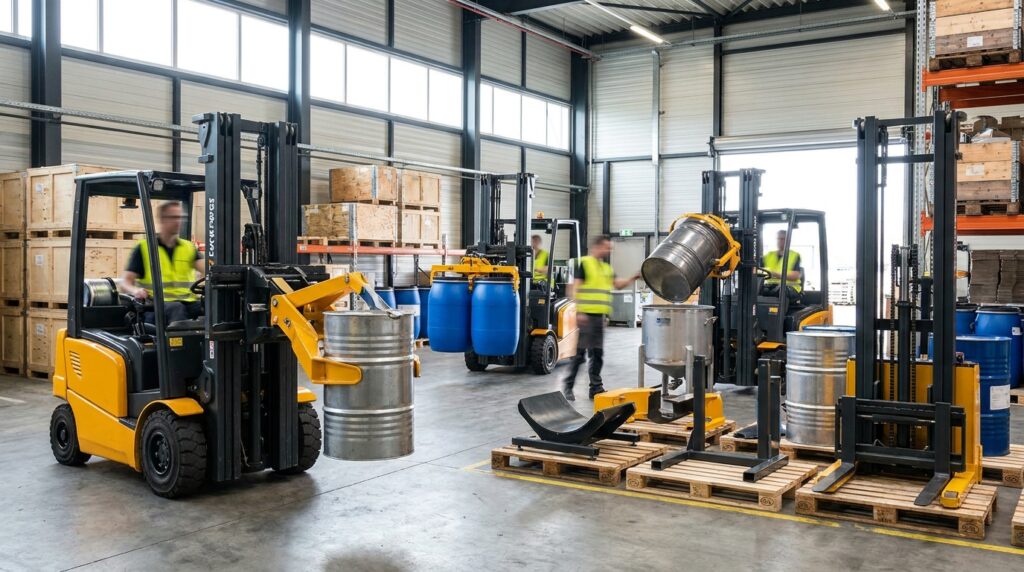
Forklift Drum Handling Attachments: Your Ultimate Selection Guide
SEO Title: Forklift Drum Handling Attachments: The Complete Guide for Industrial Buyers
Meta Description: Master forklift drum handling with our comprehensive selection guide. Discover attachment types, material considerations, size/weight capacity, compatibility, safety, maintenance, and buying advice for warehouse managers, engineers, and safety professionals.
Choosing the right equipment for your warehouse operations is paramount to efficiency, safety, and profitability. When it comes to handling drums, a ubiquitous item in many industrial settings, specialized forklift attachments are indispensable. These tools transform your standard forklift into a versatile drum-handling machine, reducing manual labor, minimizing the risk of spills and injuries, and speeding up your workflows. This comprehensive guide will delve deep into the world of forklift drum handling attachments, providing warehouse managers, plant engineers, safety managers, and industrial equipment buyers with the knowledge needed to make informed decisions. We’ll explore the various types available, crucial selection factors, operational considerations, and essential maintenance practices to ensure you find the perfect solution for your specific needs.
For those interested in enhancing their understanding of Forklift Drum Handling Attachments, a related article that provides valuable insights into the broader topic of material handling is available. This article discusses the fundamentals of material handling, including various equipment and techniques that can improve efficiency and safety in the workplace. You can read more about it in the article titled “What is Material Handling?” by following this link: What is Material Handling?.
Understanding the Spectrum of Forklift Drum Handling Attachments
The primary goal of forklift drum handling attachments is to securely grip, lift, and maneuver drums of various materials, sizes, and weights. The diversity of drum types and operational requirements has led to a range of attachment designs, each optimized for specific tasks. Understanding these differences is the first step in selecting the most appropriate solution.
Drum Clamps: The Versatile Grip
Drum clamps are perhaps the most common type of forklift drum handling attachment. They operate by utilizing powerful jaws or clamps that securely grip the rim or body of the drum. This method provides a firm hold, allowing for safe and controlled lifting and transportation.
Overhead Drum Clamps
These attachments are designed to lift drums from the top, typically by gripping the reinforced rim. They are excellent for applications where the drum needs to be lifted vertically and transported without tilting. Many overhead drum clamps are adjustable to accommodate different drum diameters. They are particularly useful for high-volume operations involving steel or fiber drums where the rim provides a consistent gripping surface.
Side Gripping Drum Clamps
Side gripping clamps, also known as “vertical drum clamps,” grip the side of the drum. This allows for more flexibility in positioning and often enables the forklift to carry multiple drums side-by-side, increasing efficiency. They are suitable for a wider range of drum materials, including plastic drums, as they distribute pressure across a larger surface area. Some models can even handle drums stacked on top of each other.
Vertical Drum Handlers
These attachments focus on securely holding the drum’s vertical axis, allowing for both lifting and controlled tilting. They are ideal for processes that require pouring or emptying drums. The gripping mechanism can vary, from hydraulic cylinders to mechanical toggles, ensuring a secure hold during movement and tilting operations.
Drum Lifters and Grabs: Specialized Lifting Solutions
Beyond clamping mechanisms, other attachments focus on lifting and manipulating drums with different approaches.
Drum Tippers and Rotators
For applications involving the dispensing or emptying of drum contents, drum tippers and rotators are essential. These attachments allow the forklift to securely hold a drum and then rotate it to a desired angle, facilitating controlled pouring. They can range from simple manual rotation devices to fully automated hydraulic systems. These are crucial for industries dealing with liquids, powders, or granules that need to be transferred from drums.
Drum Forks
These specialized forks slide under a drum, supporting its base. They are often used for transporting drums where a rim grip might be problematic or for very heavy drums. Drum forks provide a stable base of support, minimizing the risk of the drum tipping over during transport. They are a simpler, more robust solution for straightforward drum transport.
Drum Carriers
These are less common as direct forklift attachments and more as auxiliary equipment that can be loaded onto forks. They typically involve a frame or cradle that holds one or more drums. While not directly attached to the forklift’s mast, they leverage the forklift’s lifting capacity to move drums.
Key Factors for Selecting the Right Forklift Drum Handling Attachment
The decision of which forklift drum handling attachment to invest in hinges on a careful assessment of several critical factors. Overlooking any of these can lead to inefficient operations, equipment damage, or safety hazards.
Drum Material and Construction
The material and construction of the drums you handle will significantly influence the type of attachment required.
- Steel Drums: These are robust and often have reinforced rims, making them ideal for overhead or rim-gripping clamps. Their rigidity allows for secure handling with minimal deformation.
- Plastic Drums (HDPE): Plastic drums are lighter but can be more susceptible to deformation under pressure. Side-gripping clamps that distribute pressure evenly are generally preferred. Ensure the clamp’s gripping surfaces are designed to prevent puncturing or damaging the plastic.
- Fiber Drums: These drums, often used for dry goods, have a different rim structure and body rigidity. Specific attachments designed for fiber drums are recommended to ensure a secure and damage-free grip.
Drum Size and Dimensions
Drums come in a variety of standard and non-standard sizes. Your attachment must be compatible with the diameter and height of the drums you commonly handle.
- Standard Drum Sizes: Common sizes include 30-gallon (approximately 22.5 inches in diameter) and 55-gallon (approximately 23.5 inches in diameter) drums. Many attachments are designed to accommodate these standard sizes with adjustable features.
- Non-Standard Drums: If you handle drums with significantly different dimensions, you may need a custom-built attachment or one with a wider adjustment range. Always verify the specified range of operation for any attachment.
Drum Weight and Capacity Requirements
The weight of the drums, especially when full, is a critical safety and operational consideration. The attachment and the forklift itself must have adequate capacity.
- Attachment Capacity: Each drum handling attachment will have a maximum weight capacity. This should always be considered in conjunction with the forklift’s lifting capacity. Ensure the attachment’s rating comfortably exceeds the maximum weight of your loaded drums.
- Forklift Capacity: The forklift’s rated capacity at its load center must be sufficient to lift the combined weight of the forklift, the attachment, and the drum. Adding an attachment can shift the forklift’s center of gravity, potentially reducing its effective lifting capacity. Consult your forklift’s manual and the attachment manufacturer’s specifications.
Operational Environment and Workflow
The specific environment where the drums are handled and the nature of your workflow will dictate the best attachment choice.
- High-Volume Warehousing: For rapid throughput, side-gripping clamps that can handle multiple drums or quick-release mechanisms are beneficial.
- Chemical or Hazardous Material Handling: In these sensitive environments, spill containment is paramount. Attachments that offer a secure, leak-proof grip and controlled tilting for precise pouring are essential. Drum tippers and rotators with safety locks are crucial.
- Food and Beverage Production: Hygiene and prevention of contamination are key. Attachments made from food-grade materials and designed for easy cleaning are necessary.
- Narrow Aisles and Confined Spaces: The maneuverability of the forklift with the attachment attached is important. Compact attachments that don’t significantly increase the forklift’s overall width or length are advantageous.
Forklift Compatibility
Not all forklift drum handling attachments are universal. Compatibility with your existing forklift fleet is a non-negotiable requirement.
- Forklift Class and Type: Ensure the attachment is designed for your forklift’s class (e.g., Class I, II, III, IV, V) and type (e.g., electric, internal combustion).
- Mounting System: Attachments typically mount to the forklift’s carriage. Common mounting systems include ITA Class II, Class III, or hook-on systems. Verify that the attachment’s mounting system matches your forklift’s carriage.
- Hydraulic Requirements: Many advanced drum handling attachments, particularly those with powered tilting or clamping, require hydraulic power from the forklift. Ensure your forklift has the necessary hydraulic circuits and flow rates. Some attachments are self-contained with their own power source, offering greater flexibility.
Practical Applications and Benefits of Forklift Drum Handling Attachments
The strategic implementation of forklift drum handling attachments can unlock significant operational improvements across various industries. The benefits extend beyond mere convenience, impacting safety, productivity, and cost-efficiency.
Enhancing Warehouse Efficiency
- Reduced Cycle Times: Attachments allow for faster loading, unloading, and movement of drums. Instead of multiple manual steps, a forklift operator can pick up, transport, and place drums in a single, efficient operation. This is crucial for meeting tight deadlines and optimizing inventory turnover.
- Increased Throughput: By reducing handling time per drum, your warehouse can process a higher volume of goods, leading to improved overall throughput and better utilization of warehouse space.
- Optimized Space Utilization: The ability to stack drums or place them in specific configurations more easily can lead to more efficient use of vertical and horizontal storage space.
Improving Workplace Safety
- Minimizing Manual Handling Injuries: Drum handling is physically demanding and can lead to back injuries, strains, and sprains. Forklift attachments eliminate the need for manual lifting, pushing, and pulling, significantly reducing the risk of these injuries.
- Preventing Spills and Leaks: Improper manual handling or inadequate equipment can result in drums tipping over, leading to costly and dangerous spills. Securely gripping attachments and controlled tilting mechanisms greatly reduce this risk, especially crucial when dealing with hazardous materials.
- Reducing Dropped Loads: Well-designed and properly used attachments ensure a secure grip on drums, minimizing the chance of them falling from the forks or the attachment itself.
Expanding Operational Capabilities
- Precision Drum Tipping and Pouring: For industries requiring precise dispensing of liquids or powders, drum tippers and rotators enable controlled pouring without the need for separate dispensing equipment, streamlining processes and reducing the risk of overfilling or spillage.
- Handling Difficult Drum Types: Certain attachments are specifically designed to handle drums that might be challenging for standard forks, such as those with irregular shapes or fragile construction.
- Increased Forklift Versatility: By adding a drum handling attachment, your existing forklifts become more adaptable, capable of performing a wider range of tasks without needing dedicated, single-purpose equipment.
For those looking to enhance their understanding of material handling equipment, a related article that provides valuable insights is available at I Like Material Handling. This resource complements the information found in the Forklift Drum Handling Attachments: Complete Selection Guide, offering a broader perspective on various tools and techniques that can optimize your operations. Exploring both articles can help you make informed decisions about the best equipment for your specific needs.
Safety Considerations for Forklift Drum Handling
Safety is paramount in any material handling operation. When using forklift drum handling attachments, a robust safety protocol is essential to prevent accidents and ensure the well-being of personnel.
Operator Training and Competency
- Specialized Training: Forklift operators must receive specific training on the safe operation of drum handling attachments. This training should cover the attachment’s features, limitations, load capacities, and emergency procedures.
- Pre-Operational Checks: Operators must conduct thorough pre-operational checks of both the forklift and the drum handling attachment before each shift. This includes inspecting hydraulic lines, clamps, locking mechanisms, and structural integrity.
- Awareness of Surroundings: Operators must always be aware of their surroundings, including pedestrians, other equipment, and overhead obstructions. Drum handling can sometimes involve maneuvering in tight spaces, requiring heightened vigilance.
Attachment Operation and Load Integrity
- Secure Gripping: Ensure the attachment is properly engaged with the drum before lifting. For drum clamps, verify that the jaws are fully closed and securely gripping the rim or body. For drum forks, ensure the drum is fully supported.
- Center of Gravity: Be mindful of the drum’s center of gravity, especially when it’s full or partially empty. This affects the forklift’s stability and requires careful maneuvering.
- Controlled Movements: All forklift movements, including acceleration, braking, and turning, should be smooth and controlled. Avoid sudden jerks or sharp turns, which can dislodge the drum or compromise the forklift’s stability.
- Load Stability: Never attempt to lift or transport drums that are unstable, damaged, or improperly sealed. Visually inspect each drum before handling.
- Maximum Capacity Adherence: Strictly adhere to the maximum weight and size capacities specified by both the attachment and forklift manufacturers. Overloading is a primary cause of accidents.
Environmental and Material Specific Safety
- Hazardous Materials: If handling drums containing hazardous materials, ensure all safety precautions specific to those materials are followed. This may include specialized ventilation, spill containment measures, and appropriate personal protective equipment (PPE).
- Flammable Environments: In areas with flammable materials or atmospheres, use only ATEX-certified or intrinsically safe equipment.
- Temperature Considerations: Extreme temperatures can affect the performance of hydraulic systems and the integrity of drum materials. Be aware of operating temperature ranges for both the attachment and the drums.
Maintenance and Longevity of Your Drum Handling Attachment
Regular maintenance is key to ensuring the reliable performance, safety, and longevity of your forklift drum handling attachments. Proactive care will prevent costly downtime and unexpected repairs.
Routine Inspections and Cleaning
- Daily Checks: Operators should perform daily visual inspections for any obvious signs of damage, wear, or fluid leaks. Cleanliness is also crucial; remove any dirt, debris, or residue that could interfere with operation or cause corrosion.
- Weekly Checks: A more thorough inspection should include checking all hydraulic hoses and fittings for leaks or damage, verifying the condition of clamping jaws or gripping surfaces, and ensuring all fasteners are tight.
- Monthly Lubrication: Follow the manufacturer’s lubrication schedule for all moving parts, pivot points, and hydraulic cylinders. Using the correct type of lubricant is essential.
Scheduled Preventative Maintenance
- Manufacturer Recommendations: Always refer to the attachment manufacturer’s recommended maintenance schedule. This often includes specific checks and servicing intervals for hydraulic systems, wear parts, and structural components.
- Hydraulic System Service: Hydraulic systems are critical for the operation of many drum handling attachments. Ensure fluid levels are checked regularly, and the fluid is changed according to the manufacturer’s recommendations to prevent contamination and system wear.
- Wear Part Replacement: Identify and replace any worn or damaged wear parts, such as clamping pads, seals, or bushings, before they cause more significant problems or compromise safety.
Repair and Record Keeping
- Prompt Repairs: Address any identified issues or minor damages immediately. Delaying repairs can lead to more extensive and costly damage, as well as safety hazards.
- Qualified Technicians: For significant repairs or hydraulic system servicing, use qualified and experienced technicians who are familiar with your specific attachment models.
- Maintenance Log: Maintain a detailed log of all maintenance performed, including inspections, repairs, and part replacements. This record is invaluable for tracking the attachment’s history, scheduling future maintenance, and troubleshooting issues.
Choosing a Reputable Supplier for Forklift Drum Handling Attachments
When investing in forklift drum handling attachments, partnering with a reputable supplier like Fredon Handling is crucial for ensuring you receive high-quality products, expert advice, and reliable support.
What to Look For in a Supplier
- Expertise and Experience: A supplier with a proven track record and deep understanding of material handling solutions, particularly drum handling, is essential. They should be able to offer informed recommendations based on your specific needs.
- Product Range and Quality: Look for a supplier that offers a diverse range of drum handling attachments from trusted manufacturers, catering to various drum types, sizes, and operational requirements. The quality of the equipment should be evident in its construction and materials.
- After-Sales Support and Service: Beyond the initial purchase, reliable after-sales support, including technical assistance, spare parts availability, and maintenance services, is vital for long-term operational success.
- Customization Capabilities: For unique or highly specific applications, a supplier’s ability to offer custom-designed attachments or modifications can be a significant advantage.
- Safety Focus: A supplier that emphasizes safety in their product offerings and provides comprehensive safety guidelines and training resources demonstrates a commitment to responsible material handling.
Fredon Handling: Your Partner in Drum Handling Solutions
At Fredon Handling, we understand the critical role that efficient and safe drum handling plays in your operations. Our extensive range of forklift drum handling attachments is designed to meet the diverse demands of modern industrial environments. Whether you’re looking for robust drum clamps, versatile drum tippers, or specialized drum forks, we have solutions to enhance your productivity and safety. We pride ourselves on offering high-quality equipment, backed by unparalleled industry expertise and dedicated customer support. We are committed to helping you find the perfect forklift drum handling attachment that aligns with your budget, operational requirements, and safety standards.
Frequently Asked Questions About Forklift Drum Handling Attachments
Here are some common questions regarding forklift drum handling attachments:
Q1: Can any forklift use a drum handling attachment?
Not all forklifts are compatible with all drum handling attachments. Compatibility depends on the forklift’s class, mounting system (e.g., ITA carriage size), hydraulic capabilities, and overall lifting capacity. It is crucial to match the attachment’s specifications with your forklift’s capabilities.
Q2: How do I determine the correct capacity for a drum handling attachment?
You need to consider the maximum weight of the drums you will be handling. The attachment’s rated capacity must exceed this weight, and you must also ensure your forklift’s capacity at the required load center is sufficient to lift the combined weight of the forklift, attachment, and drum. Always refer to the manufacturer’s specifications for both the forklift and the attachment.
Q3: Are drum handling attachments suitable for plastic drums?
Yes, many forklift drum handling attachments, particularly side-gripping clamps, are designed to safely handle plastic drums. It’s important to choose an attachment with appropriate gripping surfaces that distribute pressure evenly to avoid damaging the plastic. Verify the attachment’s suitability for plastic drums with the manufacturer.
Q4: How often should I lubricate my drum handling attachment?
Lubrication schedules vary by manufacturer and attachment type, but generally, moving parts and pivot points require regular lubrication. Refer to the operator’s manual for your specific attachment for the recommended frequency and type of lubricant. Daily visual inspections should also note any signs of wear that might indicate a need for immediate attention.
Q5: What is the difference between a drum clamp and a drum fork attachment?
A drum clamp typically grips the rim or body of the drum to lift and maneuver it, offering a secure hold for vertical transport or tilting. A drum fork attachment slides under the drum, supporting its base for transport. Drum clamps are often more versatile for various handling tasks, while drum forks provide a stable base for straightforward movement.
Conclusion: Invest in the Right Forklift Drum Handling Attachment for Optimal Operations
The selection and proper utilization of forklift drum handling attachments are not merely operational upgrades; they are strategic investments in efficiency, safety, and the overall health of your business. By carefully considering drum material, size, weight, operational environment, and forklift compatibility, you can identify the ideal attachment that transforms your forklift into a specialized, powerful tool. Prioritizing safety through comprehensive training and diligent maintenance will ensure a productive and injury-free workplace.
Fredon Handling is dedicated to providing you with the highest quality forklift drum handling attachments and the expert guidance you need to make the best choice. We understand the challenges of industrial material handling and are here to support your operational goals.
Ready to optimize your drum handling processes?
Contact Fredon Handling today for a personalized consultation and explore our comprehensive range of forklift drum handling solutions.