
Heavy, awkward or repetitive loads can be difficult to move efficiently using only floor-based equipment.
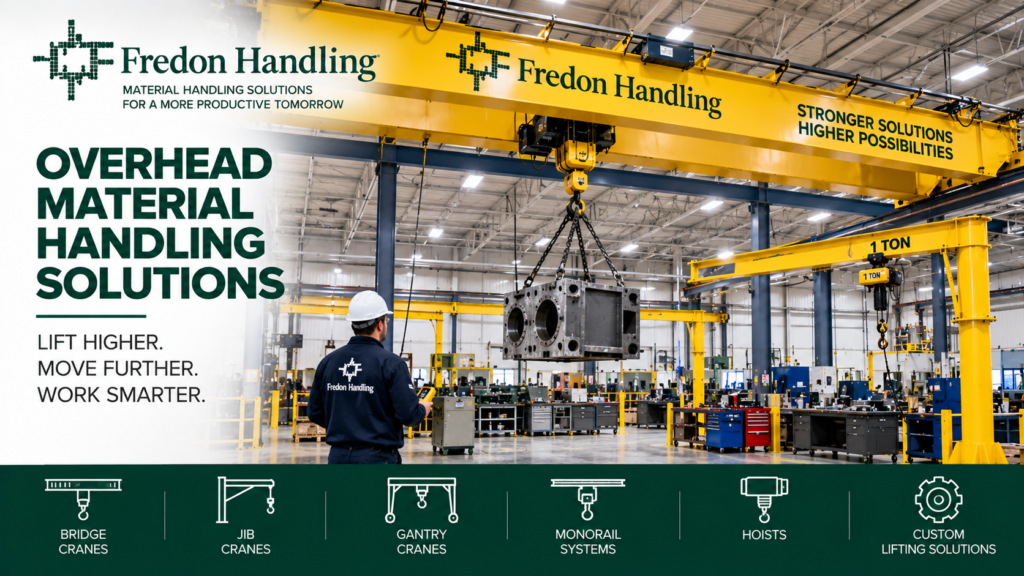
Overhead material handling systems allow facilities to lift, move and position materials above the floor, helping reduce congestion while supporting production, assembly, maintenance and machine-loading operations.
Fredon Handling provides overhead handling solutions for manufacturers, warehouses and industrial facilities, including bridge cranes, jib cranes, gantry cranes, monorails, hoists and application-specific lifting systems.
The right solution depends on the load, required movement, coverage area, lifting frequency and facility conditions.
What Is Overhead Material Handling?
Overhead material handling uses cranes, hoists and related lifting equipment to move loads above the facility floor.
Depending on the application, an overhead system may allow loads to:
- Lift vertically
- Move horizontally
- Rotate
- Travel along a fixed path
- Move across a defined work area
- Position accurately at a machine or workstation
Overhead systems can be especially useful where heavy loads must move repeatedly within a production area.
Common Overhead Handling Challenges
Facilities often consider overhead handling when they experience problems such as:
- Repetitive manual lifting
- Heavy components being moved by hand
- Limited forklift access
- Floor congestion
- Difficult machine loading
- Awkward or irregular loads
- Repeated movement between workstations
- Need for more precise load positioning
- Large components occupying valuable floor space during handling
The best solution begins by understanding where the load starts, where it needs to go and how accurately it must be positioned.
Workstation Bridge Cranes
Workstation bridge cranes provide lifting coverage across a defined work area.
The bridge moves along parallel runways while the hoist travels across the bridge, allowing the load to move in multiple directions.
Applications may include:
- Assembly
- Machine loading
- Fabrication
- Production cells
- Maintenance
- Material positioning
- Component handling
Workstation bridge cranes can be particularly useful when loads need to move throughout a rectangular operating area.
Jib Cranes
Jib cranes provide localized lifting around a workstation, machine or production area.
A jib crane can rotate through a defined radius and may be appropriate when the load remains close to one primary operating point.
Common applications include:
- Machine tending
- Welding
- Assembly
- Maintenance
- Tool handling
- Component installation
A jib crane may provide a simpler solution when full-area bridge crane coverage is not required.
Gantry Cranes
Gantry cranes use a freestanding supporting structure.
They can provide lifting capability in areas where a permanent overhead runway system may not be practical.
Potential applications include:
- Maintenance
- Equipment handling
- Assembly
- Fabrication
- Temporary lifting areas
- Production support
The proper configuration depends on capacity, span, height and required mobility.
Monorail Systems
Monorail systems guide suspended loads along a defined route.
They are especially useful when materials repeatedly move between specific points.
Applications may include:
- Production lines
- Assembly areas
- Paint operations
- Finishing processes
- Machine transfer
- Inspection
- Material routing
A monorail can help create predictable material movement where the load path is already known.
Industrial Hoists
Hoists provide the vertical lifting function within many overhead handling systems.
Depending on the application, hoists may be used with:
- Bridge cranes
- Jib cranes
- Gantry cranes
- Monorails
- Fixed lifting points
Selection factors may include:
- Load weight
- Lift height
- Operating frequency
- Required lifting speed
- Control requirements
- Duty cycle
- Facility environment
The hoist and supporting structure should be selected as one complete lifting system.
Crane vs. Hoist
A hoist primarily raises and lowers the load.
A crane provides the structure and horizontal movement that allows the load to travel through a larger area.
For example, a bridge crane may move the load across a production cell while the hoist controls vertical movement.
Understanding the required directions of movement helps determine the appropriate system.
Overhead Handling for Machine Loading
Machine loading is one of the most common applications for overhead handling.
Heavy components may need to be:
- Lifted from pallets
- Rotated
- Positioned
- Lowered into equipment
- Removed after machining
- Moved to inspection or the next operation
A jib crane or workstation bridge crane can sometimes provide more precise positioning than relying on a forklift for every movement.
Overhead Handling for Assembly
Large assemblies may require components to be supported while employees position and fasten them.
Overhead lifting systems can help with:
- Large component assembly
- Fabrication
- Machinery assembly
- Automotive components
- Equipment manufacturing
- Maintenance and repair
The crane can support the weight while employees guide the component into position.
Overhead Handling and Floor Space
One advantage of overhead material handling is that the load moves above the floor.
This may help reduce dependence on:
- Forklift travel
- Floor carts
- Large turning areas
- Temporary staging
Overhead systems can be particularly valuable in production areas where floor space is already heavily used.
Overhead Handling and Ergonomics
Heavy and awkward materials can create difficult manual handling tasks.
Overhead cranes and hoists can help support the load while employees control its movement.
Potential benefits may include reducing:
- Manual lifting
- Carrying
- Repositioning
- Pushing
- Pulling
However, the entire task should be evaluated, including controls, reach, positioning accuracy and how employees interact with the suspended load.
Freestanding vs. Building-Supported Systems
Overhead systems may be freestanding or supported by the building structure.
Freestanding Systems
Freestanding systems use independent columns and support structures.
They may be useful when:
- Building structure is not suitable
- Greater installation flexibility is needed
- The system may need future modification
- Crane loads should remain independent of the building
Building-Supported Systems
Building-supported systems may reduce the need for additional floor columns where the structure can support the required loads.
The appropriate approach depends on facility and structural conditions.
Qualified professionals should evaluate structural requirements for each project.
Overhead Handling and Workstations
Overhead lifting systems often work well with industrial workstations.
A typical production cell might include:
- Workstation
- Hydraulic lift table
- Parts storage
- Jib crane
- Hoist
- Tool storage
Each system performs a different part of the material handling process.
Planning them together can create a more efficient work area.
Overhead Handling and Material Positioning
Many lifting applications require more than simply raising a load.
The material may need to be:
- Rotated
- Tilted
- Aligned
- Held in position
- Installed
- Transferred
In these cases, the crane, hoist and below-the-hook device should be evaluated as part of one positioning system.
Below-the-Hook Lifting Equipment
Some loads require specialized devices between the hoist and the material.
Below-the-hook equipment may include devices designed to:
- Grip
- Support
- Balance
- Rotate
- Secure
- Position loads
The appropriate device depends on load geometry, weight and handling requirements.
Overhead Handling for Manufacturing
Manufacturing operations may use overhead lifting throughout the facility.
Potential applications include:
- Raw material handling
- Machine loading
- Welding
- Assembly
- Fabrication
- Maintenance
- Inspection
- Finished component handling
The most effective system should support the production sequence rather than interrupt it.
Overhead Handling for Maintenance
Maintenance departments often need to lift motors, pumps, tooling or machine components.
Overhead handling can provide controlled lifting within maintenance and repair areas.
Potential applications include:
- Equipment repair
- Component removal
- Tooling changes
- Motor handling
- Pump maintenance
- Machine servicing
The required system depends on load weights, coverage and maintenance frequency.
How to Choose an Overhead Handling Solution
Several factors should be evaluated.
Maximum Load Weight
Determine the heaviest expected load.
Load Dimensions
Large or irregular loads may require different handling devices.
Required Movement
Does the load need to:
- Move vertically only?
- Rotate around one location?
- Travel along a fixed path?
- Move throughout a rectangular area?
Lift Height
Determine how high the load must be raised.
Coverage Area
Identify the full area where the load must travel.
Operating Frequency
Occasional maintenance lifting presents different requirements from continuous production use.
Positioning Accuracy
Some applications require precise positioning while others only require basic transfer.
Facility Conditions
Evaluate:
- Ceiling height
- Headroom
- Columns
- Machinery
- Aisles
- Workstations
- Structural conditions
- Existing equipment
Overhead Handling Safety
Overhead lifting equipment should be selected, inspected and maintained in accordance with applicable requirements and manufacturer instructions.
Facilities should verify current OSHA, ANSI, ASME and other relevant requirements for their specific equipment and operation.
Operators should also receive appropriate training for the equipment being used.
Any damaged or improperly operating lifting equipment should be evaluated before continued use.
Information to Gather Before Requesting a Quote
Before contacting Fredon Handling, gather:
- Maximum load weight
- Load dimensions
- Load shape
- Required lift height
- Required coverage area
- Travel path
- Operating frequency
- Desired lifting speed
- Positioning requirements
- Building dimensions
- Ceiling height
- Available headroom
- Column locations
- Nearby machinery
- Existing equipment
- Photos or drawings
The more application detail available, the easier it is to identify appropriate options.
Frequently Asked Questions About Overhead Handling
What is overhead material handling?
Overhead material handling uses cranes, hoists and related equipment to lift and move materials above the facility floor.
What types of cranes are used for overhead handling?
Common systems include bridge cranes, jib cranes, gantry cranes and monorails.
What is the difference between a crane and hoist?
The hoist raises and lowers the load, while the crane provides the structure and horizontal movement.
When should a jib crane be used?
A jib crane may be appropriate when loads need to move within a localized radius around one workstation or machine.
When is a bridge crane better?
A bridge crane may be better when loads need to move throughout a larger rectangular work area.
Can overhead handling reduce forklift traffic?
In some applications, yes. Overhead systems can move materials above the floor and reduce the need for forklifts within production cells or work areas.
Improve Heavy Material Movement With Overhead Handling
The right overhead handling system starts with understanding the load, movement and work area.
Fredon Handling can help evaluate your facility and identify crane, hoist and overhead material handling options appropriate for your application.
Whether you need a workstation bridge crane, jib crane, gantry crane, monorail or specialized lifting system, we can help you plan the solution.